A pickleball court looks surprisingly compact when you see one from the sidelines, but its dimensions make a big difference to how the game is played. The court must provide enough room for serving, volleying, and moving safely without making the playing area unnecessarily large.
The good news is that the standard pickleball court has a simple, consistent size. Whether you are planning a backyard court, converting a tennis court, or checking the dimensions before buying equipment, knowing the measurements helps you plan the space correctly.
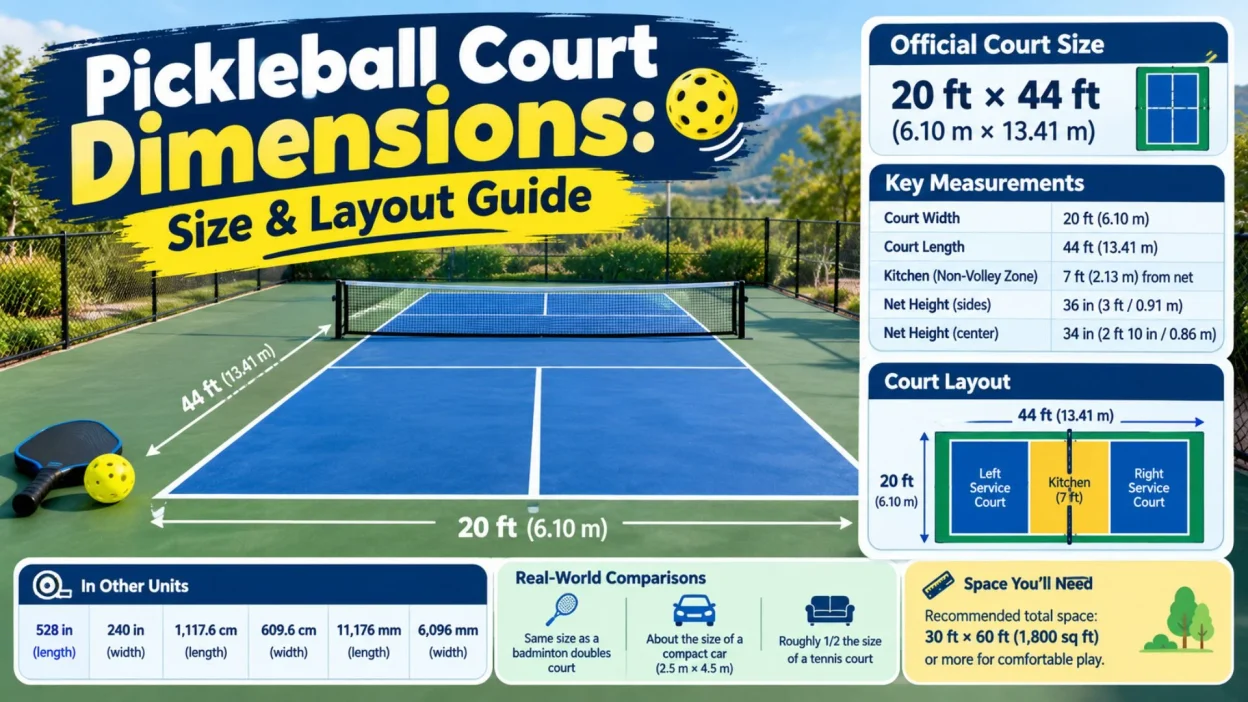
A regulation court measures 20 feet wide by 44 feet long (6.10 meters by 13.41 meters). These dimensions apply to both singles and doubles play. The lines, kitchen area, and net position determine how the playing space is divided, while additional clearance around the court makes playing more comfortable.
In this guide, you will find pickleball court dimensions in feet, inches, centimeters, and meters, along with the official layout, comparisons with familiar spaces, recommended surrounding clearance, and practical ways to measure a court accurately.
Every Pickleball Court Measurement Converted
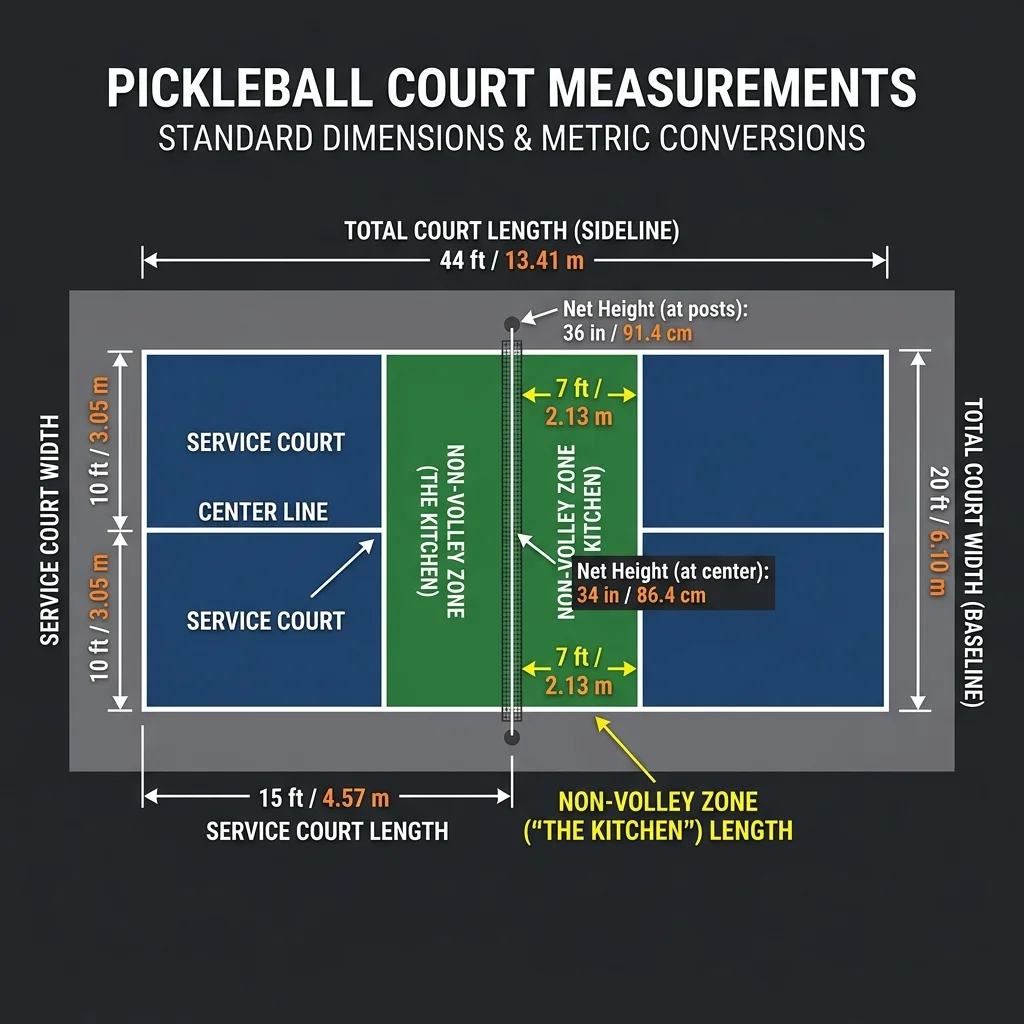
The standard pickleball court is rectangular, measuring 20 feet across and 44 feet from baseline to baseline. These measurements describe the playing surface itself, not the additional space needed outside the boundary lines.
Here is a conversion table for planning a court, checking dimensions, or comparing the layout with your available space.
| Measurement | Official or calculated size |
|---|---|
| Court width | 20 feet |
| Court length | 44 feet |
| Width in inches | 240 inches |
| Length in inches | 528 inches |
| Width in centimeters | 609.6 cm |
| Length in centimeters | 1,117.6 cm |
| Width in millimeters | 6,096 mm |
| Length in millimeters | 11,176 mm |
| Width in meters | 6.096 m |
| Length in meters | 13.4112 m |
| Court area | 880 square feet |
| Court area in square meters | Approximately 81.75 m² |
| Court perimeter | 128 feet |
| Diagonal, corner to corner | Approximately 48.33 feet |
The court’s width and length are official playing dimensions. The metric figures are mathematical conversions, so you may see them rounded to 6.10 m by 13.41 m in court-planning materials.
How the conversion math works
Converting pickleball court dimensions is straightforward:
- Feet to inches: Multiply feet by 12.
- Feet to centimeters: Multiply feet by 30.48.
- Feet to meters: Multiply feet by 0.3048.
- Square feet to square meters: Multiply the area by 0.092903.
For example, a 44-foot court length equals \(44 \times 12 = 528\) inches. To convert it into meters, multiply 44 by 0.3048 to get 13.4112 meters.
The total playing area is \(20 \times 44 = 880\) square feet. That number is useful for understanding the court’s footprint, but it does not include run-off space, seating, fencing, or walkways.
How Pickleball Court Dimensions Work
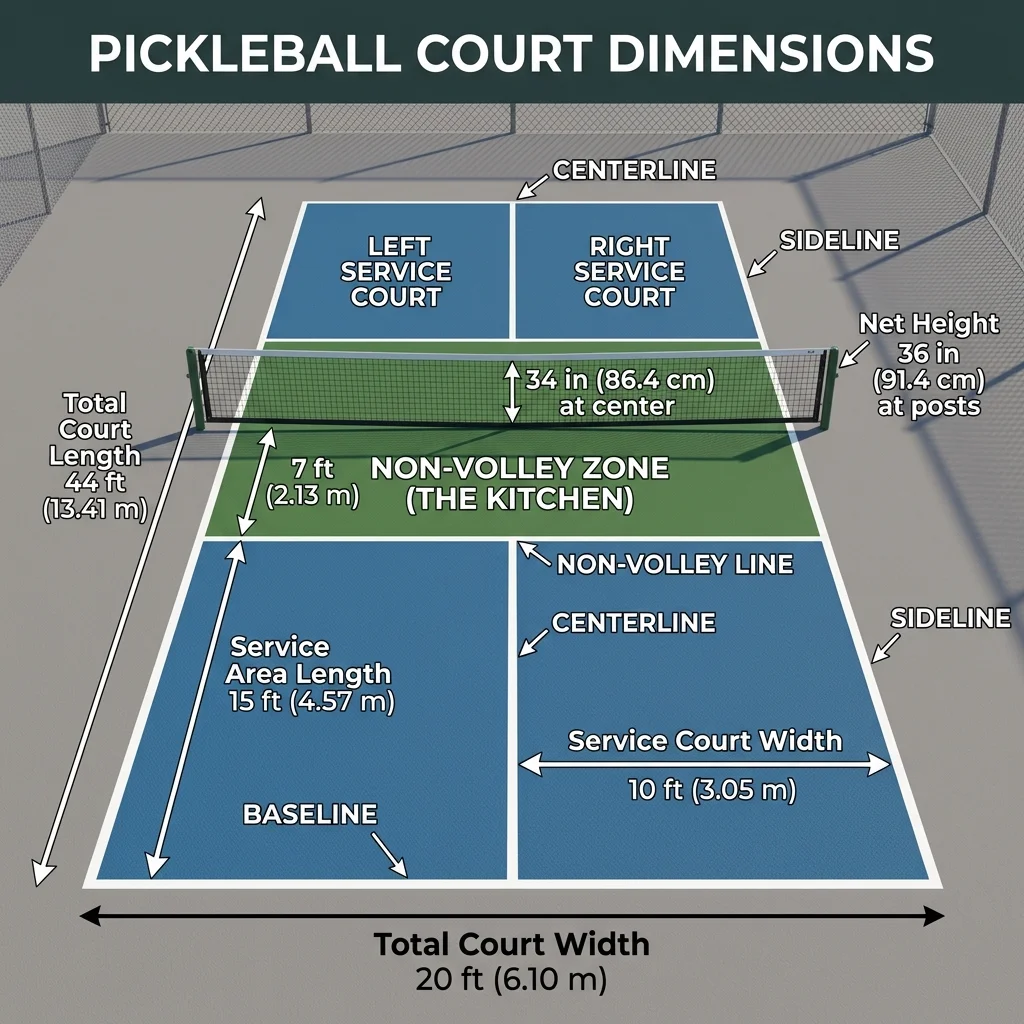
A pickleball court is divided into serving areas, a non-volley zone near the net, and the two backcourt sections. Each marking has a purpose, so measuring the outside rectangle alone is not enough to reproduce the regulation layout.
The non-volley zone, or kitchen
The kitchen is the area extending 7 feet from the net toward each baseline. It runs across the full 20-foot width of the court, with the non-volley-zone line marking its outer edge.
Players may enter this area, but they cannot volley the ball while standing in it or touching its boundary line. This rule encourages controlled shots and makes the space near the net particularly important.
Service courts and centerline
Beyond the kitchen, each side is divided into right and left service courts by a centerline. The centerline runs from the kitchen line toward the baseline, separating the two service areas.
Each service court is 10 feet wide and 15 feet deep. The service area is measured from the kitchen line to the baseline, rather than from the net itself.
Net position and height
The net crosses the court at its midpoint, dividing the 44-foot length into two equal 22-foot halves. A regulation pickleball net is 36 inches high at the sidelines and 34 inches high at the center.
This slight dip in the middle is intentional. When installing a permanent net, measure its height at both locations rather than assuming the top edge should remain level.
Singles versus doubles
One useful detail is that singles and doubles use the same outside court dimensions. Unlike some racket sports, pickleball does not add wider boundary lines for doubles.
The same kitchen and service-court markings remain in place. The difference is how many players cover each side and how they position themselves during a rally.
12 Real-World Ways to Visualize a Pickleball Court
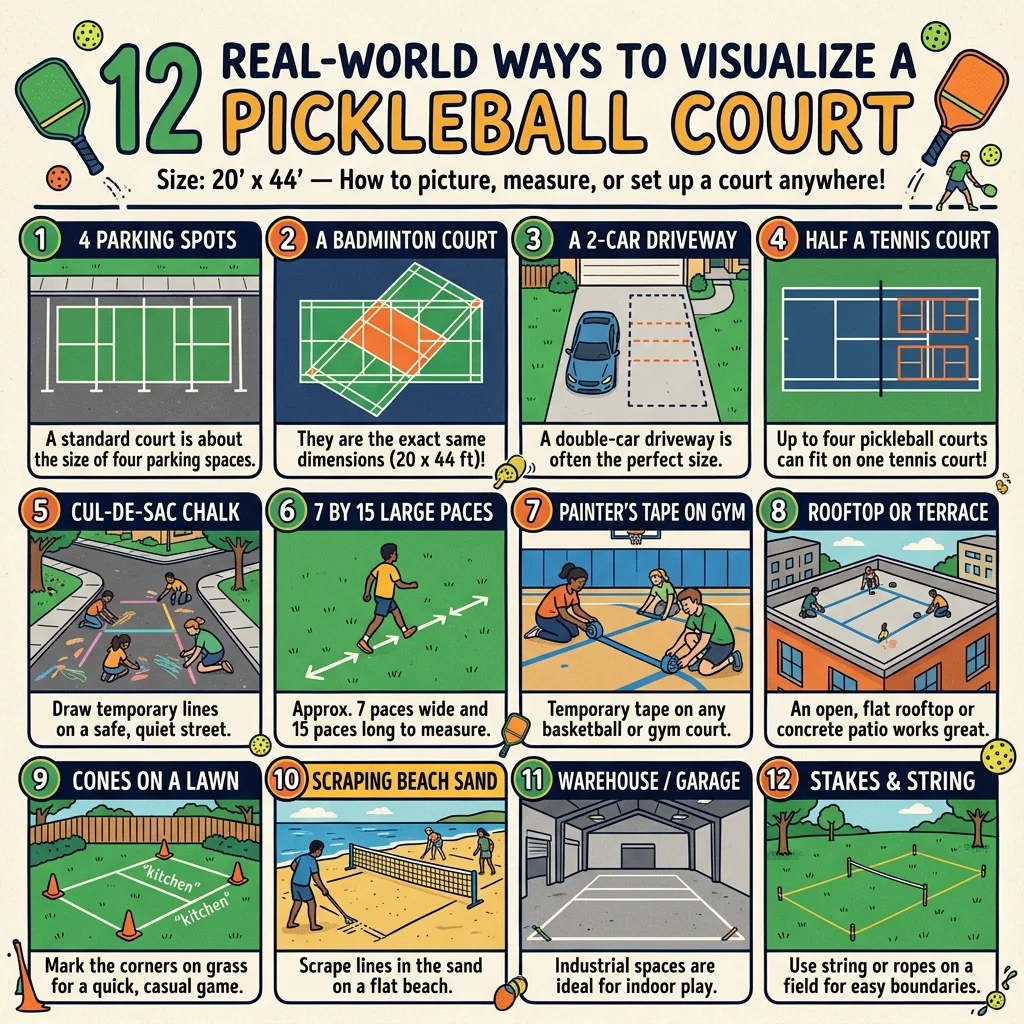
Numbers make sense on paper, but comparing a court with familiar sports spaces and everyday areas makes the dimensions easier to picture. The following comparisons use standard published dimensions where available and clearly distinguish exact matches from approximate similarities.
1. A Standard Badminton Doubles Court
A standard badminton doubles court measures 20 feet wide by 44 feet long. That makes its playing rectangle exactly the same size as a regulation pickleball court.
This is one of the most useful comparisons because both sports use the same outside dimensions. If you have access to a properly marked badminton doubles court, its outer rectangle provides a direct visual reference for pickleball.
The interior markings are different, however. Badminton uses its own service lines and boundary rules, so the existing markings cannot simply be treated as pickleball lines.
2. A Tennis Court
A standard tennis doubles court measures 36 feet wide by 78 feet long. Compared with pickleball’s 20-by-44-foot playing area, a tennis court is substantially larger.
The tennis court has 2.8 times the playing area of a pickleball court, based on those standard dimensions. That makes tennis facilities useful when planning a conversion to pickleball.
The conversion is not simply a matter of repainting one rectangle. The number of pickleball courts that can fit depends on the required spacing, orientation, fencing, and available run-off areas.
3. A Basketball Half-Court
A basketball half-court varies by facility, but a common high-school or professional full-court width is 50 feet. A half-court layout may use approximately 50 feet of width and around 47 feet of length, depending on the design.
That means a typical basketball half-court footprint can be wider and slightly longer than the 20-by-44-foot pickleball playing rectangle. It may provide enough raw area, but the usable shape and obstacles matter.
The basketball hoop, pole, painted arcs, and safety zones must be considered before adding pickleball markings. A rectangular area that fits on paper might still have unsafe obstructions near the sidelines.
4. A Volleyball Court
An indoor volleyball court measures 18 meters by 9 meters, or approximately 59 feet by 29.5 feet. It is wider and longer than a pickleball court, so its playing rectangle offers a useful comparison.
Its total playing area is approximately 1,743 square feet, nearly twice the 880 square feet of a pickleball court. This is a comparison of playing surfaces only, not the extra clearance needed around either sport.
A volleyball court can help illustrate the amount of space required for multiple players to move freely. Still, a shared facility needs suitable markings and safe separation between activities.
5. A Table Tennis Playing Area
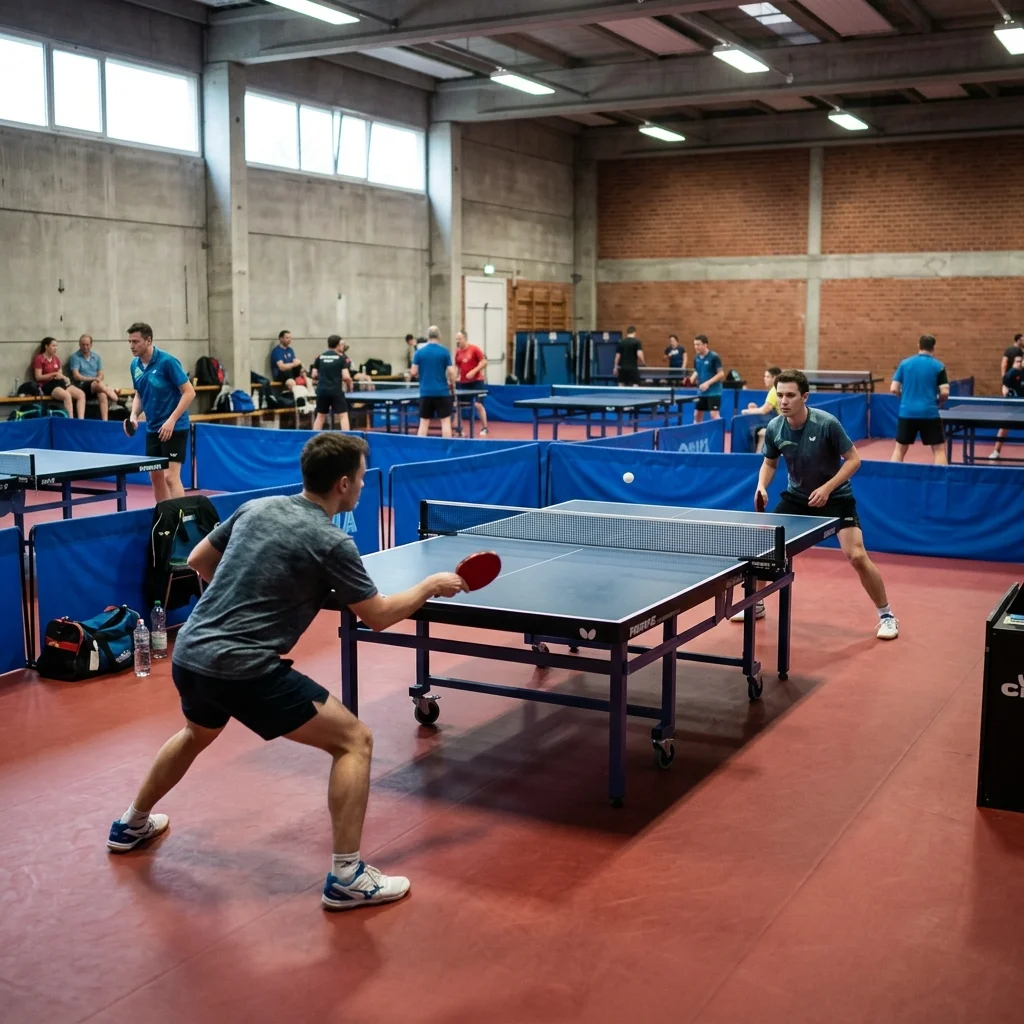
A regulation table tennis table measures about 9 feet long by 5 feet wide. It is much smaller than a pickleball court, but the comparison shows how much extra floor space a sport needs beyond its main equipment.
You could place several table tennis tables inside an 880-square-foot rectangle, but their spacing would determine whether people could play comfortably. A court needs room for movement, not just enough space for the central equipment.
This distinction matters when designing a recreational room. The footprint of a table or net is not the same as the footprint of the complete playing area.
6. A Two-Car Garage
A two-car garage varies by home design, but a garage around 20 feet wide and 20 feet deep has approximately 400 square feet of floor area. That is less than half the area of a regulation pickleball court.
The comparison is useful because many homeowners already understand the size of their garage. A full court measuring 20 feet by 44 feet would need more than twice the floor area of that example garage, with a much longer rectangular footprint.
Garage dimensions are not standardized, and interior usable space may be reduced by storage, doors, columns, and parked vehicles. Measure the actual clear area before using a garage as a planning reference.
7. A Residential Swimming Pool
Residential swimming pools come in many sizes. A pool measuring 20 feet by 40 feet has an area of 800 square feet, which is fairly close to the 880-square-foot pickleball playing surface.
The pool is 4 feet shorter than a regulation pickleball court, while its width matches the court’s 20 feet. This makes it an easy comparison for visualizing the size of the rectangle.
However, the pool’s water surface is not a usable court. If you are planning a backyard installation, the surrounding deck, drainage, fencing, and safe clearance are just as important as the playing rectangle.
8. A Small Backyard Garden
A rectangular garden measuring 20 feet by 44 feet would occupy the same footprint as a pickleball court. This comparison can be especially helpful for homeowners deciding whether their yard has enough room.
Picture a garden with a 20-foot frontage and a 44-foot run into the yard. That long rectangle gives a practical sense of the court’s proportions, even if you have never visited a pickleball facility.
Actual gardens vary considerably, so use your own garden measurements rather than assuming all residential gardens have this footprint. Also remember that fencing and clearance can extend beyond the court’s boundary lines.
9. A School Playground
School playgrounds often contain open rectangular spaces that can help you visualize a pickleball court. Their dimensions vary by school, so a playground is a useful visual reference rather than a standardized measurement.
Marking out a 20-foot-wide strip and extending it 44 feet creates the same playing footprint. The court may look small within a large playground, but it becomes easier to understand once the kitchen and service lines are added.
Before using a school playground for actual play, check the surface, slope, drainage, nearby activity, and any permanent equipment. The space must be safe as well as large enough.
10. A Long Living Room

A living room measuring 20 feet wide and 44 feet long would match a pickleball court’s dimensions, although rooms that long are uncommon in many homes. The comparison is useful because it translates an outdoor sports measurement into a familiar indoor shape.
The 20-foot width is generous for many living rooms, while 44 feet creates a noticeably long space. Thinking of the court as a long room can help you imagine its proportions more easily than looking at the area figure alone.
For a more realistic comparison, measure your own living room and imagine extending its length until it reaches 44 feet. This gives you a personal reference instead of relying on an assumed standard room size.
11. A Four-Car Parking Arrangement
Parking spaces vary by country and facility, but a common individual space is roughly 9 feet wide by 18 feet long. Four spaces placed side by side would span approximately 36 feet by 18 feet, before adding driving aisles.
That arrangement is wider but much shorter than a pickleball court. It helps illustrate why a court’s 44-foot length is significant even though the width is only 20 feet.
Parking layouts are useful for rough planning, not final court design. Vehicle access lanes, curbs, parked cars, and pedestrian routes can reduce the usable space considerably.
12. A Backyard Badminton Setup
A casual backyard badminton setup may use a smaller or loosely marked area rather than a regulation doubles court. That makes it familiar to many families, but it should not be confused with the standard 20-by-44-foot badminton doubles rectangle.
To visualize pickleball, mark a 20-foot width and a 44-foot length on an open lawn. The difference between a casual net setup and a regulation-sized court becomes clear once the outer lines are visible.
Grass can also change how a ball bounces and how securely players move. A lawn may be useful for rough visualization, but a suitable hard or purpose-built sports surface is preferable for regular pickleball play.
How Much Space Do You Need for a Pickleball Court?
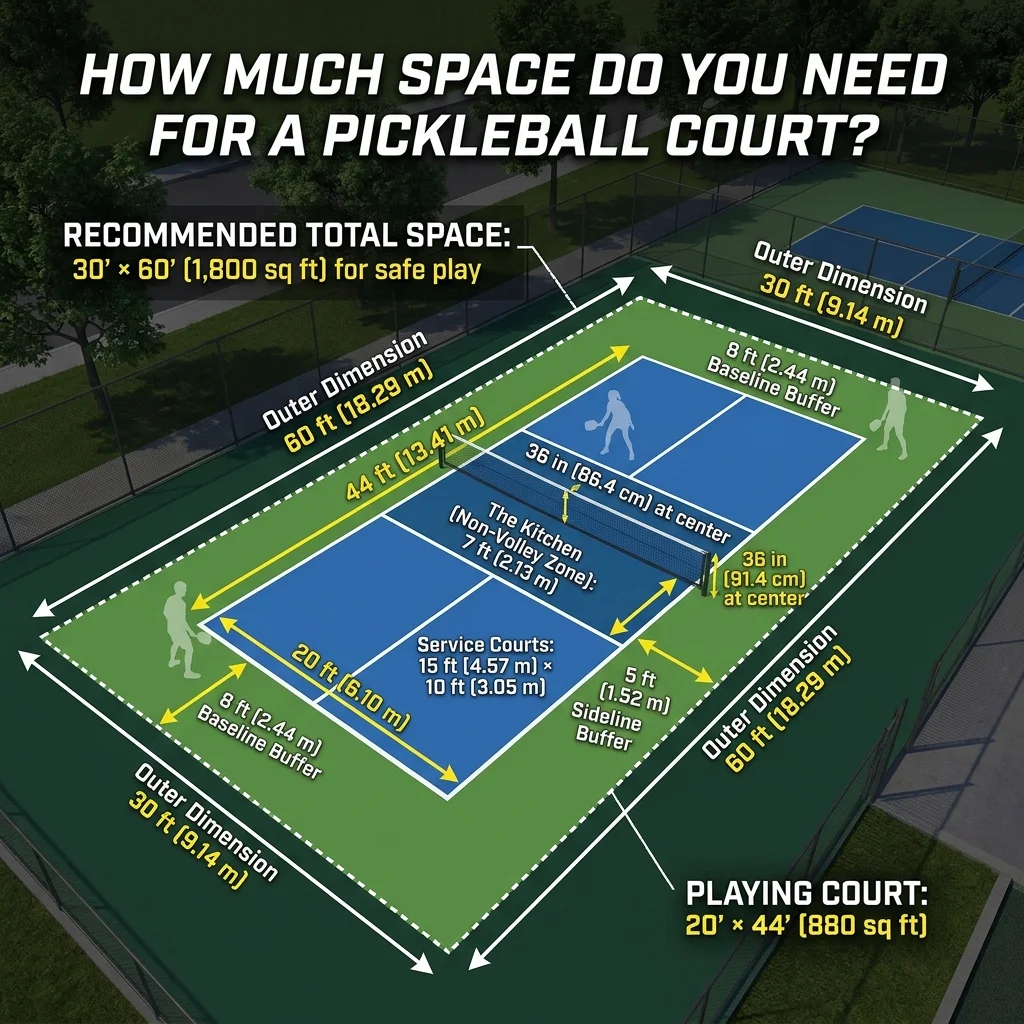
The playing rectangle measures 880 square feet, but the total space needed for a usable court is larger. Players need room beyond the boundary lines to move, stop, and reach shots without running into fences or nearby objects.
Minimum playing area versus recommended space
A useful planning distinction is the court itself versus the full court footprint.
| Space requirement | Dimensions | Total area |
|---|---|---|
| Playing surface | 20 × 44 ft | 880 sq ft |
| Compact overall footprint | 30 × 60 ft | 1,800 sq ft |
| More comfortable planning footprint | 34 × 64 ft | 2,176 sq ft |
The 30-by-60-foot and 34-by-64-foot figures are planning examples, not the official playing dimensions. The appropriate clearance depends on the facility, available land, fencing, and intended level of play. Competitive facilities may require more generous space.
A compact layout gives you 5 feet of clearance at each side and 8 feet beyond each baseline. A 34-by-64-foot footprint provides 7 feet along each side and 10 feet behind each baseline.
For a backyard court, consider the available space around the rectangle before choosing the layout. A court that fits only when measured from line to line may leave too little room for safe movement.
How much land should you allow?
For a basic planning estimate, use these calculations:
- Playing area: 880 square feet.
- Compact footprint: 1,800 square feet.
- Larger example footprint: 2,176 square feet.
If you are working with a rectangular yard, measure its usable length and width first. Subtract space occupied by trees, walls, sheds, drains, and other obstacles before deciding where the court should go.
Can you fit a pickleball court in a backyard?
Yes, if your backyard has enough clear, relatively level space. The main challenge is often not fitting the playing rectangle but providing sufficient room around it.
Check the ground surface, drainage, nearby windows, overhead branches, lighting, and access to the court. If you plan to install permanent fencing or lighting, include those features in your initial measurements rather than adding them after construction.
How to Measure a Pickleball Court Without Guesswork
You do not need specialist surveying equipment to make an initial layout. A tape measure, a few markers, and a clear plan can help you establish the rectangle before painting permanent lines.
1. Mark the four corners
Measure 44 feet along the intended length and 20 feet across the width. Mark each corner with a cone, chalk mark, or temporary stake appropriate for the surface.
Check the rectangle before adding the inner lines. If the corners are misplaced, the service areas and kitchen markings will also be inaccurate.
2. Check the diagonal measurements
For a true 20-by-44-foot rectangle, the diagonal from one corner to the opposite corner is approximately 48.33 feet.
Measure both diagonals. If they are equal and the side lengths are correct, the rectangle is likely square in layout. Small differences can indicate that a corner needs adjustment.
3. Mark the kitchen lines
The non-volley zone extends 7 feet from the net on each side. Since the net sits halfway along the 44-foot court, the kitchen lines are 15 feet from each baseline.
This leaves a 15-foot service area between each kitchen line and baseline. Mark the kitchen boundaries across the full width of the court.
4. Add the centerline
Each service area is 10 feet wide. Measure halfway across the court, at 10 feet from either sideline, and mark the centerline from the kitchen line to the baseline on each side.
Check that the centerline meets the kitchen line correctly. Accurate markings help players identify the correct serving area and make the layout easier to follow.
5. Verify the net height
The net should measure 36 inches at both sidelines and 34 inches at the center. Check the height after installation because a poorly adjusted net can affect play.
A measuring tape is the simplest option for the final check. Body measurements and household references can help estimate a space, but they should not replace actual measurements when installing a regulation court.
FAQs
What are the official pickleball court dimensions?
A standard pickleball court is 20 feet wide and 44 feet long. These dimensions apply to both singles and doubles matches.
How many feet is a pickleball court?
The court measures 44 feet in length and 20 feet in width. Its playing area is 880 square feet.
What are pickleball court dimensions in meters?
The court measures approximately 6.10 meters wide by 13.41 meters long. Its playing area is about 81.75 square meters.
What are pickleball court dimensions in centimeters?
The standard width is 609.6 centimeters, and the length is 1,117.6 centimeters. These figures are direct conversions from 20 feet and 44 feet.
How big is the kitchen on a pickleball court?
The kitchen, officially called the non-volley zone, extends 7 feet from the net on each side. It spans the entire 20-foot court width.
How high is a pickleball net?
The net is 36 inches high at the sidelines and 34 inches high at the center. That equals 3 feet at the sides and 2 feet 10 inches in the middle.
How much space is needed to build a pickleball court?
The playing surface requires 880 square feet. A compact planning footprint is 30 by 60 feet, or 1,800 square feet, while a more generous example is 34 by 64 feet, or 2,176 square feet.
Can you convert a tennis court into pickleball courts?
Yes. Tennis facilities can accommodate pickleball courts, but the number depends on the available dimensions, court orientation, clearance, fencing, and access. The markings and net setup must also be adapted for pickleball.
Are singles and doubles pickleball courts different sizes?
No. Both formats use the same 20-by-44-foot court. Players change their positioning and coverage, but the outside dimensions remain the same.
How do you measure a pickleball court accurately?
Measure the 44-foot length and 20-foot width, then check the diagonals to confirm the corners form a rectangle. After that, mark the kitchen lines 7 feet from the net and add the service-area centerlines.
Where That Leaves You
A regulation pickleball court measures 20 feet wide by 44 feet long, giving you a playing surface of 880 square feet. In metric units, that is approximately 6.10 by 13.41 meters.
One of the easiest ways to picture the dimensions is to compare the court with a standard badminton doubles court, which uses the same outside measurements. If you are planning a home installation, remember that the playing surface is only part of the calculation. Additional clearance makes movement safer and gives players more room to reach difficult shots.
Start by measuring the available space, marking a rectangle, and checking both diagonals before installing the net or painting lines. That simple process helps you avoid costly layout mistakes and makes it easier to create a court that fits your needs.