
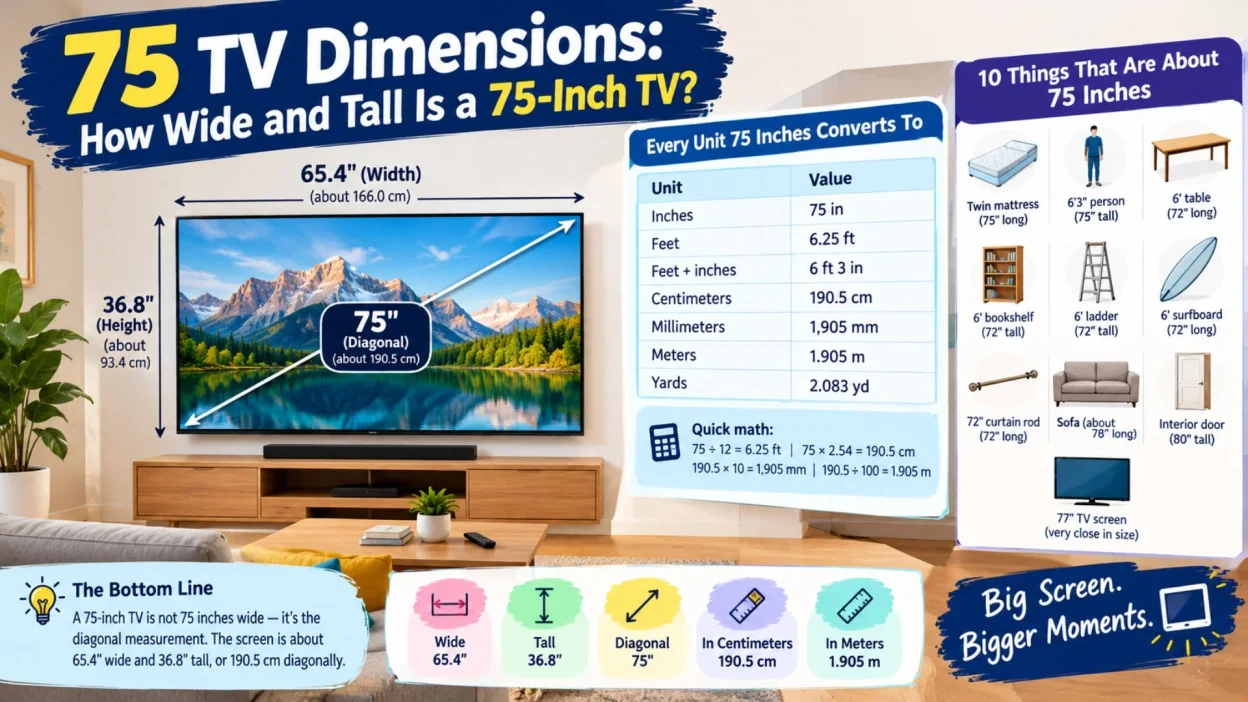
A 75-inch TV sounds enormous until you realize that the number does not describe the TV’s width. It measures the screen diagonally, from one corner to the opposite corner.
That difference matters when you’re planning a media wall, choosing a TV stand, or wondering whether a 75-inch screen will actually fit your room. A 75-inch television is much wider than it is tall, thanks to the modern 16:9 widescreen shape.
For a standard 16:9 screen, a 75-inch TV has a screen width of about 65.4 inches and a screen height of about 36.8 inches. The actual television can be slightly larger because of its bezel and frame.
A 75-inch screen equals 6 feet 3 inches diagonally, 190.5 centimeters, 1.905 meters, and 1,905 millimeters.
The comparisons below make those numbers easier to picture. You’ll see how a 75-inch TV compares with mattresses, tables, doors, furniture, people, and other familiar objects.
🟦 Every Unit 75 Inches Converts To
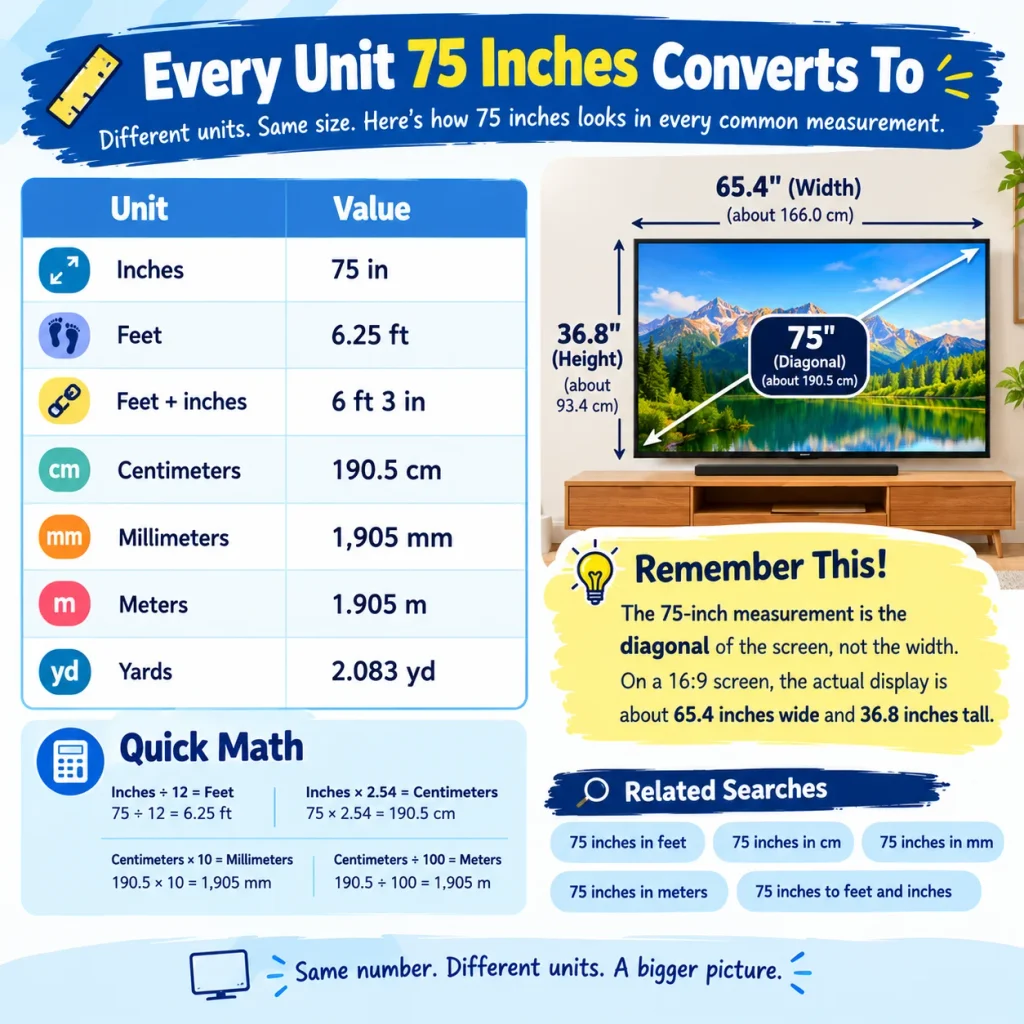
The easiest way to understand 75 TV dimensions is to separate the diagonal screen measurement from the TV’s actual width and height.
| Unit | 75 Inches |
|---|---|
| Inches | 75 in |
| Feet | 6.25 ft |
| Feet + inches | 6 ft 3 in |
| Centimeters | 190.5 cm |
| Millimeters | 1,905 mm |
| Meters | 1.905 m |
| Yards | 2.083 yd |
| Standard 16:9 screen width | 65.4 in |
| Standard 16:9 screen height | 36.8 in |
| Screen width in cm | 166.0 cm |
| Screen height in cm | 93.4 cm |
The basic conversions are straightforward.
To convert inches to feet, divide by 12:
75 ÷ 12 = 6.25 feet
To convert inches to centimeters, multiply by 2.54:
75 × 2.54 = 190.5 cm
For millimeters, multiply the centimeter measurement by 10:
190.5 × 10 = 1,905 mm
And for meters, divide the centimeter measurement by 100:
190.5 ÷ 100 = 1.905 meters
One important detail remains: 75 inches is the diagonal, not the width. On a 16:9 TV screen, the visible display itself is roughly 65.4 inches wide and 36.8 inches tall.
🟩 Where a 75-Inch TV Fits on the Screen Size Scale
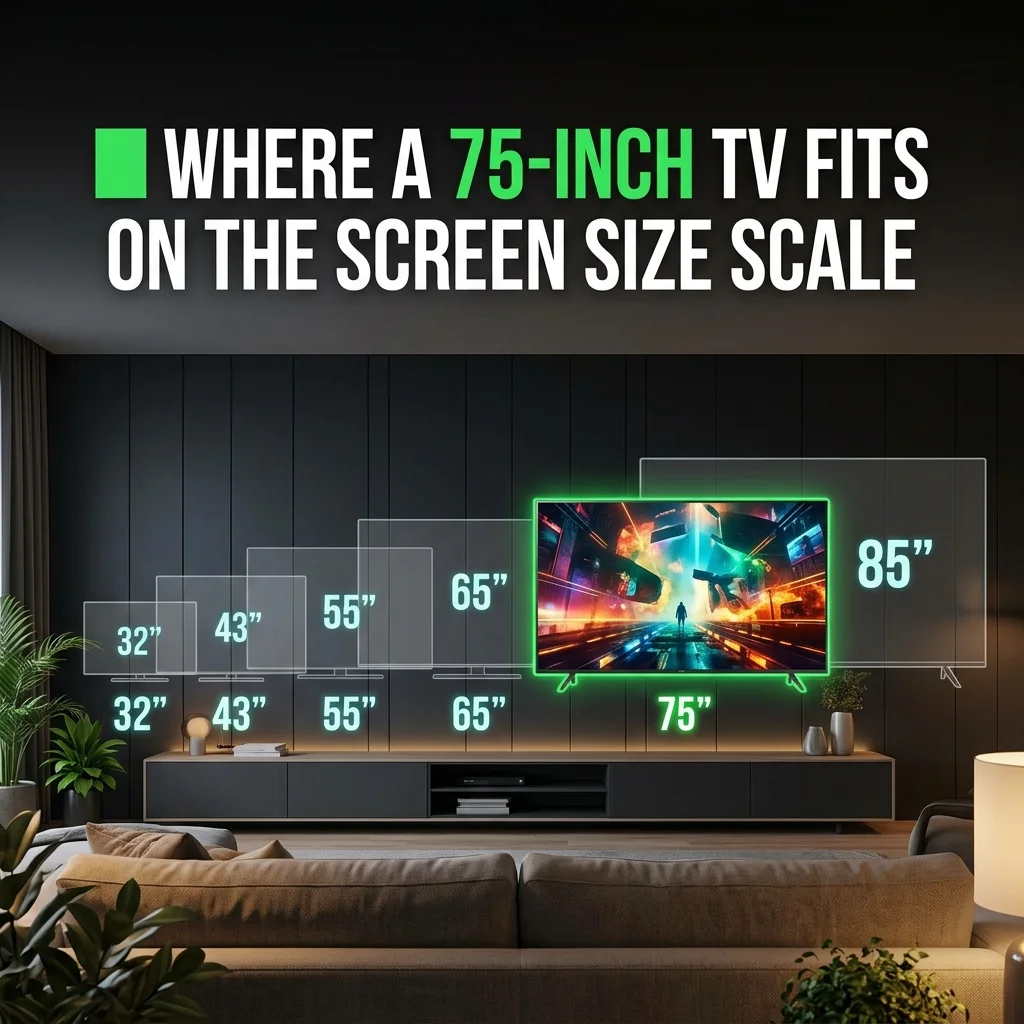
A 75-inch TV sits firmly in the large-screen category for a typical home.
It is noticeably larger than common 55- and 65-inch televisions. At the same time, it is not as physically imposing as the very largest 85- or 98-inch screens.
The most useful numbers are these:
- 📺 75-inch diagonal: 6 feet 3 inches
- ↔️ Screen width: about 65.4 inches
- ↕️ Screen height: about 36.8 inches
- 📏 Screen width: about 166 cm
- 📐 Screen height: about 93.4 cm
- 🖥️ Screen shape: approximately 16:9
- 🏠 Overall TV size: slightly larger than the bare screen
- 🪑 Furniture planning: width matters more than the 75-inch diagonal
- 🧱 Wall planning: include room for the frame and mounting hardware
- 📦 Transport planning: packaging will be considerably larger than the screen
The 65.4-inch width is the number to remember when you’re checking a wall or TV cabinet.
A television’s exact outside dimensions depend on the model. Thin bezels can keep the frame only slightly beyond the screen, while thicker designs add more width and height.
🟨 10 Things That Measure Around 75 Inches
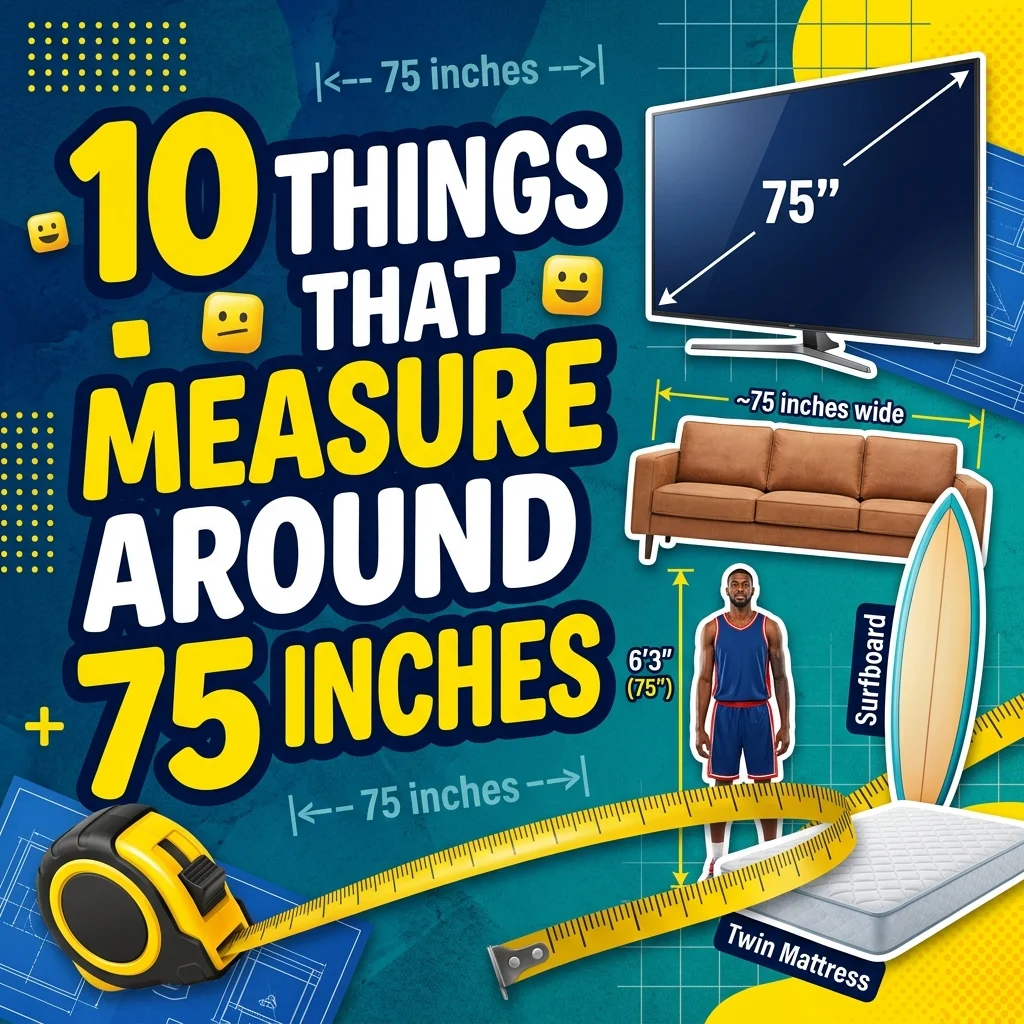
The diagonal of a 75-inch TV is easier to understand when you compare it with objects you already know.
A Standard Twin Mattress
A standard twin mattress in the United States is commonly 38 inches wide by 75 inches long. That makes its length exactly the same as the diagonal measurement of a 75-inch TV.
The comparison is useful because mattresses are familiar and easy to picture. If you have ever seen a twin mattress laid flat, its long edge gives you a very close sense of 75 inches.
The important difference is orientation. The mattress measures 75 inches from end to end, while the television reaches 75 inches from one screen corner to the opposite corner.
Picture a twin mattress’s long side standing upright. That length is almost the same distance as the diagonal of the TV.
A Person Who Is 6 Feet 3 Inches Tall

Someone who is exactly 6 feet 3 inches tall measures 75 inches from head to toe.
That makes a person of this height one of the simplest ways to visualize the diagonal measurement. Stand that person beside a 75-inch TV and their height would match the screen’s diagonal distance.
Of course, human height and TV dimensions are measured differently. A person’s height is vertical, while the TV measurement runs diagonally across the display.
Still, the comparison gives you an immediate mental picture: 75 inches is a little over six feet.
A Six-Foot Folding Table
Many folding banquet and event tables are made in a 6-foot length, which equals 72 inches.
That is only 3 inches shorter than 75 inches. Put another way, the difference is just one quarter of a foot.
A six-foot table is therefore an excellent nearby reference if you have one at home, school, work, or an event.
Imagine extending that table by just three inches. You would be very close to the diagonal measurement of a 75-inch TV.
A Six-Foot Bookshelf

Tall bookcases are often available around the 6-foot height range, making a 72-inch bookshelf a useful comparison.
At 72 inches, it falls just three inches short of 75 inches. That small difference is difficult to notice without putting the two measurements directly beside each other.
The comparison also helps explain why a 75-inch diagonal does not mean the TV will stand 75 inches tall. A television with a 16:9 screen is much wider than it is high.
Picture a six-foot bookcase standing upright, then add roughly three inches to its height.
A Six-Foot Ladder
A common 6-foot step ladder reaches approximately 72 inches when measured by its stated height.
That puts it only three inches below 75 inches. If you have a six-foot ladder nearby, it provides a practical reference for the overall distance.
The ladder also demonstrates why a measurement can feel different depending on orientation. A 75-inch TV’s diagonal is not the same as its vertical height.
Imagine measuring from one bottom corner of the TV to the opposite top corner. That diagonal is about three inches longer than a six-foot ladder’s stated height.
A Six-Foot Surfboard

Six-foot surfboards are a real size category, especially among shorter boards designed for maneuverability and smaller riders.
At 72 inches, a six-foot board is only 3 inches shorter than 75 inches. That makes it a surprisingly good visual reference for the TV’s diagonal.
The shape is obviously different from a television, but the end-to-end distance is what matters for this comparison.
Lay the board beside an imaginary 75-inch line and the extra three inches would be a small extension beyond its nose.
A 72-Inch Curtain Rod
Adjustable curtain rods are commonly sold with ranges that include 72 inches, although their usable length depends on the model.
A 72-inch setting is exactly six feet, leaving it three inches shorter than 75 inches.
This is a useful household comparison because curtain rods are long, straight objects that make distance easy to see.
If you can picture a six-foot curtain rod stretched across a wall, add three inches at one end. That gives you a close approximation of 75 inches.
A Sofa Around 78 Inches Long

Many standard sofas fall somewhere around the 70- to 90-inch range, with some compact models measuring close to 78 inches.
At 78 inches, such a sofa is only 3 inches longer than 75 inches. That makes it a useful furniture-scale comparison.
Unlike the TV, however, the sofa’s length is measured straight from one end to the other. The TV reaches 75 inches only when measured diagonally across the screen.
Imagine measuring the long edge of a roughly 78-inch sofa and then removing three inches. You would be very close to 75 inches.
An 80-Inch Interior Door
A common interior door height in the United States is 80 inches.
That is 5 inches longer than 75 inches, so it provides a slightly larger but still familiar comparison.
The difference is small enough to visualize. If you imagine marking a line five inches below the top of an 80-inch door, the remaining distance would be about 75 inches.
This comparison is especially helpful when thinking about a 75-inch TV’s diagonal. The TV’s corner-to-corner distance is close to the full height of a standard interior door.
A 77-Inch TV Screen
Some television models, particularly OLED televisions, are sold with a 77-inch diagonal screen.
A 77-inch screen is just 2 inches larger diagonally than a 75-inch TV. That difference is relatively small compared with the overall screen size.
The physical width and height also change slightly because the screen keeps the same general 16:9 shape.
If you have seen a 77-inch TV, you have already seen something extremely close to the size represented by a 75-inch diagonal.
🟥 The 75-Inch TV Size Question People Actually Mean

When someone searches for 75 TV dimensions, they often really want to know one thing:
How wide and tall is a 75-inch TV?
For a standard 16:9 screen, the answer is approximately:
- ↔️ 65.4 inches wide
- ↕️ 36.8 inches tall
- 📏 166.0 cm wide
- 📐 93.4 cm tall
- 🔺 75 inches diagonally
The diagonal is calculated from the screen’s width and height using the geometry of a 16:9 rectangle.
That is why you cannot simply say that a 75-inch TV is 75 inches wide. The 75-inch number runs corner to corner.
Why the Actual TV Can Be Larger
The numbers above describe the screen area, not necessarily the complete outside dimensions of the television.
A modern TV may have a narrow bezel, but the frame still adds some width and height. The stand can also increase the overall height substantially.
So if you are measuring a wall, cabinet, or entertainment center, use the manufacturer’s listed dimensions for the specific model.
How Much Wall Space Does a 75-Inch TV Need?
A 75-inch screen itself is roughly 65.4 inches wide.
That means a wall opening that is exactly 65.4 inches wide would be too tight for most actual TV models. You need to account for the bezel, mounting arrangement, cables, and the visual space you want around the television.
For a clean installation, measure the exact TV before drilling or buying a fixed-size cabinet.
🟪 Getting to 75 Inches Without a Tape Measure
You can estimate 75 inches without carrying a tape measure, but these methods are approximations.
Use a Twin Mattress
The long side of a standard twin mattress is 75 inches.
If you have one nearby, its length provides one of the strongest household references for exactly 75 inches.
Compare With a Six-Foot Object
Six feet equals 72 inches.
A six-foot table, ladder, bookshelf, or similar object is therefore only three inches short of 75 inches.
That is close enough for a quick visual estimate, although it is not suitable for precise installation work.
Use a 6-Foot-3-Inch Person
A person who stands 6 feet 3 inches tall measures 75 inches in height.
This can give you an immediate sense of how long the TV’s diagonal is.
Measure the TV’s Screen Diagonally
If you already own the television, measure from the visible screen’s lower corner to the opposite upper corner.
Do not measure the outer frame unless you specifically want the television’s physical dimensions.
Remember the 16:9 Shape
For a standard 75-inch 16:9 screen, remember the shortcut:
About 65.4 inches wide × 36.8 inches tall.
That is the most useful mental picture when planning furniture or wall space.
🟧 FAQs
How many feet is a 75-inch TV?
A 75-inch diagonal equals 6.25 feet, or exactly 6 feet 3 inches.
How many centimeters is 75 inches?
75 inches equals 190.5 centimeters.
How many meters is 75 inches?
75 inches equals 1.905 meters.
How wide is a 75-inch TV?
A standard 16:9 75-inch screen is approximately 65.4 inches wide, or about 166.0 cm. The complete television can be slightly wider because of its frame.
How tall is a 75-inch TV?
The visible 16:9 screen is approximately 36.8 inches tall, or about 93.4 cm. The actual TV height depends on the model and whether its stand is included.
Is a 75-inch TV actually 75 inches wide?
No. The 75-inch figure refers to the diagonal screen measurement, not the width.
What everyday object is about 75 inches?
A standard twin mattress is commonly 75 inches long, making it one of the closest everyday comparisons. A six-foot table is also close at 72 inches.
Can I visualize 75 inches without a tape measure?
Yes. Think of a 6-foot-3-inch person or the 75-inch length of a standard twin mattress. For a rough estimate, a six-foot object is only three inches shorter.
Is there a standard 75-inch TV size?
Yes. 75-inch is a common TV screen category. However, the exact outside dimensions vary by manufacturer, bezel design, and stand.
🟦 Where That Leaves You
The most important thing to remember about 75 TV dimensions is that 75 inches describes the screen’s diagonal. A standard 16:9 display is approximately 65.4 inches wide and 36.8 inches tall.
For a quick mental picture, compare the diagonal with the 75-inch length of a standard twin mattress or the height of a person who is 6 feet 3 inches tall. Those references make the number much easier to understand.
If you’re buying or mounting a 75-inch TV, use the screen dimensions for visualization but check the manufacturer’s exact width, height, depth, and stand measurements before installation. The diagonal tells you the screen class; the model’s specifications tell you whether it actually fits your space.
Once you remember “75 inches = 6 feet 3 inches diagonally,” the size becomes much easier to picture.