A full size mattress can look spacious in a showroom but feel surprisingly different once you put it inside a bedroom. The difference often comes down to a few inches of width, the amount of space around the bed, and whether two people will share it regularly.
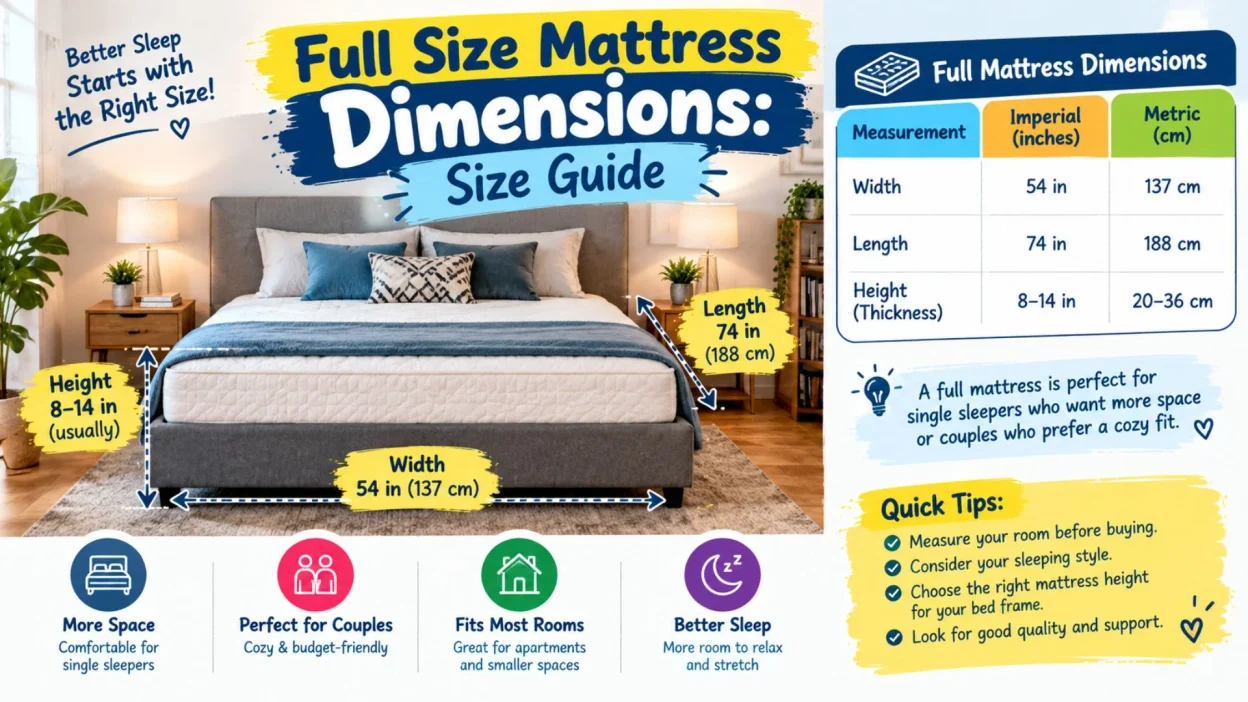
The standard full size mattress measures 54 inches wide and 75 inches long. That works out to 4 feet 6 inches wide and 6 feet 3 inches long. In metric measurements, it is approximately 137.16 cm wide and 190.5 cm long.
These dimensions make a full mattress a practical option for a single adult, a teenager, or a guest bedroom where space matters. It offers more width than a twin mattress but takes up less floor space than a queen.
Below, you’ll find full size mattress dimensions in inches, feet, centimeters, and millimeters, along with comparisons to familiar objects, bedroom planning tips, and advice for estimating the size without a measuring tape. You’ll also learn how a full mattress compares with a double bed and whether it can comfortably accommodate two sleepers.
Every Unit Full Size Mattress Dimensions Convert To

The standard full mattress has a rectangular sleeping surface measuring 54 inches across and 75 inches from head to foot. When checking furniture listings, measure both directions rather than treating the mattress as a single number.
| Measurement | Width | Length |
|---|---|---|
| Inches | 54 in | 75 in |
| Feet | 4.5 ft | 6.25 ft |
| Feet and inches | 4 ft 6 in | 6 ft 3 in |
| Centimeters | 137.16 cm | 190.5 cm |
| Millimeters | 1,371.6 mm | 1,905 mm |
| Meters | 1.3716 m | 1.905 m |
| Yards | 1.5 yd | 2.083 yd |
These figures describe the mattress itself, not the bed frame or the entire space needed for a comfortable bedroom layout.
How to calculate full mattress dimensions
The conversions are straightforward once you know the inch measurements.
- Inches to feet: Divide inches by 12. A 54-inch width equals 4.5 feet, while 75 inches equals 6.25 feet.
- Inches to centimeters: Multiply by 2.54. This gives 137.16 cm wide and 190.5 cm long.
- Inches to millimeters: Multiply by 25.4. The results are 1,371.6 mm and 1,905 mm.
- Inches to meters: Divide the centimeter measurement by 100, giving 1.3716 m by 1.905 m.
For everyday planning, you can round these to approximately 137 × 191 cm, or about 1.37 × 1.91 meters.
The mattress thickness is a separate measurement. Many full mattresses are around 8–14 inches thick, although some are thinner or considerably thicker. Check the manufacturer’s specifications if you need to know the overall height of the bed.
Also, remember that a mattress and its foundation may have slightly different dimensions. If you’re buying a bed frame, check its interior mattress platform measurements instead of relying on the mattress size label alone.
Where a Full Mattress Fits on the Bed Size Chart
A full mattress sits between a twin and a queen in the standard US mattress-size lineup. It gives a single sleeper extra room to spread out without requiring as much floor space as a queen bed.
Common US mattress sizes; actual product dimensions may vary slightly by manufacturer.
| Mattress size | Typical dimensions | Best-known use |
|---|---|---|
| Twin | 38 × 75 in | Children’s rooms and compact spaces |
| Twin XL | 38 × 80 in | Taller single sleepers |
| Full (double) | 54 × 75 in | Single adults and guest rooms |
| Queen | 60 × 80 in | Couples and larger bedrooms |
| King | 76 × 80 in | Couples wanting more sleeping width |
Is a full mattress large enough for one adult?
For many adults, yes. At 54 inches wide, a full mattress provides 16 inches more width than a standard twin mattress. That extra space can make rolling over, stretching out, or changing sleeping positions more comfortable.
Its 75-inch length, however, is the same as a standard twin. A person who is tall may find that their feet sit close to the edge, especially if they sleep fully stretched out. A twin XL or queen mattress offers 80 inches of length.
How much room does a full mattress need?
A 54 × 75-inch mattress has a sleeping surface of about 28.1 square feet. That is the mattress footprint only; it does not include the surrounding walking space, nightstands, or frame.
For a more comfortable layout, leave room to walk beside the bed and access drawers or closet doors. Around 24 inches of clear space on an accessible side can be a useful planning target, though the ideal amount depends on the room and its furniture.
A room measuring approximately 10 × 10 feet can often accommodate a full bed, but the layout matters. A bulky headboard, deep frame, or large dresser can make the same room feel much tighter.
12 Real-World Ways to Visualize a Full Mattress
The easiest way to understand a mattress measurement is to compare it with objects you already know. These examples use familiar lengths and widths to help you picture the bed’s footprint before moving furniture or placing an order.
1. A Standard Twin Mattress

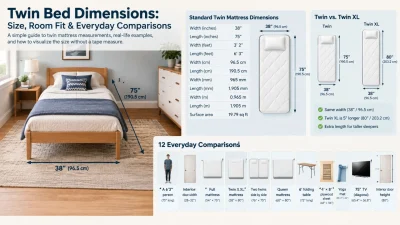
A standard twin mattress is typically 38 inches wide and 75 inches long. Its length matches a full mattress, making it a particularly useful comparison.
The full mattress adds 16 inches of width while keeping the same standard length. That extra width is substantial: it gives a single sleeper more room without extending the bed farther into the room.
Twin mattresses are common in children’s bedrooms, bunk beds, and compact guest spaces. Their familiar size makes it easier to imagine how much wider a full mattress will feel.
Picture a twin mattress lying beside a full mattress with both head ends aligned. The twin will end at the same point, but the full will extend noticeably farther to either side.
[IMAGE: twin and full mattresses side by side with their widths and lengths labeled]
2. A Queen Mattress

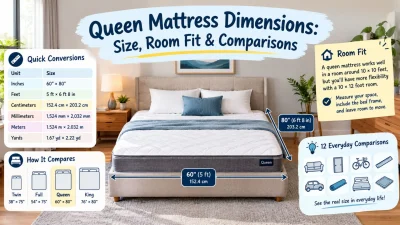
A standard queen mattress is about 60 inches wide and 80 inches long. Compared with a full mattress, it is 6 inches wider and 5 inches longer.
That difference may not sound huge, but it changes both the sleeping surface and the room footprint. A queen provides more room for two people and a little more length for taller sleepers.
Queen beds are among the most popular choices for primary bedrooms. Their larger dimensions also mean that bedding and frames designed for queens should not automatically be used with full mattresses.
Imagine adding a 6-inch strip along the width and 5 inches along the length of a full mattress. Those extra sections illustrate the difference between the two standard sizes.
[IMAGE: full mattress beside queen mattress with width and length measurements]
3. A Six-Foot Folding Table

A common six-foot folding table measures 72 inches long. That is only 3 inches shorter than the 75-inch length of a full mattress.
The comparison is useful because folding tables are often sold by their length in feet. If you’ve seen one set up at a party or family gathering, you’ve already seen something close to the mattress’s head-to-foot dimension.
Table widths vary. A typical rectangular folding table may be around 30 inches wide, so it is much narrower than a full mattress across its 54-inch width.
Imagine a full mattress extending just 3 inches beyond one end of a six-foot table when the other ends are aligned. This helps visualize the mattress length without confusing it with the width.
[IMAGE: six-foot folding table next to a full mattress showing their similar lengths]
4. An Interior Door’s Height

Many standard interior doors are approximately 80 inches tall, although sizes vary by home and region. That makes a typical door about 5 inches taller than a full mattress is long.
Doors are familiar vertical reference points, especially when you’re planning furniture in a bedroom. The comparison works best for understanding length, not mattress width.
Door heights are standardized in many modern homes, but older properties and custom builds may use different dimensions. Measure the actual door if you want a reliable reference.
Imagine laying the mattress lengthwise beside an 80-inch door. The mattress would come up about 5 inches short of the door’s full height.
[IMAGE: full mattress length compared vertically with an 80-inch interior door]
5. A Six-Foot Yoga Mat

A common yoga mat is around 68–72 inches long, while longer versions can measure 78 inches or more. A 72-inch mat is 3 inches shorter than a full mattress.
This is a useful comparison for anyone who exercises at home. Yoga mats are designed to accommodate a person’s body on the floor, so their length is easy to compare with the head-to-foot measurement of a bed.
Unlike a mattress, a yoga mat is narrow, usually around two feet wide. It illustrates length well but does not represent the full sleeping surface.
Picture a 72-inch yoga mat stretched out on the floor. A full mattress would extend a few inches beyond its end and provide considerably more width.
[IMAGE: standard 72-inch yoga mat beside a full mattress footprint outline]
6. A Loveseat Sofa

Many compact loveseats are approximately 48–60 inches wide. A loveseat near 54 inches across therefore has a width close to that of a full mattress.
Sofas vary considerably by style, arm thickness, and manufacturer. Some are much wider than 54 inches, so this comparison is most useful when you’re looking at a compact two-seat model.
A loveseat’s overall width includes its arms. A mattress measurement, by contrast, refers to the sleeping surface and doesn’t include any frame or headboard.
Imagine measuring a compact loveseat from its outer left arm to its outer right arm. If that distance is around 54 inches, it gives you a quick visual reference for the width of a full mattress.
[IMAGE: compact loveseat sofa with a labeled 54-inch width and full mattress outline]
7. A Five-Foot Desk

A desk measuring 60 inches across is 6 inches wider than a full mattress. Many home-office desks fall near this width, though compact and extra-wide models are also common.
The comparison is particularly helpful when you’re deciding whether a full bed and a work area can share one bedroom. A desk of this width can take up a similar amount of wall space to a full mattress’s length.
Desk depth is usually much smaller than mattress length, so it shouldn’t be used to estimate the full bed footprint. Always consider the chair and clearance needed to pull it out.
Imagine a 60-inch desk along one wall and a full mattress along another. Their long edges will occupy comparable stretches of the room, but the bed will project farther into the space.
[IMAGE: 60-inch desk and full mattress footprint drawn to scale in a small bedroom]
8. A Large Bath Towel

Many large bath towels measure around 27–30 inches wide and 54–60 inches long. The longer edge of a towel in this range is reasonably close to the 54-inch width of a full mattress.
Towels are easy to find at home, making them useful for rough visualization. However, their dimensions differ by brand and type, and a bath sheet can be considerably larger than a standard bath towel.
A towel won’t represent the mattress’s complete rectangular surface. It offers a reference for one dimension only, and fabric can fold or stretch slightly when laid down.
If your towel measures 54 inches long, lay it across the mattress width in your imagination. The two measurements would match, although the mattress would be much longer in the other direction.
[IMAGE: large bath towel laid flat with its length compared to full mattress width]
9. A Standard Pillow

A typical US standard bed pillow measures approximately 20 × 26 inches. Two pillows placed side by side along their 26-inch edges create a combined width of 52 inches, just 2 inches short of a full mattress’s 54-inch width.
This is a convenient household comparison because most people have seen standard bed pillows. Pillow dimensions can vary, and fluffy pillows may spread beyond their nominal measurements.
Two pillows don’t cover the entire mattress width with a perfect fit in every arrangement. The result depends on their orientation and whether their edges are compressed or rounded.
Imagine placing two standard pillows next to each other with their 26-inch sides aligned across the bed. Their combined span comes close to the full mattress width, leaving only a small gap.
[IMAGE: two standard bed pillows arranged side by side across a full mattress]
10. A Six-Foot Bookshelf

A bookshelf that stands 72 inches tall is 3 inches shorter than a full mattress’s 75-inch length. This is a comparison of height versus length, rather than two objects used in the same direction.
Tall bookcases are common in living rooms, offices, and bedrooms. Their height provides a practical visual marker for imagining how long a mattress is from head to foot.
Bookshelf sizes vary widely, and some are much shorter or taller than six feet. Check the listed height if you want to use a particular bookcase as a reference.
Imagine tipping a 72-inch bookcase measurement onto the floor as a straight line. A full mattress would extend another 3 inches beyond it.
[IMAGE: 72-inch bookshelf next to a floor outline showing the 75-inch mattress length]
11. A Five-Foot Bathtub

A common alcove bathtub is around 60 inches long. That is 15 inches shorter than the 75-inch length of a full mattress, so it is a useful nearby reference rather than an exact match.
Many standard bathtubs are designed to fit a 60-inch wall opening, which makes this measurement familiar to people who have renovated bathrooms or compared fixtures. Freestanding tubs and other models can be longer or shorter.
The tub’s outer dimensions may differ from the usable interior bathing area. Mattress measurements, meanwhile, describe the sleeping surface, so the two objects serve different purposes.
Picture the bathtub’s length as a five-foot line on the floor. A full mattress would extend another 15 inches beyond that line.
[IMAGE: five-foot alcove bathtub with a labeled 60-inch length compared with a full mattress]
12. A Full Mattress Bed Frame

A frame made for a full mattress generally needs an interior space that accommodates a 54 × 75-inch mattress. Its outer dimensions may be several inches larger, depending on the rails, headboard, and footboard.
This is the most important practical comparison if you’re shopping for bedroom furniture. A frame labeled “full” should be designed for a standard full mattress, but the total floor space it occupies may be larger than the mattress itself.
Platform beds with slim rails often have a relatively small footprint beyond the mattress. Upholstered frames and chunky wooden designs can add more width and length.
Before purchasing, compare the frame’s listed overall dimensions with your available room space. The mattress may fit perfectly inside the frame while the complete bed still leaves less walking room than you expected.
[IMAGE: full bed frame with arrows showing interior mattress dimensions and larger outside frame dimensions]
Full vs. Double Bed: What’s the Difference?
If you’ve searched for a full mattress, you’ve probably also seen the term double bed. In the United States, these names generally refer to the same standard mattress size: 54 inches wide by 75 inches long.
The naming difference can be confusing because mattress sizes and labels aren’t identical in every country. A double bed in another market may have different dimensions, so always check the measurements rather than relying on the name alone.
Is a full mattress the same as a double mattress?
For standard US mattress shopping, yes. A full mattress and a double mattress usually measure 54 × 75 inches.
The word “double” can suggest that the mattress is designed for two adults, but that doesn’t mean it provides the same comfort as a queen. A full mattress gives each person only about 27 inches of width when two people share it.
Full mattress vs. queen mattress
The queen is 6 inches wider and 5 inches longer than a full mattress. That adds 30 square inches of surface area? No—the actual difference is much larger when comparing the entire surfaces.
A full mattress covers 4,050 square inches, while a queen covers 4,800 square inches. The queen therefore provides 750 additional square inches of sleeping surface, roughly 18.5% more than a full.
| Feature | Full mattress | Queen mattress |
|---|---|---|
| Width | 54 inches | 60 inches |
| Length | 75 inches | 80 inches |
| Surface area | 4,050 sq. in. | 4,800 sq. in. |
| Typical use | Single sleeper or guest room | Couples or spacious single sleeping |
| Room considerations | Easier to fit in smaller rooms | Needs more floor space |
Can two adults sleep comfortably on a full mattress?
Two adults can share a full mattress, but whether it’s comfortable depends on their body sizes, sleeping habits, and personal preferences.
With 54 inches of total width, each person gets the equivalent of a 27-inch-wide sleeping space if the bed is divided evenly. That’s narrower than a standard twin mattress, which is 38 inches wide.
For occasional guest stays, a full mattress may be perfectly adequate for a couple. For everyday use, many couples prefer a queen because its additional width and length give them more room to move.
What size sheets fit a full mattress?
Look for sheets labeled full or double for a standard US full mattress. The fitted sheet must accommodate the 54 × 75-inch sleeping surface, plus the mattress depth.
That final measurement matters. A thick pillow-top mattress or one with a deep comfort layer may require deep-pocket sheets even when its width and length are standard.
Check the product packaging for the fitted sheet’s mattress-size range and pocket depth. Don’t assume that every sheet labeled “full” will fit a mattress of every thickness.
Getting to Full Mattress Dimensions Without a Tape Measure
You can estimate a full mattress’s size without owning a measuring tape. The goal is to establish a rough footprint first, then use a proper measuring tool before buying furniture or arranging a tight room.
Use a six-foot reference
A six-foot folding table measures 72 inches long, close to the mattress’s 75-inch length. Imagine adding another 3 inches to the table’s length to approximate the bed.
This is a convenient mental reference, but only if you know the table’s actual dimensions. Some tables marketed as six-foot models may have slightly different measurements.
Count standard bed pillows
Two standard pillows, each about 26 inches along their longer edge, span approximately 52 inches when placed side by side. That’s close to the full mattress’s 54-inch width.
This is useful for visualizing width, not the complete length of the bed. Pillow sizes can also vary, so use this method as a rough estimate rather than a precise measurement.
Compare it with a twin mattress
If you have access to a standard twin mattress, remember that both twin and full mattresses are usually 75 inches long.
The full mattress is 16 inches wider. This makes the twin a particularly good reference if you’re upgrading from a smaller bed and want to understand the extra floor space you’ll need.
Mark the dimensions on the floor
For a more useful room-planning estimate, mark a rectangle measuring 54 inches by 75 inches using removable painter’s tape.
If you don’t have a tape measure, you can first estimate the dimensions using a known object and then borrow or obtain a measuring tool to verify the rectangle. Avoid relying on hand spans or footsteps for exact sizing because individual measurements vary.
Once marked, place cardboard boxes or other movable objects around the rectangle to represent nightstands and walking space. This helps you see whether drawers, doors, and wardrobes will remain accessible.
Allow for the bed frame
Don’t stop at the mattress outline. A frame may add several inches to either dimension, particularly if it has a large headboard, upholstered sides, or a footboard.
Measure the frame’s total outside width and length before committing to a bedroom layout. If you are also planning a dresser or bedside table, mark those footprints separately.
For more practical size comparisons, you can explore related guides such as [INTERNAL LINK: Twin Mattress Dimensions], [INTERNAL LINK: Queen Mattress Dimensions], and [INTERNAL LINK: How Big Is a 10 × 10 Room?].
FAQs About Full Size Mattress Dimensions
How many feet is a full size mattress?
A standard full mattress is 4 feet 6 inches wide and 6 feet 3 inches long. In decimal feet, that is 4.5 feet by 6.25 feet.
How many centimeters is a full mattress?
The standard US full mattress measures approximately 137.16 cm wide and 190.5 cm long. For everyday room planning, you can round this to about 137 × 191 cm.
How many millimeters is a full mattress?
A full mattress measures approximately 1,371.6 mm wide and 1,905 mm long. These conversions are based on the standard 54 × 75-inch mattress dimensions.
How many meters is a full mattress?
A full mattress is approximately 1.37 meters wide and 1.91 meters long. Its exact converted dimensions are 1.3716 × 1.905 meters.
Is a full mattress big enough for two people?
Two adults can share a full mattress, but space may feel limited because each person gets an equivalent width of about 27 inches. A queen mattress is often more comfortable for couples who share a bed every night.
Is a full mattress the same as a double bed?
In standard US mattress sizing, the terms full and double generally describe the same size: 54 inches by 75 inches. In other countries, double-bed dimensions can differ, so check the listed measurements.
What size room do you need for a full mattress?
A room around 10 × 10 feet can often accommodate a full mattress, depending on the bed frame, other furniture, and door placement. Leave enough clearance for walking, opening drawers, and accessing closets.
What everyday object is close to a full mattress’s length?
A six-foot folding table is a useful comparison. At 72 inches long, it’s only 3 inches shorter than a standard full mattress, which measures 75 inches.
Can I use queen sheets on a full mattress?
Queen fitted sheets generally won’t fit a full mattress properly because the queen mattress is wider and longer. Flat sheets may be usable if they’re large enough, but fitted sheets should match the mattress size and depth.
How thick is a full size mattress?
Thickness varies by design and manufacturer. Many full mattresses are approximately 8–14 inches thick, while some specialty or pillow-top models are thicker. Always check the product’s specifications for its exact depth.
Where That Leaves You
A standard full size mattress measures 54 inches wide by 75 inches long, equivalent to 4 feet 6 inches by 6 feet 3 inches, or approximately 137 × 191 cm. Those numbers give you a reliable starting point for shopping, measuring a bedroom, or comparing different bed sizes.
One of the easiest ways to picture its length is to think of a six-foot folding table with another 3 inches added. For width, two standard bed pillows placed side by side come close to the 54-inch span.
Before buying a mattress or frame, mark out the sleeping surface and account for the frame’s outer dimensions, bedside furniture, and walking clearance. A few minutes of measuring can prevent a bed from overwhelming a small room.
The main takeaway is simple: a full mattress offers a generous single-sleeper surface without taking up as much space as a queen. Measure the room as well as the mattress, and you’ll have a much clearer idea of what fits.