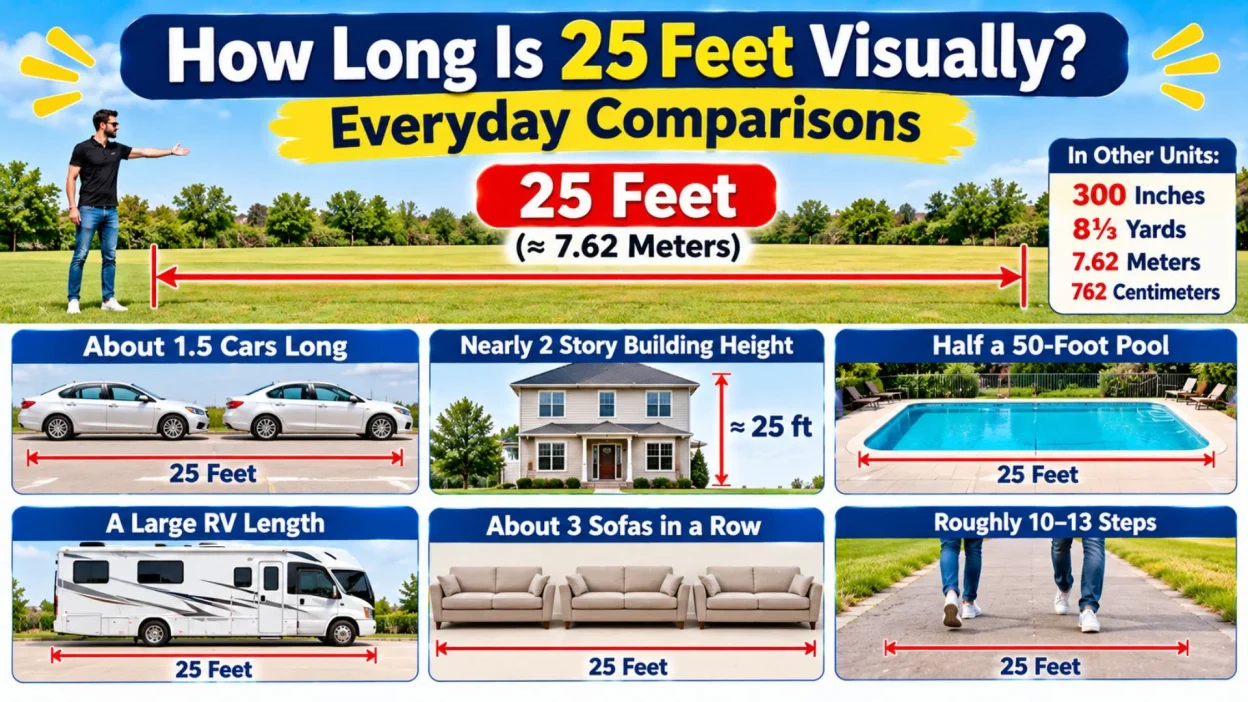
Have you ever wondered how long 25 feet really is? This measurement can be difficult to picture if you do not regularly use feet to measure distances. Whether you are planning a room, measuring a backyard, checking a property, or estimating the length of an object, familiar comparisons can make 25 feet easier to visualize.
25 feet equals 300 inches, 7.62 meters, or 762 centimeters. That is longer than many cars, roughly the height of a two-story building, and about the length of a large recreational vehicle. These comparisons give you a useful starting point for imagining the distance.
However, the best visual reference depends on your surroundings. A basketball court, a car, a room, or a row of household objects can help you estimate this length without immediately reaching for a measuring tape.
In this guide, you will discover what 25 feet looks like in real life, how it compares with familiar objects, and how to estimate the distance when you do not have measuring tools available.
📐 How Long Is 25 Feet in Different Measurements?
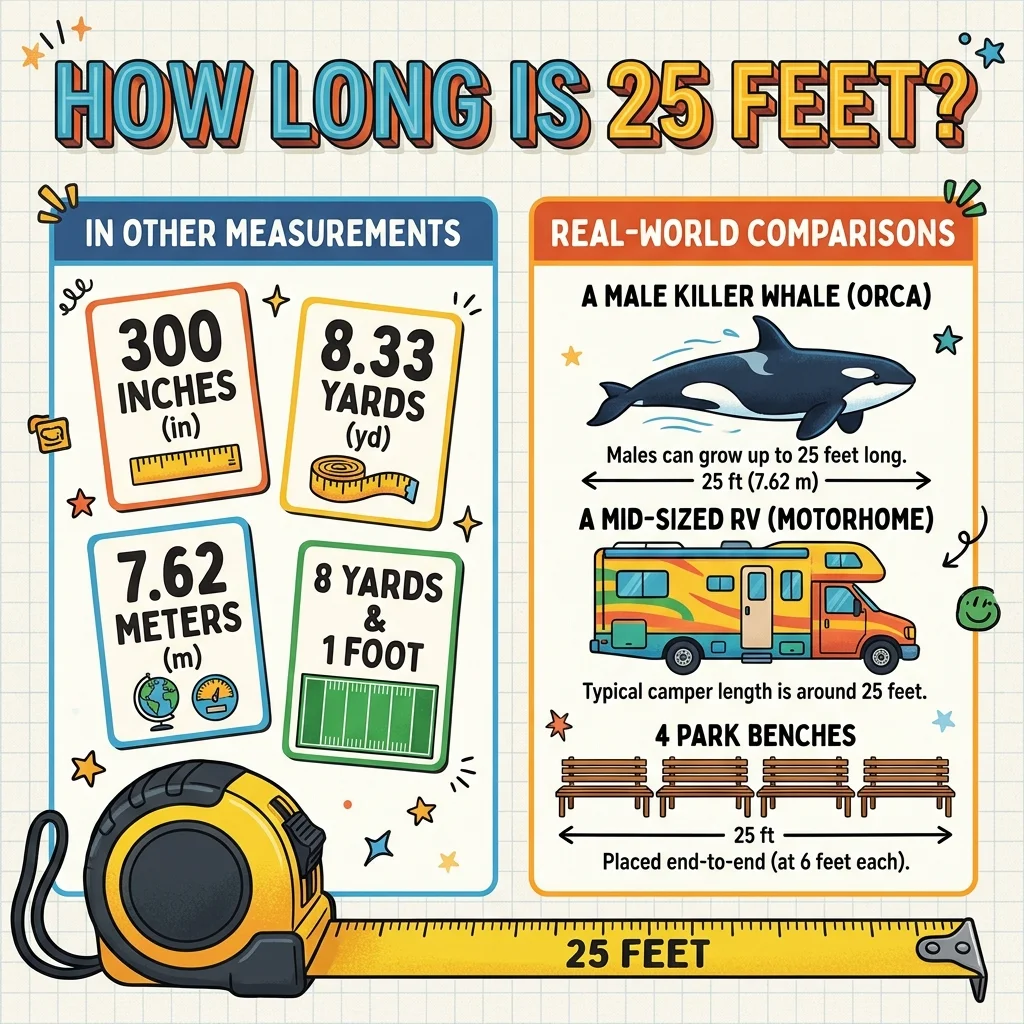
Before comparing 25 feet with everyday objects, it helps to understand the measurement in other units. This makes it easier to picture the distance whether you normally use feet, inches, meters, or centimeters.
| Measurement Unit | Equivalent of 25 Feet |
|---|---|
| Feet | 25 ft |
| Inches | 300 inches |
| Yards | 8.33 yards |
| Meters | 7.62 meters |
| Centimeters | 762 cm |
| Millimeters | 7,620 mm |
How Many Inches Are in 25 Feet?
There are 300 inches in 25 feet because each foot contains 12 inches.
The calculation is simple:
25 × 12 = 300 inches
This conversion is helpful when comparing smaller measurements or using a measuring tape marked in inches.
How Many Meters Is 25 Feet?
25 feet equals 7.62 meters.
To convert feet into meters, multiply the number of feet by 0.3048.
25 × 0.3048 = 7.62 meters
This metric equivalent is especially useful when reading international product specifications, planning spaces, or measuring outdoor areas.
How Many Yards Is 25 Feet?
25 feet equals 8⅓ yards, or approximately 8.33 yards.
Since one yard equals three feet, divide 25 by three to calculate the equivalent.
25 ÷ 3 = 8.33 yards
This measurement can help you visualize a distance on a lawn, sports field, or other open space.
👀 What Does 25 Feet Look Like in Real Life?
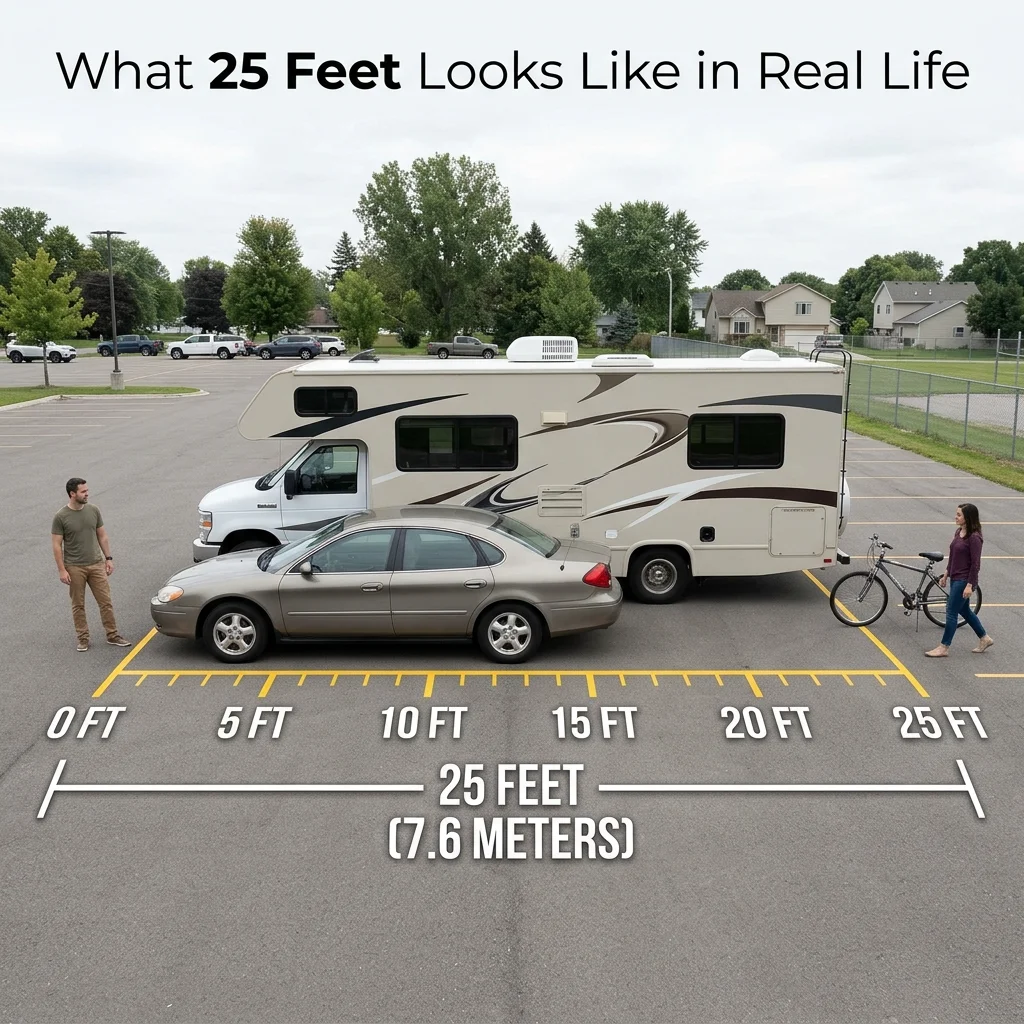
The easiest way to understand a long measurement is to compare it with familiar objects. The following examples provide a practical sense of scale, although actual dimensions vary depending on the item.
🚗 About Four to Five Cars Parked in a Row
Many passenger cars measure approximately 14–16 feet long, although smaller and larger vehicles exist.
A 25-foot distance is therefore longer than one typical car. If you imagine several cars parked bumper to bumper, the distance would cover roughly one and a half to two average cars, depending on their lengths.
For a more direct comparison, imagine a car measuring 15 feet long. Add another 10 feet, and the combined distance reaches 25 feet.
This is useful when estimating parking spaces, driveways, and outdoor areas. Keep in mind that the actual space required for parked cars also includes gaps and room for maneuvering.
🏠 Roughly the Height of a Two-Story Building
Many two-story residential buildings are approximately 20–25 feet tall to the roofline, although architectural designs vary considerably.
This makes a two-story building a helpful reference for visualizing 25 feet vertically. Imagine measuring from the ground to a roof that sits around that height.
The exact height depends on ceiling height, floor construction, roof design, and the ground level around the building.
A tall two-story home may exceed 25 feet, while a compact building may be shorter. Treat this comparison as a general visual guide rather than an architectural measurement.
🚌 About the Length of a Small Shuttle Bus
Some small shuttle buses measure around 20–25 feet long, while larger buses can be considerably longer.
A vehicle near the upper end of this range can provide a useful picture of a 25-foot distance. Imagine a long vehicle occupying much of a driveway or parking area.
This comparison is especially helpful when estimating space for vehicle storage or planning an outdoor area.
However, bus dimensions differ by model, so check the manufacturer’s specifications if you need to know whether a particular vehicle will fit.
🏊 A Large Portion of a Swimming Pool

A 25-foot distance equals half the length of a 50-foot swimming pool.
This is a straightforward comparison because 50 feet is a common pool length in some facilities. Imagine standing at one end of such a pool and looking toward the midpoint.
Not every swimming pool measures 50 feet. Residential pools may be shorter or longer, so the comparison works best when you know the pool’s actual dimensions.
🏀 A Significant Distance on a Basketball Court
A regulation basketball court is much longer than 25 feet. For example, an NBA court is 94 feet long, making 25 feet a little over one-quarter of its length.
Picture walking from one baseline toward the opposite end. After covering 25 feet, you would have traveled approximately 26.6% of the court’s total length.
This comparison is useful if you have access to a basketball court and want a familiar visual reference. Court dimensions vary by league and level of play, so use the appropriate court measurements for precise calculations.
🛋️ Around the Length of Several Sofas
A typical sofa may measure approximately 6–8 feet wide, although designs vary widely.
If you imagine three sofas measuring about 8 feet each, their combined widths would be 24 feet. That is very close to 25 feet.
This comparison makes the measurement easier to visualize indoors. It can also help when planning furniture arrangements, although lining up sofas is only a mental reference, not a reliable way to measure a room.
🪜 About the Reach of a Tall Extension Ladder
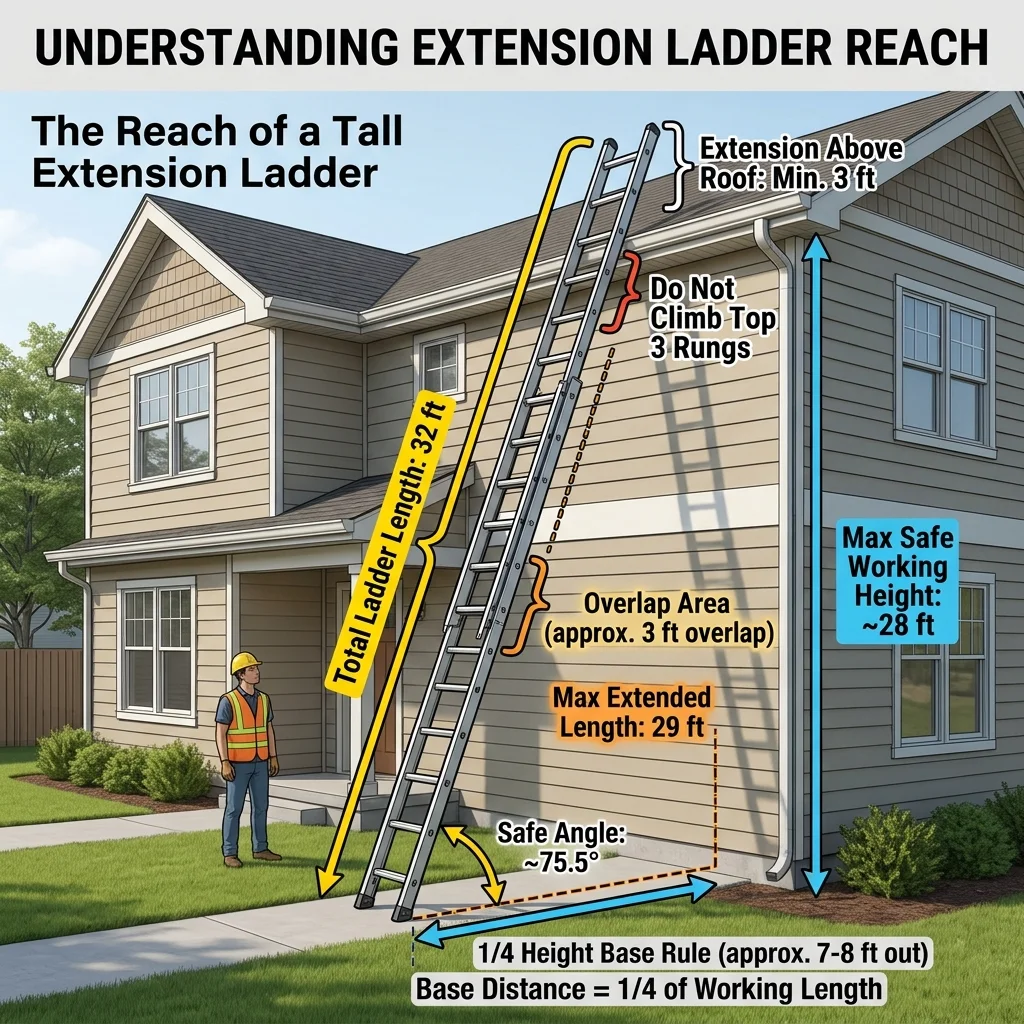
Some extension ladders reach lengths greater than 25 feet, while others are shorter. A ladder labeled for a particular maximum length may have a different usable working height because of its design and required setup angle.
A ladder with an extended length near 25 feet can provide a visual reference for the measurement.
However, ladder length is not the same as safe working reach. Never use a ladder comparison to estimate a safe climbing height; follow the manufacturer’s instructions and appropriate safety guidance.
🌳 Similar to the Height of a Mature Small Tree
Some small ornamental trees reach heights around 20–25 feet when mature. Others remain much shorter or grow substantially taller.
A tree standing around 25 feet tall gives you a useful way to picture the measurement vertically. Imagine a tree whose crown reaches roughly the height of a two-story roof.
Tree height varies by species, age, growing conditions, and pruning. Use the actual height of a known tree if you need a more accurate comparison.
🚐 Comparable to Some Recreational Vehicles
Smaller recreational vehicles and camper vans vary greatly in length. Some are close to 20 feet, while larger motorhomes can be 30 feet or more.
A recreational vehicle around 25 feet long offers a useful reference for understanding the distance horizontally.
Imagine the vehicle parked beside a house or in a designated parking area. Its length helps show that 25 feet is a substantial distance for a single object.
Always check the specific vehicle’s listed length before planning storage or parking.
🏡 A Little Longer Than Many Living Rooms
Living rooms differ significantly in size, but some measure around 12–20 feet along one wall. A 25-foot distance may be longer than the length of a compact living room.
Imagine walking from one end of a long room to the other. In a room measuring 15 feet long, you would need to travel another 10 feet to reach 25 feet.
This comparison is useful when planning furniture, flooring, or room layouts. Measure the actual wall-to-wall distance before buying materials or arranging large objects.
🏡 Where Is a 25-Foot Measurement Useful?
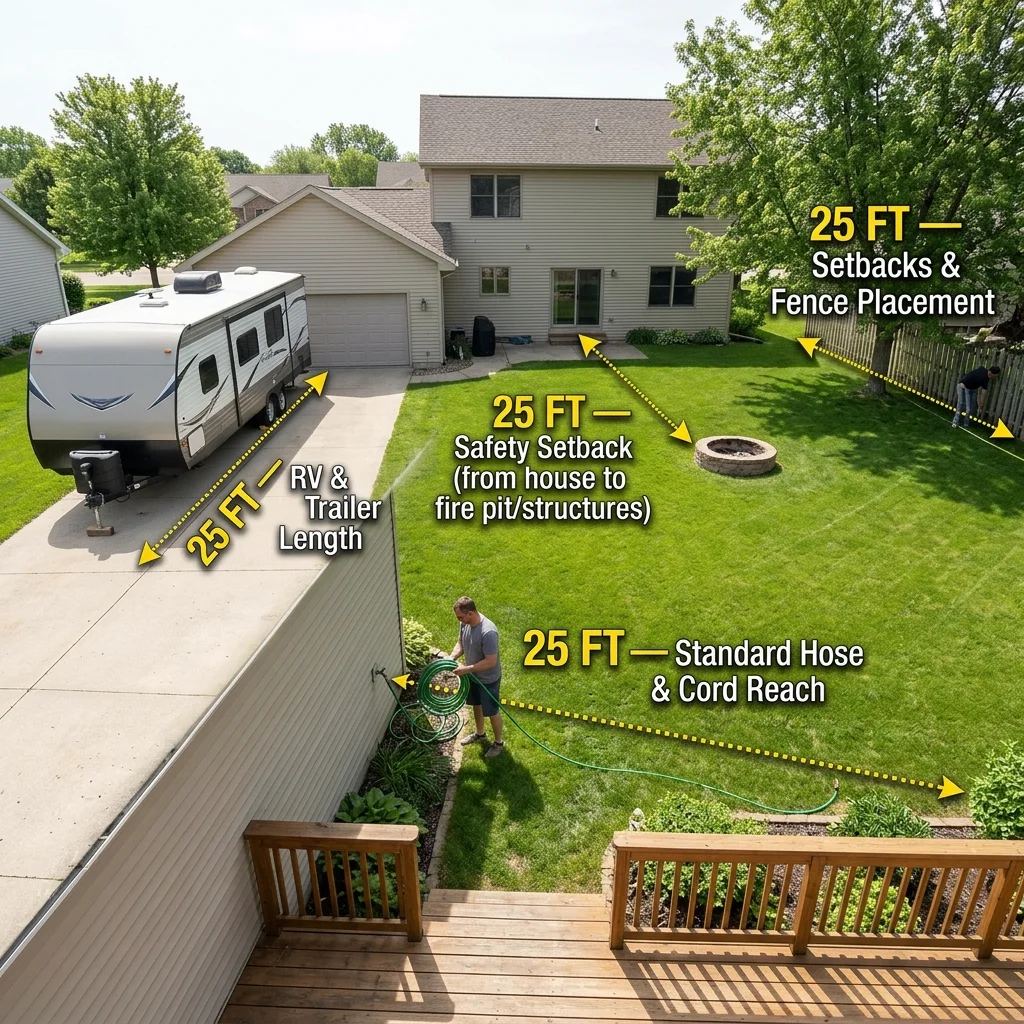
Understanding 25 feet can help with everyday planning, particularly when dealing with outdoor spaces and larger objects.
Planning a Backyard or Garden
A 25-foot distance can help you estimate the space available for a garden path, seating area, or row of plants.
For example, a garden bed that stretches 25 feet along a fence occupies a noticeable portion of a typical residential yard.
Before purchasing materials, measure the actual space and account for corners, obstacles, and access paths.
Measuring a Driveway
A 25-foot distance may be relevant when planning a driveway, checking the position of a parked vehicle, or estimating the available space between a garage and the street.
However, a vehicle’s length and the total parking space required are different measurements. You may need extra room to open doors and move safely.
Check your local requirements if you are planning a permanent driveway or construction project.
Estimating Indoor Space
Large rooms, workshops, and open-plan living areas can include distances of 25 feet or more.
Knowing this measurement helps when choosing flooring, arranging furniture, or deciding where to place large items.
Measure both the length and width of the room. A 25-foot wall does not automatically mean the entire room is 25 feet wide.
Planning Decorations and Event Layouts
A 25-foot measurement can help when estimating the length of a banner, decorative garland, or seating arrangement.
For example, a 25-foot string of lights may cover a long section of a patio or garden.
Check the actual length of the product and leave enough extra material for turns, attachment points, or draping.
👣 How to Estimate 25 Feet Without a Measuring Tape
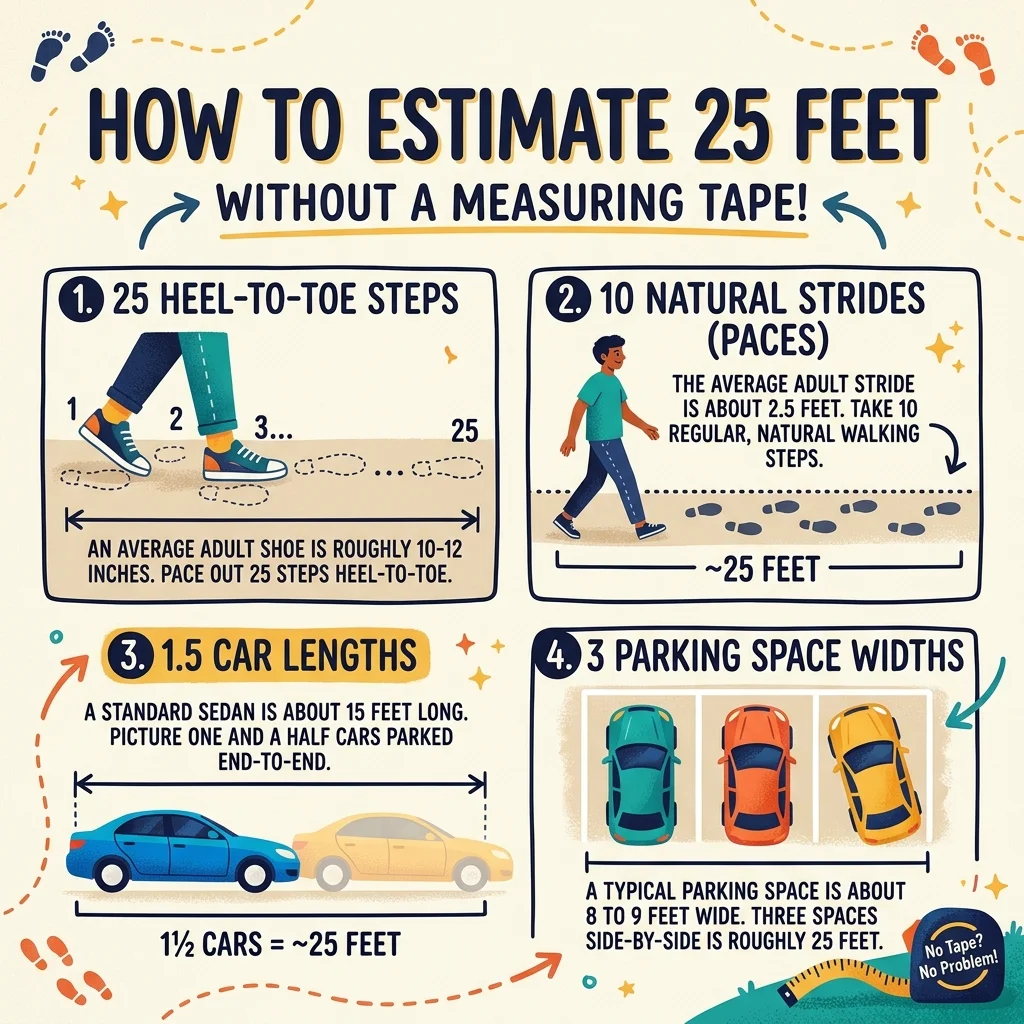
You can estimate a 25-foot distance using familiar measurements or a simple walking technique. These approaches are helpful for rough estimates, but they are not substitutes for accurate measuring tools.
Count Your Walking Steps
An adult’s walking step often covers roughly 2–2.5 feet, although stride length varies by height, walking style, and pace.
At that rough rate, 25 feet may take around 10–13 ordinary steps.
For a better personal estimate, walk a known distance and count your steps. For example, if you take 12 steps to cover 25 feet, you can use that count as a rough reference for similar distances.
Do not assume every step covers exactly the same distance. Uneven ground, slopes, and changes in walking speed can affect the result.
Use a Known Object as a Reference
If you know the length of an object, use it to estimate a longer distance.
For instance, a 5-foot object would need to be imagined five times in a row to cover 25 feet.
A familiar car or a marked sports area can also help, provided you know its actual dimensions.
Visualize 7.62 Meters
Because 25 feet equals 7.62 meters, you can picture a line measuring a little more than seven and a half meters.
This may be easier if you normally use the metric system. You can also divide the distance mentally into three sections of approximately 2.54 meters each.
The result is still an estimate unless you measure the distance directly.
Use a Measuring Tape or Laser Measure
For accurate results, use a tape measure long enough to cover the distance or a suitable laser distance meter.
Keep the tape straight and level where appropriate. When measuring vertically or across uneven ground, follow the tool’s instructions and take care around obstacles.
For construction, property boundaries, or other precision-sensitive tasks, use an appropriate measuring method rather than relying on visual estimates.
❓ Frequently Asked Questions About 25 Feet
Is 25 Feet Considered Long?
For an everyday object, 25 feet is a substantial length. It equals 7.62 meters and is longer than many cars. However, it is short compared with a large building, swimming pool, or sports field.
Whether it feels long depends on what you are measuring.
How Many Meters Is 25 Feet?
Twenty-five feet equals 7.62 meters.
Multiply 25 by 0.3048 to convert feet into meters.
How Many Inches Are in 25 Feet?
There are 300 inches in 25 feet.
Each foot contains 12 inches, so multiply 25 by 12.
Is 25 Feet Taller Than a Two-Story House?
Some two-story houses are around 25 feet tall, while others are shorter or taller. The total height depends on the building’s design, ceiling heights, roof structure, and ground level.
Therefore, 25 feet is a useful rough comparison but not a universal height for a two-story house.
How Many Steps Does It Take to Walk 25 Feet?
It may take roughly 10–13 ordinary walking steps for an adult, depending on stride length.
To estimate your own walking distance, count your steps across a measured area and use the result as a personal reference.
Is 25 Feet Half a Basketball Court?
No. A full NBA basketball court is 94 feet long, so 25 feet is slightly more than one-quarter of its length. Half the court’s length is 47 feet.
Other basketball courts may have different dimensions.
Can I Estimate 25 Feet Without a Tape Measure?
Yes. You can use walking steps, known object lengths, or a familiar sports court to estimate the distance.
These methods are useful for rough planning, but a tape measure or suitable distance meter provides a more reliable result.
How Does 25 Feet Compare With 25 Yards?
Twenty-five feet equals approximately 8.33 yards, while 25 yards equals 75 feet.
Therefore, 25 yards is three times as long as 25 feet.
✅ Conclusion
So, how long is 25 feet visually? It equals 300 inches, 8⅓ yards, or 7.62 meters. You can picture it as a distance longer than a typical car, close to the height of some two-story buildings, or roughly half the length of a 50-foot swimming pool.
Everyday comparisons make this measurement easier to understand, whether you are planning a backyard, estimating a room, or checking the space needed for a vehicle. Still, objects vary in size, so comparisons should only provide a general sense of scale.
When precision matters, use a suitable measuring tape or distance meter to confirm the actual length.