A twin bed can look surprisingly small in a furniture showroom and feel much bigger once you place it in a bedroom. The trick is that mattress dimensions tell only part of the story. You also need to think about the bed frame, walking space, and whether the mattress will comfortably fit the person sleeping on it.
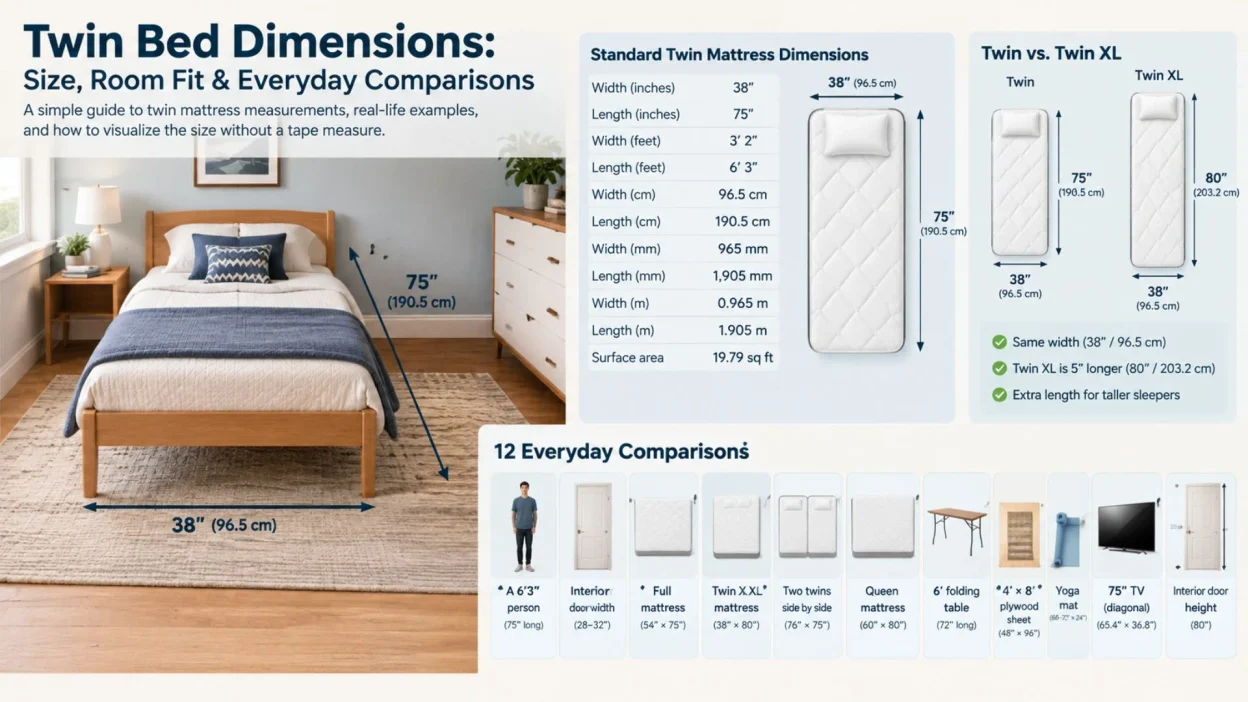
Standard twin size bed dimensions in the United States are 38 inches wide by 75 inches long. That works out to 3 feet 2 inches wide and 6 feet 3 inches long, making it a popular choice for children’s bedrooms, guest rooms, dormitories, and compact living spaces.
In metric measurements, a standard twin mattress is approximately 96.5 cm wide and 190.5 cm long. Its rectangular shape provides enough room for one sleeper while taking up considerably less floor space than a full or queen bed.
In this guide, you’ll learn the exact conversions, how twin mattresses compare with other bed sizes, and how to picture their dimensions using familiar objects. We’ll also cover room planning, twin XL mattresses, and simple ways to estimate the space without pulling out a measuring tape.
Every Twin Bed Measurement Converted

The easiest way to understand a twin mattress is to start with its standard dimensions. These measurements refer to the mattress itself, not the complete bed frame.
| Measurement | Standard Twin Mattress |
|---|---|
| Width in inches | 38 inches |
| Length in inches | 75 inches |
| Width in feet | 3 feet 2 inches |
| Length in feet | 6 feet 3 inches |
| Width in centimeters | 96.52 cm |
| Length in centimeters | 190.5 cm |
| Width in millimeters | 965.2 mm |
| Length in millimeters | 1,905 mm |
| Width in meters | 0.9652 m |
| Length in meters | 1.905 m |
| Width in yards | 1.06 yards |
| Length in yards | 2.08 yards |
| Mattress surface area | 19.79 square feet |
These figures use the common US twin mattress standard. Actual products may vary slightly, and dimensions in other countries may differ.
How the conversions work

Converting twin size bed dimensions is straightforward once you separate the width from the length.
- Inches to feet: Divide the number of inches by 12. A 38-inch width equals 3 feet 2 inches, while a 75-inch length equals 6 feet 3 inches.
- Inches to centimeters: Multiply by 2.54. Therefore, 38 inches is 96.52 cm, and 75 inches is 190.5 cm.
- Inches to millimeters: Multiply by 25.4. The mattress measures 965.2 mm wide and 1,905 mm long.
- Inches to meters: Divide the centimeter measurement by 100. The result is 0.9652 m wide by 1.905 m long.
The mattress surface area is approximately 19.79 square feet, calculated by multiplying 38 inches by 75 inches and converting the result from square inches to square feet.
One important detail: a mattress measuring 38 by 75 inches does not guarantee that the complete bed will fit inside a 38-by-75-inch floor space. Bed frames, headboards, and footboards often extend beyond the mattress.
Where Twin Dimensions Fit on a Bed Size Chart
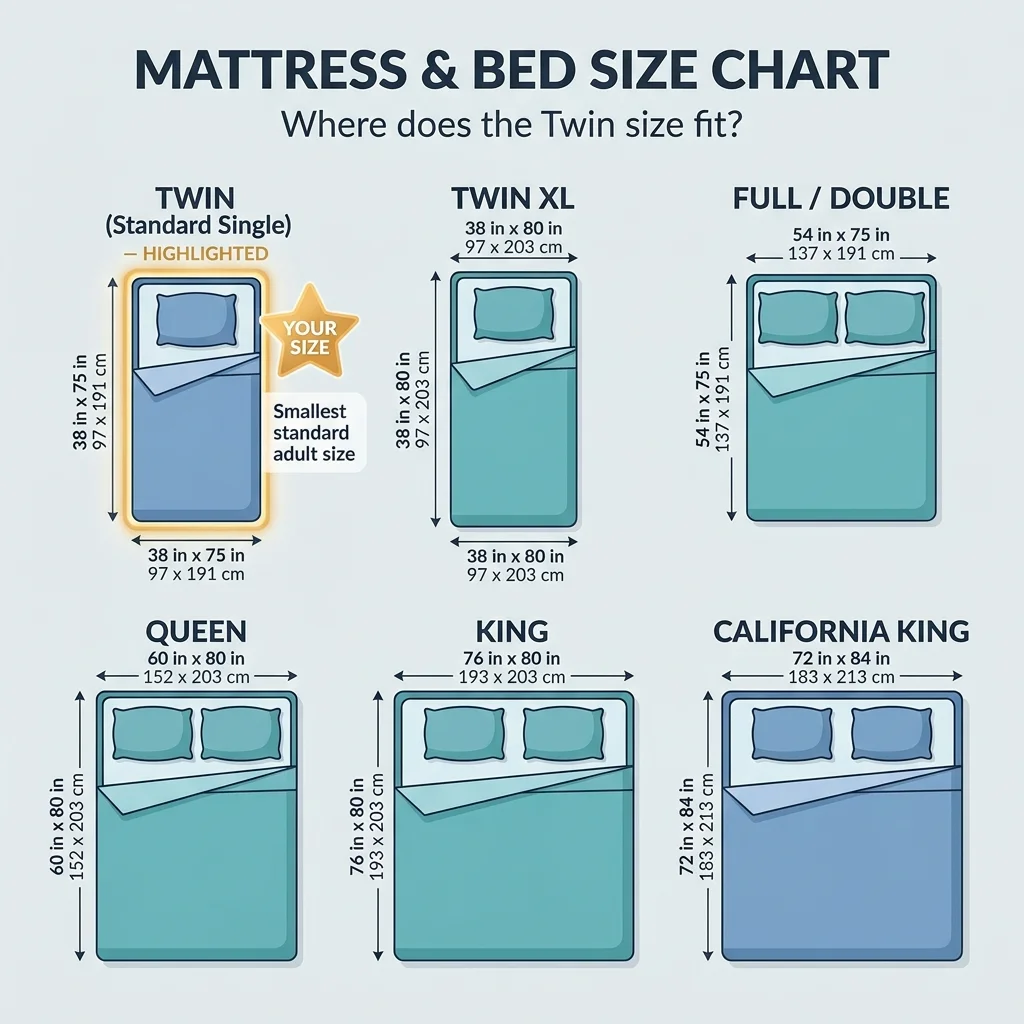
A twin mattress is one of the smallest standard adult mattress sizes in the United States. Its main advantage is the balance between a usable sleeping surface and a relatively small footprint.
Here is how it compares with other common US mattress sizes.
| Mattress size | Width | Length | Typical use |
|---|---|---|---|
| Crib | 28 in | 52 in | Infants and toddlers |
| Twin | 38 in | 75 in | Children, teens, single sleepers |
| Twin XL | 38 in | 80 in | Taller single sleepers, dorms |
| Full | 54 in | 75 in | Single sleepers wanting more width |
| Queen | 60 in | 80 in | Couples and individuals wanting more space |
| King | 76 in | 80 in | Couples wanting a wider sleeping surface |
These are common US mattress dimensions. Individual manufacturers may have slight variations.
Is a twin bed big enough for an adult?

Yes, a twin bed can work well for an adult who sleeps alone and does not need much room to spread out. The 38-inch width is relatively narrow, however, particularly for people who move around frequently during sleep.
The more important consideration is length. At 75 inches, a twin mattress is 6 feet 3 inches long. It can suit many adults, but someone close to or taller than that length may prefer a twin XL, which adds another 5 inches.
How much room does a twin bed need?
The mattress itself occupies about 19.79 square feet. Your bedroom needs additional space for getting in and out of bed, opening doors, accessing wardrobes, and moving around furniture.
For practical planning, a room around 7 by 10 feet may accommodate a twin bed, depending on the entrance, closet, and other furniture. A room measuring 8 by 10 feet offers 80 square feet of floor area and generally provides more flexibility.
These are planning examples rather than minimum room-size rules. Measure the actual bed frame and consider the layout before purchasing.
12 Things That Help You Visualize a Twin Bed
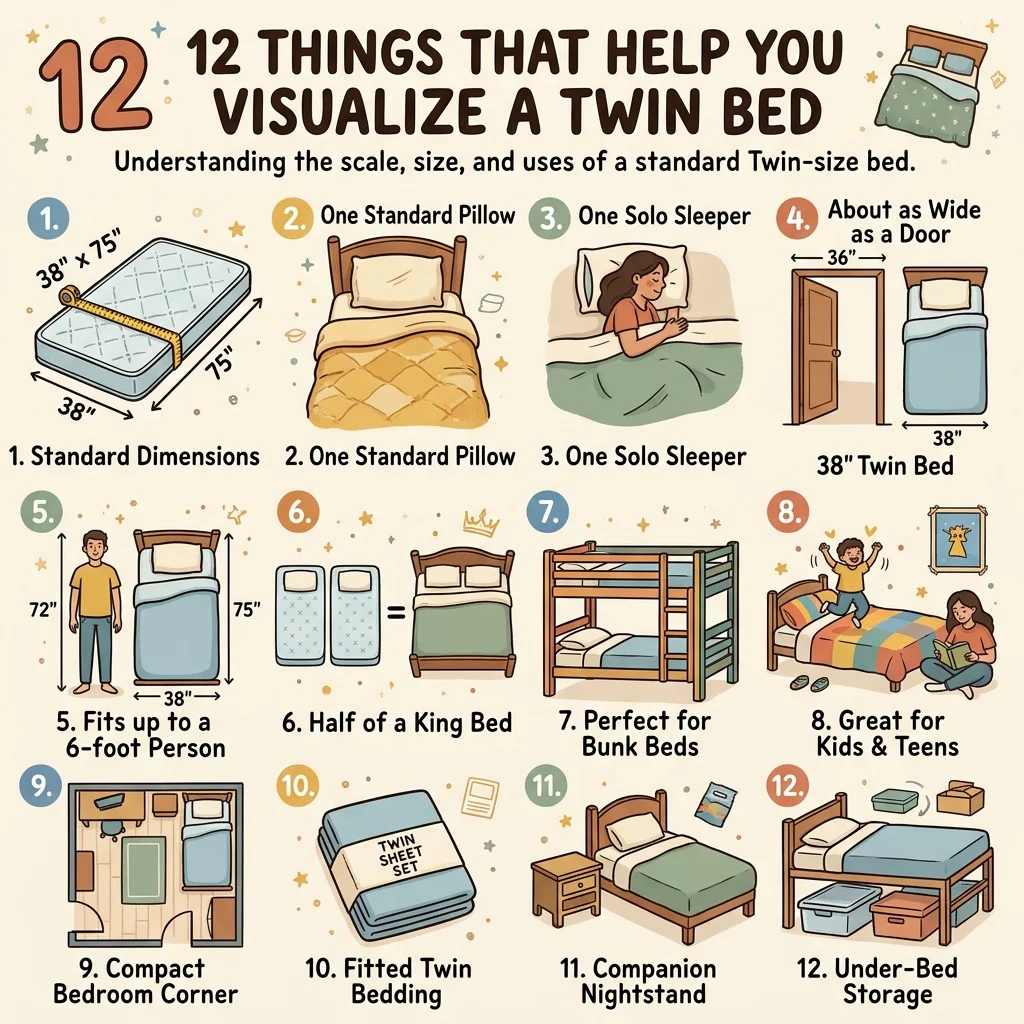
The best way to understand a twin mattress is to compare its dimensions with familiar items and spaces. Some comparisons help explain its length, while others make its width and overall footprint easier to imagine.
Remember that the mattress is a rectangle measuring 38 by 75 inches. An object that matches one dimension does not necessarily match the entire mattress.
A 6-Foot-3-Inch Person Lying Lengthwise
A person who is 6 feet 3 inches tall has a height equal to the mattress’s 75-inch length. This provides an easy mental reference for the long side of a twin bed.
However, matching the numbers does not mean the fit will be comfortable. A person of that height would have almost no extra length for a pillow or room to stretch out, depending on their sleeping position.
Mattresses also do not need to match a person’s standing height exactly. The important consideration is whether there is enough space for the sleeper’s full body and preferred sleeping posture.
A Standard Interior Doorway’s Width
Many interior doorways are approximately 28 to 32 inches wide, although actual widths vary. A 38-inch twin mattress is wider than these common doorway openings.
This comparison is especially useful when moving a mattress into a bedroom. The mattress may need to be tilted or turned to pass through a doorway, hallway, or stairwell.
A mattress’s flexibility can help, but the bed frame may be more difficult to maneuver. Measure the narrowest point along the delivery route instead of checking only the bedroom door.
A Standard Full-Size Mattress
A full mattress typically measures 54 by 75 inches, while a twin measures 38 by 75 inches. Both are usually the same length, but the full mattress is 16 inches wider.
That extra width makes a noticeable difference for people who like to sleep with their arms extended or change positions during the night. It also takes up more floor space.
Picture a twin mattress with another 16-inch strip added along its width. That strip is the difference between the two mattress sizes, and it explains why a full bed can feel substantially roomier.
A Twin XL Mattress
A twin XL mattress shares the standard twin’s 38-inch width but measures 80 inches long instead of 75 inches. The additional 5 inches are intended to give taller sleepers more legroom.
Twin XL mattresses are common in college dormitories and other settings where a narrow bed needs to accommodate a variety of heights.
Imagine extending the foot of a standard twin mattress by 5 inches. The result is still narrow, but the longer sleeping surface can be more comfortable for someone who finds a regular twin too short.
Two Standard Twin Mattresses Side by Side
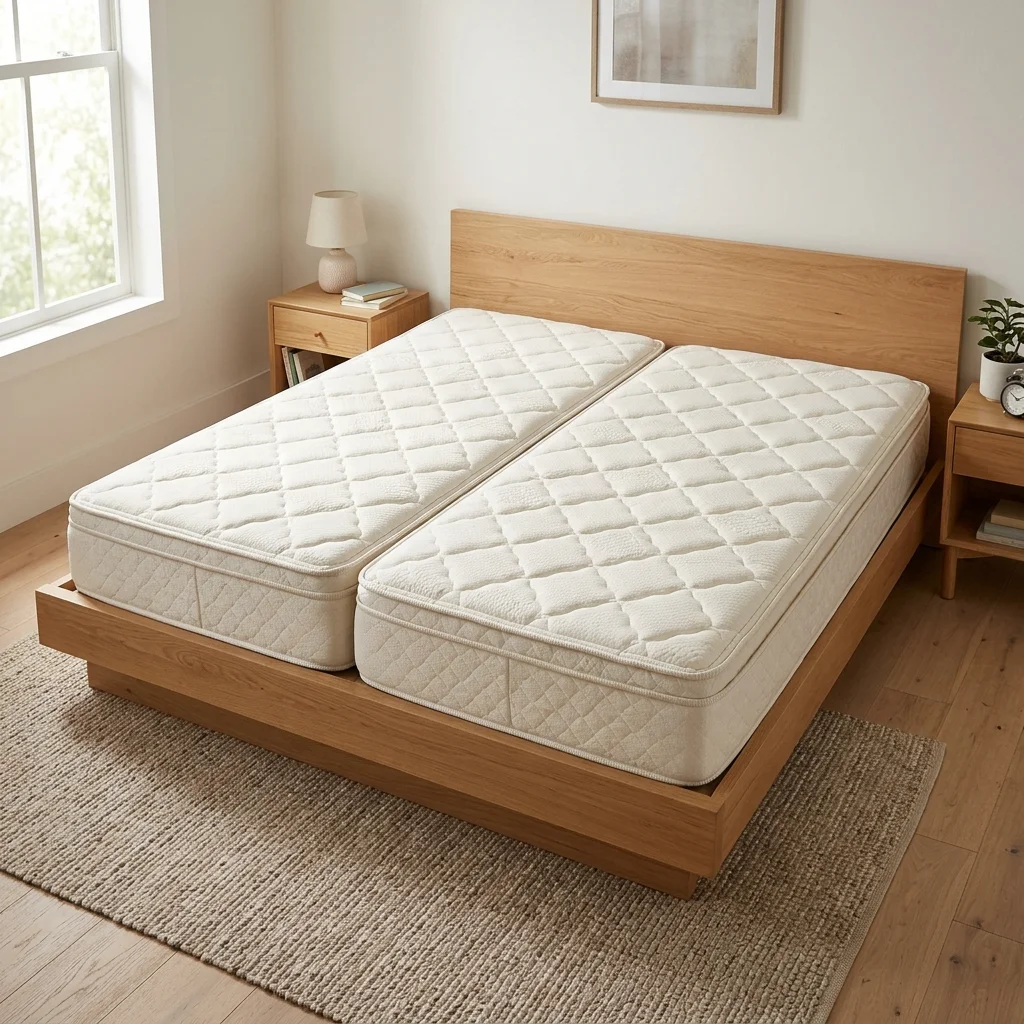
Two twin mattresses placed side by side create a combined sleeping surface approximately 76 inches wide by 75 inches long. That is much wider than a single twin mattress.
This arrangement is sometimes useful in flexible guest rooms or shared sleeping spaces. However, two standard twins side by side do not exactly equal a standard king mattress because a king is typically 76 by 80 inches.
The comparison makes the twin’s narrowness easy to understand: a second twin nearly doubles the width while keeping the same length.
A Standard Queen Mattress
A standard queen mattress measures 60 by 80 inches. Compared with a twin, it adds 22 inches in width and 5 inches in length.
That is a substantial increase in sleeping space. A queen can accommodate couples, while a twin is primarily designed for one sleeper.
Visualize a twin mattress with a wide section added along one side and a little extra length at the bottom. The resulting rectangle gives you a useful impression of how much more floor space a queen requires.
A 6-Foot Folding Table
A common 6-foot folding table is 72 inches long. That makes it just 3 inches shorter than a standard twin mattress’s 75-inch length.
Folding tables are available in different widths, but many rectangular models are around 30 inches wide. That is narrower than a twin mattress, which measures 38 inches across.
If you have a folding table at home, imagine extending its long edge by roughly 3 inches. You will have a useful estimate of the twin mattress length, although the table’s width will not match the mattress.
A 4-by-8-Foot Plywood Sheet
A standard sheet of plywood measures 48 by 96 inches. It is wider and longer than a twin mattress, but it offers a helpful reference for understanding the scale of the bed.
A twin mattress is 10 inches narrower and 21 inches shorter than this sheet. Those differences are substantial enough to see clearly when the two rectangles are compared.
Plywood is commonly sold in this format for construction and woodworking. If you have seen a full sheet in a workshop, picture a smaller rectangle cut from it to understand the twin mattress’s footprint.
A 3-by-6-Foot Area Rug
A rug measuring 3 by 6 feet is 36 by 72 inches. That makes it close to a twin mattress, which measures 38 by 75 inches.
The mattress is 2 inches wider and 3 inches longer. These small differences make a 3-by-6-foot rug a useful visual reference for the approximate scale of a twin bed.
Rugs are sold in many actual sizes, so check the label before relying on this comparison. Also, a rug’s dimensions do not account for a bed frame or the space needed around the mattress.
A Standard Yoga Mat
Many yoga mats measure about 68 to 72 inches long and around 24 inches wide. A twin mattress is longer and substantially wider.
The comparison is useful because yoga mats are common household items with a clear rectangular shape. A typical mat comes close to the mattress length but falls short in both dimensions.
Imagine extending a 72-inch yoga mat by about 3 inches and adding another 14 inches or so to its width. That gives you a rough picture of the space occupied by a twin mattress.
A 75-Inch Television’s Screen Diagonal
A 75-inch television sounds as though it might be as long as a twin mattress, but the number refers to the screen’s diagonal measurement rather than its width or height.
A typical 16:9 television with a 75-inch diagonal has a screen approximately 65.4 inches wide and 36.8 inches tall, excluding the frame. A twin mattress is 75 inches long, so the mattress is still longer than the television’s screen is wide.
This is a useful reminder that measurements depend on how an object is measured. A diagonal, a width, and a length are different things, even when the numbers sound similar.
A Standard Interior Door’s Height
A common US interior door is 80 inches tall. That is 5 inches longer than a twin mattress’s 75-inch length.
If you stand next to a standard door, you can use its height to estimate the mattress length. The mattress would be slightly shorter than the door’s vertical dimension.
This comparison is particularly helpful when planning a room because both the bed and the door occupy space that affects movement. Just remember that door heights and styles vary, so use the actual measurements when precision matters.
The Twin vs. Twin XL Question

One of the most common questions people ask when shopping for a single bed is whether they should choose a twin or twin XL. The difference is small on a product listing but can matter when someone is sleeping on it every night.
| Feature | Twin | Twin XL |
|---|---|---|
| Width | 38 inches | 38 inches |
| Length | 75 inches | 80 inches |
| Width in cm | 96.52 cm | 96.52 cm |
| Length in cm | 190.5 cm | 203.2 cm |
| Sleeping surface | 19.79 sq ft | 21.11 sq ft |
| Best suited for | Children and many single sleepers | Taller single sleepers |
The width is identical, so twin XL does not give you extra room to spread out sideways. Its extra 5 inches of length can make a meaningful difference for taller people.
Will twin sheets fit a twin XL mattress?
Usually, standard twin fitted sheets are not designed for twin XL mattresses because the XL mattress is 5 inches longer. Some flexible bedding products may fit both sizes, but you should check the manufacturer’s listed dimensions.
Flat sheets and comforters can sometimes be used across both sizes because they do not need to fit tightly around the mattress. Fitted sheets are the products that require the closest size match.
Does a twin mattress fit every twin bed frame?
Not necessarily. A frame labeled twin is generally designed for a standard twin mattress, but the frame’s outer dimensions depend on its construction.
A metal platform frame may add relatively little to the mattress footprint, while a bulky wooden frame or one with a headboard and footboard may extend several inches beyond it.
Before buying a mattress or frame, check both the mattress dimensions and the manufacturer’s compatibility specifications.
Estimating Twin Bed Dimensions Without a Tape Measure

You can get a reasonable idea of how large a twin bed is by using familiar references. These methods work for visualization and rough planning, but they should not replace actual measurements when buying furniture.
Use a 6-foot folding table
A common 6-foot table is 72 inches long. Imagine adding another 3 inches to its length to estimate the long side of a twin mattress.
Compare it with your height
A 75-inch mattress is 6 feet 3 inches long. If you know your own height, you can compare it with that figure, keeping in mind that standing height and lying-down measurements are not identical in every practical situation.
Picture a 3-by-6-foot rug
A 36-by-72-inch rug is close to a twin mattress’s footprint. Imagine making it slightly wider and longer to get a useful estimate.
Mark the floor with removable tape
For a more practical room-planning test, mark a rectangle measuring approximately 38 by 75 inches on the floor. Then mark a second, larger rectangle for the frame if you know its outer dimensions.
Measure the available room space
If you’re deciding whether a twin bed will fit, measure the wall, doorway, and walking paths. A bed that fits on paper may still obstruct a closet door or leave too little room to move comfortably.
Frequently Asked Questions
What are the standard twin size bed dimensions?
A standard US twin mattress measures 38 inches wide by 75 inches long. In metric units, that is 96.52 cm by 190.5 cm. The bed frame may have larger overall dimensions.
How many feet is a twin bed?
A twin mattress is 3 feet 2 inches wide and 6 feet 3 inches long. Its width is approximately 3.17 feet, and its length is 6.25 feet.
How many centimeters is a twin mattress?
A standard twin mattress is 96.52 cm wide and 190.5 cm long. These conversions apply to the common US twin size.
How many meters is a twin bed?
The mattress measures approximately 0.965 meters wide and 1.905 meters long. Allow additional room if you’re calculating the space needed for the bed frame.
Is a twin bed big enough for an adult?
Yes, a twin can work for many adults who sleep alone. Its 38-inch width is relatively narrow, and its 75-inch length may be insufficient for taller sleepers who need additional legroom.
What is the difference between a twin and a twin XL?
Both mattresses are typically 38 inches wide. A twin XL measures 80 inches long, which makes it 5 inches longer than a standard twin mattress.
Can two people sleep on a twin bed?
Two people can physically share a twin mattress, but its 38-inch width provides limited room for each person. A full, queen, or king mattress is generally more practical for regular shared sleeping.
How much space should I leave around a twin bed?
There is no single clearance requirement for every bedroom. As a practical planning goal, aim for around 24–30 inches of accessible space along the side you use to get in and out of bed when the room allows, while also accounting for doors, wardrobes, and other furniture.
Where That Leaves You
A standard twin mattress measures 38 inches wide by 75 inches long, or approximately 96.5 cm by 190.5 cm. Its compact footprint makes it a practical choice for children’s rooms, dormitories, guest bedrooms, and spaces where a larger mattress would take up too much floor area.
The easiest way to picture its length is to compare it with a 6-foot folding table, which is only 3 inches shorter. For the width, remember that a twin mattress is 38 inches across—enough for one sleeper, but considerably narrower than a full or queen bed.
If you’re buying one, measure the mattress space, check the frame’s outer dimensions, and consider a twin XL if the sleeper needs more legroom. Those three checks will help you choose a bed that fits both the room and the person using it.