A Nether portal can look enormous when it glows purple inside a dark Minecraft cave, yet the smallest working version is surprisingly compact. The trick is understanding the difference between the obsidian frame and the opening through which your character travels.
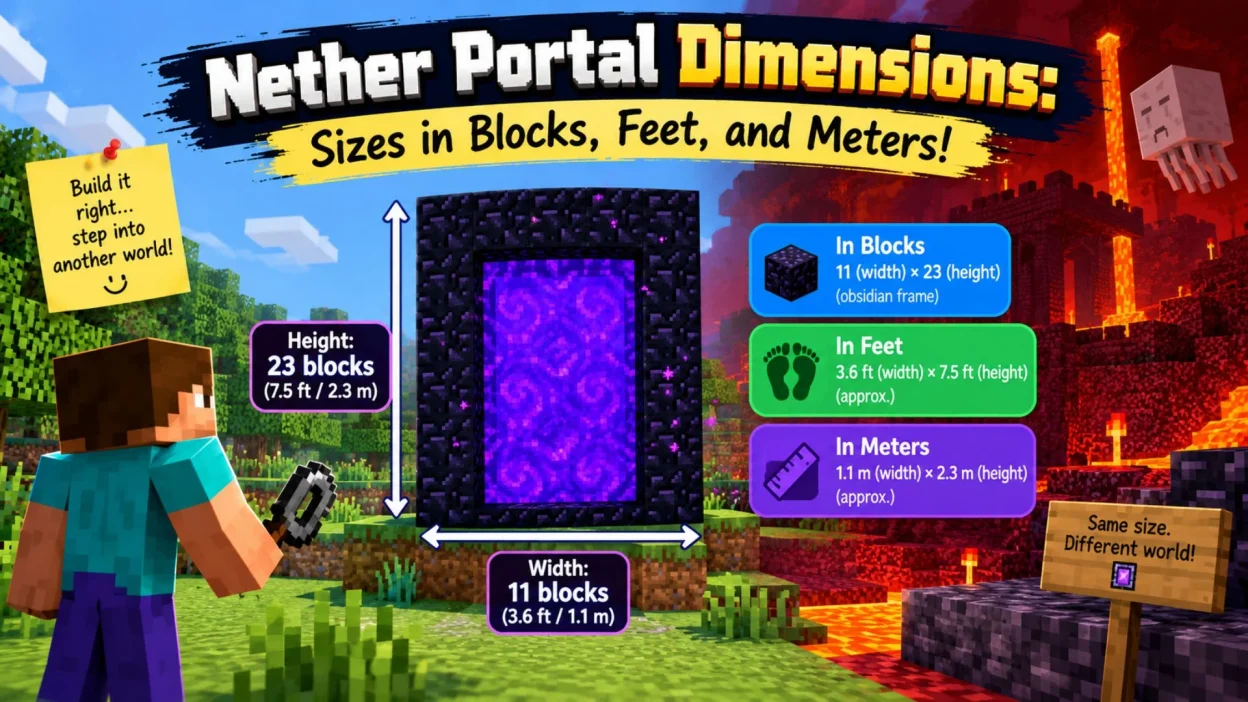
The standard minimum Nether portal measures 4 blocks wide and 5 blocks tall on the outside. Inside that frame, the actual portal opening is only 2 blocks wide and 3 blocks tall. Larger portals are possible, so you do not have to stick with the classic rectangle.
For a real-world comparison, Minecraft blocks are commonly treated as roughly one meter across for visualization. Using that convention, the smallest frame is approximately 4 meters wide and 5 meters tall, although these are game-block equivalents rather than official real-world construction measurements.
The minimum Nether portal dimensions equal 4 × 5 blocks externally, approximately 13.12 × 16.40 feet, 400 × 500 centimeters, 4,000 × 5,000 millimeters, and 4 × 5 meters. The interior opening is 2 × 3 blocks, or approximately 2 × 3 meters using the same convention.
This guide explains minimum and maximum Nether portal sizes, the blocks required to build them, practical comparisons, and the easiest ways to estimate the dimensions while playing Minecraft.
🔢 Every Nether Portal Dimension Converted

Minecraft measures structures in blocks rather than feet or centimeters.
For Nether portals, the most useful measurements are the outside frame and the clear opening inside it.
Minimum Nether Portal Dimensions
| Measurement | Outside Frame | Interior Opening |
|---|---|---|
| Width in blocks | 4 blocks | 2 blocks |
| Height in blocks | 5 blocks | 3 blocks |
| Width in feet, approximately | 13.12 ft | 6.56 ft |
| Height in feet, approximately | 16.40 ft | 9.84 ft |
| Width in centimeters, approximately | 400 cm | 200 cm |
| Height in centimeters, approximately | 500 cm | 300 cm |
| Width in millimeters, approximately | 4,000 mm | 2,000 mm |
| Height in millimeters, approximately | 5,000 mm | 3,000 mm |
| Width in meters, approximately | 4 m | 2 m |
| Height in meters, approximately | 5 m | 3 m |
These metric and imperial figures use the convenient assumption that one Minecraft block represents approximately one meter. They are not physical dimensions specified by the game.
Maximum Nether Portal Dimensions
| Measurement | Outside Frame | Interior Opening |
|---|---|---|
| Width in blocks | 23 blocks | 21 blocks |
| Height in blocks | 23 blocks | 21 blocks |
| Width in feet, approximately | 75.46 ft | 68.90 ft |
| Height in feet, approximately | 75.46 ft | 68.90 ft |
| Width in centimeters, approximately | 2,300 cm | 2,100 cm |
| Height in centimeters, approximately | 2,300 cm | 2,100 cm |
| Width in meters, approximately | 23 m | 21 m |
The maximum portal is a substantial rectangle compared with the standard version. The game permits rectangular portal frames ranging from 4 × 5 blocks to 23 × 23 blocks, measured along the outside edges.
How to Calculate Nether Portal Conversions
You can convert Minecraft block measurements into familiar units using a simple reference scale.
For approximate real-world comparisons, treat one block as one meter:
- Meters: Multiply the block count by 1.
- Centimeters: Multiply the block count by 100.
- Millimeters: Multiply the block count by 1,000.
- Feet: Multiply the block count by approximately 3.28084.
- Inches: Multiply the block count by approximately 39.3701.
For example, a five-block-tall frame corresponds to approximately five meters, or 16.40 feet, under this convention.
A three-block-tall opening corresponds to approximately three meters, or 9.84 feet.
Remember that these conversions help you visualize Minecraft’s block grid. They do not mean a Minecraft portal occupies the same physical space as a real architectural doorway.
📐 Where Nether Portal Sizes Fit on the Minecraft Scale

A portal’s size becomes easier to understand when you separate the outside frame from the empty space inside.
The obsidian creates the border, while the purple portal blocks fill the usable rectangular opening.
The Standard Portal: 4 × 5 Blocks
The smallest conventional Nether portal uses a frame that is four blocks wide and five blocks tall.
Its inside opening is two blocks wide and three blocks tall. That gives your character a compact vertical passage without requiring a large obsidian structure.
This is the most practical option for many survival players because it requires fewer materials than a giant portal.
The Maximum Portal: 23 × 23 Blocks
At the other end of the scale, the largest permitted frame is 23 blocks wide and 23 blocks tall.
Its inner opening measures 21 × 21 blocks. This creates a much larger visual feature for a base entrance, decorative build, or dramatic portal room.
However, a larger portal is not required for ordinary travel. The basic portal performs the same central job without demanding a huge amount of obsidian.
Why the Frame and Opening Have Different Dimensions
The outside measurement includes the obsidian surrounding the portal.
The inside measurement excludes the frame and counts only the portal’s clear rectangular area. A standard frame therefore measures four blocks across, but the opening measures only two blocks across.
The same distinction applies vertically: five blocks outside and three blocks inside.
That two-block difference in each dimension comes from the top, bottom, left, and right borders. The corner blocks may be omitted when building the frame, but the frame must still have a valid rectangular shape.
🧱 10 Useful Ways to Visualize Nether Portal Dimensions
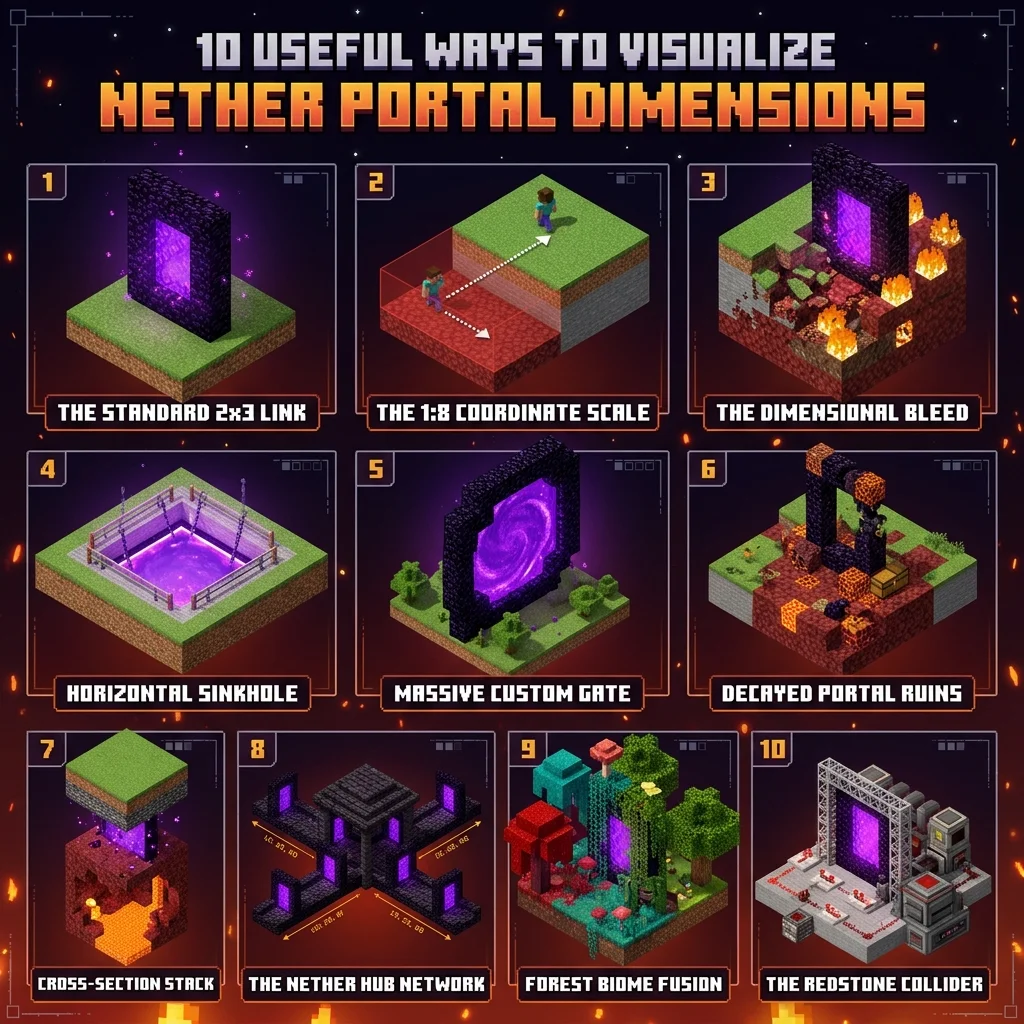
A block grid is the easiest reference for understanding a Nether portal.
These comparisons use the actual Minecraft building dimensions first, followed by approximate real-world equivalents where useful.
1. The Smallest Frame Is Four Blocks Wide
The minimum portal frame spans four blocks horizontally. That width includes both vertical obsidian sides and the space between them.
For a beginner, counting four blocks across the bottom is a straightforward way to establish the correct width before building upward.
Using the one-block-equals-one-meter convention, this is roughly four meters wide. That is a visualization aid, not a literal physical measurement.
2. The Smallest Frame Is Five Blocks Tall
The standard frame rises five blocks from the bottom to the top.
Count the bottom row, three rows of interior space, and the top row. This gives the complete five-block exterior height.
At approximately five meters under the conventional scale, the frame is taller than its width. That vertical shape is what gives the familiar portal its upright appearance.
3. The Opening Is Two Blocks Wide
The usable interior of a minimum portal is two blocks wide.
The obsidian sides take up the outer edges, leaving a two-block-wide opening for the purple portal surface. This is why counting only the outside blocks can make the portal seem wider than its active area.
If you are recreating the design in a drawing or planning a small entrance, remember that the clear opening—not the full frame—is the important measurement for passage space.
4. The Opening Is Three Blocks Tall
The minimum portal opening is three blocks tall, measured between the bottom and top obsidian rows.
This creates a rectangular opening that is taller than it is wide. The proportions are easy to remember because the interior is two blocks across and three blocks high.
When constructing a portal, leave those three central rows clear. Filling the interior with ordinary blocks prevents the portal from forming correctly.
5. The Frame Uses a Five-Row Vertical Pattern
A basic portal can be visualized as five horizontal rows.
The first row forms the base, the middle three rows create the opening, and the final row closes the top. The two side columns complete the rectangular border.
This row-by-row approach helps players avoid accidentally building a four-row or six-row frame when counting quickly.
6. The Frame Uses Four Columns Across
The minimum portal has four columns across its exterior width.
The left and right columns form the sides, while the two central columns define the opening. Looking at the structure this way makes it easier to distinguish the four-block frame from the two-block passage.
It is also a useful method for building from a screenshot: count the outer columns first, then check the clear space between them.
7. The Minimum Frame Has a 2:3 Interior Proportion
The interior opening measures two blocks wide by three blocks tall.
That means the opening’s height is one-and-a-half times its width. This proportion helps explain why the standard portal looks like a narrow upright rectangle rather than a square.
For decorative builds, preserving this ratio keeps the familiar portal appearance even when you draw it on paper or use it as a design reference.
8. The Maximum Frame Is 23 Blocks Wide
A maximum-size portal can span 23 blocks horizontally along its outer frame.
Compared with the four-block minimum width, that is almost six times as wide. It can become a major feature of a large Minecraft build rather than a small passage in a wall.
If you plan a giant portal, map out the width before placing obsidian. A simple block-by-block outline can prevent you from building a frame that exceeds the game’s size limit.
9. The Maximum Frame Is 23 Blocks Tall
The maximum frame height is also 23 blocks.
This is much taller than the standard five-block frame and produces a broad, dramatic portal opening. The interior reaches 21 blocks high when the top and bottom frame rows are excluded.
Because a giant portal occupies a lot of wall space, consider its surroundings before building it into a base. A wide frame can dominate a room or landscape.
10. The Maximum Opening Is 21 × 21 Blocks
Inside the largest permitted frame, the active portal area measures 21 blocks wide and 21 blocks tall.
Unlike the standard opening, which is a vertical rectangle, this maximum opening is square. That makes it useful for visualizing how much the portal’s appearance can change as its frame grows.
The maximum opening is not necessary for normal Nether travel. It is mainly useful when you want a larger portal design or a striking architectural feature.
🎮 How Big Can a Nether Portal Be?
The most common question about Nether portal dimensions is whether a portal must use the smallest design or can be expanded.
Minecraft supports a range of rectangular sizes, but there are limits. The outside frame must be at least four blocks wide and five blocks tall, or five blocks wide and four blocks tall if the orientation is reversed. Its maximum outside dimensions are 23 × 23 blocks.
Minimum Size and Obsidian Requirements
A minimum portal frame has 14 positions if you include all four corners. However, the corner blocks are not required for activation.
That means you can build the classic frame with 10 obsidian blocks by leaving the four corners empty. If you prefer a complete rectangular outline, use 14 obsidian blocks instead.
The empty interior must remain clear for the portal to activate.
Maximum Size and Building Considerations
A 23 × 23 outer frame is the maximum size. With all corners filled, its perimeter requires 88 obsidian blocks.
If all four corner positions are omitted, the frame uses 84 obsidian blocks. This count assumes a single rectangular frame with no shared edges from neighboring portals.
A larger frame requires substantially more materials, so the minimum design is often more practical in survival mode.
Can a Nether Portal Be Wider Than It Is Tall?
Yes. The frame does not have to be square. It can be rectangular, provided its width and height stay within the game’s permitted limits.
For example, a 4 × 5 frame is the standard minimum, while larger rectangular frames can extend to the maximum dimensions. The exact arrangement must still form a valid upright rectangle.
Do the Corners Have to Be Obsidian?
No. The four corners of the frame can be left empty.
The top, bottom, and side sections still need to form the correct rectangular border. Leaving out the corners saves four obsidian blocks without changing the standard opening’s dimensions.
📏 Estimating Portal Dimensions Without a Measuring Tape

You do not need a physical ruler to check a Nether portal.
The game’s block grid gives you a built-in measurement system, so counting and observing the frame is usually enough.
- Count the bottom blocks: A minimum frame is four blocks wide across its exterior base.
- Count the rows: A standard frame has five rows from bottom to top.
- Count the interior: The clear opening is two blocks wide and three blocks tall.
- Use a screenshot: A front-facing screenshot makes it easier to count blocks without perspective distortion.
- Compare the corners: If you have a complete frame, check that both sides and the top and bottom form a consistent rectangle.
For real-world conversions, use one meter per Minecraft block as a convenient approximation. For exact in-game building, however, the block count is the reliable measurement.
If you are also comparing other Minecraft structures, use this placeholder for a related guide: [INTERNAL LINK: Minecraft block dimensions and building measurements].
❓ Nether Portal Dimensions FAQs
How many blocks wide is a Nether portal?
The smallest Nether portal frame is four blocks wide on the outside, leaving a two-block-wide interior opening. Larger portals can be built up to 23 blocks wide externally.
How tall is a standard Nether portal?
The minimum frame is five blocks tall, while the clear opening inside is three blocks tall. The maximum frame height is 23 blocks.
How many feet is a Nether portal?
Using the rough convention of one Minecraft block equaling one meter, the minimum frame is approximately 13.12 feet wide and 16.40 feet tall. These are illustrative conversions rather than official physical dimensions.
How many centimeters is a Nether portal?
The minimum outside frame corresponds to approximately 400 centimeters wide and 500 centimeters tall under the one-meter-per-block convention. Its interior opening corresponds to roughly 200 × 300 centimeters.
What is the maximum Nether portal size?
The maximum outside frame measures 23 × 23 blocks. The active opening inside that frame measures 21 × 21 blocks.
How much obsidian does a standard Nether portal need?
You need at least 10 obsidian blocks if you leave the four corners empty. A complete frame with all four corners included uses 14 blocks.
Can I make a square Nether portal?
Yes. The maximum portal can have a square 23 × 23 outside frame, producing a 21 × 21 interior opening. Smaller square frames are possible when they meet the minimum size requirements.
Can I build a Nether portal horizontally?
No. A conventional Nether portal must be an upright rectangular frame. It cannot be built flat on the ground like a horizontal structure.
✅ Where That Leaves You
The key to understanding Nether portal dimensions is to separate the outside frame from the opening. The smallest frame measures 4 × 5 blocks, while the usable portal space inside measures 2 × 3 blocks.
For quick visualization, you can treat each Minecraft block as approximately one meter, giving the minimum frame an illustrative size of 4 × 5 meters. Just remember that the game’s actual building rules are based on blocks, not real-world construction units.
If you want a simple, resource-friendly portal, start with the minimum frame. If your goal is a dramatic base entrance, a larger rectangular portal can create the look you want—as long as you stay within the 23 × 23 block maximum.