
A queen mattress can look surprisingly large in a furniture showroom and feel much smaller once two people, pillows, and blankets are on it. The numbers make more sense when you compare them with your bedroom, a standard door, or the footprint of other furniture.
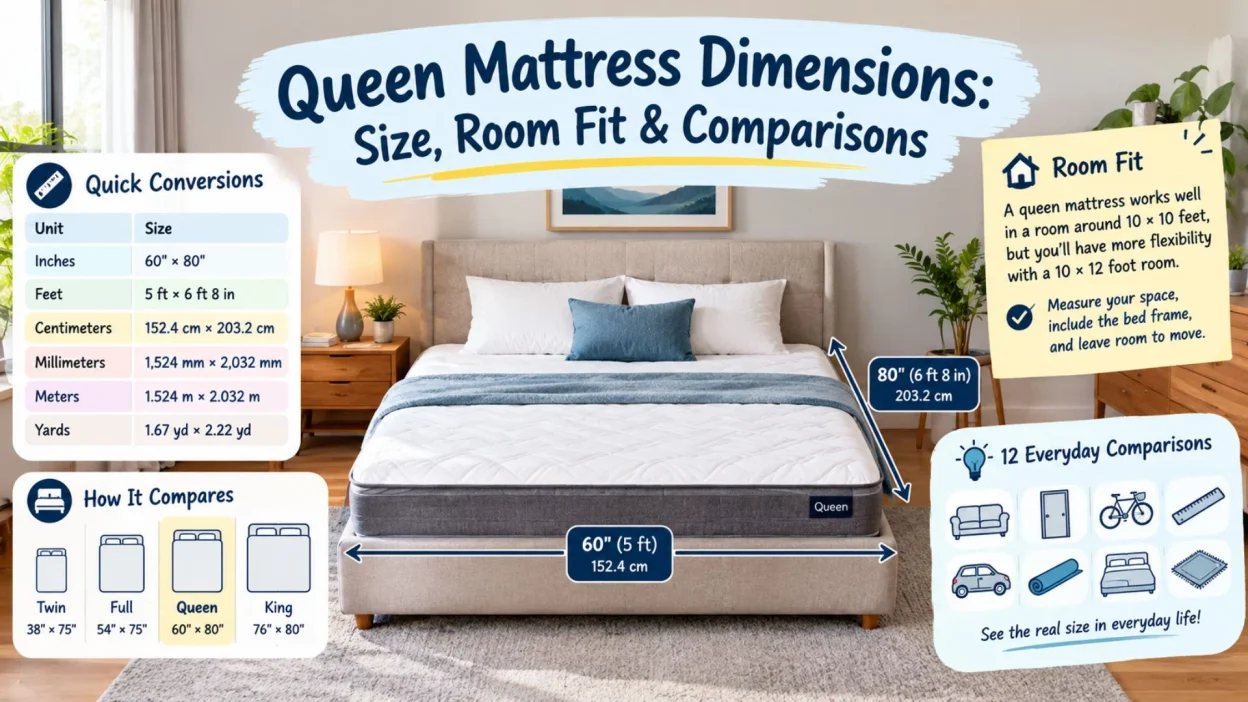
In the United States, standard queen size mattress dimensions are 60 inches wide by 80 inches long. That works out to 5 feet wide by 6 feet 8 inches long, or 152.4 cm × 203.2 cm. It offers more sleeping space than a full mattress without taking up as much room as a king.
These measurements are useful when shopping for a mattress, choosing a bed frame, planning a bedroom layout, or checking whether a new bed will fit through a doorway. Keep in mind that the mattress itself and the complete bed frame have different dimensions.
This guide breaks down queen mattress measurements in several units, compares the size with 12 familiar objects and furniture items, and explains how to estimate the space you need before buying a bed.
Queen Mattress Dimensions in Every Useful Unit

A standard US queen mattress is 60 inches across and 80 inches from head to foot. The width gives two adults room to sleep side by side, while the extra length accommodates most sleepers comfortably.
| Measurement | Width | Length |
|---|---|---|
| Inches | 60 in | 80 in |
| Feet | 5 ft | 6 ft 8 in |
| Centimeters | 152.4 cm | 203.2 cm |
| Millimeters | 1,524 mm | 2,032 mm |
| Meters | 1.524 m | 2.032 m |
| Yards | 1.67 yd | 2.22 yd |
The mattress has a rectangular footprint of approximately 33.3 square feet, or 3.10 square meters. This is the area covered by the mattress alone, not the space required to walk around the bed.
How the conversions work
The calculations are straightforward:
- Inches to feet: Divide the inches by 12. For example, 60 inches ÷ 12 = 5 feet.
- Inches to centimeters: Multiply by 2.54. So, 80 × 2.54 = 203.2 cm.
- Inches to millimeters: Multiply by 25.4. That makes 60 inches equal to 1,524 mm.
- Inches to meters: Multiply by 0.0254. Therefore, 80 inches equals 2.032 meters.
If you’re searching for queen mattress dimensions in feet, the easiest version to remember is 5 feet wide and 6 feet 8 inches long. In centimeters, it’s 152.4 cm wide and 203.2 cm long.
These are nominal standard dimensions. Actual products can vary slightly, so check the manufacturer’s specifications before ordering a fitted sheet, mattress protector, or frame.
Where a Queen Mattress Fits on the Bed Size Chart

A queen mattress sits between a full mattress and a king mattress in the standard US sizing system. It’s a popular choice for couples, guest rooms, and bedrooms where a king would leave too little space for other furniture.
Here is how the main sizes compare:
| Mattress size | Width | Length | Approx. surface area |
|---|---|---|---|
| Twin | 38 in | 75 in | 19.8 sq ft |
| Twin XL | 38 in | 80 in | 21.1 sq ft |
| Full (Double) | 54 in | 75 in | 28.1 sq ft |
| Queen | 60 in | 80 in | 33.3 sq ft |
| King | 76 in | 80 in | 42.2 sq ft |
| California King | 72 in | 84 in | 42.0 sq ft |
These are standard US mattress dimensions. Product specifications can vary.
A queen gives you 6 inches more width and 5 inches more length than a standard full mattress. Compared with a king, it is 16 inches narrower but has the same standard length.
That extra width on a king can make a difference for couples who want more personal sleeping space. A queen, however, may leave more room for bedside tables, wardrobes, and walking paths in a smaller bedroom.
Is a queen mattress big enough for two people?
For many couples, yes. A 60-inch-wide mattress provides about 30 inches of width per person when the space is divided evenly. That’s a useful amount of room, although people who spread out, share the bed with children, or sleep with pets may prefer a king.
A queen is also a flexible choice for a guest room because it accommodates one adult very comfortably and gives two guests a shared sleeping surface without requiring a king-sized bedroom.
12 Things That Help You Visualize a Queen Mattress
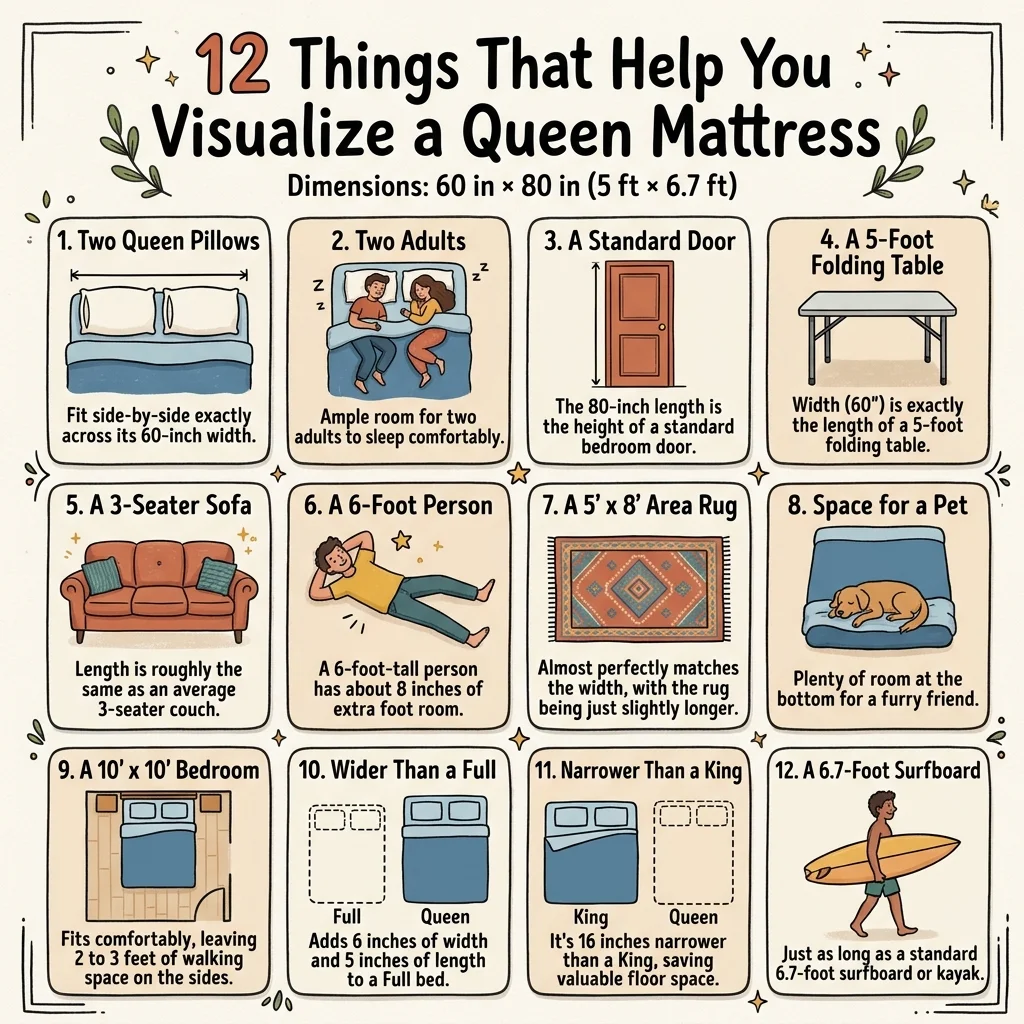
Numbers are helpful, but familiar objects make the size easier to picture. These comparisons use common dimensions as reference points; they are not all exact matches, and several depend on the particular product.
A 5-Foot-Wide Rectangle
Width comparison
Imagine a straight line stretching 5 feet from one side to the other. That’s the width of a standard queen mattress. It is wider than many compact desks and provides a substantial sleeping surface for one person.
The 60-inch width is fixed by the standard size, but the amount of room you feel you have depends on how you sleep and how much bedding you use.
Picture two 30-inch-wide zones side by side. Each represents half the mattress, giving you a simple way to imagine how much width two people share.
A 6-Foot-8-Inch Rectangle
Length comparison
The mattress measures 80 inches from head to foot, which is 6 feet 8 inches. That is longer than a 6-foot person by 8 inches, although pillows and sleeping position can affect how much usable length remains.
This length is standard for both queen and king mattresses in the US. It suits many adults, but particularly tall sleepers should check whether their feet may reach the edge when they stretch out.
To visualize it, imagine a 6-foot-tall person lying straight and add another 8 inches beyond their height. That gives you a rough mental picture of the mattress length.
Two Twin XL Mattresses Side by Side
Width and length comparison
A standard Twin XL mattress is 38 inches wide by 80 inches long. Put two of them side by side and the combined surface is 76 inches wide by 80 inches long, matching the nominal dimensions of a standard king mattress rather than a queen.
This comparison is useful because Twin XL mattresses are often used in adjustable or split-bed arrangements. The shared 80-inch length also makes the queen’s length easier to understand.
Imagine the queen as slightly shorter in width than the combined pair: two Twin XL mattresses together are 16 inches wider than a queen, while their length is the same.
A Standard Full Mattress
Bedroom furniture comparison
A full mattress is typically 54 inches wide by 75 inches long. A queen adds 6 inches of width and 5 inches of length, which may not sound dramatic until you consider the extra room across the entire sleeping surface.
That additional space can help couples feel less cramped, while a full mattress can be a practical choice for one sleeper or a compact guest room.
Imagine adding a 6-inch strip along the side and a 5-inch strip at the foot of a full mattress. The result is roughly the footprint of a queen.
A Standard King Mattress
Larger mattress comparison
A standard king mattress measures 76 inches wide by 80 inches long. It has the same length as a queen, but provides 16 additional inches of width.
That extra space can be helpful for couples who value room to spread out. The trade-off is a larger footprint that may limit where bedside tables and other bedroom furniture can go.
Picture a queen mattress with an extra 8 inches added to each side. That approximates the king’s greater width while keeping the head-to-foot length unchanged.
A Typical Interior Door

Moving and access comparison
Many interior doors are around 30 to 32 inches wide, although sizes vary by home and building standards. A queen mattress is 60 inches wide when laid flat, so it is much broader than a typical doorway.
A flexible mattress can often be maneuvered through a doorway by tilting or bending it slightly, depending on its construction. Foam, hybrid, and traditional innerspring mattresses behave differently, so never assume every model can be folded.
Visualize a doorway around 30 inches wide and a queen’s 60-inch width as roughly twice that measurement. Remember, however, that getting a mattress through a door depends on its thickness, flexibility, the hall layout, and turning space—not width alone.
A 5-Foot Sofa
Living room comparison
Some compact loveseats and small sofas have an overall width close to 5 feet, although many are wider. A sofa around 60 inches across can help you picture the queen mattress’s width.
The comparison is about the outside span, not the usable seating area. Sofa arms, cushions, and backrests reduce the space available for sitting, whereas a mattress offers a mostly flat surface.
Imagine the mattress width lining up with the full width of a compact loveseat. This makes the 5-foot measurement feel less abstract, especially if you already have similar furniture at home.
A 6-Foot-8-Inch Area Rug
Length comparison
An area rug with a length of about 6 feet 8 inches shares the same length as a standard queen mattress. Rug dimensions are often sold in feet, so this is a useful way to connect mattress measurements with home décor.
Rugs come in many standard sizes, and an exact 80-inch length is not universal. A 5-by-8-foot rug, for example, measures 60 by 96 inches and is 16 inches longer than the mattress.
Picture an 80-inch line running from the head of the bed to its foot. You can mark it out on the floor before moving furniture to estimate how much of the room the mattress will occupy.
A Standard 8-Foot Ceiling
Room scale comparison
An 8-foot ceiling is 96 inches high. A queen mattress is 80 inches long, so its length is 16 inches less than the ceiling height measurement.
This is not a direct furniture match because one measurement is horizontal and the other is vertical. Still, it gives a familiar number to compare with the mattress’s longest side.
Imagine laying an 80-inch line against a wall beneath an 8-foot ceiling height marker. The mattress length would cover five-sixths of that vertical measurement.
A Pair of 30-Inch-Wide Spaces
Sleeping space comparison
Split a queen mattress’s 60-inch width into two equal sections, and each section is 30 inches wide. This is a simple way to picture the space available to each person when two sleepers share the bed evenly.
The comparison is only a planning aid. People do not stay within perfectly straight halves while sleeping, and pillows, body size, and preferred sleeping positions all affect comfort.
Imagine a center line down the mattress and two equal rectangles on either side. It quickly shows why a queen can work for couples, but may feel narrower than a king to people who want extra elbow room.
A 3-by-5-Foot Area of Floor Space
Area comparison
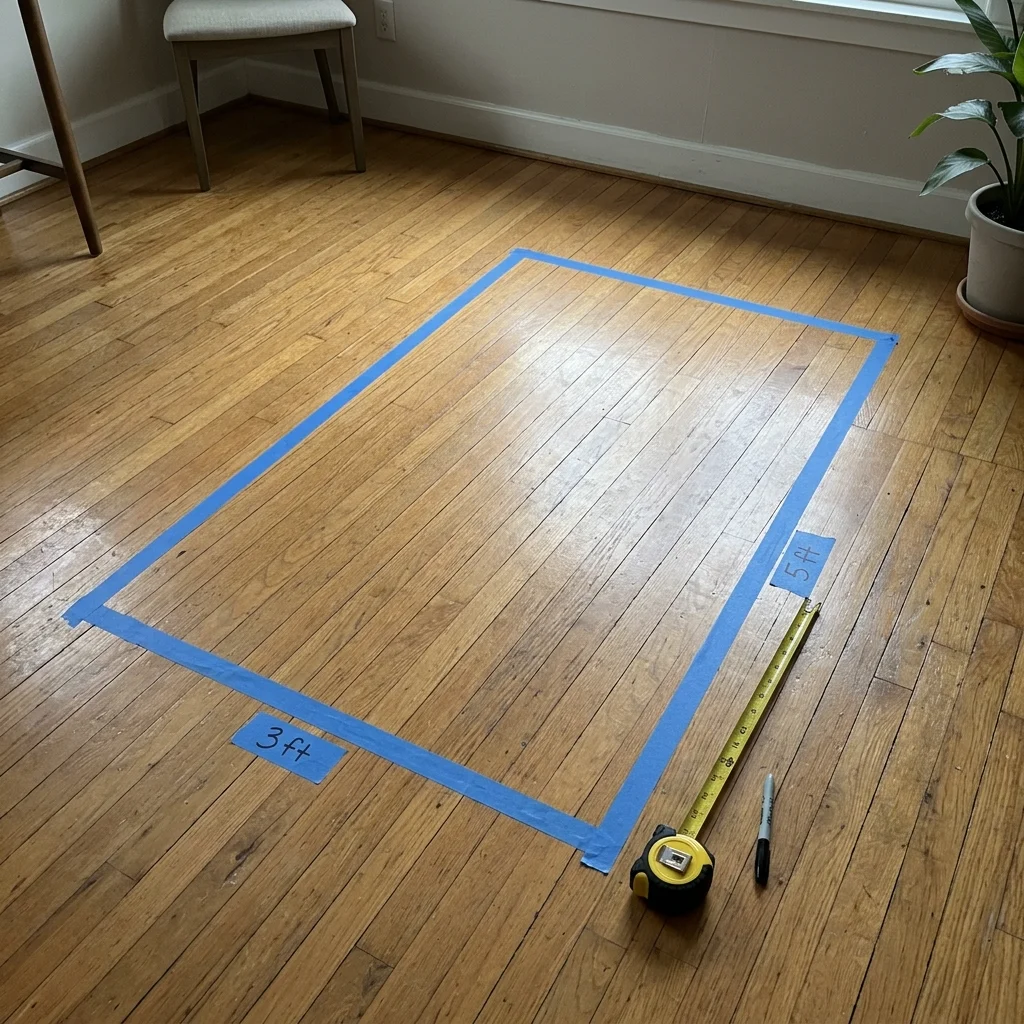
A 3-by-5-foot rectangle covers 15 square feet. Two such rectangles together cover 30 square feet, which is fairly close to a queen mattress’s approximately 33.3-square-foot footprint.
This is an area comparison rather than a shape match. Two smaller rectangles may not have the same overall length and width as the mattress, but they help make the surface area easier to imagine.
Picture two 3-by-5-foot floor mats laid out beside each other. Their combined area is a little smaller than the mattress surface, giving you a rough sense of how much floor the bed covers.
A Standard 60-by-80-Inch Mattress Protector
Bedding comparison
A queen mattress protector labeled 60 by 80 inches is designed around the standard queen mattress footprint. This is one of the most direct comparisons because the protector’s stated length and width correspond to the mattress size.
The depth matters too. A mattress protector must fit over the mattress thickness, which can vary considerably by brand and model. Check the product’s pocket depth and fit guidance rather than looking only at length and width.
If you have a queen protector already, its flat dimensions provide a practical reference for the mattress size. It is still best to check the label, since some products are designed to stretch or accommodate a range of mattress depths.
Will a Queen Mattress Fit Your Bedroom?

Knowing the mattress dimensions is only half the job. You also need enough room for the bed frame, bedside furniture, closet doors, and a comfortable path around the bed.
A queen mattress covers approximately 33.3 square feet, but the bed frame usually extends beyond the mattress edges. Measure the complete frame if you’re working with a tight layout.
What size bedroom works for a queen bed?
A queen can work in a room around 10 by 10 feet, but the result depends on the door location, windows, wardrobes, and other furniture. A room around 10 by 12 feet generally gives you more flexibility.
For a simple example, a 10-by-10-foot bedroom measures 120 by 120 inches. After placing a 60-by-80-inch mattress in the room, the remaining floor area is not automatically usable walking space; its shape and location matter.
Before purchasing, sketch the room and mark the mattress footprint. Then add the bed frame and the space you want beside and at the foot of the bed.
How much space should you leave around the bed?
There is no single clearance that suits every bedroom. As a practical planning target, try to preserve around 24–30 inches for important walking paths where the layout allows. More space can make it easier to change sheets, get in and out of bed, and open drawers.
Also check the route into the bedroom. Measure door openings, hallways, stairs, and tight turns before delivery day. A mattress may fit in the bedroom but still be difficult to maneuver through the home.
How to Visualize Queen Mattress Dimensions Without a Tape Measure

You can estimate a queen mattress’s footprint without specialist tools, although these methods are less precise than measuring the actual space.
Use floor tiles as a guide
If you know the dimensions of your floor tiles, count the tiles across an area measuring roughly 60 by 80 inches. For example, with 12-inch square tiles, the mattress width is five tile widths and its length is 6⅔ tile lengths.
Tile sizes and grout spacing vary, so treat this as a planning estimate.
Mark out the mattress with paper or string
Use string, masking tape, or folded paper to mark a rectangle on the floor. Make the shorter sides 5 feet apart and the longer sides 6 feet 8 inches apart.
This creates a clear outline of the mattress footprint and helps you see whether the bed will interfere with furniture or doorways.
Compare it with a full mattress
If you already own a full bed, the queen is 6 inches wider and 5 inches longer. Mark a small extension along one side and at the foot to estimate the difference.
Check the manufacturer’s specifications
If you are buying online, use the product’s published width and length instead of relying on photographs. Images can make mattresses look larger or smaller depending on camera angle and the surrounding furniture.
Frequently Asked Questions
What are standard queen size mattress dimensions?
A standard US queen mattress measures 60 inches wide by 80 inches long. In feet, that’s 5 feet by 6 feet 8 inches, and in centimeters, it’s 152.4 by 203.2 cm.
How many feet is a queen mattress?
A queen mattress is 5 feet wide and 6 feet 8 inches long. Its length is approximately 6.67 feet when expressed as a decimal.
How many centimeters is a queen mattress?
A standard queen mattress is 152.4 cm wide and 203.2 cm long. These conversions are based on the standard US dimensions of 60 by 80 inches.
How many meters is a queen mattress?
It measures 1.524 meters wide and 2.032 meters long. Its surface area is approximately 3.10 square meters.
Is a queen mattress big enough for two adults?
For many couples, a queen offers enough room for comfortable sleep. Each person gets about 30 inches of width if the mattress is divided evenly, but people who need extra room may prefer a king.
Is a queen mattress bigger than a full mattress?
Yes. A standard full mattress is 54 by 75 inches, while a queen is 60 by 80 inches. The queen provides 6 extra inches of width and 5 extra inches of length.
What size room do you need for a queen mattress?
A room around 10 by 10 feet may accommodate a queen bed, depending on the furniture and layout. A larger room can provide more comfortable walking paths and space for bedside tables.
Will a queen mattress fit on a queen bed frame?
Usually, yes, if the frame is designed for a standard US queen mattress. However, frames can have different outer dimensions, and some platform or adjustable bases have specific compatibility requirements. Check the manufacturer’s measurements before buying.
Is a queen mattress the same size in every country?
No. Mattress sizing conventions vary between countries and manufacturers. If you’re buying a mattress, frame, or bedding internationally, check the listed dimensions in inches or centimeters instead of relying on the word “queen” alone.
Where That Leaves You
A standard queen mattress measures 60 inches wide by 80 inches long, equivalent to 5 feet by 6 feet 8 inches, or 152.4 by 203.2 centimeters. Its surface covers about 33.3 square feet.
The easiest way to picture it is as a 5-by-6-foot-8-inch rectangle on your bedroom floor. Mark those dimensions with tape or string, then account for the bed frame and walking space before committing to the purchase.
That small planning step can help you choose a mattress that fits your room, suits your sleeping needs, and leaves enough space to move around comfortably.