A queen bed sounds familiar until you try to picture its actual footprint. You may know it is a common bedroom size, but imagining 60 inches wide by 80 inches long is harder without a ruler or tape measure.
That is why queen size bed dimensions are easier to understand when you compare them with familiar furniture, rugs, doors, and other everyday objects.
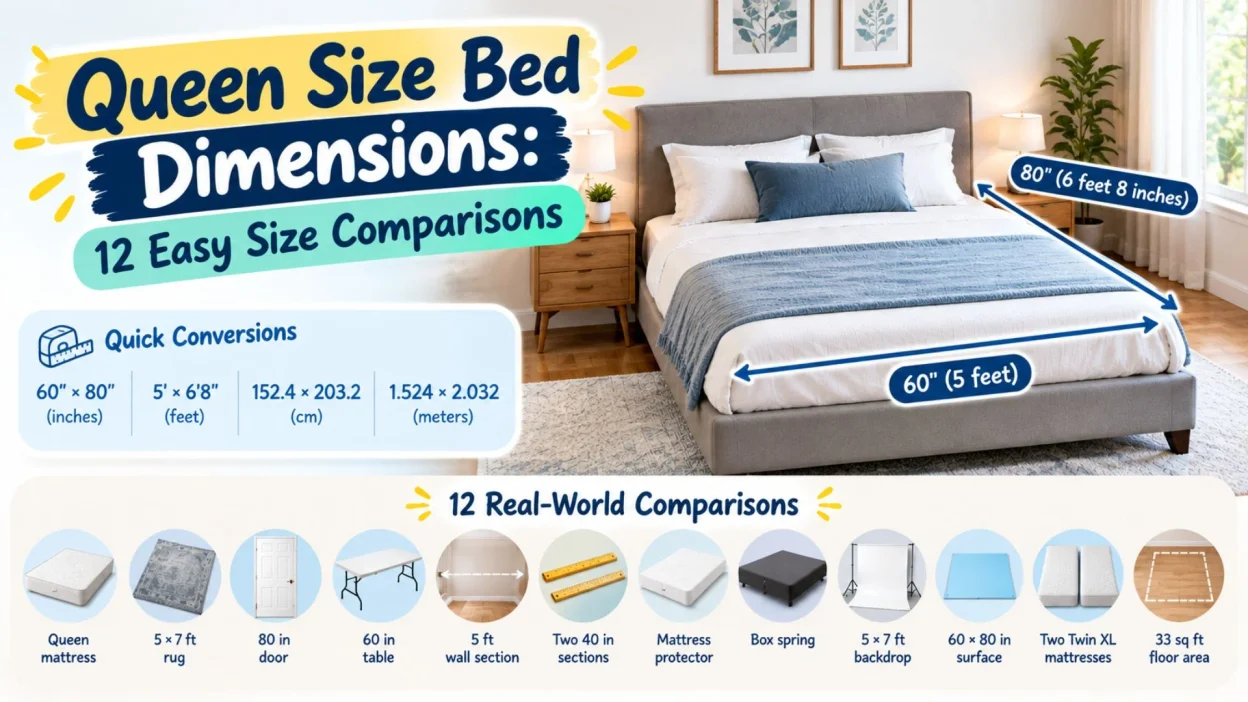
In the United States, a standard queen mattress measures 60 inches wide and 80 inches long. That works out to 5 feet wide and 6 feet 8 inches long.
A standard queen size bed is 60 inches × 80 inches, or 5 feet × 6 feet 8 inches, which equals 152.4 × 203.2 centimeters, 1.524 × 2.032 meters, and 1,524 × 2,032 millimeters.
This guide breaks those queen bed dimensions into simple conversions and real-world comparisons. By the end, you should be able to visualize the size even without a measuring tape.
Queen Size Bed Dimensions in Every Useful Unit
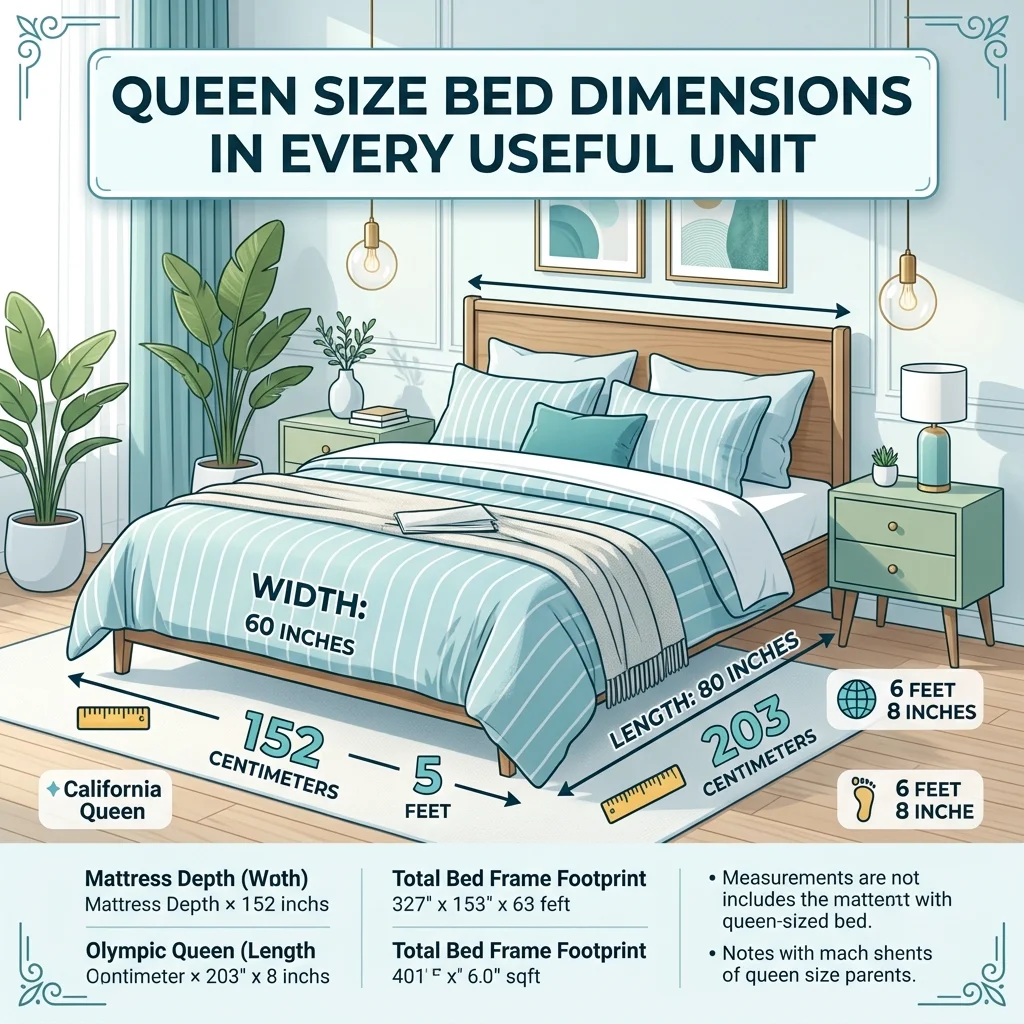
The easiest way to understand a queen mattress is to separate its width from its length.
| Unit | Queen Bed Width | Queen Bed Length |
|---|---|---|
| Inches | 60 inches | 80 inches |
| Feet | 5 feet | 6 feet 8 inches |
| Centimeters | 152.4 cm | 203.2 cm |
| Millimeters | 1,524 mm | 2,032 mm |
| Meters | 1.524 m | 2.032 m |
| Yards | 1.67 yd | 2.22 yd |
The total sleeping surface is about 33.3 square feet.
The conversion is straightforward. For inches to feet, divide by 12. So, 60 inches becomes 5 feet, while 80 inches becomes 6 feet 8 inches.
For centimeters, multiply inches by 2.54. Therefore, 60 inches equals 152.4 cm, and 80 inches equals 203.2 cm.
For meters, divide the centimeter measurement by 100. That gives you 1.524 meters wide by 2.032 meters long.
So, when someone searches for queen size bed dimensions in feet, the simple answer is 5 feet wide × 6 feet 8 inches long. In centimeters, queen bed dimensions are 152.4 × 203.2 cm.
Where a Queen Bed Fits on a Mattress Size Chart

A queen mattress sits between a full and a king in the common U.S. mattress lineup.
| Mattress Size | Approx. Width | Approx. Length |
|---|---|---|
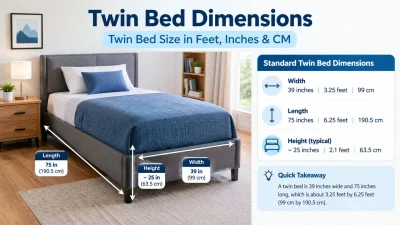
| Twin | 38 in | 75 in |
| Twin XL | 38 in | 80 in |
| Full | 54 in | 75 in |
| Queen | 60 in | 80 in |
| King | 76 in | 80 in |
| California King | 72 in | 84 in |
The queen and king mattresses have the same standard length of 80 inches. The major difference is width.
A queen is 6 inches wider than a full while keeping the same 75-inch-versus-80-inch length difference. Compared with a king, a queen is 16 inches narrower but has the same 80-inch length.
That makes a queen a useful middle ground for bedrooms where a king would take up too much floor space.
Keep in mind that mattress dimensions can vary by country. The measurements above refer to the common U.S. queen mattress size.
12 Things That Help You Visualize Queen Bed Dimensions
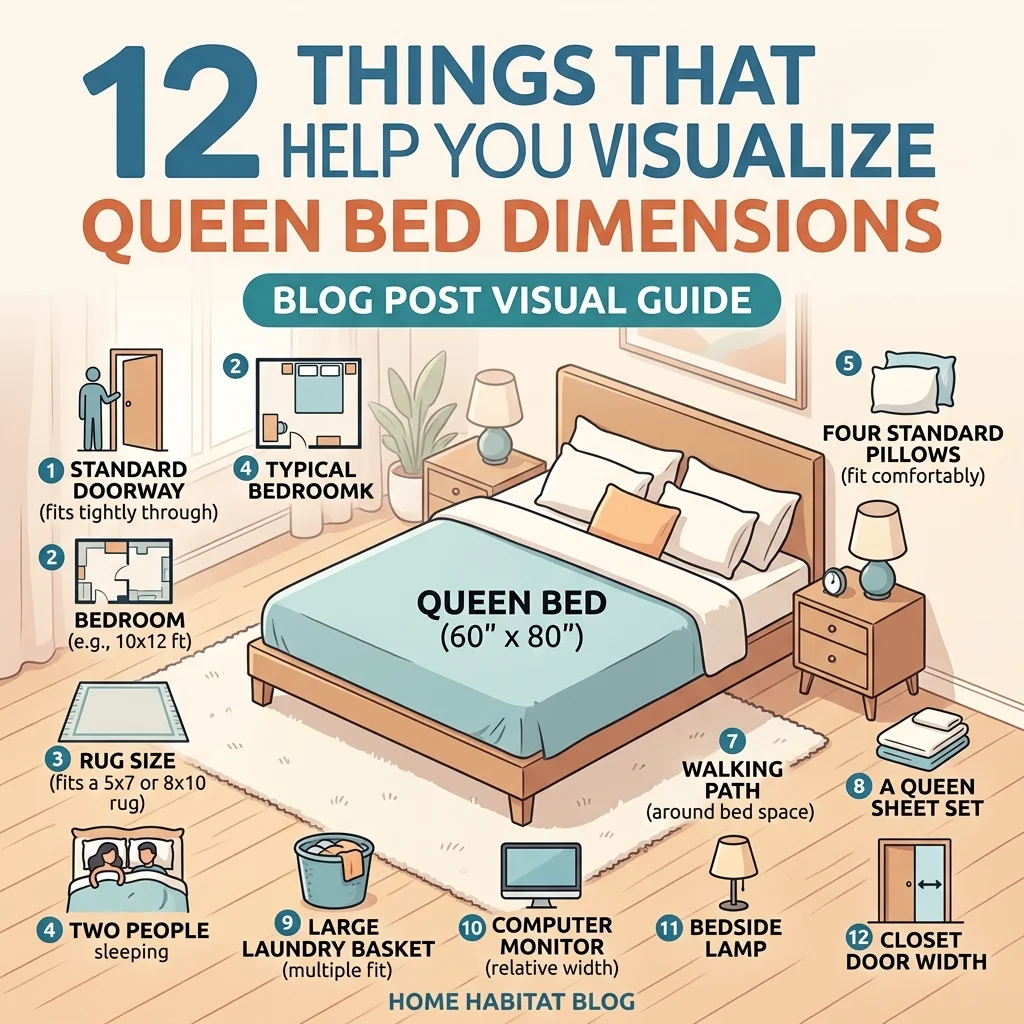
1. A Standard Queen Mattress
The most obvious comparison is also the most useful: a standard queen mattress itself measures 60 × 80 inches.
That means the mattress is exactly 5 feet across and 6 feet 8 inches from head to foot. Its sleeping surface covers roughly 33.3 square feet.
The rectangular shape is easier to picture if you imagine standing at the foot of the bed. You would be looking across a 5-foot-wide surface.
In a bedroom, that footprint becomes more noticeable once you add the bed frame and walking space around it.
2. A 5 × 7 Foot Area Rug
A common 5 × 7 foot area rug is very close to the footprint of a queen mattress.
The rug is 60 inches wide, exactly matching the queen’s standard width. However, its 84-inch length is 4 inches longer than the mattress.
That makes a 5 × 7 rug a particularly useful visual reference. Place one on the floor and imagine shortening it slightly at one end.
The result gives you a good sense of how much floor space the queen mattress occupies.
3. An 80-Inch Interior Door

Many standard interior doors are around 80 inches tall, although actual door sizes vary.
That is the same as the length of a standard queen mattress. In other words, the mattress is 6 feet 8 inches from head to foot.
This comparison is especially useful because doors are familiar reference points. Stand beside an 80-inch door and imagine laying that same height horizontally.
The mattress would stretch about that far from one end to the other.
4. A 60-Inch Folding Table
A 60-inch folding table is exactly 5 feet long.
That matches the width of a standard queen mattress, although the table is much narrower from front to back.
This gives you an easy way to visualize the shorter dimension. A five-foot table provides a familiar reference for the queen’s side-to-side measurement.
Imagine turning that five-foot span across the head or foot of the mattress.
5. A 5-Foot-Wide Wall Section
A five-foot section of wall is the same width as a standard queen mattress.
This is useful when planning bedroom layouts because walls provide a fixed reference point. Measure or estimate five feet along a wall and mark the endpoints.
That distance represents the mattress width before considering the frame.
Seeing the width against a wall also makes it easier to judge how much room remains for nightstands or other furniture.
6. Two 40-Inch Lines End to End

Two 40-inch lengths placed together make exactly 80 inches.
That matches the length of a standard queen mattress.
You might visualize this using two familiar 40-inch measuring segments, although the actual objects do not need to be identical. The key is the combined length.
Picture one 40-inch section followed by another 40-inch section. Together, they stretch 6 feet 8 inches.
7. A 60 × 80-Inch Mattress Protector
A queen mattress protector is generally designed around the standard 60 × 80-inch mattress footprint.
Unlike a decorative object, this comparison is useful because mattress accessories are made specifically around mattress dimensions.
The protector also helps explain why the numbers matter. A fitted product needs to accommodate the mattress width and length rather than simply covering an approximate area.
When shopping, the label “Queen” usually indicates compatibility with the standard queen mattress dimensions, but thickness specifications still matter for fitted products.
8. A Queen Box Spring
A traditional queen box spring or foundation is designed to support a queen mattress and is generally built around the same 60 × 80-inch footprint.
This makes it another direct physical reference for queen dimensions.
The foundation may look different from the mattress because it has its own construction and height. However, its length and width are designed to work with the corresponding mattress size.
Think of it as the solid rectangular base beneath the sleeping surface.
9. A 5 × 7 Foot Photography Backdrop

A 5 × 7 foot backdrop is another close comparison.
Its 5-foot width matches the width of a queen mattress, while its 7-foot length is 4 inches longer than the mattress.
Photographers commonly use rectangular backdrops for portraits and product photography. Seeing one laid flat gives you a useful sense of the queen’s overall footprint.
Imagine trimming four inches from the long edge, and you are very close to the standard queen mattress outline.
10. A 60 × 80-Inch Flat Surface
A flat surface measuring 60 × 80 inches has exactly the same footprint as a standard queen mattress.
This could be a large temporary floor mat, display surface, or other rectangular panel made to those dimensions.
The important part is not its height or purpose. It is the rectangle created by the two measurements.
If you can mark a 60-inch by 80-inch rectangle on the floor, you have created a full-size visual template for a queen mattress.
11. Two Twin XL Mattresses Compared With a Queen
A Twin XL mattress is typically 38 × 80 inches.
Two Twin XL mattresses placed side by side would therefore create a surface about 76 × 80 inches. The length matches a queen, but the combined width is 16 inches greater.
This comparison is useful because it shows where a queen sits relative to a wider sleeping arrangement.
Picture two long Twin XL mattresses next to each other. Then remove 8 inches from each side of the combined width, and you are at the queen’s 60-inch width.
12. A 33-Square-Foot Floor Area
A queen mattress covers about 33.3 square feet.
That is not a single object, but it is one of the clearest ways to understand the overall footprint. Imagine a floor area slightly larger than a 5 × 6.5-foot rectangle.
This perspective becomes especially useful when planning a bedroom. The mattress itself takes up about 33 square feet before you add a frame, nightstands, benches, dressers, or walking areas.
So the real space needed for a queen bed is always larger than its mattress dimensions suggest.
The Bedroom Space Question People Actually Mean

When people search for queen size bed dimensions, they often have a second question in mind: Will a queen bed fit comfortably in my bedroom?
The mattress itself needs a 60 × 80-inch rectangle. However, that does not mean a bedroom only needs to be 60 × 80 inches.
You need additional clearance for walking around the bed, opening drawers, using doors, and placing other furniture. The required room size therefore depends on the layout and the amount of space you want around the mattress.
For example, putting the head of the bed against a wall leaves the 80-inch length extending into the room. A pair of nightstands will also increase the practical width needed.
Queen Bed vs. Full Bed
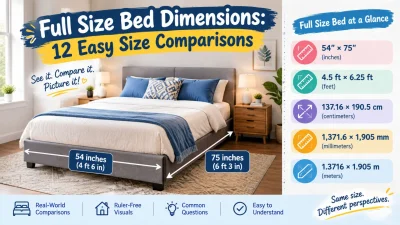
A full mattress is typically 54 × 75 inches, while a queen is 60 × 80 inches.
That means a queen adds 6 inches of width and 5 inches of length compared with a full.
The difference sounds modest on paper. In a small bedroom, however, those extra inches can noticeably change how furniture fits.
Queen Bed vs. King Bed
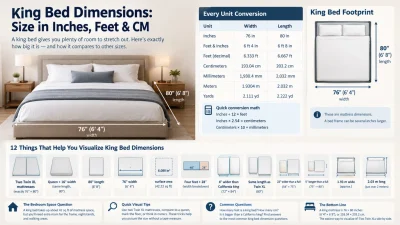
A standard king is typically 76 × 80 inches.
The queen and king share the same 80-inch length. The king simply adds 16 inches of width.
That makes the width difference easy to visualize: imagine adding 8 inches to each side of a queen mattress.
How to Visualize a Queen Bed Without a Tape Measure

You do not always need a measuring tape to get a useful mental picture.
Use a 5-Foot Reference
The queen is exactly 5 feet wide. A five-foot section of wall, table, or floor gives you a useful width reference.
Remember that this is the mattress width, not the total width of the finished bed.
Use an 80-Inch Door
An 80-inch door is a convenient reference for the mattress length.
Imagine laying that vertical door measurement horizontally. That gives you approximately the 6-foot-8-inch length of a queen mattress.
Mark the Floor With a 5 × 7 Rectangle
If you have enough floor space, a 5 × 7-foot rug is an excellent visual guide.
A queen mattress is 5 × 6 feet 8 inches. So a 5 × 7-foot rug gives you almost the same footprint, with only 4 extra inches of length.
Compare It With a Full Mattress
If you already have access to a full-size mattress, a queen is slightly larger in both directions.
Add roughly 6 inches to the width and 5 inches to the length. That small increase represents the difference between the two common mattress sizes.
Remember the Footprint
The easiest mental shortcut is:
Queen = 5 feet wide × 6 feet 8 inches long.
That is usually more useful for bedroom planning than memorizing the measurement in millimeters.
FAQs About Queen Size Bed Dimensions
How many feet is a queen size bed?
A standard queen mattress is 5 feet wide and 6 feet 8 inches long. In decimal feet, that is approximately 5 × 6.67 feet.
How many cm are queen size bed dimensions?
A standard queen mattress measures 152.4 cm wide by 203.2 cm long.
How many meters is a queen size bed?
A queen mattress is 1.524 meters wide and 2.032 meters long. Its approximate footprint is 3.10 square meters.
How many inches is a queen size mattress?
The standard U.S. queen mattress measures 60 inches wide by 80 inches long.
How wide is a queen size bed?
The mattress itself is 60 inches, or 5 feet, wide. A bed frame can be slightly wider depending on its design.
How long is a queen size bed?
A standard queen mattress is 80 inches long, which equals 6 feet 8 inches.
Is a queen bed bigger than a full bed?
Yes. A typical full mattress measures 54 × 75 inches, while a queen measures 60 × 80 inches. The queen is therefore 6 inches wider and 5 inches longer.
Is a queen bed the same length as a king?
Yes, under standard U.S. dimensions, both a queen and a king mattress are 80 inches long. The king is wider at about 76 inches compared with the queen’s 60 inches.
What everyday object is about the size of a queen bed?
A 5 × 7-foot area rug is one of the easiest visual comparisons. It has the same 60-inch width and is only 4 inches longer than a standard queen mattress.
Can I visualize queen bed dimensions without a tape measure?
Yes. Think of the queen as a 5-foot-wide by 6-foot-8-inch-long rectangle. A 5 × 7-foot rug provides a particularly close floor-space comparison.
Where That Leaves You
The simplest way to remember queen size bed dimensions is 60 × 80 inches. That is 5 feet wide by 6 feet 8 inches long, or about 152.4 × 203.2 cm.
For a quick visual, think of a 5 × 7-foot rug. It has the same 5-foot width and is only 4 inches longer than the queen mattress.
Once you picture that rectangle on the floor, queen bed dimensions become much easier to understand. Just remember that the mattress is only the starting footprint; the frame and walking space require additional room.