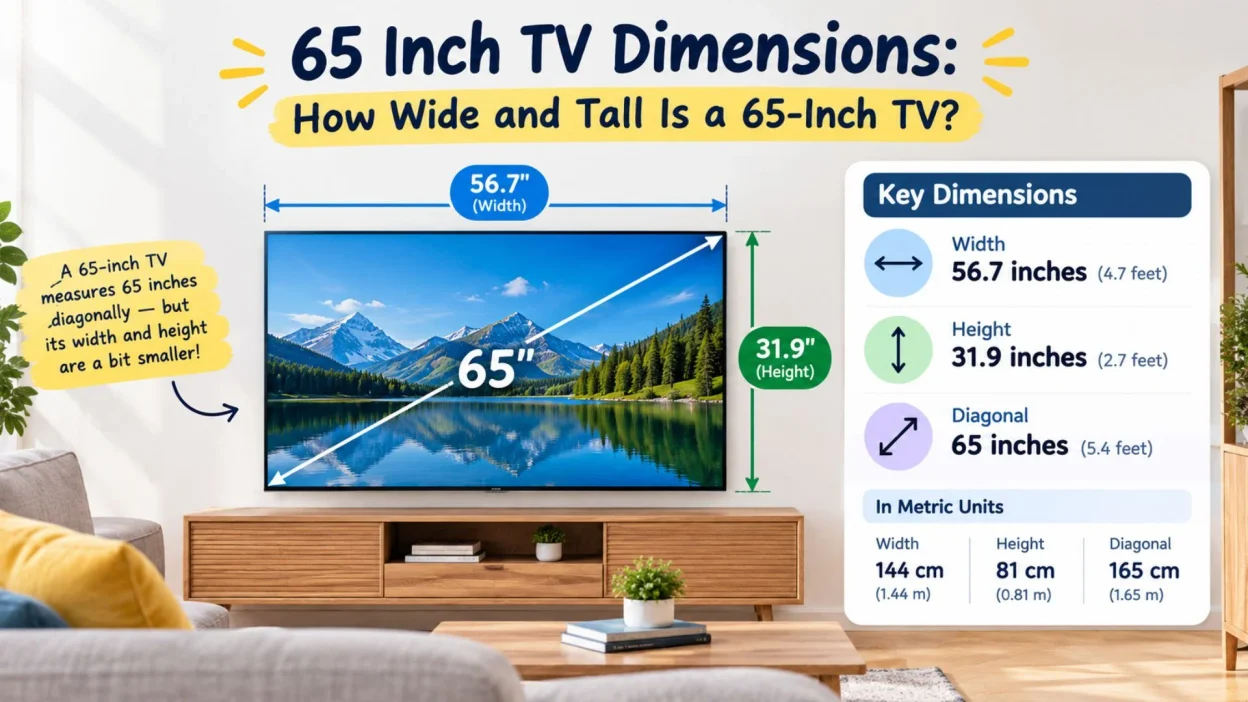
A 65-inch TV sounds enormous when you hear the number, but the number itself does not tell you how much wall or furniture space the television actually needs. That is because 65 inches refers to the screen’s diagonal, measured from one corner to the opposite corner—not its width.
For a standard 16:9 widescreen display, a 65-inch screen is about 56.7 inches wide and 31.9 inches tall before accounting for the bezel or other parts of the television. That works out to roughly 4 feet 8.7 inches wide and 2 feet 7.9 inches tall.
In metric measurements, the 65-inch diagonal equals 165.1 cm, while the calculated screen area is approximately 143.9 cm wide by 80.9 cm tall. Actual TV bodies can be slightly larger or smaller depending on the model, bezel, frame, and stand.
A 65-inch 16:9 TV screen is approximately 56.7 inches wide, 31.9 inches tall, 143.9 cm wide, 80.9 cm tall, and 165.1 cm diagonally. This guide explains those dimensions, shows where they fit on a practical size scale, and compares the TV with familiar furniture and household objects.
Every Unit a 65 Inch TV Screen Converts To
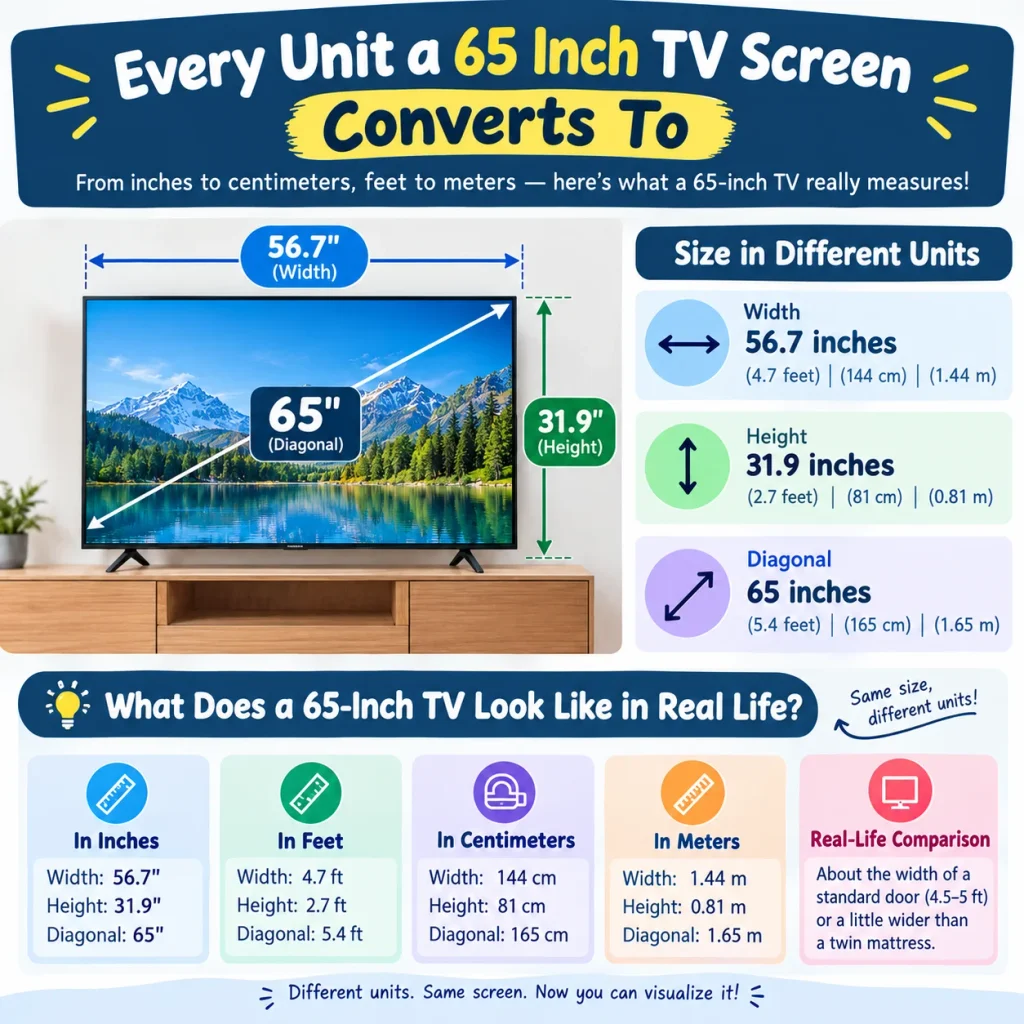
The easiest way to understand a 65-inch television is to separate its diagonal screen measurement from its actual width and height. Assuming the common 16:9 aspect ratio, the numbers work out as follows.
| Measurement | Approximate value |
|---|---|
| Diagonal | 65 inches |
| Diagonal in feet | 5.42 feet |
| Diagonal in centimeters | 165.1 cm |
| Diagonal in millimeters | 1,651 mm |
| Diagonal in meters | 1.651 m |
| Screen width | 56.65 inches |
| Screen height | 31.87 inches |
| Screen width in feet | 4.72 ft |
| Screen height in feet | 2.66 ft |
| Screen width in cm | 143.90 cm |
| Screen height in cm | 80.94 cm |
| Screen width in meters | 1.439 m |
| Screen height in meters | 0.809 m |
The diagonal conversion is straightforward. One inch equals 2.54 centimeters, so:
65 × 2.54 = 165.1 cm
That means a 65-inch TV has a diagonal of 165.1 cm, or 1.651 meters.
The width and height require the 16:9 aspect ratio. Using the diagonal and the Pythagorean relationship between width, height, and diagonal gives a screen width of about 56.65 inches and a height of about 31.87 inches.
Remember that these are calculated screen dimensions. A television’s outside dimensions can differ because manufacturers add bezels, frames, speakers, ports, and stands.
Where 65 Inch TV Dimensions Fit on a Common Size Scale
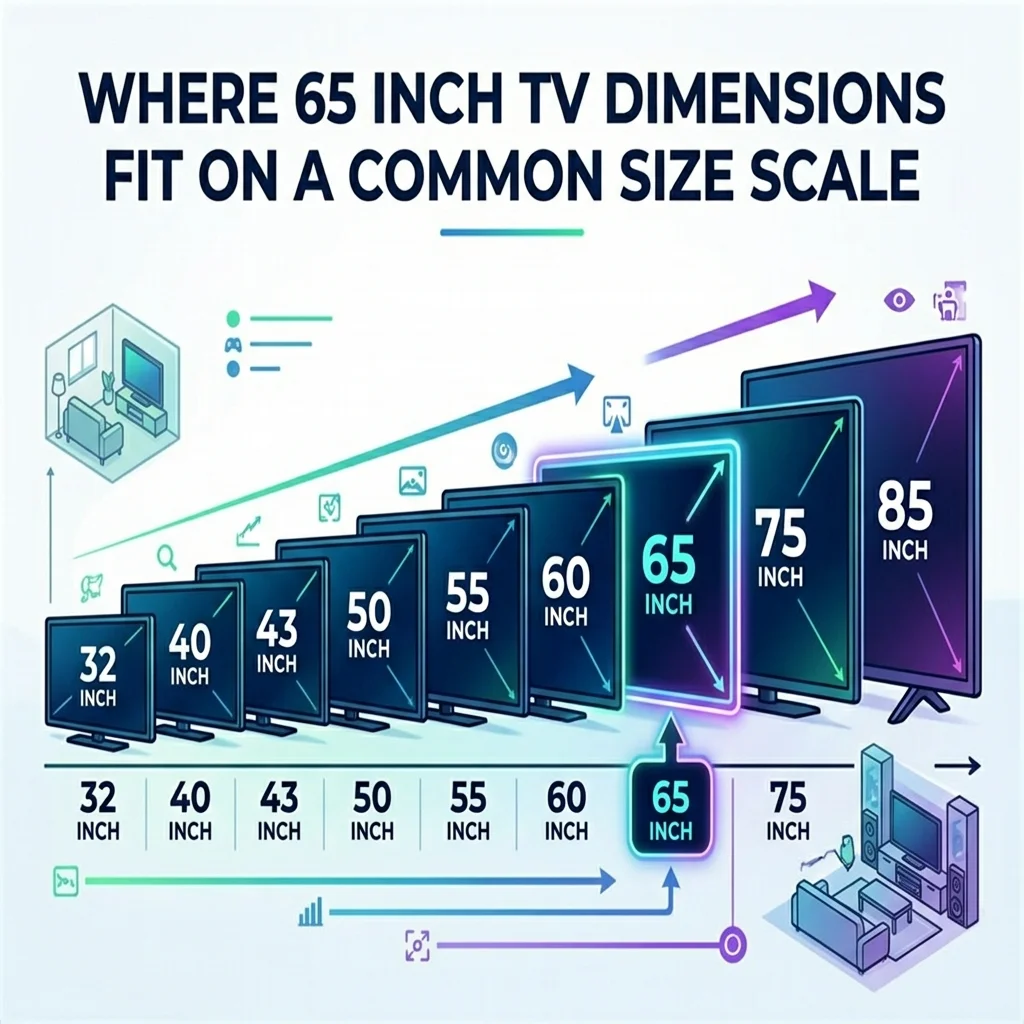
A 65-inch TV sits in a useful middle ground for large-screen home entertainment. It is considerably wider than a typical 55-inch television, yet it does not require the wall space of a 75- or 85-inch model.
The screen itself is almost 57 inches wide. That is just under 5 feet, which is an easier number to visualize than the 65-inch diagonal.
The screen height is just under 32 inches. So if you picture a rectangle roughly 4 feet 9 inches across and 2 feet 8 inches high, you are close to the visible 16:9 screen.
Actual models show why shoppers should not rely on the diagonal alone. For example, Samsung lists one 65-inch QLED model at about 57.1 inches wide without its stand, while Sony lists several 65-inch models around 56.9–57 inches wide.
Height varies more noticeably once a stand is included. A current Sony 65-inch BRAVIA 6, for example, is listed at 56.88 inches wide and 34 inches high with its stand, while the same TV’s overall depth with the stand is 12 inches.
That distinction matters when you are checking whether a TV will fit on a media console. The screen may be about 32 inches tall, but the complete television can approach 34–36 inches in height depending on the stand design.
12 Things That Help You Visualize 65 Inch TV Dimensions

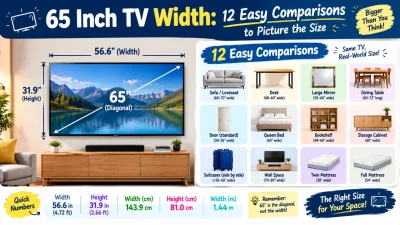
The most useful way to picture a 65-inch television is not to imagine a mysterious 65-inch object. Instead, compare its approximately 57-inch width and 32-inch screen height with things you already know.
1. A Queen Mattress Is Close to the TV’s Width
A standard queen mattress is 60 inches wide. A 65-inch 16:9 TV screen is about 56.7 inches wide, so the mattress is only a few inches wider.
That makes a queen mattress an excellent visual reference when planning wall space. Imagine placing the television across the width of the mattress: the screen would be slightly narrower.
The comparison is especially useful because mattress dimensions are familiar to many households.
Keep in mind that mattress sizes can vary slightly by manufacturer, while the TV’s calculated screen width assumes a 16:9 display.
2. A Five-Foot Folding Table Is Slightly Wider
Many folding tables are available in 5-foot, or 60-inch, lengths. That is only about 3.3 inches longer than the calculated width of a 65-inch TV screen.
If you have a five-foot table at home, its long edge gives you a useful approximation. A 65-inch television would occupy nearly all of that span.
This is one reason a TV console around 60 inches wide can feel visually balanced with a 65-inch television, although the exact furniture choice depends on the TV’s feet and stand.
3. A 60-Inch Bathtub Is Similar in Length

A common alcove bathtub is often around 60 inches long. That makes the tub roughly 3 inches longer than the screen width of a 65-inch TV.
The comparison is useful because a bathtub’s 5-foot length is easy to imagine even if you do not own one.
It does not mean every bathtub is exactly 60 inches; sizes vary. Think of it as a practical five-foot reference for understanding how wide the TV screen is.
4. A Full-Size Mattress Is a Little Narrower
A standard full mattress is approximately 54 inches wide, which is about 2.7 inches narrower than a 65-inch TV’s calculated screen width.
Place the two measurements side by side mentally and the television would extend slightly beyond each side of the mattress.
This is a useful comparison when you are trying to picture the TV without a ruler. A 65-inch TV is not five feet wide, but it gets quite close.
5. A 5-Foot Bench Gives a Good Width Reference
A five-foot bench is another convenient comparison because 60 inches is close to the TV’s approximately 56.7-inch screen width.
The difference is only about 3.3 inches, so the television would be slightly narrower than the bench.
For furniture planning, this comparison helps you visualize why a 65-inch TV usually looks substantial on a wall without necessarily dominating an entire room.
6. A 60-Inch Media Console Is Just a Little Wider
A media console measuring around 60 inches across is close to the width of a 65-inch TV. The console would extend a little beyond the screen on both sides if centered.
That extra furniture width can be useful because it creates room for speakers, game consoles, decorations, or other equipment.
However, always check the actual TV stand footprint rather than assuming every 65-inch television uses the same support arrangement.
7. A 5-by-7-Foot Rug Is Much Larger in Area
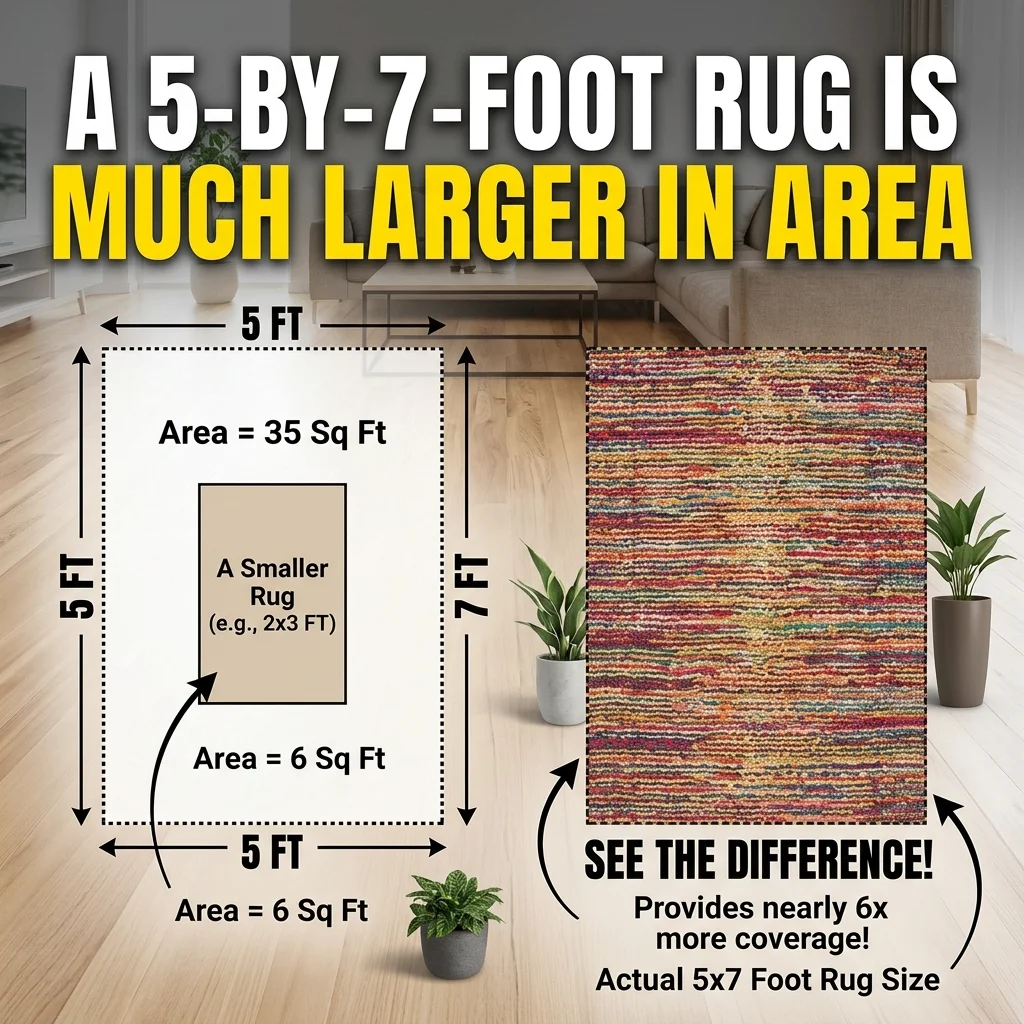
A 5-by-7-foot rug measures 60 by 84 inches. Its shorter side is therefore close to the 65-inch TV’s roughly 57-inch width.
The comparison helps put the television into a room-scale perspective. The TV’s width is almost the same as the short side of a common 5-by-7-foot area rug.
The rug is obviously much larger overall because it extends 84 inches in the other direction.
8. A Standard Interior Door Is Taller Than the TV
A common interior door is often around 80 inches tall, while the visible screen height of a 65-inch TV is only about 31.9 inches.
That means the TV’s screen height is roughly two-fifths of an 80-inch door.
This is a useful reminder that a 65-inch television is wide rather than exceptionally tall. Its large diagonal comes primarily from the broad 16:9 shape.
9. A 32-Inch Monitor Is Close to the TV’s Screen Height
A 32-inch monitor is a useful numerical reference for the television’s approximately 31.9-inch screen height.
The dimensions are not identical because a monitor’s 32-inch rating normally describes its diagonal, while the TV’s approximately 31.9-inch figure here is its vertical height.
Still, placing a 32-inch object vertically beside the TV gives a surprisingly good visual sense of the TV’s height.
10. A 4-by-8-Foot Sheet of Plywood Is Much Longer
A standard sheet of plywood is commonly 48 by 96 inches. Its 48-inch width is noticeably narrower than a 65-inch TV’s approximately 56.7-inch screen width.
Its 96-inch length, meanwhile, is far greater than the television’s width.
This comparison is useful because construction materials give you a strong sense of scale: the TV is wider than a four-foot sheet but nowhere near eight feet across.
11. A 5-Foot Curtain Rod Is Nearly the Same Width

Curtain rods are commonly sold in adjustable ranges that include lengths around 60 inches. A 60-inch rod is therefore close to the 56.7-inch width of a 65-inch TV screen.
If you can picture a five-foot curtain rod stretched horizontally across a wall, imagine the TV occupying slightly less space.
The comparison is particularly useful when planning wall-mounted TVs because both measurements are horizontal spans.
12. A 60-Inch Dining Table Is Slightly Wider
Some dining tables are designed around 60-inch lengths, placing them only a few inches beyond the width of a 65-inch TV screen.
This makes a five-foot dining table another practical reference for the TV’s horizontal footprint.
Unlike the screen, however, a dining table’s shape and usable surface depend on its depth and design. Use the 60-inch length only as a width comparison.
The 65-Inch TV Size Question People Actually Mean

When someone asks, “How big is a 65-inch TV?” they usually want to know something more practical than the diagonal.
They are really asking questions such as: How wide is it? Will it fit on my wall? Will it fit on my TV stand? How high will it be? How much room should I leave around it?
For a standard 16:9 screen, the answer is approximately 56.7 inches wide by 31.9 inches tall. The diagonal is 65 inches, but that diagonal does not represent the horizontal width.
This is why a 65-inch TV should not be placed into a 65-inch-wide space. The screen alone is already close to 57 inches wide, and the television’s outside frame may add a little more.
Real-world models confirm that the finished body is generally around the same width. Samsung’s published specifications for several 65-inch sets show widths of roughly 57 inches without the stand, while Sony’s 65-inch models similarly fall around 56.9–57 inches wide.
Height is where the product design becomes more important. A TV without a stand can be around 33 inches tall, while a stand can push the overall height into the mid-30-inch range. Sony’s current BRAVIA 6, for example, measures 34 inches high with its standard stand.
Depth also changes considerably between models and mounting methods. A wall-mounted television can sit relatively close to the wall, while a table stand may project roughly 10–14 inches depending on the design. Sony lists one 65-inch BRAVIA model at 13.75 inches deep with its stand, while Samsung models can be around 8.8–11.2 inches deep with their stands.
So, if you are shopping for a 65-inch TV, use about 57 inches of width and 32–36 inches of height as an initial planning range, then check the exact manufacturer’s specifications for the model you intend to buy.
Getting to 65 Inch TV Dimensions Without a Tape Measure
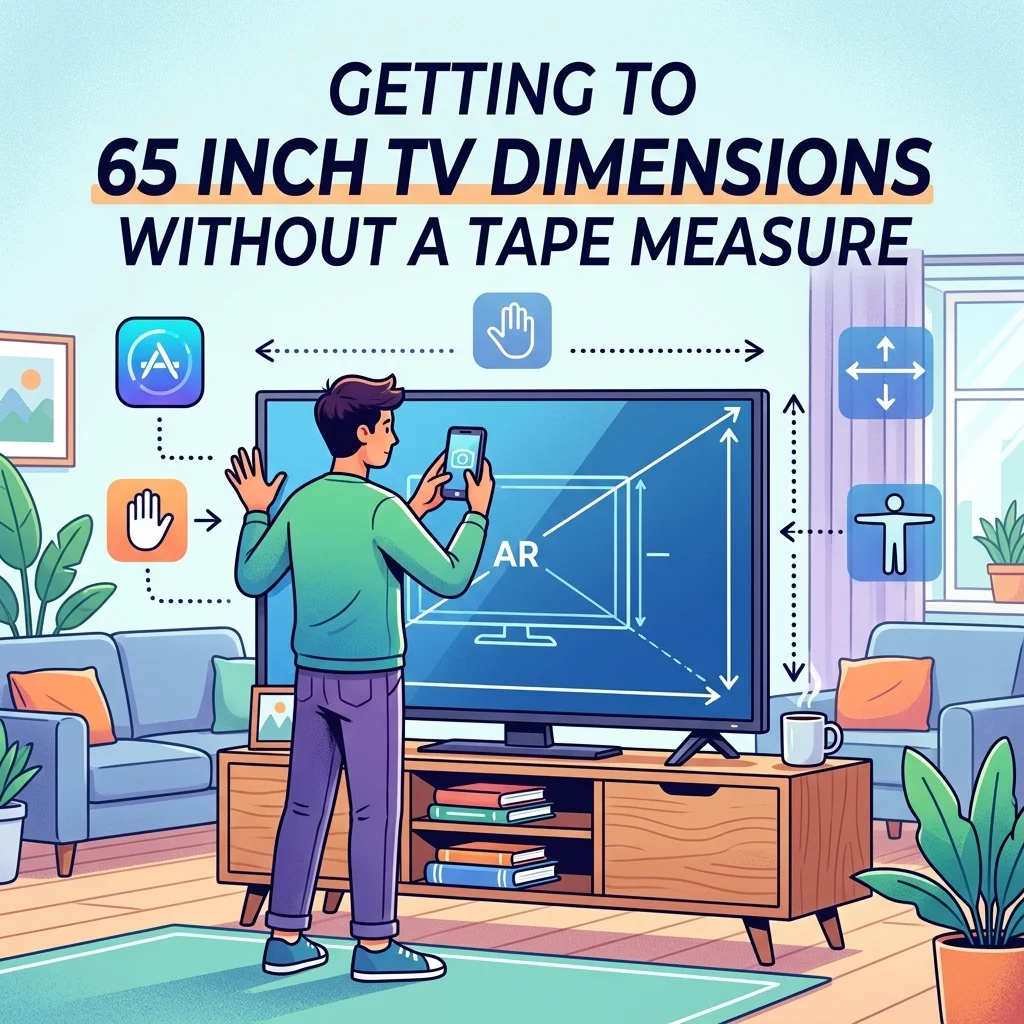
You can estimate the size of a 65-inch television surprisingly well with a few familiar references.
Use a five-foot reference. Five feet equals 60 inches. Since the screen is about 56.7 inches wide, picture a horizontal span slightly shorter than five feet.
Use a queen mattress. A queen mattress is about 60 inches wide, making it only a few inches wider than the calculated TV screen. Imagine the TV spanning almost the entire mattress width.
Use your wall space. If you have a section of wall that is roughly five feet across, a 65-inch TV screen will use most of it horizontally. Leave additional room based on the actual TV frame and your preferred visual spacing.
Use two feet eight inches for height. The screen itself is approximately 31.9 inches tall, or just under 2 feet 8 inches. This gives you a useful mental reference when planning vertical placement.
Use the actual product dimensions before installing. Approximation is fine for getting a general sense of scale, but it should not replace the manufacturer’s specifications when choosing a stand, wall mount, cabinet, or installation location.
FAQs About 65 Inch TV Dimensions
How wide is a 65-inch TV?
A standard 16:9 65-inch screen is approximately 56.7 inches wide, or about 143.9 cm. The actual television body may be slightly wider depending on the bezel and frame.
How tall is a 65-inch TV?
The calculated 16:9 screen height is approximately 31.9 inches, or about 80.9 cm. With a stand attached, many actual TVs are taller, commonly reaching the mid-30-inch range depending on the model.
How many feet is a 65-inch TV?
The 65-inch diagonal equals about 5.42 feet. However, the screen itself is only about 4.72 feet wide and 2.66 feet tall because the 65-inch figure measures diagonally.
How many centimeters is a 65-inch TV?
The diagonal of a 65-inch TV is 165.1 cm. For a standard 16:9 screen, the calculated width is about 143.9 cm and the height is about 80.9 cm.
How many meters is a 65-inch TV?
A 65-inch diagonal equals 1.651 meters. The screen is approximately 1.439 meters wide and 0.809 meters tall when using the standard 16:9 ratio.
How wide should a TV stand be for a 65-inch TV?
There is no single required stand width because TV feet and stand designs vary. Since a 65-inch screen is roughly 57 inches wide, a console around 60 inches wide gives a close visual match, but you should check the manufacturer’s stand footprint before purchasing.
Is a 65-inch TV actually 65 inches wide?
No. The 65-inch measurement refers to the diagonal screen measurement, not the horizontal width. A standard 16:9 65-inch screen is approximately 56.7 inches wide.
Can I visualize a 65-inch TV without a tape measure?
Yes. Picture a horizontal span just under five feet. A queen mattress, five-foot table, or 60-inch furniture piece is slightly wider than the screen, making these useful everyday references.
Where That Leaves You
The most important number to remember is that a 65-inch TV has a diagonal of 65 inches, but its 16:9 screen is only about 56.7 inches wide and 31.9 inches tall. In metric terms, that is approximately 143.9 cm by 80.9 cm, with a 165.1 cm diagonal.
For an easy mental picture, imagine a five-foot-wide object and make it slightly narrower. That gets you close to the screen’s horizontal size. A queen mattress or 60-inch table provides a similarly useful reference.
Just remember that screen dimensions are not the same as the complete television dimensions. Frames, bezels, stands, and mounting arrangements can change the final footprint, so use these figures for visualization and the manufacturer’s specifications for final installation planning.