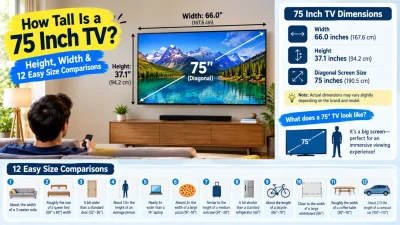
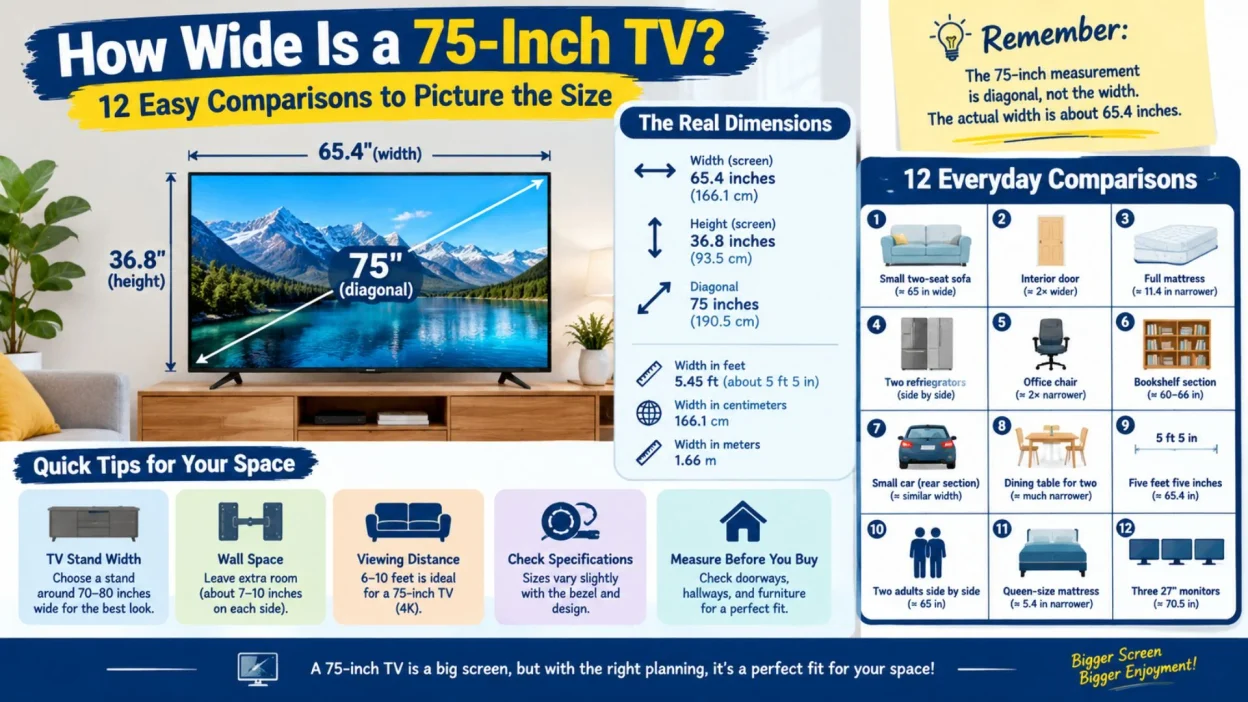
A 75-inch TV sounds huge, but how much space does it actually take up on your wall or TV stand? If you are planning to upgrade your home entertainment setup, knowing the real width of a 75-inch television can help you choose the right screen size without making your room feel crowded.
Here is the interesting part: a 75-inch TV is measured diagonally, not from left to right. Therefore, the screen is much wider than many people expect, especially when they see the number for the first time. For a typical widescreen television with a 16:9 aspect ratio, the screen measures approximately 65.4 inches wide and 36.8 inches tall.
That is about 5 feet 5 inches wide, making it a great option for movie nights, sports, gaming, and family entertainment. However, the actual dimensions can vary slightly depending on the television’s bezel and design.
In this guide, you will discover how wide a 75-inch TV really is, how it compares with everyday objects, how much wall space you need, and how to estimate its size without using a measuring tape. By the end, you will have a much clearer picture of whether this impressive screen fits your room.
📏 How Wide Is a 75-Inch TV Exactly?
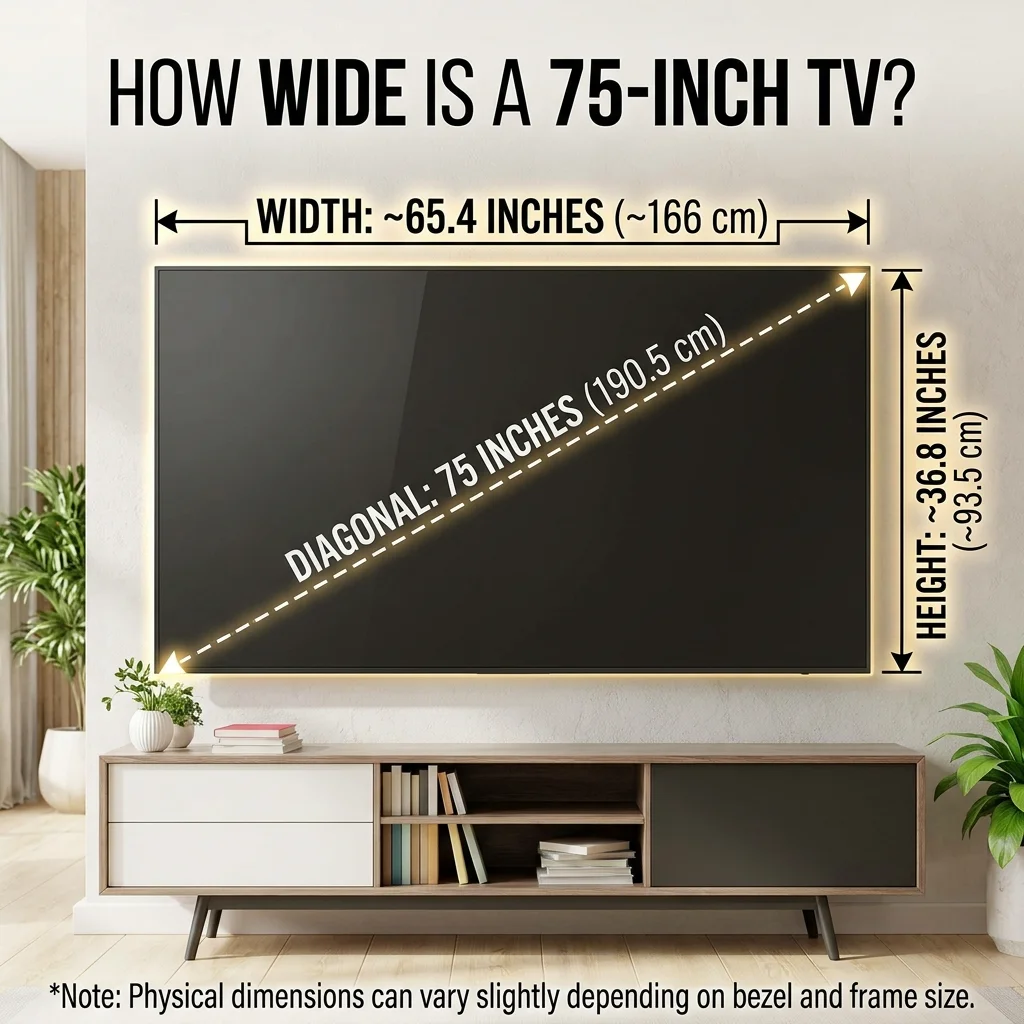
A standard 75-inch TV with a 16:9 widescreen aspect ratio has a screen width of approximately 65.4 inches (166.1 cm). Its screen height is around 36.8 inches (93.5 cm), measured without the stand.
Because manufacturers use different bezel designs and casing dimensions, the complete television may be slightly wider or taller than these screen measurements.
Here are the approximate dimensions to keep in mind:
- Screen width: 65.4 inches
- Screen height: 36.8 inches
- Diagonal screen measurement: 75 inches
- Width in feet: About 5 feet 5 inches
- Width in centimeters: About 166.1 cm
- Width in meters: About 1.66 meters
- Height in centimeters: About 93.5 cm
Keep in mind that these figures describe the visible screen area. For wall mounting or furniture planning, check the manufacturer’s specifications for the complete TV dimensions.
📐 Why Is a 75-Inch TV Only About 65 Inches Wide?
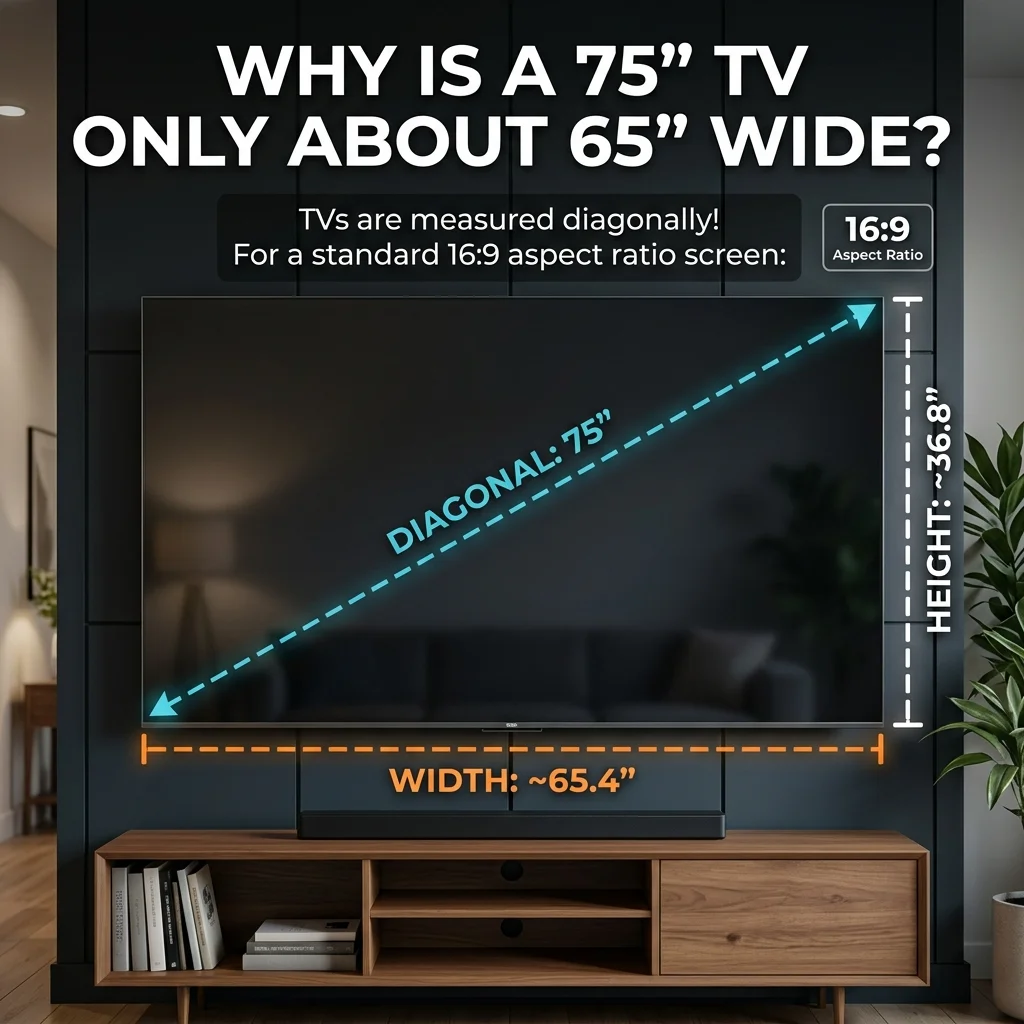
The number in a television’s name refers to its diagonal screen measurement, running from one corner to the opposite corner. It does not represent the horizontal width.
Most modern televisions use a 16:9 aspect ratio. This means the screen is 16 units wide for every 9 units of height.
Using this ratio, a 75-inch diagonal produces a screen that is approximately 65.4 inches wide and 36.8 inches tall.
Think of a right triangle drawn across half the screen’s width and height. The diagonal is the longest side, so it must be longer than either the width or height.
Consequently, a 75-inch television does not measure 75 inches from left to right. Instead, its width is a little over 65 inches, which is still a substantial amount of space.
🏠 12 Everyday Comparisons to Picture a 75-Inch TV’s Width
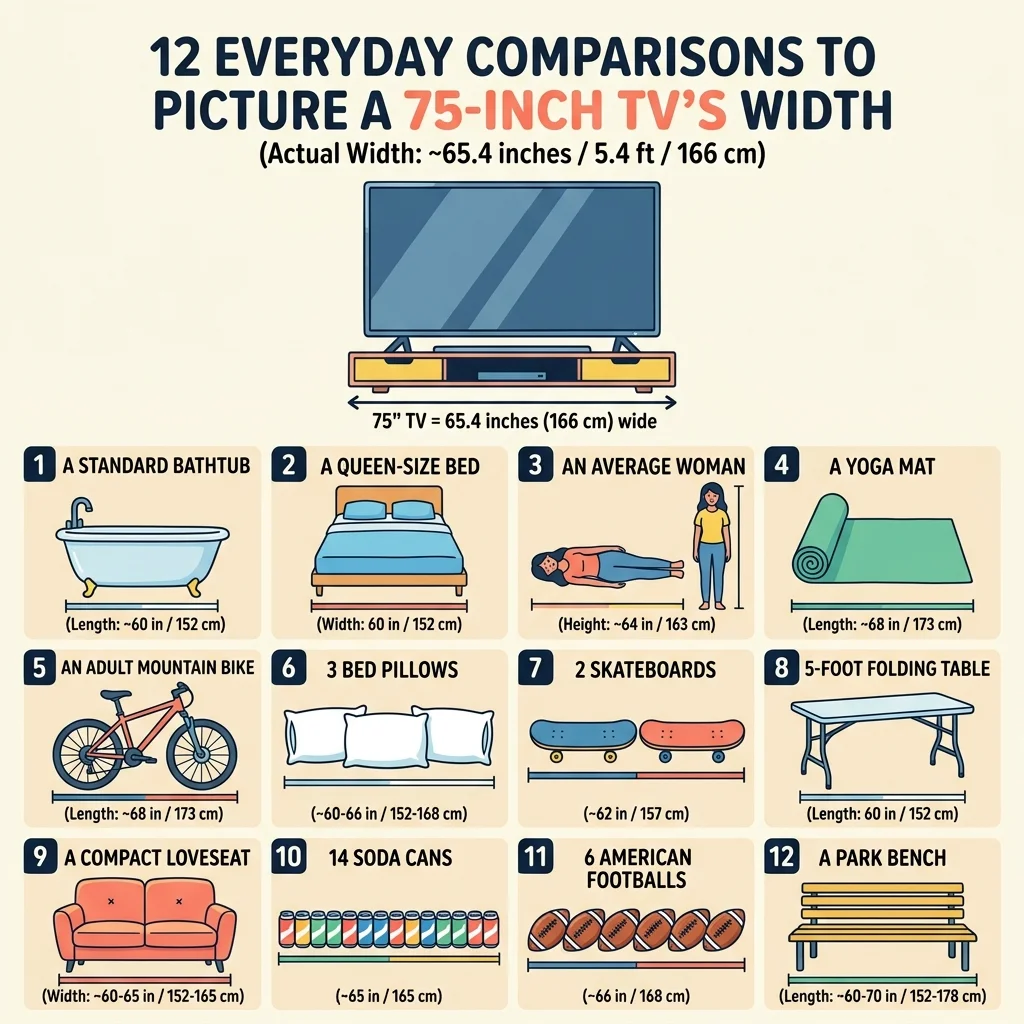
Numbers can be difficult to visualize. Fortunately, comparing a television with familiar household objects makes its size much easier to understand.
🛋️ 1. About the Width of a Small Two-Seat Sofa
A 75-inch TV is approximately 65.4 inches wide. Some compact two-seat sofas have a similar overall width, although many are wider.
Imagine a small sofa placed against a wall. A 75-inch television can occupy a similar horizontal space, creating a large focal point in your living room.
🚪 2. Wider Than a Standard Interior Door
Many standard interior doors are approximately 28 to 32 inches wide. Therefore, a 75-inch TV is a little more than twice as wide as a typical 30-inch door.
This comparison shows why you should measure doorways, hallways, and staircases before bringing a large television home.
🛏️ 3. About the Width of a Full-Size Mattress
A typical full-size mattress is approximately 54 inches wide. In comparison, a 75-inch TV is about 11.4 inches wider.
Picture a full mattress placed horizontally against a wall. The television would extend noticeably beyond both sides if centered above it.
🧊 4. About Two Standard Refrigerators Side by Side
A standard refrigerator may be around 30 to 36 inches wide, depending on its style. Two narrower refrigerators placed side by side could approach the width of a 75-inch TV.
Although refrigerator sizes vary, this gives you a useful visual reference for understanding how much horizontal space the screen occupies.
🪑 5. Wider Than a Typical Office Desk Chair
Many office chairs measure approximately 24 to 30 inches across their outer edges. As a result, a 75-inch television can be more than twice as wide as a typical chair.
Imagine placing two chairs side by side. The TV may still extend beyond them, depending on the models you compare.
📚 6. Similar to a Long Bookshelf Section
A wide bookshelf or cabinet section can measure around 60 to 66 inches across. This makes it a useful comparison for the horizontal width of a 75-inch television.
If you already have a cabinet of this size, you can use it to visualize the approximate width before shopping for your new screen.
🚗 7. Similar to the Width of a Small Car’s Rear Section
Some small cars have rear sections or trunk areas that appear roughly comparable in width when viewed from certain angles. However, vehicle body dimensions vary significantly, so this is only a loose visual reference.
A more reliable comparison is to measure a familiar object in your driveway and compare it directly with the TV’s 65.4-inch width.
🍽️ 8. Wider Than a Typical Dining Table for Two
Small dining tables often measure around 30 to 36 inches wide. A 75-inch TV is considerably wider than that measurement.
Picture the screen spanning well beyond the width of a compact dining table. This helps explain why a large TV can dominate a smaller room.
🧺 9. About Five Feet Five Inches Across
This is one of the easiest ways to imagine the television’s width. Five feet equals 60 inches, so the screen extends another 5.4 inches beyond that.
If you can picture a five-foot horizontal line, add roughly half a foot to understand the width of a typical 75-inch screen.
🧍 10. Roughly the Width of Two Adults Standing Shoulder to Shoulder
Two adults standing side by side may occupy a combined width close to 65 inches, depending on their body sizes and posture.
This comparison is not exact, but it gives you a simple way to imagine how much space the TV takes up across a wall.
🛏️ 11. Wider Than a Queen-Size Mattress Is Deep
A queen-size mattress is generally 60 inches wide and 80 inches long. At approximately 65.4 inches, a 75-inch TV is 5.4 inches wider than the mattress’s width.
This is a particularly useful comparison if you are planning a large screen for a bedroom.
🖥️ 12. Like Several Computer Monitors Placed Together
A typical 27-inch monitor with a 16:9 aspect ratio is approximately 23.5 inches wide. Three such monitors placed side by side would span around 70.5 inches before accounting for gaps.
Therefore, a 75-inch television is a little narrower than three 27-inch monitors arranged in a row, although the combined arrangement would have more total screen area in a different layout.
📊 75-Inch TV Dimensions in Inches, Feet, and Centimeters
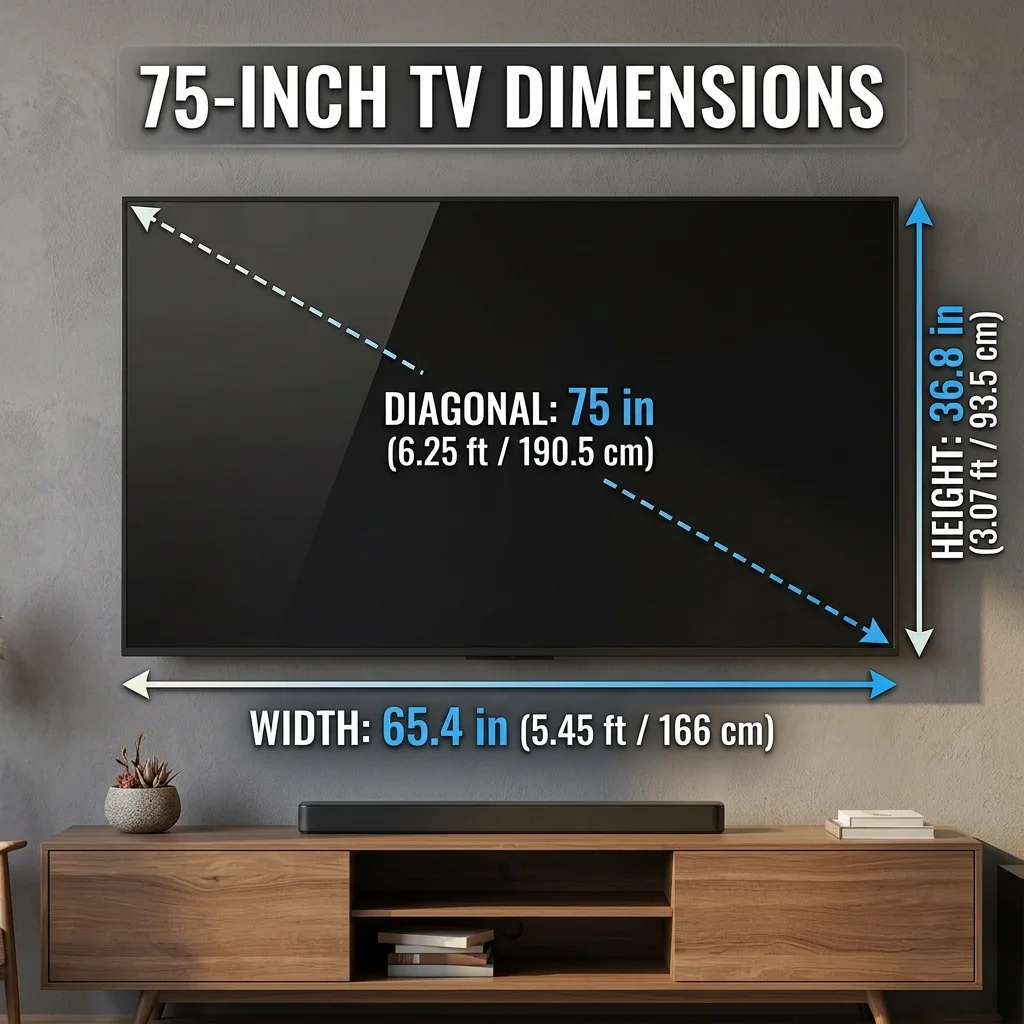
The following table summarizes the approximate screen measurements for a standard 75-inch television.
| Measurement | Inches | Centimeters |
|---|---|---|
| Diagonal | 75 in | 190.5 cm |
| Width | 65.4 in | 166.1 cm |
| Height | 36.8 in | 93.5 cm |
| Width in feet | 5.45 ft | 166.1 cm |
| Height in feet | 3.07 ft | 93.5 cm |
These figures assume a 16:9 screen. The complete television may have slightly larger external dimensions because of its frame.
🪑 How Wide Should a TV Stand Be for a 75-Inch TV?
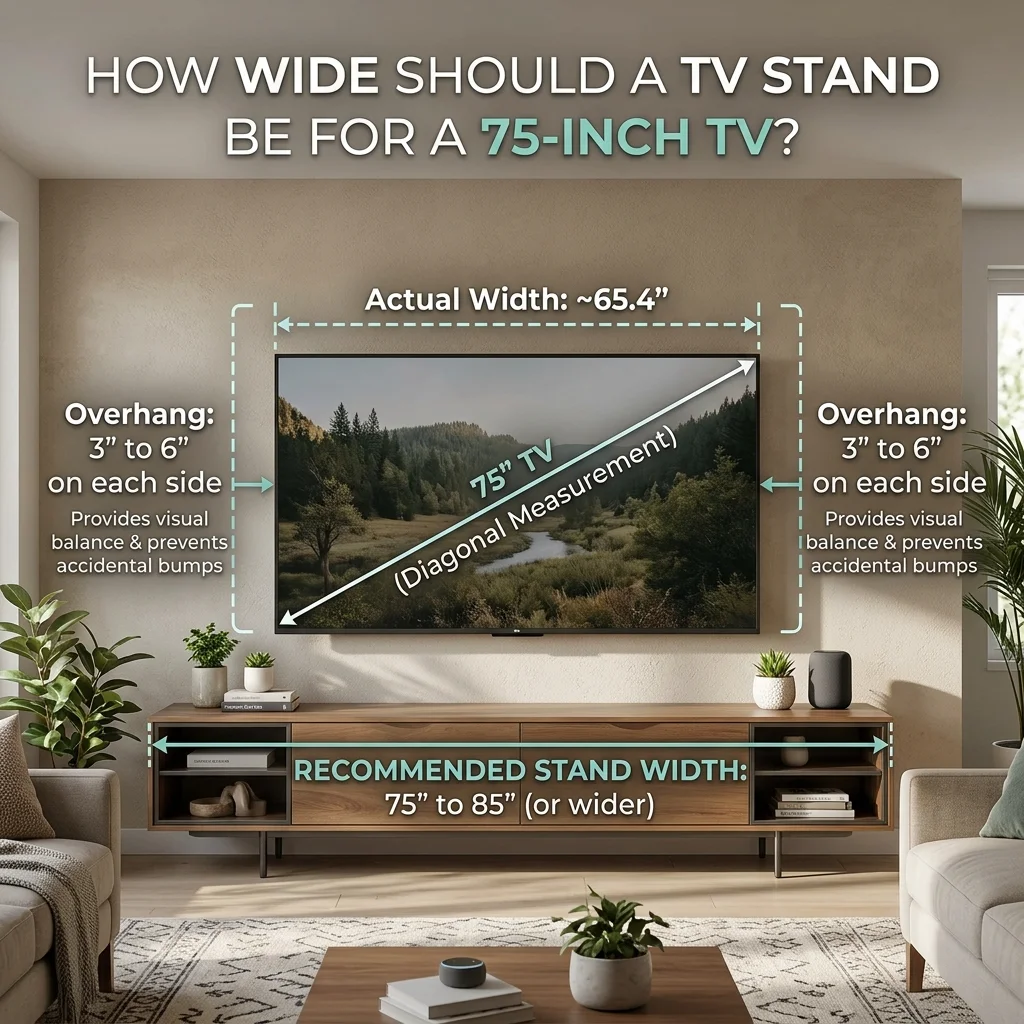
A 75-inch television has a screen width of approximately 65.4 inches. However, choosing the right TV stand requires more than matching the screen’s width.
For a balanced appearance, a stand around 70 to 80 inches wide can be a practical starting point. This gives the television some space on either side, although the ideal size depends on your room and furniture style.
Before purchasing a stand, check these details:
- TV feet placement: Some televisions have widely spaced feet, while others use a central stand.
- Stand weight capacity: Make sure the furniture supports the TV’s full weight.
- Available depth: The stand must accommodate the feet or base securely.
- Room proportions: A wider stand may look more balanced beneath a large television.
- Soundbar space: Leave enough room if you plan to place a soundbar below the screen.
Importantly, do not assume that a stand is suitable just because it is wider than 65 inches. The distance between the TV’s feet may determine whether the television fits securely.
🧱 How Much Wall Space Do You Need for a 75-Inch TV?
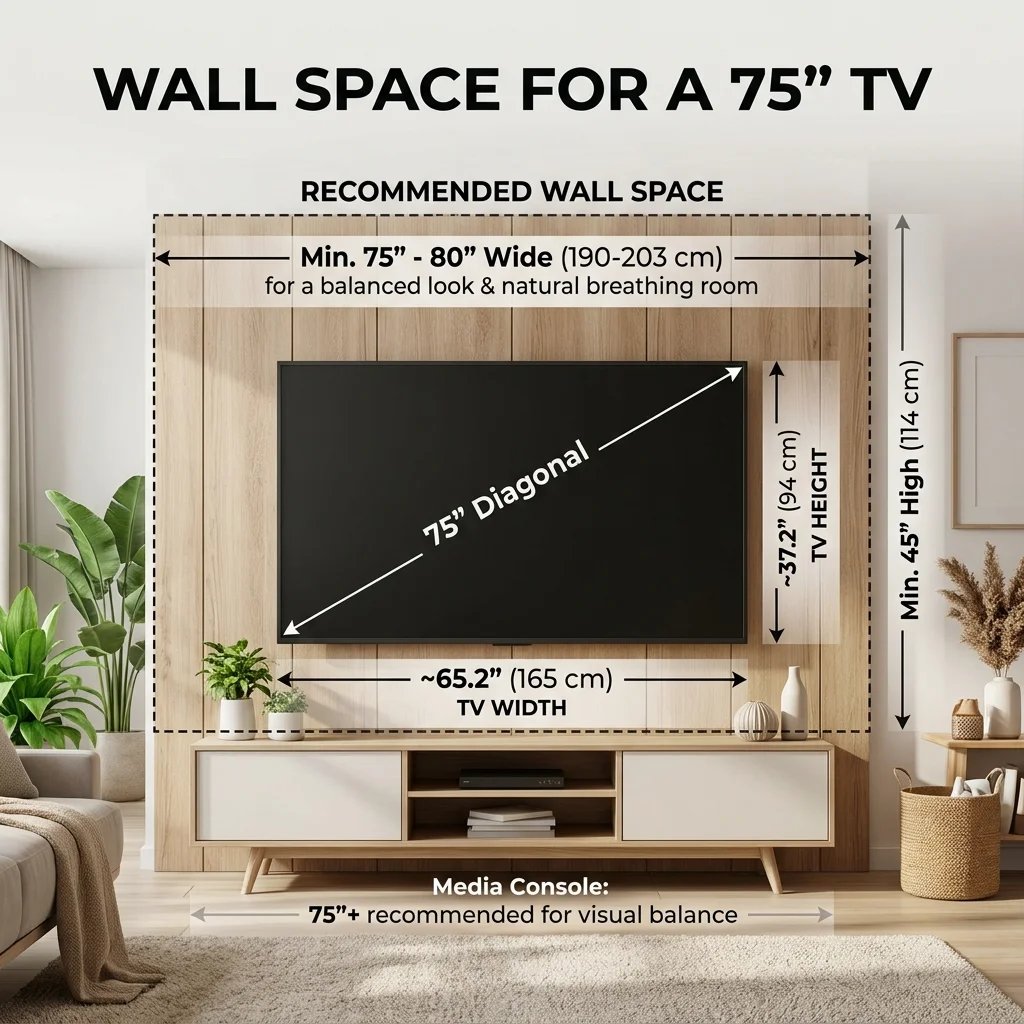
A 75-inch TV typically needs at least 65.4 inches of horizontal screen space. However, leaving additional room around it usually makes installation easier and improves the overall appearance.
For example, a wall section that is 80 inches wide would leave approximately 7.3 inches on each side if the screen were centered and measured at 65.4 inches wide.
Here are a few practical tips:
- Measure the available wall width before ordering the television.
- Check the complete TV width in the manufacturer’s specifications.
- Leave room for cables, wall mounts, and nearby shelves.
- Avoid placing the television where doors or cabinets could interfere with it.
- Consider sunlight, glare, and viewing angles before choosing the final position.
If you are mounting the TV, follow the mounting bracket’s instructions and verify that the wall and hardware can safely support the television.
📺 How Wide Is a 75-Inch TV With Its Stand?
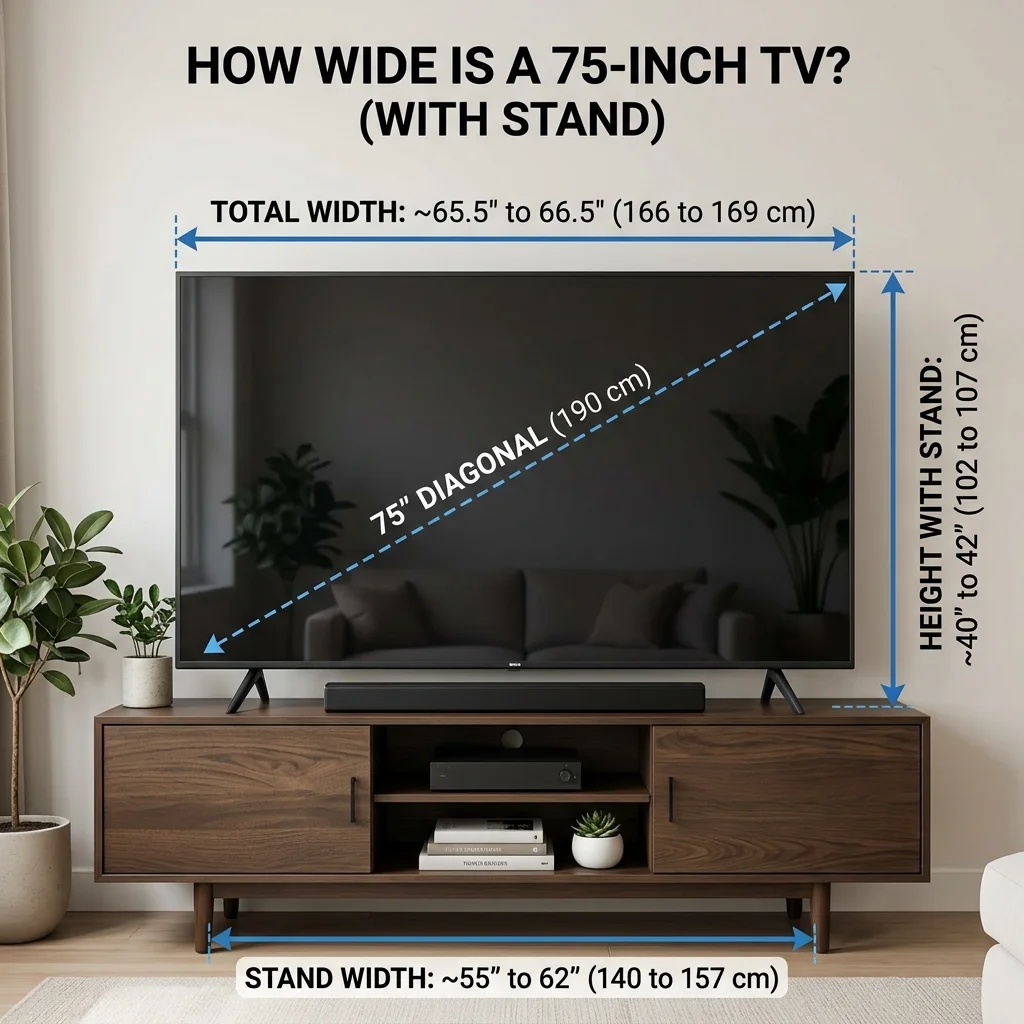
The screen itself is approximately 65.4 inches wide, but the complete television can be slightly wider because of its outer frame.
The stand usually affects the television’s height and depth more than its overall width. However, some TV feet extend outward, so their placement can determine the minimum width of the furniture beneath the screen.
For the most accurate measurements, check three separate specifications:
- TV dimensions without stand: Useful for wall mounting.
- TV dimensions with stand: Useful for furniture and room planning.
- Stand or feet spacing: Important when checking whether the TV fits on an existing cabinet.
These measurements are not interchangeable. Therefore, always check the exact model before making a purchase.
👀 How Far Away Should You Sit From a 75-Inch TV?
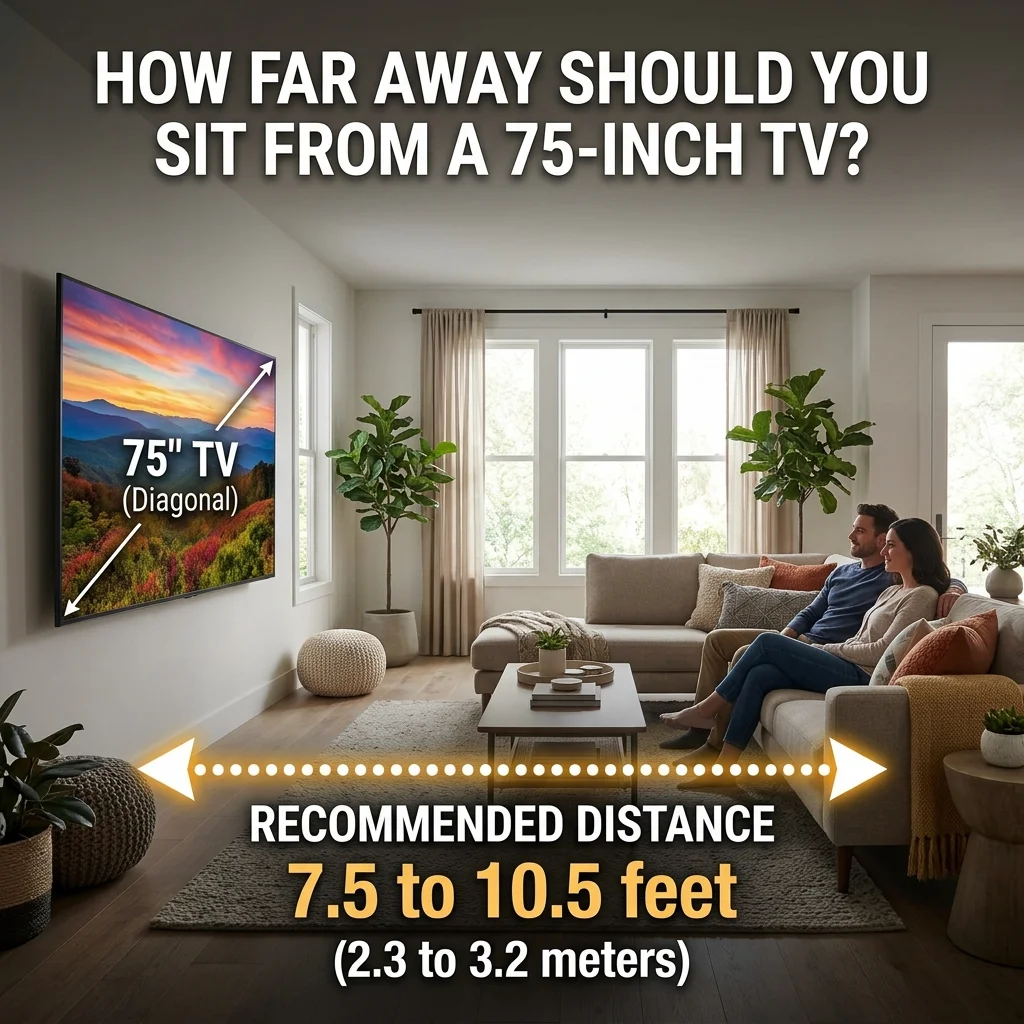
The best viewing distance depends on your personal preference, screen resolution, and whether you enjoy an immersive movie experience.
For a 75-inch 4K television, sitting approximately 6 to 10 feet away can be a useful starting range for many viewers. Some people prefer sitting closer for a more immersive picture, while others prefer additional distance.
Consider these factors when choosing your seating position:
- 4K resolution: Allows you to sit closer without seeing individual pixels as easily.
- Room size: Determines how far back your sofa can reasonably sit.
- Content type: Movies and gaming may benefit from a more immersive view.
- Personal comfort: Choose a distance that lets you watch without straining your eyes or neck.
Remember that viewing distance is a recommendation rather than a strict rule. Adjust your seating to suit your room and comfort.
📏 How to Measure a 75-Inch TV Without a Measuring Tape
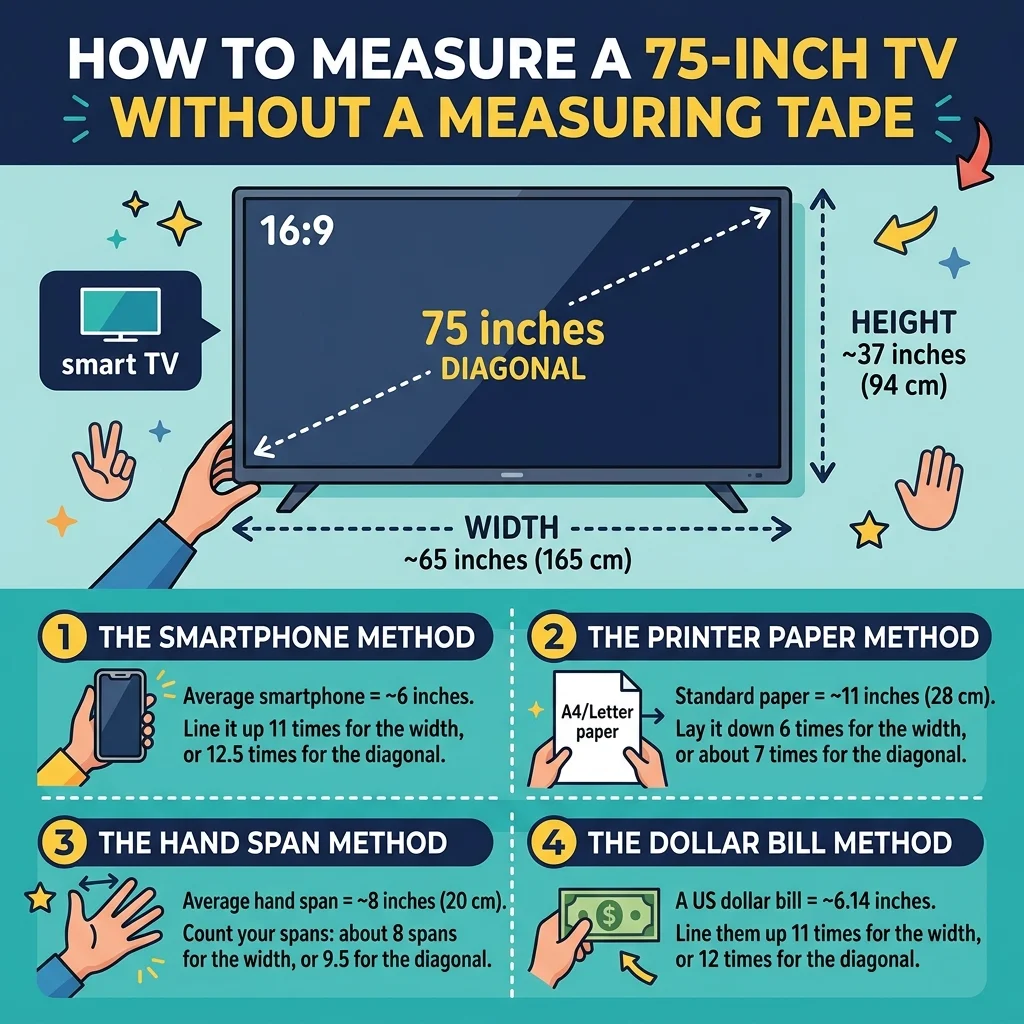
If you do not have a measuring tape available, you can still estimate the width of a 75-inch television using familiar measurements.
Use a standard sheet of paper. A US letter-size sheet is 11 inches long. Placing six sheets end to end gives you 66 inches, which is very close to the screen’s approximate 65.4-inch width.
Use a ruler. If you have a 12-inch ruler, measuring five full lengths gives you 60 inches. Add approximately another 5.4 inches to estimate the screen width.
Use your furniture. A cabinet or desk with a known width can help you picture the television’s size. For example, a 60-inch cabinet would be about 5.4 inches narrower than the screen.
Use floor or wall markings. If you can safely mark two points about 65 inches apart, the distance will give you a rough idea of the screen’s width.
These methods are helpful for visualization, but they should not replace accurate measurements when installing a wall mount or checking whether a television fits through a doorway.
❓ Frequently Asked Questions About 75-Inch TV Width
How wide is a 75-inch TV in inches?
A typical 75-inch television with a 16:9 aspect ratio has a screen width of approximately 65.4 inches. The full TV may be slightly wider because of its frame.
How wide is a 75-inch TV in feet?
The screen is approximately 5.45 feet wide, or about 5 feet 5 inches. This measurement refers to the visible screen rather than the complete television casing.
How wide is a 75-inch TV in centimeters?
A typical 75-inch TV screen is approximately 166.1 centimeters wide. The actual exterior width depends on the manufacturer’s design.
How tall is a 75-inch TV?
A standard 16:9 screen measures approximately 36.8 inches (93.5 cm) tall, excluding the stand. The overall height will vary by model.
Is a 75-inch TV actually 75 inches wide?
No. The 75-inch measurement represents the diagonal distance between opposite corners of the screen. Its horizontal width is approximately 65.4 inches.
Will a 75-inch TV fit on a 60-inch TV stand?
The screen itself is wider than a 60-inch stand, so it would extend beyond the furniture on both sides. More importantly, the TV’s feet must be fully supported. Check the manufacturer’s foot spacing and weight requirements before using any stand.
How much bigger is a 75-inch TV than a 65-inch TV?
A typical 65-inch TV screen is about 56.7 inches wide, while a 75-inch screen is about 65.4 inches wide. That means the 75-inch model is approximately 8.7 inches wider and also has a larger overall screen area.
Is a 75-inch TV too big for a small room?
Not necessarily. A 75-inch TV can work in a smaller room if the viewing distance, wall space, and furniture layout are suitable. However, measuring your room and considering your preferred seating distance will help you decide.
Conclusion
A typical 75-inch TV is approximately 65.4 inches wide, 36.8 inches tall, and 75 inches diagonally. In other words, the screen is about 5 feet 5 inches wide, making it a substantial centerpiece for a living room, bedroom, or home theater.
Everyday comparisons, such as a full-size mattress, a small two-seat sofa, or a five-foot horizontal line, can help you picture its size more easily. Nevertheless, the exact exterior dimensions vary between models, particularly when you include the frame and stand.
Before buying your television, measure your wall, check the width of your TV stand, and confirm the manufacturer’s specifications. With a little planning, you can choose a 75-inch TV that fits your space comfortably and delivers the big-screen viewing experience you want.