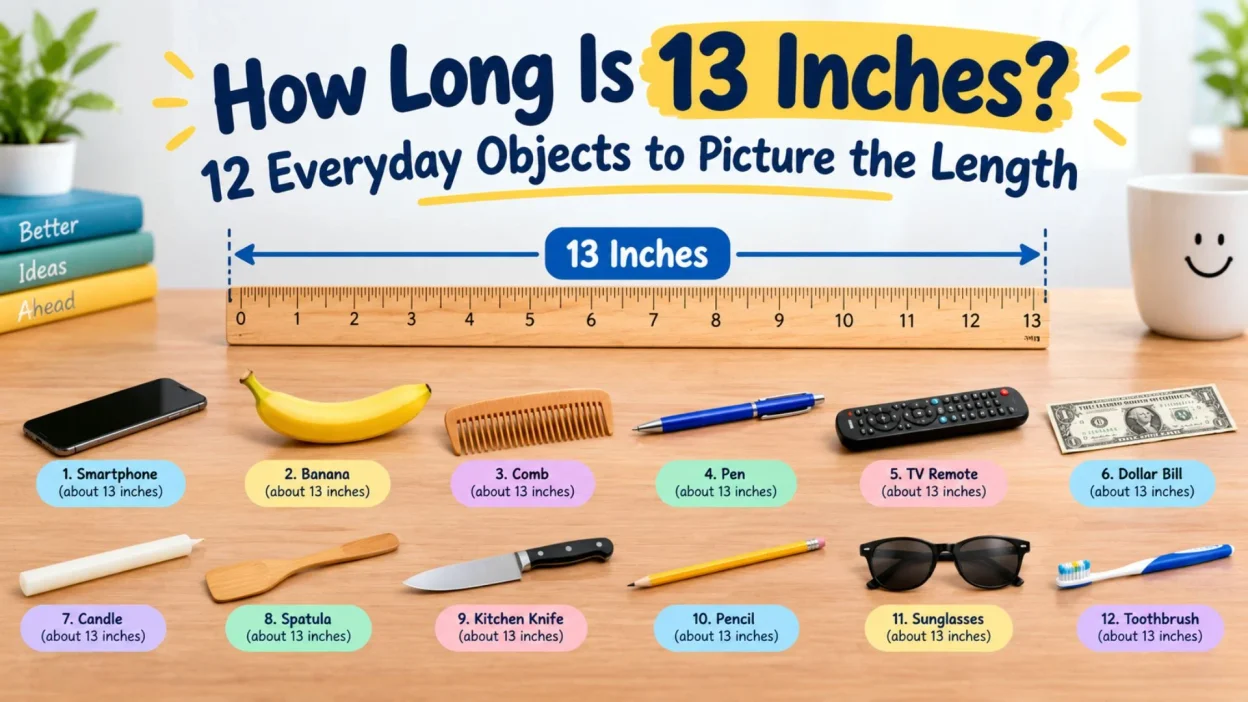
Thirteen inches is just a little longer than a foot, but picturing that length without a ruler can be surprisingly difficult. Think of a standard 12-inch ruler with another inch added to the end. That small extra section brings you to 13 inches.
You might come across this measurement when shopping for a laptop, checking a kitchen tool’s dimensions, measuring a shelf, or choosing a storage container. The challenge is knowing what 13 inches looks like in the real world, especially when a product listing gives measurements in unfamiliar units.
The easiest way to understand this length is to compare it with everyday objects and convert it into measurements you already recognize. These comparisons also help you estimate the size when a measuring tape is not available.
13 inches equals 1 foot 1 inch, 33.02 centimeters, 330.2 millimeters, and 0.3302 meters.
Every Unit 13 Inches Converts To
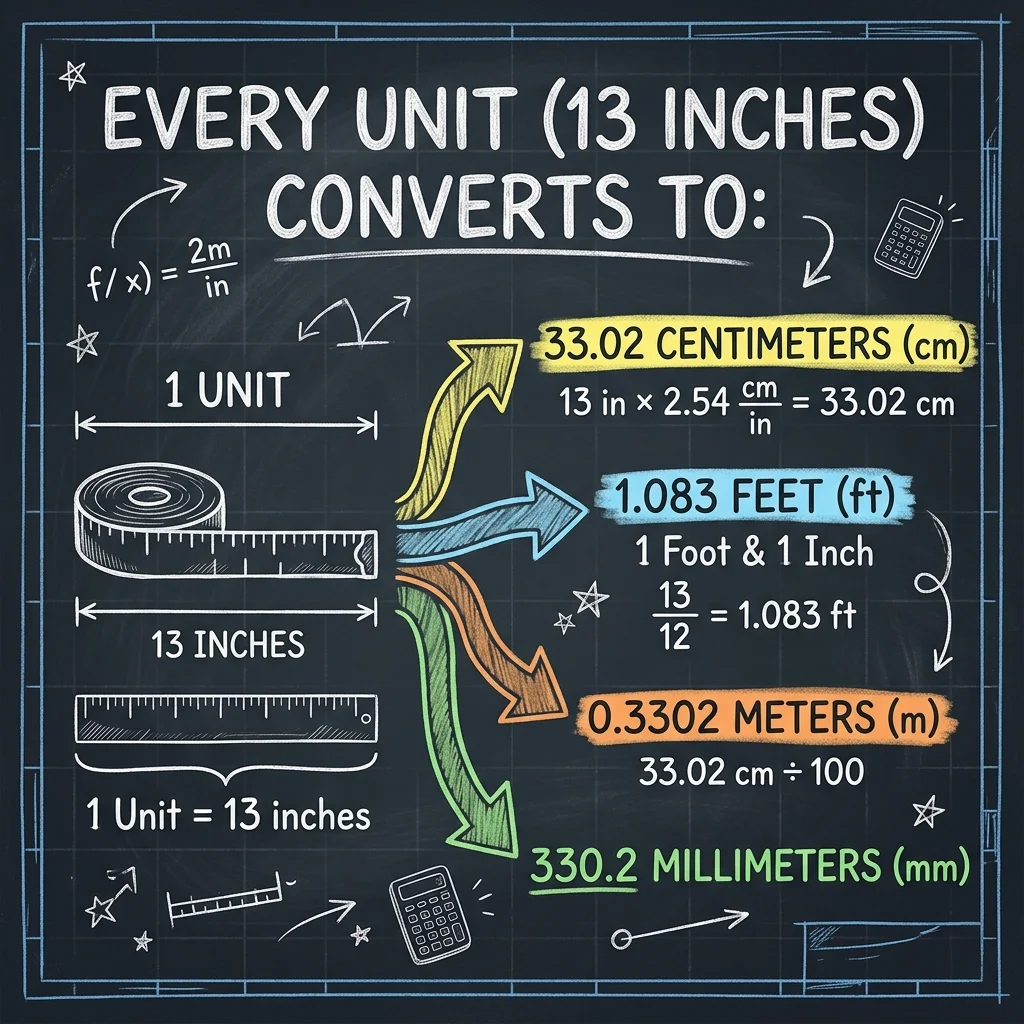
Thirteen inches is a straightforward measurement to convert into imperial and metric units. Whether you are comparing product dimensions, planning a DIY project, or measuring an object at home, these equivalents help you understand its actual length.
| Unit | Value |
|---|---|
| Inches | 13 inches |
| Feet | 1.0833 feet |
| Feet and inches | 1 foot 1 inch |
| Centimeters | 33.02 cm |
| Millimeters | 330.2 mm |
| Meters | 0.3302 m |
| Yards | 0.3611 yards |
How to Convert 13 Inches to Feet
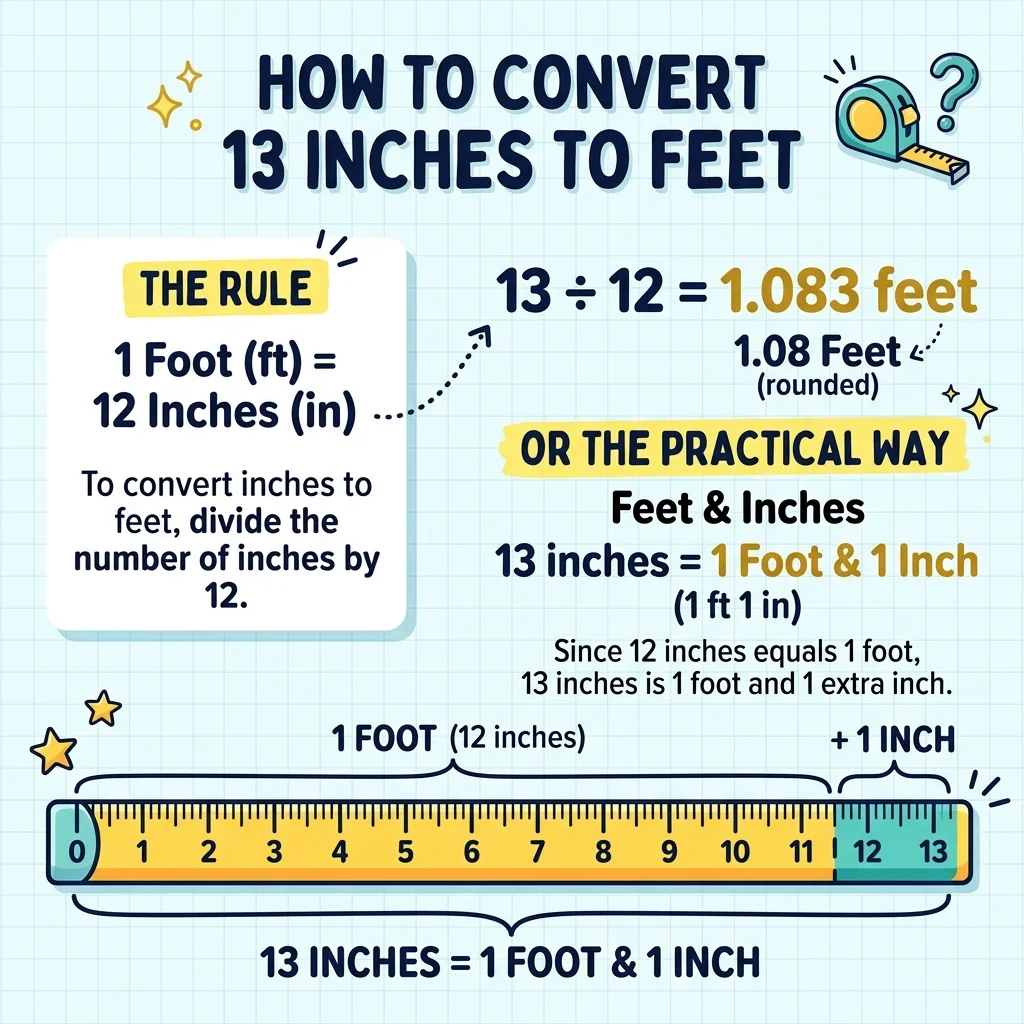
There are 12 inches in a foot. Divide 13 by 12 to calculate the length in feet.
13 ÷ 12 = 1.0833 feet
Therefore, 13 inches is approximately 1.0833 feet, or 1 foot and 1 inch. The second format is often easier to picture when measuring furniture, shelves, and household items.
How Many Centimeters Is 13 Inches?
One inch equals exactly 2.54 centimeters. Multiply 13 by 2.54 to get the metric equivalent.
13 × 2.54 = 33.02 cm
So, 13 inches in cm equals 33.02 centimeters. For everyday estimates, you can round that to 33 cm.
How Many Millimeters Is 13 Inches?
A centimeter contains 10 millimeters. Since 13 inches equals 33.02 centimeters, multiplying by 10 gives you 330.2 millimeters.
This means 13 inches in mm equals 330.2 mm. Millimeters are particularly useful when working with detailed product specifications, hardware, or construction measurements.
How Long Is 13 Inches in Meters?
One meter contains approximately 39.37 inches. Dividing 13 by 39.37 gives approximately 0.3302 meters.
In simple terms, 13 inches is just over 0.33 meters. You can also think of it as roughly one-third of a meter.
Where 13 Inches Sits on a Common Size Scale
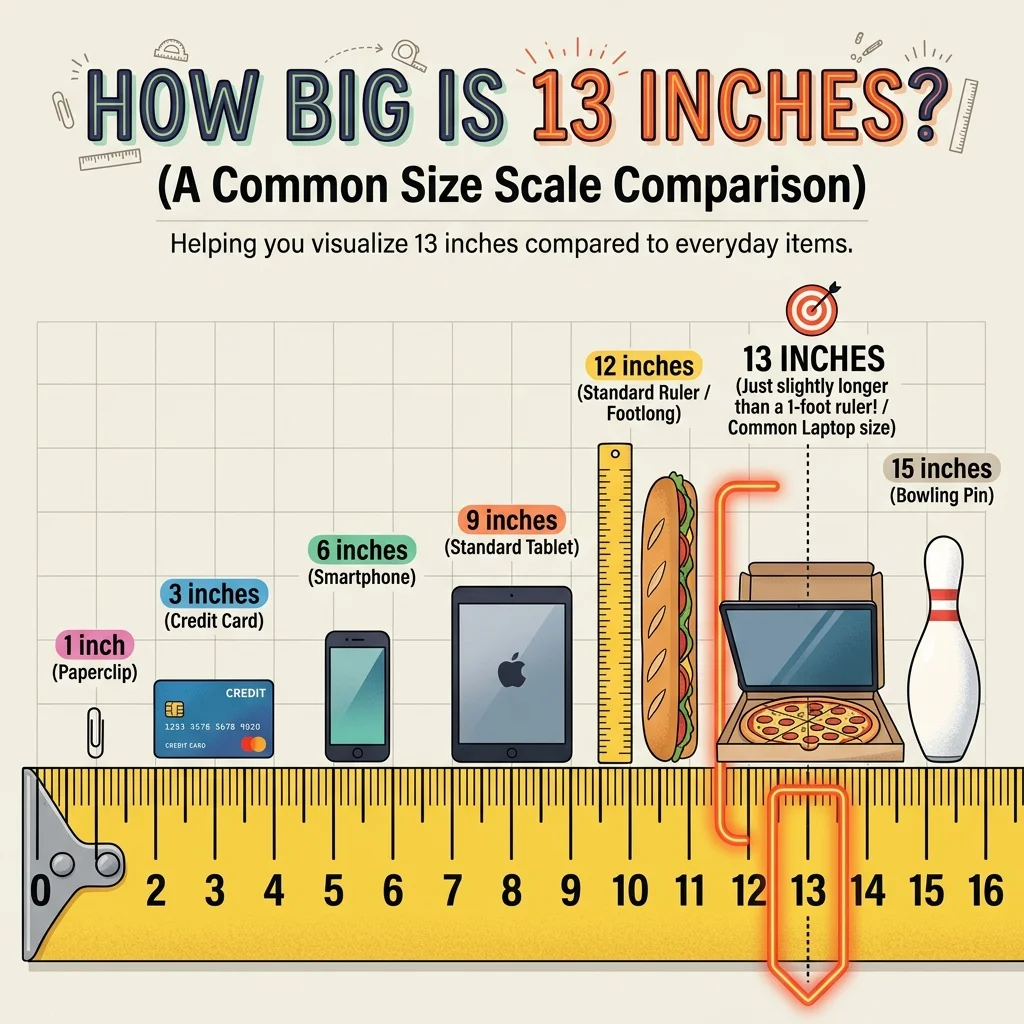
Thirteen inches falls just beyond the one-foot mark. That makes it a useful reference for understanding the size of small household objects, compact equipment, and certain product dimensions.
Here are three simple ways to put the measurement into context.
Compared with a 12-inch ruler: A standard foot-long ruler measures exactly 12 inches. Add one more inch, and you reach 13 inches.
Compared with US letter paper: Standard US letter paper measures 8.5 by 11 inches. Thirteen inches is 2 inches longer than its longest edge.
Compared with a 30-centimeter ruler: Thirteen inches equals 33.02 cm, so it extends about 3.02 cm beyond the 30 cm mark.
These comparisons also show why a measurement can look different depending on its orientation. A 13-inch length is not the same as a 13-inch width or a 13-inch diagonal. When measuring an object, identify which dimension the number describes.
For example, a shelf listed as 13 inches deep has a different shape and purpose from a screen advertised as 13 inches diagonally.
12 Things That Measure Around 13 Inches
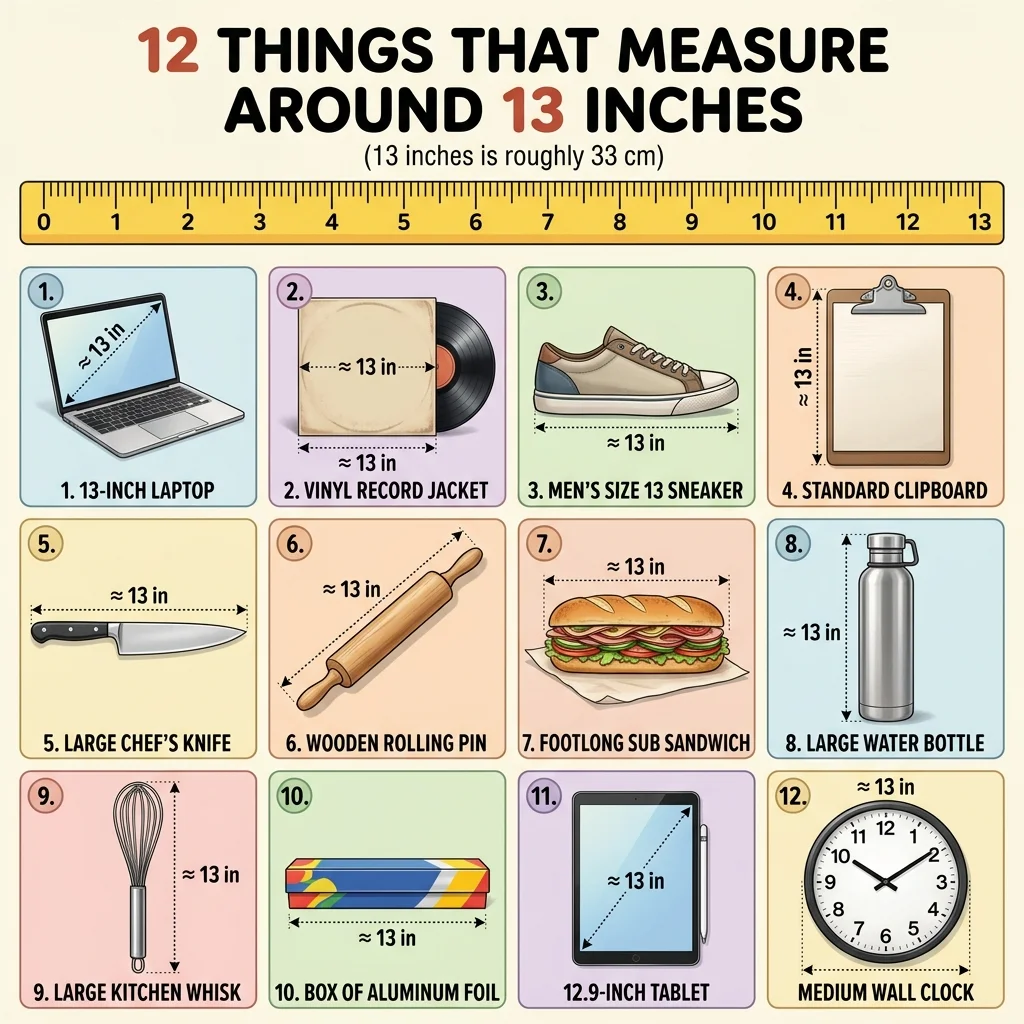
Everyday objects can help you understand 13 inches without constantly converting numbers. The examples below include items that may measure close to this length, along with familiar references that make the measurement easier to visualize.
Dimensions vary between products, so treat approximate examples as visual guides rather than guaranteed measurements.
1. A 13-Inch Pizza
A pizza with a 13-inch diameter measures 13 inches straight across its center, from one outer edge to the opposite edge. That is equivalent to 33.02 cm.
Pizza sizes vary between restaurants. Many menus feature 12-inch and 14-inch pizzas, so a 13-inch pizza would fall between those two familiar sizes.
The diameter measures the distance across the pizza, not the distance around the crust. A circle with a 13-inch diameter has a circumference of approximately 40.84 inches.
To picture the size, imagine a ruler stretching across the center of the pizza. The full line from one side to the other represents 13 inches.
2. A 13-Inch Laptop Screen
A laptop advertised as having a 13-inch screen provides a familiar example, but there is an important detail: the measurement refers to the screen’s diagonal, not its horizontal width.
For a hypothetical 13-inch screen with a 16:9 aspect ratio, the visible display is approximately 11.33 inches wide and 6.37 inches tall. The laptop body itself may be larger because of the bezel, hinges, and keyboard.
This distinction matters when buying a laptop sleeve or checking whether a device will fit inside a bag. A 13-inch screen does not mean the entire laptop is exactly 13 inches wide.
Picture a line running diagonally from one corner of the display to the opposite corner. That line represents the advertised screen size.
3. A Sheet of US Legal-Size Paper
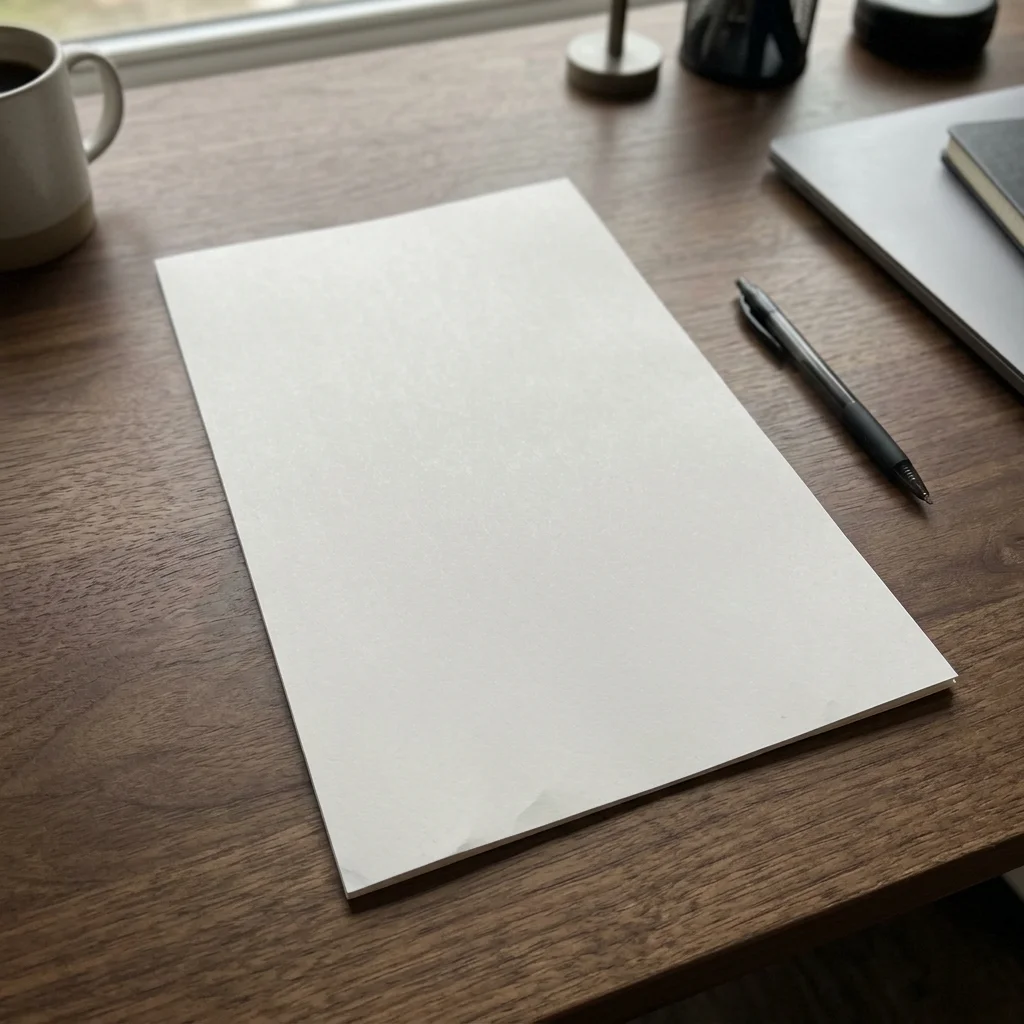
US legal-size paper measures 8.5 inches wide and 14 inches long. Its long edge is therefore only 1 inch longer than 13 inches.
This standardized paper size is useful for comparison because its dimensions are fixed. Unlike a kitchen tool or electronic device, legal-size paper does not change dimensions between ordinary manufacturers.
If you imagine removing 1 inch from the long edge, the remaining length would be 13 inches. This makes it a helpful visual reference when comparing document sizes or estimating a measurement on a desk.
The comparison is especially useful in offices where legal-size documents are commonly handled.
4. A Standard 12-Inch Ruler Plus One Inch
A standard 12-inch ruler is probably the simplest reference for this measurement. Its length represents exactly one foot, leaving only another inch to reach the target.
Unlike approximate comparisons, this method gives you a precise measurement when you have a properly marked ruler. You do not need to estimate the size of an everyday object.
Place the ruler on a flat surface and locate the 12-inch mark. Extend the line by another inch in the same direction.
That small extension is the difference between a foot and 13 inches. It can be surprisingly useful when checking the dimensions of a small box, drawer, or shelf.
5. A 30-Centimeter Ruler
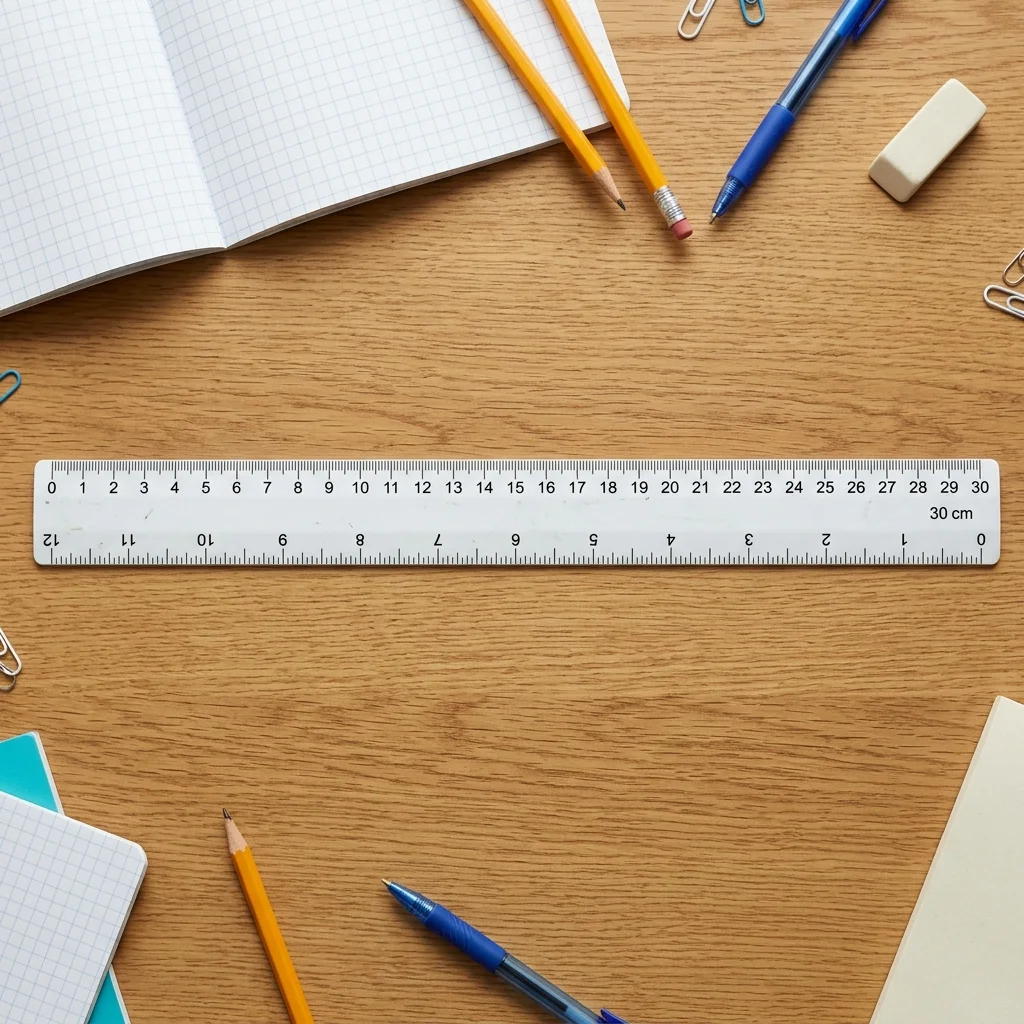
A 30 cm ruler is a common measuring tool in schools, offices, and homes. Since 13 inches equals 33.02 cm, the target measurement is just over 3 cm longer than the ruler.
This makes it a useful comparison for people who normally measure in centimeters rather than inches. You can start with the ruler’s full length and estimate the extra section.
The additional 3.02 cm is relatively small, but it is important when precision matters. A space measuring 30 cm will not quite accommodate an object that is 13 inches long.
If you have a metric ruler nearby, the comparison is straightforward: 30 cm plus about 3 cm equals approximately 13 inches.
6. A Large Chef’s Knife
Some large chef’s knives measure around 12 to 14 inches from the tip of the blade to the end of the handle. A model near the upper end of that range can be a useful comparison for 13 inches.
However, knife dimensions vary considerably. A blade advertised as 10 inches long may belong to a knife with a longer overall length once the handle is included.
This distinction is important when comparing kitchen equipment or deciding how much drawer space a knife will need. Always check whether the listed measurement refers to the blade or the complete knife.
For visualization, imagine the entire knife laid flat, with both the blade and handle included. The overall length is the measurement relevant to this comparison.
7. A Round Serving Tray
Round serving trays are available in a variety of diameters, including models around 13 inches wide. A tray of this size provides a familiar circular surface that is easy to compare with the width of a countertop or small table.
The diameter is measured straight across the center. Some trays have raised rims or handles that affect their outside dimensions, so the usable surface may be slightly smaller than the overall measurement.
A tray around this size can be useful for serving snacks, carrying cups, or arranging small dishes. Its capacity depends on the shape, depth, and usable surface area.
Picture a ruler placed across the tray from one edge to the other through its center. That straight distance is the relevant 13-inch measurement.
8. A Medium Cutting Board
Some medium-sized cutting boards measure approximately 13 inches along their longer edge. This makes them a useful reference for picturing the length on a kitchen countertop.
Cutting boards come in many dimensions, so 13 inches is an example rather than a universal standard. Some are shorter, while larger preparation boards can be considerably longer.
A board around this size may provide useful space for chopping vegetables, slicing fruit, or preparing ingredients for a small meal. The usable cutting area depends on both its length and width.
To visualize 13 inches, imagine measuring along the board’s longest edge from one end to the other. A length of 33 cm is very close to the target.
9. A Compact Computer Keyboard
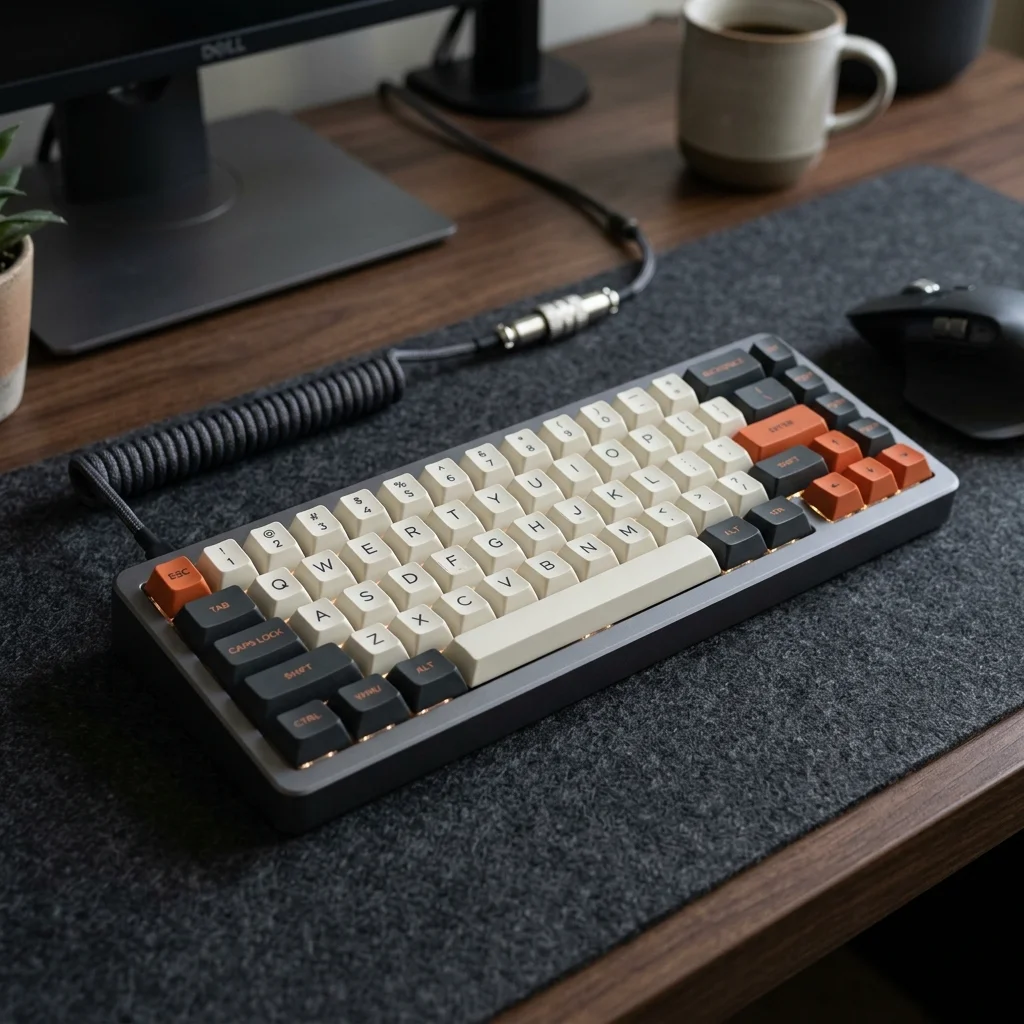
Certain compact computer keyboards measure around 13 inches wide. These models may omit a separate number pad or use a smaller layout to save desk space.
Keyboard dimensions vary by design. A full-size keyboard is often wider, while smaller travel keyboards may be substantially shorter.
If you are choosing a keyboard for a narrow desk, the outside width is more useful than the product’s general label. Checking the manufacturer’s specifications helps you determine whether the keyboard will fit.
A keyboard measuring about 13 inches wide occupies roughly 33 cm of horizontal space. Imagine measuring from its left edge to its right edge to visualize the distance.
10. A Small Display Panel
Some portable monitors and compact displays are marketed with a 13-inch screen. As with laptops, the number usually describes the diagonal of the visible display rather than the horizontal width.
The actual width and height depend on the screen’s aspect ratio. A 13-inch diagonal display can be noticeably narrower than a 13-inch ruler laid horizontally.
This matters when choosing a monitor stand, protective sleeve, or travel bag. The screen size alone may not tell you whether the entire device will fit.
Imagine a line drawn from the bottom-left corner of the visible screen to its top-right corner. That diagonal represents the nominal 13-inch display measurement.
11. A Small Decorative Cushion
Some small decorative cushions measure around 12 to 14 inches across, putting them close to 13 inches. Their familiar shape makes them useful for visualizing the measurement at home.
Cushion sizes vary, and a product listed as 13 by 13 inches has two dimensions of 13 inches. That means it measures approximately 13 inches across and 13 inches from top to bottom when laid flat.
This size can work for small chairs, decorative arrangements, or compact reading areas. The apparent dimensions may change slightly depending on how full the cushion is.
Picture a straight line across the cushion from one side seam to the other. If the cushion is approximately 13 inches wide, that line measures about 33 cm.
12. A Short Section of Shelf
A 13-inch section of shelving provides a practical example of the measurement in a home. You can use this length to estimate space for a small organizer, appliance, or decorative item.
Shelves are made in many sizes, so there is no universal shelf length of 13 inches. In this example, the measurement refers to a selected section of a larger shelf.
This comparison is especially helpful when arranging objects on a desk or planning storage. Remember that an item must fit in all relevant dimensions, including its depth and height.
Imagine marking a starting point on the shelf and measuring 13 inches along its surface. The resulting section is slightly longer than one foot.
What Does a 13-Inch Screen Actually Measure?
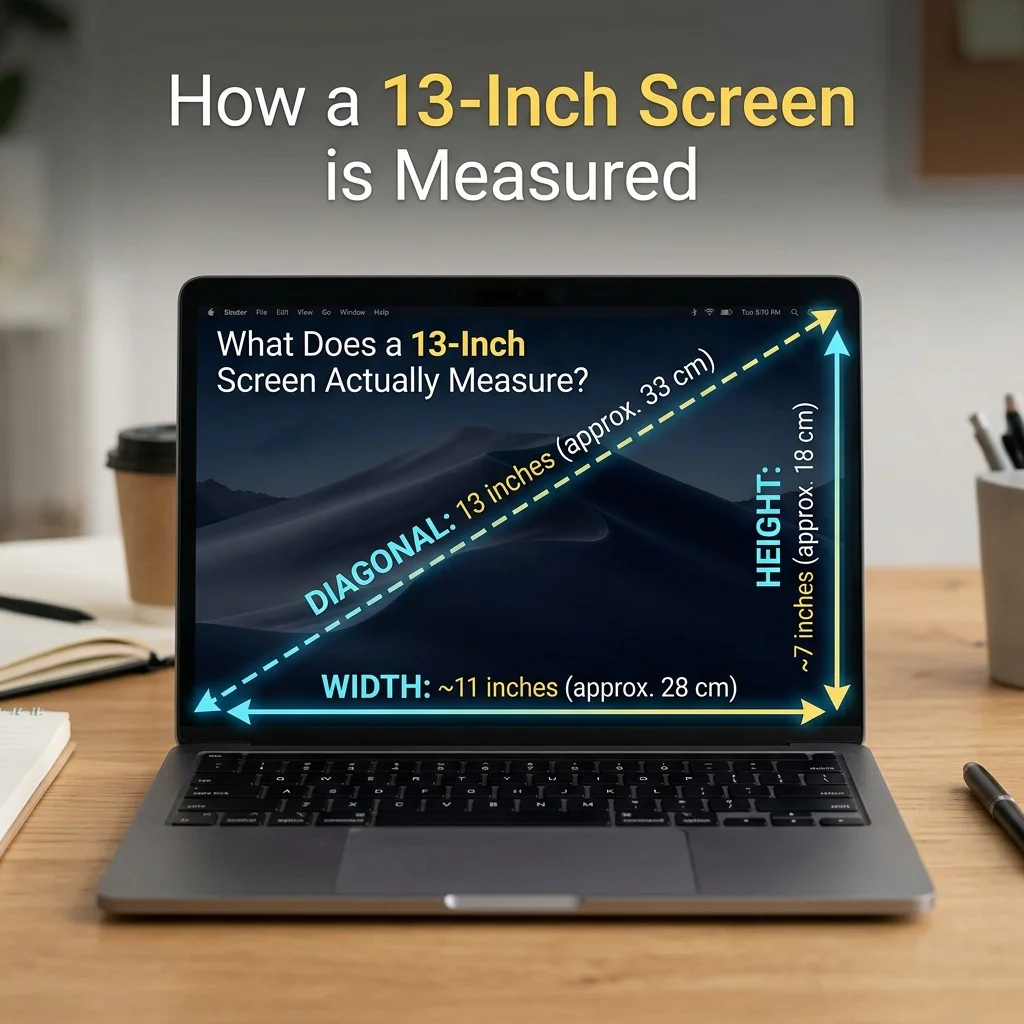
One common question about 13 inches concerns laptop screens and monitors. The reason for the confusion is that screen sizes are generally measured diagonally rather than horizontally.
For a hypothetical 13-inch display with a 16:9 aspect ratio, the approximate visible screen dimensions are:
| Screen measurement | Approximate size |
|---|---|
| Diagonal | 13 inches |
| Width | 11.33 inches |
| Height | 6.37 inches |
These figures describe the visible display area, not the complete laptop or monitor. The outside frame, stand, or other components may increase the total dimensions.
Different aspect ratios also produce different widths and heights for the same diagonal. Therefore, two screens with a 13-inch diagonal may not have identical physical dimensions.
If you are purchasing a laptop sleeve or checking storage space, look for the manufacturer’s outside dimensions. The diagonal screen measurement alone is not enough to guarantee a fit.
Getting to 13 Inches Without a Tape Measure
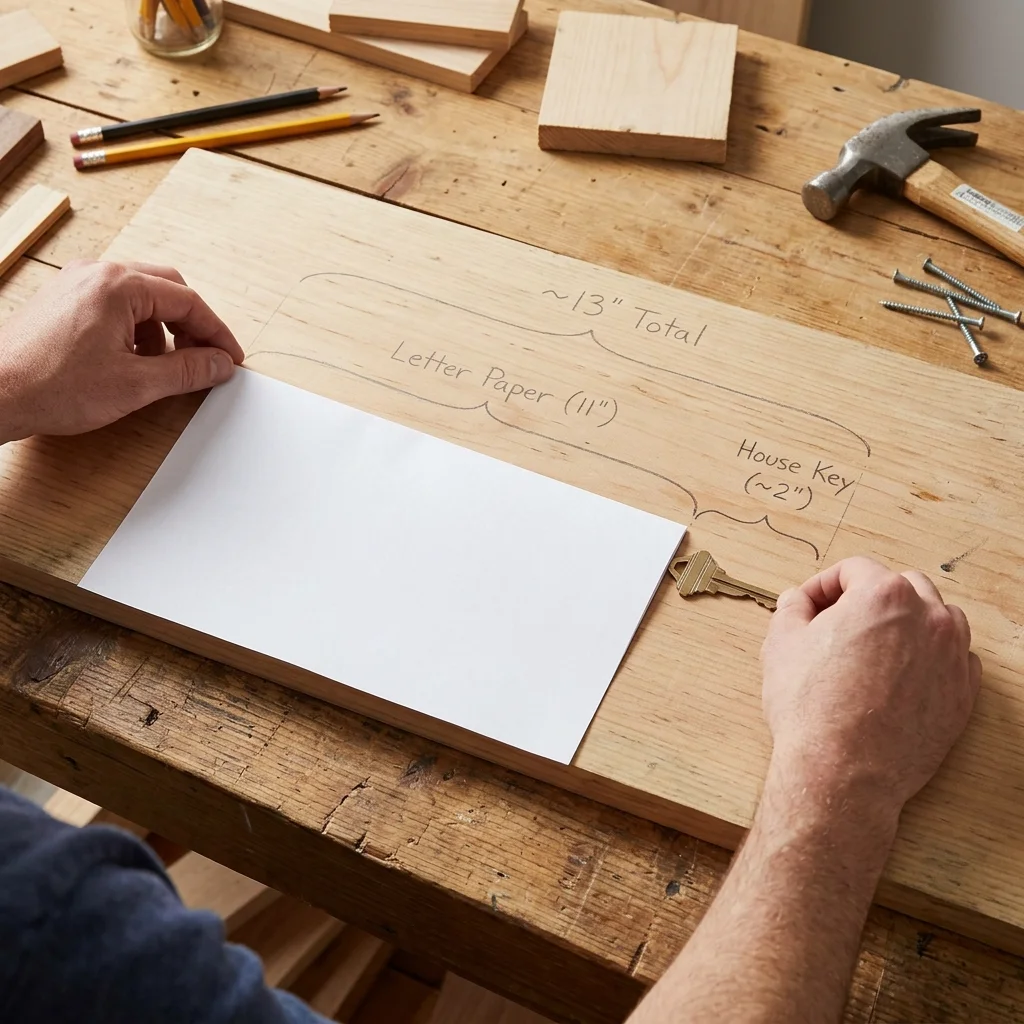
You do not always need a measuring tape to estimate a length of 13 inches. Familiar objects can help, provided you understand that an estimate is not the same as an exact measurement.
1. Start With a 12-Inch Ruler
A foot-long ruler gives you the most direct reference. Add one extra inch to its length, and you reach 13 inches.
If your ruler has clear inch markings, this method is more reliable than comparing the measurement with an object of unknown size.
2. Compare It With Letter Paper
Standard US letter paper measures 11 inches along its longer edge. Imagine extending that edge by another 2 inches, and you have a visual estimate of 13 inches.
This is a convenient method if you have printer paper available, although the paper itself is not quite as long as the target.
3. Use a 30-Centimeter Ruler
A 30 cm ruler is slightly shorter than 13 inches. Add approximately 3 cm to its length to reach 33.02 cm.
This comparison is particularly useful if the measuring tools you have at home use metric markings.
4. Use a Familiar Household Object
A compact keyboard or a medium cutting board may be close to 13 inches, depending on the model. These objects can provide a quick visual estimate when you do not have a ruler nearby.
However, everyday objects are not standardized measuring tools. Their actual dimensions may differ from the examples given here.
5. Calibrate Your Hand Span
Your hand span can serve as a personal reference if you first compare it with a ruler. Once you know how wide your own hand span is, you can use it to estimate other lengths.
Hand sizes vary from person to person, so this method is only approximate. It is not suitable for measurements where an exact fit is important.
Frequently Asked Questions
How many feet is 13 inches?
Thirteen inches equals approximately 1.0833 feet. Expressed in feet and inches, it is 1 foot and 1 inch.
How many centimeters is 13 inches?
Thirteen inches equals exactly 33.02 centimeters. For a quick estimate, you can round it to 33 cm.
How many meters is 13 inches?
Thirteen inches equals 0.3302 meters. That is a little more than one-third of a meter.
How many millimeters is 13 inches?
Thirteen inches equals 330.2 millimeters. This measurement can be useful when checking detailed product specifications or working with metric tools.
How long is 13 inches compared with a foot?
A foot measures 12 inches, so 13 inches is exactly 1 inch longer. Imagine a foot-long ruler with another inch added to its end.
Is 13 inches considered long?
It depends on the object. Thirteen inches is a modest length for a shelf or screen diagonal, but it can be substantial for a small handheld object.
What everyday object is about 13 inches long?
A medium cutting board, some compact keyboards, and certain large kitchen knives may measure close to 13 inches. A 13-inch pizza also measures approximately 13 inches across its diameter.
Can I visualize 13 inches without a tape measure?
Yes. A 12-inch ruler plus one inch is an easy reference, while an 11-inch sheet of US letter paper can help you estimate the difference. Household objects are useful for rough comparisons, but their dimensions vary.
Does a 13-inch laptop measure 13 inches wide?
No, not necessarily. The 13-inch label usually describes the diagonal measurement of the screen, while the laptop’s width and depth depend on its design.
Where That Leaves You
Thirteen inches equals 1 foot 1 inch, 33.02 cm, 330.2 mm, or 0.3302 meters. The easiest way to picture it is to start with a 12-inch ruler and add one more inch.
A compact keyboard or medium cutting board can also help you imagine the length, although their actual dimensions depend on the model. If you need an object to fit into a specific space, use the manufacturer’s measurements or check it with a ruler.
The main takeaway is simple: 13 inches is just a little longer than a foot. Once you have that reference in mind, the measurement becomes much easier to estimate in everyday life.