
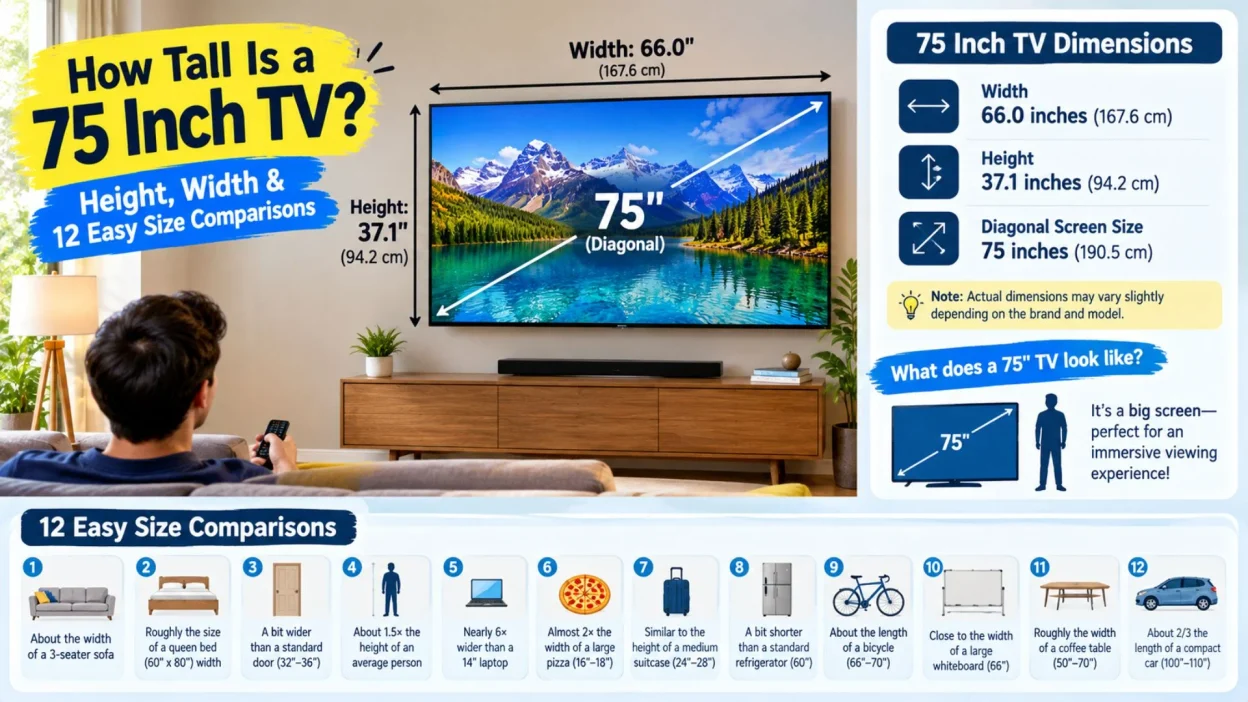
A 75-inch TV sounds enormous, but the number doesn’t tell you how tall the screen actually is. You could measure 75 inches from one end of a tape measure to the other and still struggle to picture how much wall space a television of that size will occupy. That’s because TV sizes are measured differently from most household objects.
A typical 75-inch television has a screen height of approximately 36.8 inches (93.5 cm) and a screen width of about 65.4 inches (166 cm) when it uses a standard 16:9 aspect ratio. The full television can be slightly larger once you include its bezel and frame.
This measurement matters when you’re choosing a TV for your living room, planning a wall mount, or checking whether a screen will fit on your entertainment unit. It also helps you judge how far away your sofa should be for comfortable viewing.
In this guide, you’ll learn how tall a 75-inch TV is in feet, centimeters, millimeters, and meters. You’ll also see how its dimensions compare with everyday objects, how diagonal screen measurements work, and how to estimate its size without a measuring tape.
A 75-inch TV screen is approximately 3 feet 0.8 inches tall, 93.5 centimeters, 935 millimeters, and 0.935 meters. Its width is roughly 5 feet 5.4 inches, making it a substantial screen for most rooms.
Every Unit a 75-Inch TV Converts To
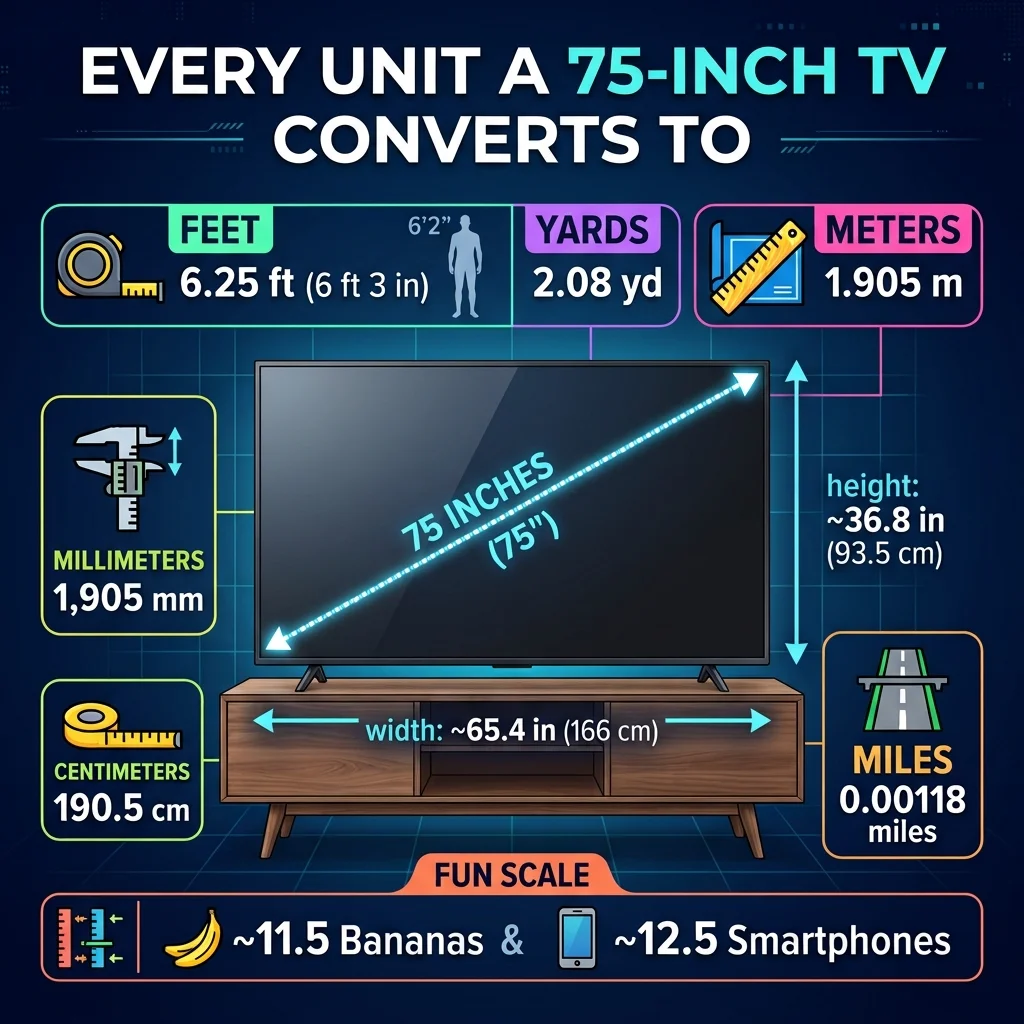
Before comparing a 75-inch television with furniture or other household objects, it helps to understand its actual dimensions.
The important detail is that 75 inches refers to the diagonal of the screen, not its height or width. For a standard widescreen TV, that diagonal produces a screen that’s approximately 36.8 inches tall and 65.4 inches wide.
| Measurement | Approximate Value |
|---|---|
| Screen diagonal | 75 inches |
| Screen height | 36.8 inches |
| Screen height in feet | 3.07 feet |
| Screen height in feet and inches | 3 feet 0.8 inches |
| Screen height in centimeters | 93.5 cm |
| Screen height in millimeters | 935 mm |
| Screen height in meters | 0.935 m |
| Screen width | 65.4 inches |
| Screen width in feet | 5.45 feet |
| Screen width in centimeters | 166 cm |
| Screen width in meters | 1.66 m |
| Screen diagonal in centimeters | 190.5 cm |
| Screen diagonal in meters | 1.905 m |
These figures describe the screen itself using a standard 16:9 aspect ratio. Actual product dimensions vary slightly by model, particularly when you include the frame, stand, or wall-mount hardware.
How to Calculate a 75-Inch TV’s Height
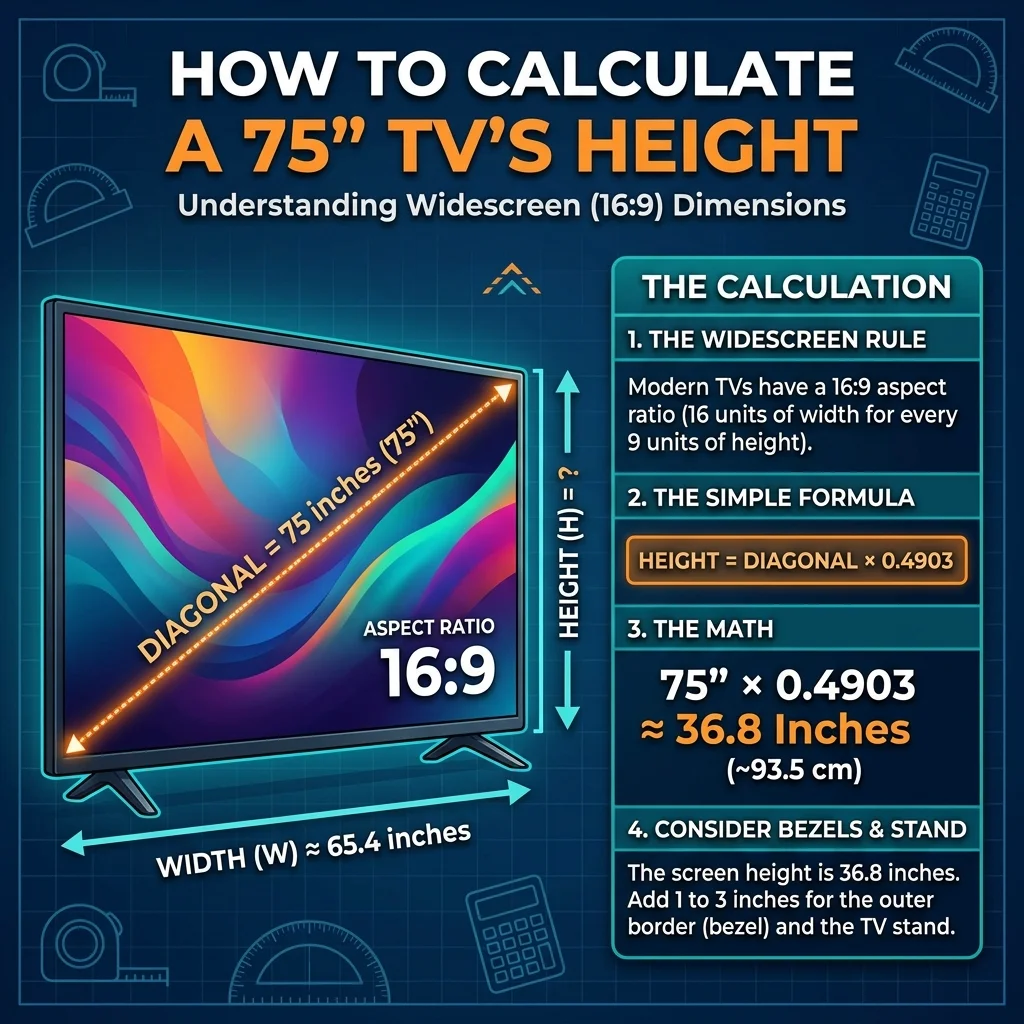
You can calculate the approximate screen height using the diagonal measurement and the standard 16:9 aspect ratio.
The formula is:
- Screen height = diagonal × 9 ÷ √(16² + 9²)
- Screen height = 75 × 9 ÷ √337
- Screen height ≈ 36.8 inches
The width uses the same calculation with 16 instead of 9, giving approximately 65.4 inches.
For everyday conversions, use these simple formulas:
- Inches ÷ 12 = feet
- Inches × 2.54 = centimeters
- Inches × 25.4 = millimeters
- Inches × 0.0254 = meters
For example, 36.8 inches × 2.54 gives approximately 93.5 cm. Similarly, dividing 36.8 by 12 gives about 3.07 feet.
Where a 75-Inch TV Fits on a Size Chart
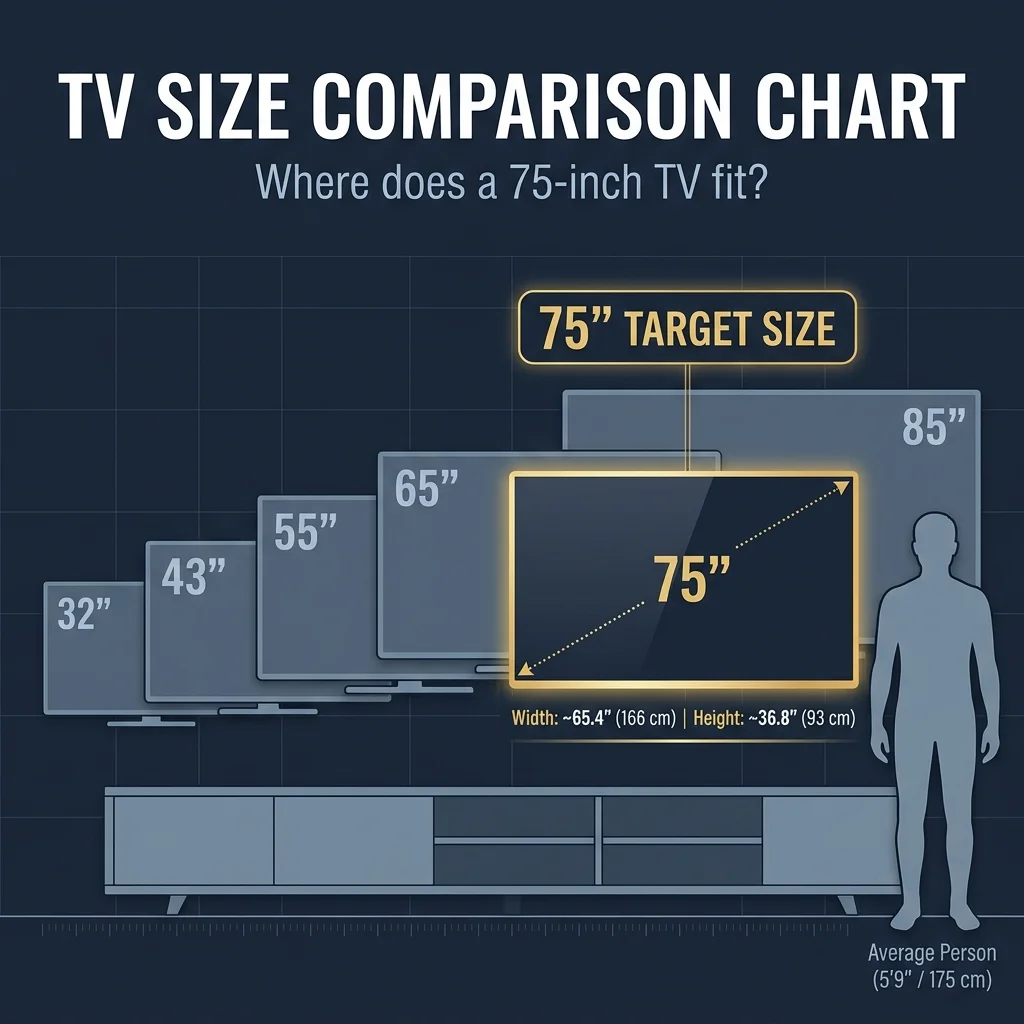
A 75-inch television is considered a large-screen TV. It’s substantially wider and taller than many standard living-room televisions, so the surrounding space matters just as much as the screen itself.
Here’s how its approximate dimensions compare with other common TV sizes using a 16:9 screen ratio.
| TV Size | Approx. Screen Height | Approx. Screen Width |
|---|---|---|
| 32-inch TV | 15.7 inches | 27.9 inches |
| 43-inch TV | 21.1 inches | 37.5 inches |
| 50-inch TV | 24.5 inches | 43.6 inches |
| 55-inch TV | 27 inches | 47.9 inches |
| 65-inch TV | 31.9 inches | 56.7 inches |
| 75-inch TV | 36.8 inches | 65.4 inches |
| 85-inch TV | 41.7 inches | 74.1 inches |
Notice how the height increases with screen size. A 75-inch TV has a screen that’s about 4.9 inches taller than a 65-inch TV. It is also approximately 8.8 inches wider.
That difference can be surprisingly noticeable when you upgrade. The larger screen occupies more of your field of view, and the extra width may affect where you place speakers, shelves, or decorative items.
However, the best size isn’t always the largest one available. Room layout, viewing distance, screen resolution, and personal preference all influence whether a 75-inch TV feels comfortable.
If you’re planning to mount one on a wall, measure the available area first. Remember to leave room for ventilation, cables, and any mounting equipment recommended by the manufacturer.
12 Things That Help You Visualize a 75-Inch TV’s Height
A measurement becomes much easier to understand when you compare it with something familiar. The screen height of a 75-inch TV is about 36.8 inches, or just over 3 feet.
The following comparisons help you picture that height in everyday settings. Most are approximations, so check the actual dimensions of an object if you need a precise match.
1. A Standard 3-Foot Measurement
<text color=”secondary” size=”sm”>Reference: 36 inches versus approximately 36.8 inches</text>
Three feet is one of the easiest ways to visualize the height of a 75-inch TV. The screen is just under an inch taller than a full 36-inch measurement.
Imagine a yardstick standing vertically. Its 3-foot length comes very close to the height of the screen, although the television is wider than the yardstick is long.
This comparison is useful because three feet is a familiar measurement for furniture, storage boxes, and household spaces. You don’t need a complicated conversion to understand it.
To picture the height, imagine a vertical line rising from the floor to about 3 feet. A 75-inch TV’s screen reaches roughly that far from its bottom edge to its top edge.
2. A Small Three-Foot Bookcase
Many compact bookcases and storage shelves stand around 3 feet tall, although their exact heights vary by design.
A bookcase measuring 36 inches would be about 0.8 inches shorter than the screen height of a typical 75-inch TV. This makes it a helpful reference if you already have one in your home.
Small bookcases are designed to fit below windows, beside desks, or into tight storage spaces. Their familiar height helps show how a TV screen can reach higher than a low piece of furniture.
Stand beside a short bookcase and imagine extending its top edge upward by less than an inch. That gives you a rough picture of the television’s screen height.
3. A Three-Foot Folding Table
Some small folding tables have tops around 36 inches above the floor. The exact height depends on whether the table is intended for children, crafts, dining, or other uses.
Compared with that table height, the screen of a 75-inch TV is only slightly taller. However, the comparison works best when you focus on the vertical distance rather than the table’s surface area.
Tables are useful visual references because many people already know how high one feels when sitting or standing beside it. A three-foot surface is often around waist height for an adult, depending on their body proportions.
Picture the table’s top edge as the bottom of a vertical measuring line. Extend that line upward by about an inch, and you’ll be close to the TV screen’s height.
4. A Tall Kitchen Counter Stool
Some counter stools have seats around 24 to 26 inches high, while bar stools are often taller. A stool’s full height can vary substantially depending on its backrest and design.
For a useful comparison, consider a low stool or chair with an overall height close to 36 inches. Its top edge would sit almost level with the screen height of a 75-inch television.
This comparison is most helpful if you have a stool at home and can check its dimensions. Unlike a fixed standard, furniture heights vary enough that you shouldn’t assume every stool is close to 3 feet tall.
Imagine standing a 36-inch stool next to the screen. The TV’s screen would extend just a little higher, helping you visualize the difference between a compact object and a large display.
5. A Child’s Three-Foot Play Structure
Some indoor play structures, toy shelves, and small activity stations are designed at around 3 feet high. Their dimensions depend on the intended age group and product style.
A 36-inch play structure is a useful reference because it is close to the screen height of a 75-inch TV. The screen would be about 0.8 inches taller.
These objects are designed to be accessible to children, so their height is often easy to recognize in a playroom or nursery. Nevertheless, always check the specific product dimensions before using one as a measuring reference.
If you imagine a three-foot play structure standing upright, its top edge would come very close to the top of the television screen when both start at the same level.
6. A Standard Interior Door Handle Height Is Much Lower
Door handles are commonly installed around 34 to 48 inches above the floor, depending on building practices and accessibility requirements. This means a typical handle may sit near or above the height of a 75-inch TV screen.
This comparison is useful because door handles are easy to spot in almost every home. However, the handle’s height is not the same as the door’s full height, so make sure you’re comparing the correct part.
A handle around 36 inches high would sit close to the screen’s top edge if the TV screen started at floor level. In a real installation, of course, the TV is usually mounted above the floor or placed on a stand.
To visualize the difference, look at a nearby door handle and imagine a vertical screen rising from the same floor level. A handle installed near 36 to 37 inches would mark roughly the screen’s top height.
7. A Three-Foot Storage Cabinet
Compact storage cabinets are often made around 30 to 36 inches tall. This makes a 36-inch cabinet a practical comparison for a television screen that’s approximately 36.8 inches high.
The exact cabinet size depends on whether it is designed for a bathroom, office, kitchen, or living room. Some models are shorter, while others include feet or a raised base.
A low cabinet also offers a useful reminder about TV placement. A television mounted above furniture will have a combined floor-to-top height that is much greater than the screen’s height alone.
Picture a cabinet measuring exactly 3 feet tall. Its top would be just below the top of a 75-inch TV screen if both were measured from the same level.
8. A Large Suitcase Standing Upright
Large checked suitcases commonly measure around 28 to 32 inches in overall height, although some travel cases are larger. Their handles and wheels may affect the final measurement.
A suitcase at the taller end of that range is still several inches shorter than a 36.8-inch television screen. This makes it a useful comparison for understanding that a large screen is taller than many everyday travel items.
Suitcases are easy to visualize because most people have handled one or seen one beside an airport check-in counter. However, their dimensions are usually given as height, width, and depth rather than screen diagonal.
Imagine a 30-inch suitcase standing upright beside the TV. The screen would extend roughly 6.8 inches higher, which is a noticeable difference.
9. A Child-Sized Table
Small children’s tables often measure around 18 to 24 inches high. Their height is considerably lower than a 75-inch TV screen, but the comparison can help you understand how much vertical space the screen occupies.
For example, a 24-inch table is about 12.8 inches shorter than the screen. That difference is slightly more than one foot.
Children’s furniture is intentionally low so that young users can sit comfortably and reach the surface. Therefore, it works as a familiar reference rather than an exact match.
Imagine stacking an additional 12 to 13 inches of height above a 24-inch table. You would reach approximately the height of the television screen.
10. A Three-Foot Garden Planter
Some large outdoor planters and decorative containers are around 3 feet tall, although many common planters are much shorter. A tall planter measuring 36 inches would come close to the screen height of a 75-inch TV.
This comparison works particularly well if you have a large planter near a patio or entrance. Its height can help you picture the vertical span without needing to think about inches or centimeters.
Remember that the overall height may include the base or feet. If you need an accurate comparison, measure the planter from its lowest point to the top rim.
A 36-inch planter would be just under an inch shorter than the screen. Picture the TV’s screen and the planter standing side by side on the same floor to see how closely they match.
11. A Large Rolling Tool Chest
Some compact rolling tool chests and workshop storage units are close to 3 feet tall, although larger tool cabinets can be substantially taller.
A chest around 36 inches high is nearly the same height as the screen of a 75-inch television. The screen would be less than an inch taller.
Tool chests are designed to store equipment at a convenient working height. Their dimensions vary by drawer arrangement, wheels, and worktop, so a specific model’s specifications are the best guide.
If you have a workshop or garage, look at the height of a compact rolling cabinet. Its top edge may give you a quick visual reference for the TV’s screen height.
12. A Large TV’s Screen Height Compared With Its Width
The most direct comparison is the television itself. A standard 75-inch TV has a screen height of approximately 36.8 inches and a width of about 65.4 inches.
That means the screen is roughly 1.78 times as wide as it is tall. This ratio is the familiar 16:9 widescreen format used by most modern televisions.
Unlike furniture comparisons, this one uses the same product and the same measurement system. It also explains why a 75-inch TV can look very wide without being anywhere near 75 inches tall.
Imagine a rectangle slightly over 5 feet wide and just over 3 feet tall. That is a much better mental picture of the screen than imagining a 75-inch vertical measurement.
How Big Is a 75-Inch TV Really?
A 75-inch TV is large enough to dominate many living rooms, but its diagonal measurement can be misleading if you don’t understand how manufacturers size screens.
Why Is a 75-Inch TV Called 75 Inches?
TV sizes are measured diagonally from one corner of the visible screen to the opposite corner. The measurement does not describe the vertical height or horizontal width.
For a standard 16:9 display, a 75-inch diagonal translates to a screen about 36.8 inches high and 65.4 inches wide. The diagonal is approximately 190.5 cm.
Think of drawing a line from the bottom-left corner of the screen to the top-right corner. That line is the 75-inch measurement.
What Is the Full Height of a 75-Inch TV?
The visible screen is approximately 36.8 inches tall. However, the complete television may be slightly taller because of the frame around the screen.
The stand adds another consideration. Depending on the model, the stand may extend below the display and increase the total height when the TV sits on a cabinet.
For wall mounting, check the manufacturer’s listed product height and mounting specifications. Those details matter more than the diagonal measurement when you’re determining whether the TV will fit into a specific space.
How Much Wall Space Does a 75-Inch TV Need?
The screen alone is approximately 65.4 inches wide and 36.8 inches tall. For planning purposes, you should check the actual dimensions of the television and allow additional space around it for cables, ventilation, and any accessories.
A wall space measuring 6 feet wide is 72 inches across. That leaves only about 6.6 inches of extra width around a 65.4-inch screen, or approximately 3.3 inches on each side if centered.
The television’s outer frame may be slightly wider than the visible screen, so always use the manufacturer’s measurements before drilling holes or buying a wall mount.
Is a 75-Inch TV Too Big for a Living Room?
Not necessarily. Whether a 75-inch TV feels too large depends on the room, viewing distance, content, and personal preference.
A large display can work well in a spacious living room or media room. However, in a small space, it may occupy much of the wall and require careful placement to avoid obstructing furniture or walkways.
Before choosing one, mark the approximate screen rectangle on your wall using removable tape. A rectangle about 65 inches wide and 37 inches high gives you a much clearer sense of the display’s size than the 75-inch label alone.
Getting to a 75-Inch TV’s Height Without a Tape Measure
You don’t always need a measuring tape to picture a 36.8-inch screen. A few familiar references can help you estimate its height, although they won’t replace accurate measurements when you’re installing a television.
Use a Three-Foot Reference
Three feet equals 36 inches, which is just under the screen height of a typical 75-inch TV. If you know what a yardstick or a 3-foot object looks like, you already have a useful starting point.
The screen extends about 0.8 inches beyond that length. It’s a small difference, so three feet is a practical mental shortcut.
Mark the Screen on a Wall
Use removable painter’s tape to outline a rectangle approximately 65.4 inches wide and 36.8 inches high. This method lets you see how the screen might look above a cabinet or sofa.
You can also sit in your usual viewing position and check whether the proposed location feels comfortable. However, remember that the outer frame and stand may change the final dimensions.
Compare It With a Low Cabinet
A cabinet about 36 inches tall is almost the same height as the screen. If you already own one, use it as a reference to visualize the vertical dimension.
This comparison is particularly useful when deciding how high to mount the TV. Just remember that the television’s mounting height is separate from its screen height.
Use Your Phone’s Measuring Tool
Many smartphones include a measurement app or augmented-reality measuring feature. Depending on your device and surroundings, it may help estimate a wall or furniture dimension.
Treat the result as an approximation rather than a guarantee. For a wall mount, cabinet fit, or installation that requires precision, verify the measurements with a suitable measuring tool.
Remember the Difference Between Screen Height and Mounting Height
A 75-inch TV screen is about 36.8 inches tall, but that does not mean its top edge should sit 36.8 inches above the floor. The final position depends on how high the bottom edge is mounted or where the stand places the screen.
For example, if the bottom of the screen is 30 inches above the floor, the top will be around 66.8 inches above the floor. That is a separate measurement from the screen’s height.
FAQs About 75-Inch TV Dimensions
How tall is a 75-inch TV in feet?
The screen of a standard 75-inch TV is approximately 3.07 feet tall, or 3 feet and 0.8 inches. The full television may be slightly taller because of its frame or stand.
How tall is a 75-inch TV in centimeters?
The screen height is approximately 93.5 cm. Actual product dimensions vary slightly by model and may include a frame that extends beyond the visible display.
How tall is a 75-inch TV in meters?
The screen is about 0.935 meters tall. For quick planning, you can think of it as just under one meter in height.
How wide is a 75-inch TV?
A standard 16:9 75-inch TV has a screen width of approximately 65.4 inches, or 166 cm. The overall television may be a little wider depending on its frame.
Is a 75-inch TV actually 75 inches tall?
No. The 75-inch measurement refers to the diagonal distance across the screen. Its screen height is about 36.8 inches, while its width is approximately 65.4 inches.
What everyday object is about as tall as a 75-inch TV screen?
A 36-inch bookcase, cabinet, or similar piece of furniture is close to the screen height. The TV screen is about 0.8 inches taller, so these objects offer a convenient visual comparison.
Can I fit a 75-inch TV on a 6-foot-wide wall?
A 6-foot wall is 72 inches wide, while a typical 75-inch TV screen is about 65.4 inches wide. It may fit, but the outer frame, mounting hardware, and clearance requirements should be checked before installation.
Does a 75-inch TV’s stand affect its height?
Yes. The stand changes how high the screen sits above the floor, and some stands also increase the total height of the assembled television. Check the manufacturer’s dimensions for both the TV without its stand and the complete setup.
Where That Leaves You
A 75-inch TV is much shorter than its name might suggest. Its screen stands about 36.8 inches tall (93.5 cm) and stretches approximately 65.4 inches wide (166 cm). In other words, the screen is a little over 3 feet high and roughly 5.5 feet wide.
One of the easiest ways to picture its height is to compare it with a 36-inch cabinet or bookcase. The screen reaches just slightly higher, making the comparison easy to visualize in an ordinary room.
Before buying or mounting a television, remember that screen dimensions and overall product dimensions are not always identical. Check the manufacturer’s measurements, then use removable tape to outline the screen on your wall. That simple step can help you judge the size far more accurately than the diagonal number alone.