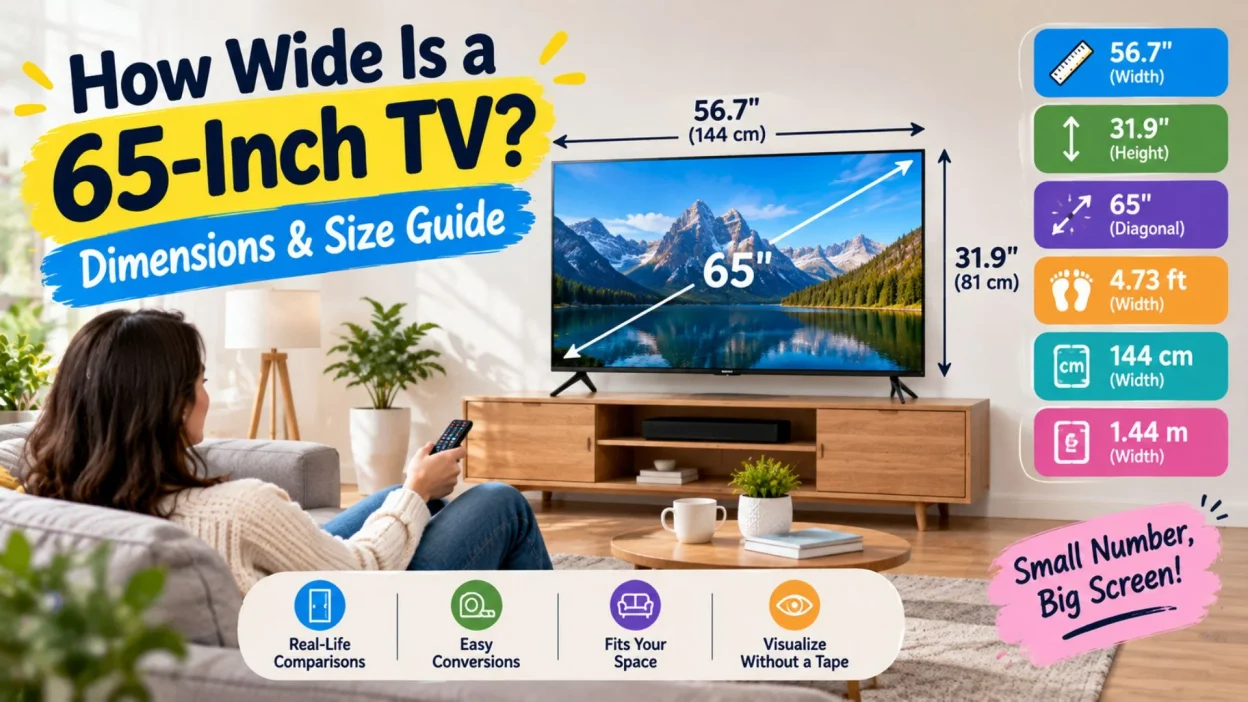
A 65-inch TV can look much bigger in a store than it does in your living room. However, the number on the box does not tell you how much horizontal space the television will occupy. That is because TV sizes are measured diagonally, from one corner of the screen to the opposite corner.
So, how wide is a 65 inch TV? A typical widescreen model has a screen width of approximately 56.7 inches, which equals about 4 feet 8.7 inches or 144 centimeters. Its screen height is roughly 31.9 inches, although the complete television may be slightly larger because of its frame.
These measurements are useful when choosing a TV stand, planning a wall-mounted setup, or checking whether a television will fit inside an entertainment unit. Even a difference of a few inches can matter when your available space is limited.
In this guide, you will learn the exact mathematical conversions, compare the screen with familiar household objects, and discover practical ways to visualize its size without a measuring tape.
A typical 65-inch TV screen is approximately 56.7 inches wide, 31.9 inches tall, 144 cm wide, 81 cm tall, and 1.44 meters wide.
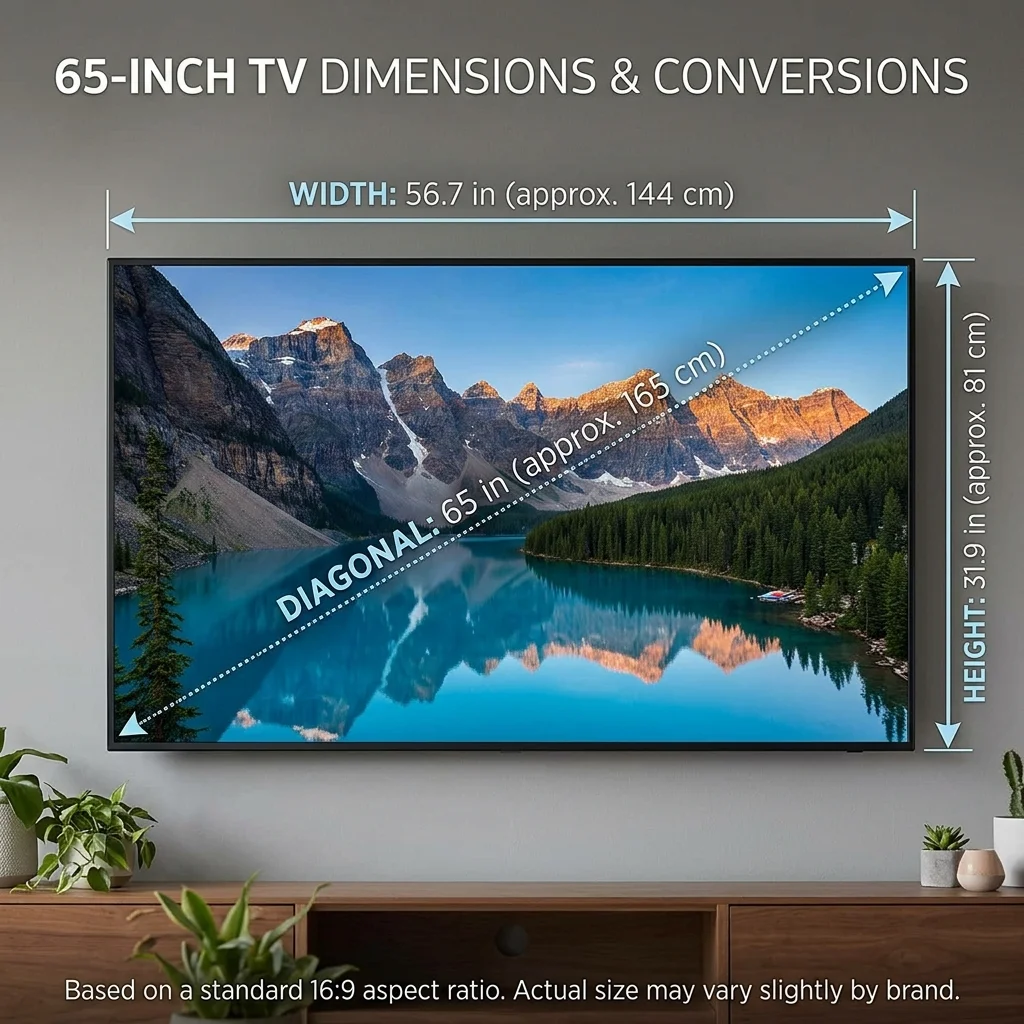
Before buying a television, it helps to understand its width and height in the measurement units you use every day. Inches are common in TV product names, while centimeters and meters are often more convenient when measuring furniture or room layouts.
The following table shows the approximate dimensions of a standard 65-inch television with a 16:9 widescreen display.
| Measurement | Approximate Value |
|---|---|
| Screen diagonal | 65 inches |
| Screen width | 56.7 inches |
| Screen height | 31.9 inches |
| Width in feet | 4.73 feet |
| Height in feet | 2.66 feet |
| Width in centimeters | 144 cm |
| Height in centimeters | 81 cm |
| Width in millimeters | 1,440 mm |
| Height in millimeters | 810 mm |
| Width in meters | 1.44 m |
| Height in meters | 0.81 m |
| Diagonal in centimeters | 165.1 cm |
| Diagonal in meters | 1.651 m |
These numbers describe the approximate visible screen, not necessarily the television’s complete outer dimensions. A frame, speakers, or other design features may add a little width or height.
How to Calculate the Width of a 65-Inch TV
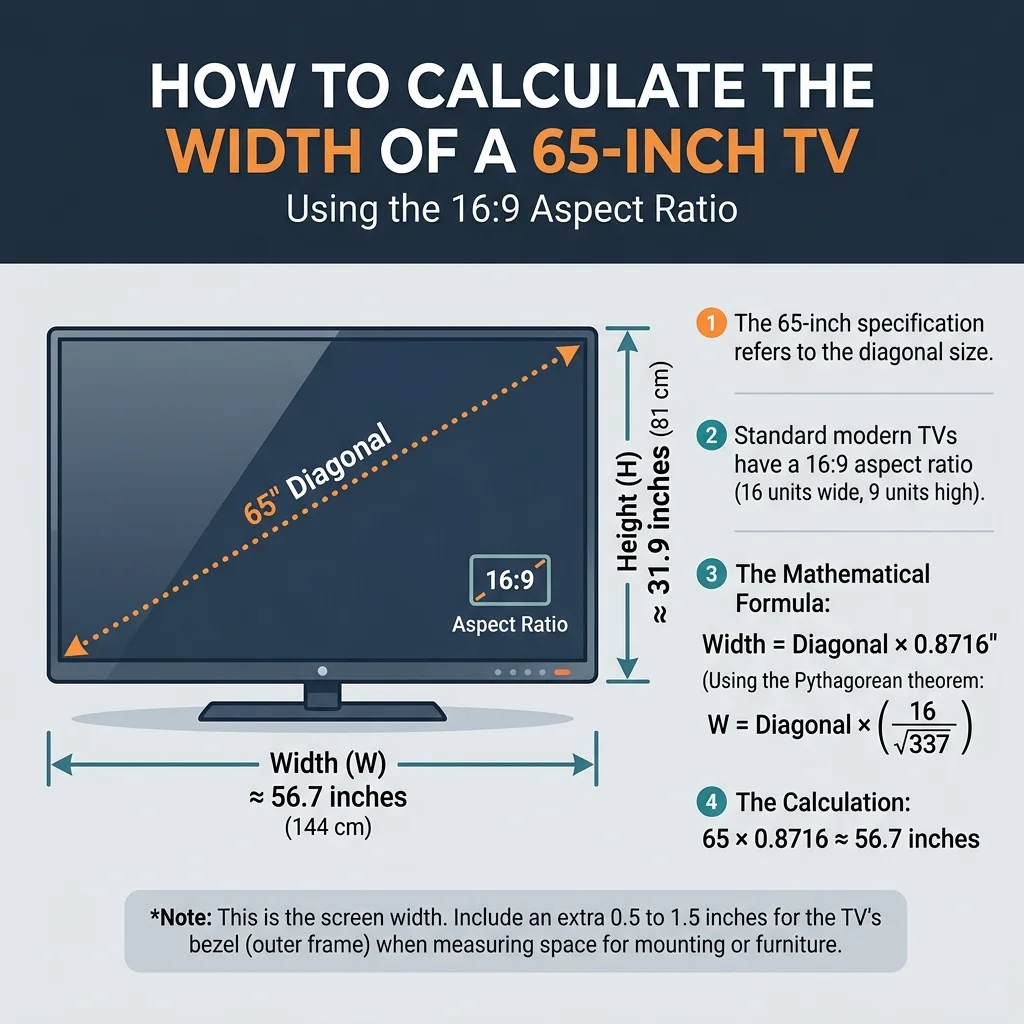
Most modern televisions use a 16:9 aspect ratio. This means the screen is 16 units wide for every 9 units of height.
Using this ratio, a 65-inch diagonal gives a screen width of approximately 56.7 inches and a height of approximately 31.9 inches.
You can also convert inches into other units with a few simple formulas:
- Inches to feet: Divide the number by 12.
- Inches to centimeters: Multiply by 2.54.
- Inches to millimeters: Multiply by 25.4.
- Inches to meters: Multiply by 0.0254.
For example, 56.7 inches multiplied by 2.54 equals approximately 144 centimeters. Similarly, dividing 56.7 by 12 gives around 4.73 feet.
Therefore, if you are searching for a 65-inch TV width in feet, you can think of it as just under 4 feet 9 inches. In metric measurements, the screen is about 144 cm or 1.44 meters wide.
However, these calculations assume a standard 16:9 display. Always check the manufacturer’s specifications when you need the exact outer dimensions.
Where a 65-Inch TV Fits on a Size Chart
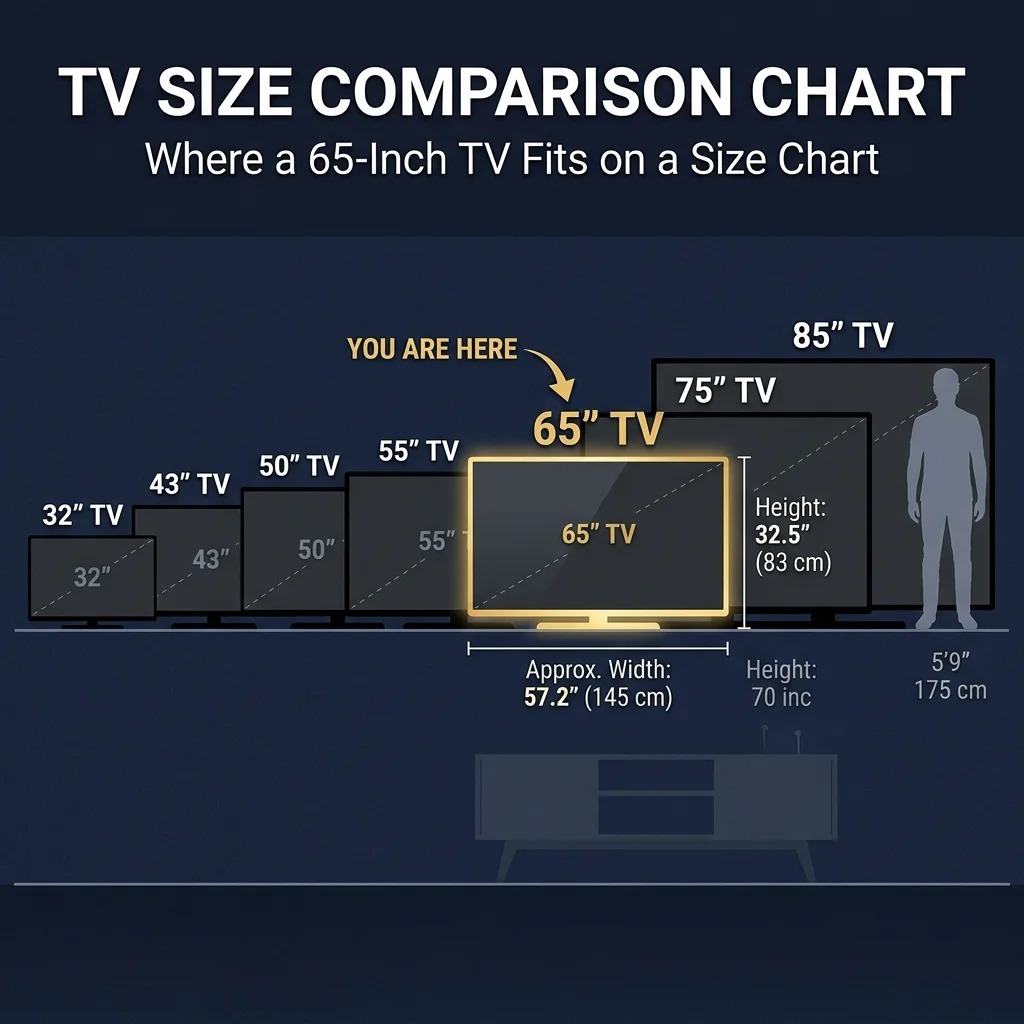
A 65-inch television is a substantial screen for a living room, bedroom, or entertainment area. Its width of approximately 56.7 inches means it occupies nearly five feet of horizontal space.
Still, it is important to compare different TV sizes before making a decision. A screen that looks enormous in a showroom may feel more manageable at home, particularly when you have enough viewing distance.
Comparing Common Television Sizes
Here is how a 65-inch TV compares with several other popular screen sizes.
| TV Size | Approximate Width | Approximate Height |
|---|---|---|
| 32-inch TV | 27.9 inches | 15.7 inches |
| 43-inch TV | 37.5 inches | 21.1 inches |
| 50-inch TV | 43.6 inches | 24.5 inches |
| 55-inch TV | 47.9 inches | 27 inches |
| 65-inch TV | 56.7 inches | 31.9 inches |
| 75-inch TV | 65.4 inches | 36.8 inches |
| 85-inch TV | 74.1 inches | 41.7 inches |
These figures are estimates for 16:9 screens and exclude the outer frame.
Moving from a 55-inch television to a 65-inch model adds almost nine inches of screen width. As a result, the larger television can provide a more immersive experience for movies, sports, and video games.
On the other hand, moving from 65 inches to 75 inches adds roughly another 8.7 inches of width. That difference can be noticeable when both televisions are viewed side by side.
Will a 65-Inch TV Fit on Your Wall?
A screen that measures approximately 56.7 inches wide needs a little more space if you want visible clearance around its edges.
For example, a wall section measuring 60 inches across may accommodate the screen itself, but there will be limited room on either side. A wider wall offers more flexibility for positioning the television and adding speakers or decorative elements.
Nevertheless, screen width is not the only measurement that matters. You should also consider the outer frame, mounting brackets, nearby furniture, wall outlets, and the viewing distance.
If you plan to place the TV on a cabinet, check the distance between its feet as well as its total width. Some stands extend toward the edges, while others use a central base.
12 Things That Help You Visualize a 65-Inch TV
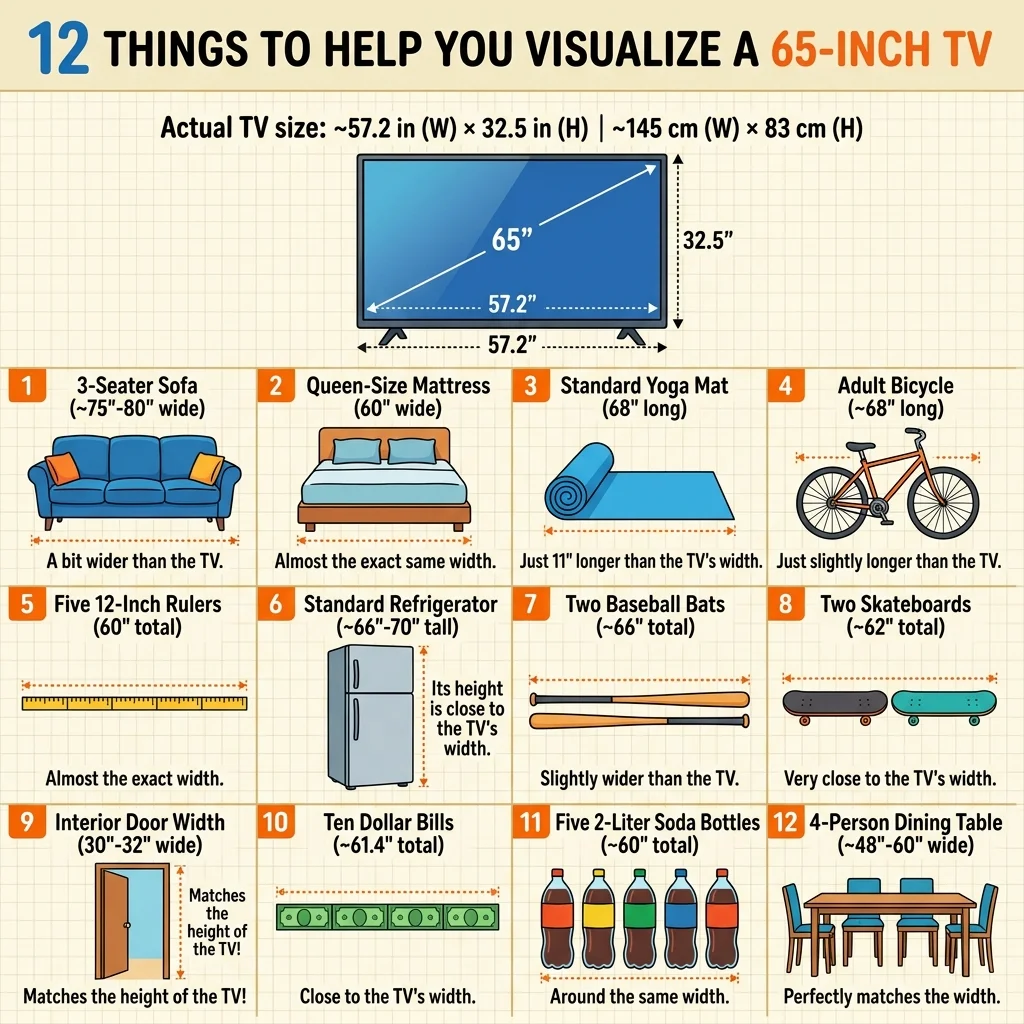
Numbers can be difficult to picture until you compare them with objects you already know. Fortunately, several common household items have dimensions close to the width of a 65-inch TV.
The screen measures approximately 56.7 inches across. The following comparisons help you understand that size in practical terms, although the exact dimensions of each object may vary.
1. A Five-Foot Folding Table
A five-foot folding table measures 60 inches long, making it a useful reference for a 65-inch TV.
The table is only about 3.3 inches longer than the screen. Therefore, the television’s width would occupy most of the table’s length if you compared the measurements along the same horizontal line.
Five-foot folding tables are commonly used for family gatherings, parties, temporary workspaces, and outdoor events. Their familiar dimensions make them easier to visualize than an abstract measurement.
Imagine placing the screen above the table. It would be nearly as wide, leaving a relatively small amount of extra length at the ends.
2. A Queen-Size Mattress
A standard queen mattress in the United States measures approximately 60 inches wide and 80 inches long.
That makes its width slightly greater than the 56.7-inch screen width of a typical 65-inch TV. The difference is only around 3.3 inches, so the two measurements are quite close.
This is a useful comparison because a queen mattress provides a broad surface that many people can picture immediately. If you already have one at home, you can use its width as a reference.
Keep in mind that mattress sizes vary between countries. The 60-by-80-inch dimensions refer to the common U.S. queen size.
3. A Standard Interior Door
Many interior doors in U.S. homes are approximately 28–32 inches wide, depending on the room and building design.
A 65-inch TV screen is therefore considerably wider than one typical interior door. If you imagine two 30-inch-wide doors side by side, their combined width would be around 60 inches.
That is slightly more than the television’s screen width. This makes a pair of doors a convenient visual reference for understanding how much horizontal space the screen occupies.
However, door dimensions are not universal. Measure your own door if you want to use it for a closer comparison.
4. A Large Office Desk
Many home office desks are around 60 inches wide, although smaller and larger versions are also common.
A 65-inch TV screen would be a little narrower than a 60-inch desk. The difference is small enough that you can picture the television occupying most of the desk’s width.
This comparison is especially helpful when planning a home entertainment setup or rearranging a room. A large desk provides a familiar reference for estimating the screen’s horizontal span.
Still, the desk’s overall width does not guarantee that it can safely support a television. Always check the TV’s weight and the furniture’s load capacity before placing it on a surface.
5. A Standard Bathtub

Many conventional rectangular bathtubs are approximately 60 inches long, although compact and oversized models are available.
Compared with a 60-inch bathtub, a 65-inch TV’s screen is about 3.3 inches narrower. This makes the bathtub a useful reference for visualizing a measurement close to five feet.
The comparison is particularly helpful if you have recently looked at bathroom fixtures or home improvement products. A five-foot bathtub is a familiar size in many residential bathrooms.
However, the actual dimensions depend on the style and model. Freestanding and soaking tubs may be longer or wider than conventional built-in versions.
6. A Six-Foot Dining Bench
A six-foot bench measures 72 inches long, which is noticeably longer than the width of a 65-inch TV.
The difference is approximately 15.3 inches. In practical terms, the television would cover most of the bench’s length but would not reach both ends.
Dining benches and outdoor benches are useful references because their long, straight shapes make comparisons easy. However, compact entryway benches may be much shorter.
If you picture the television centered above a six-foot bench, you can imagine a substantial screen with some extra horizontal space on both sides.
7. A Full-Size Acoustic Guitar
A full-size acoustic guitar is often around 38–41 inches long, depending on the design.
Although it is shorter than a 65-inch TV’s width, it offers a helpful reference for understanding the scale of the screen. The television would extend roughly 16–19 inches beyond the guitar if both were aligned at one end.
Guitars have different body shapes and overall lengths. Their scale length, which refers to the vibrating string length, is not the same as the instrument’s total length.
Imagine laying a guitar horizontally beneath the television. The screen would extend well beyond both the body and the headstock’s combined length.
8. Two Large Suitcases Side by Side
Many large checked suitcases are approximately 18–21 inches wide each.
Placed side by side, two such suitcases would span around 36–42 inches. That is narrower than a 65-inch TV screen, leaving a noticeable difference between the two measurements.
This comparison works well for frequent travelers because large suitcases are familiar household objects. It also helps demonstrate how two separate objects can combine to create a wider measurement.
However, suitcase dimensions vary by brand and design. Wheels, handles, and curved edges can affect the overall measurements.
9. A Standard Yoga Mat
A typical yoga mat is approximately 24 inches wide and 68 inches long, although extra-long and extra-wide versions are available.
Its length is greater than the width of a 65-inch television, while its width is much smaller. This makes it an interesting comparison because the two objects have very different proportions.
Yoga mats are designed to provide room for stretching, standing, and floor exercises. Their long rectangular shape is easy to recognize in a home or gym.
Imagine turning the mat sideways and comparing its length with the TV’s width. A 68-inch mat would extend about 11 inches beyond the screen.
10. A Five-Foot Bookshelf

A bookshelf that measures 60 inches across is slightly wider than a typical 65-inch TV screen.
The difference is approximately 3.3 inches, making the two measurements close enough for a useful visual comparison.
Bookshelves come in many designs, from narrow vertical units to broad pieces of furniture that span an entire wall. A five-foot width is an example rather than a standard that applies to every bookshelf.
If you already own a bookshelf of this size, imagine placing the television’s screen measurement across its front. The screen would cover almost the entire width.
11. An 80-Inch-Tall Interior Door
A common interior door in the United States is around 80 inches tall.
Compared with that height, the 56.7-inch width of a 65-inch TV is about 23.3 inches shorter. This provides a useful way to picture the screen’s width using a familiar vertical measurement.
Door heights vary by building style, location, and age. Some modern homes have taller doors, so the comparison should be treated as approximate.
Imagine turning the door’s height sideways. The TV screen would span a little over 70% of that distance.
12. A Five-Foot Wooden Board
A five-foot wooden board measures 60 inches long, which is slightly longer than the width of a 65-inch TV screen.
The difference is around 3.3 inches. Because the board is straight and narrow, it provides a simple reference for visualizing the television’s horizontal measurement.
Construction timber and trim are available in many lengths, and boards are often cut to suit a specific project. Therefore, a five-foot board is a convenient comparison rather than a universal product size.
If you imagine the board stretched across a wall, the television’s screen would be just a little narrower. For an actual installation, though, measure the television and the available space directly.
Why a 65-Inch TV Is Not 65 Inches Wide
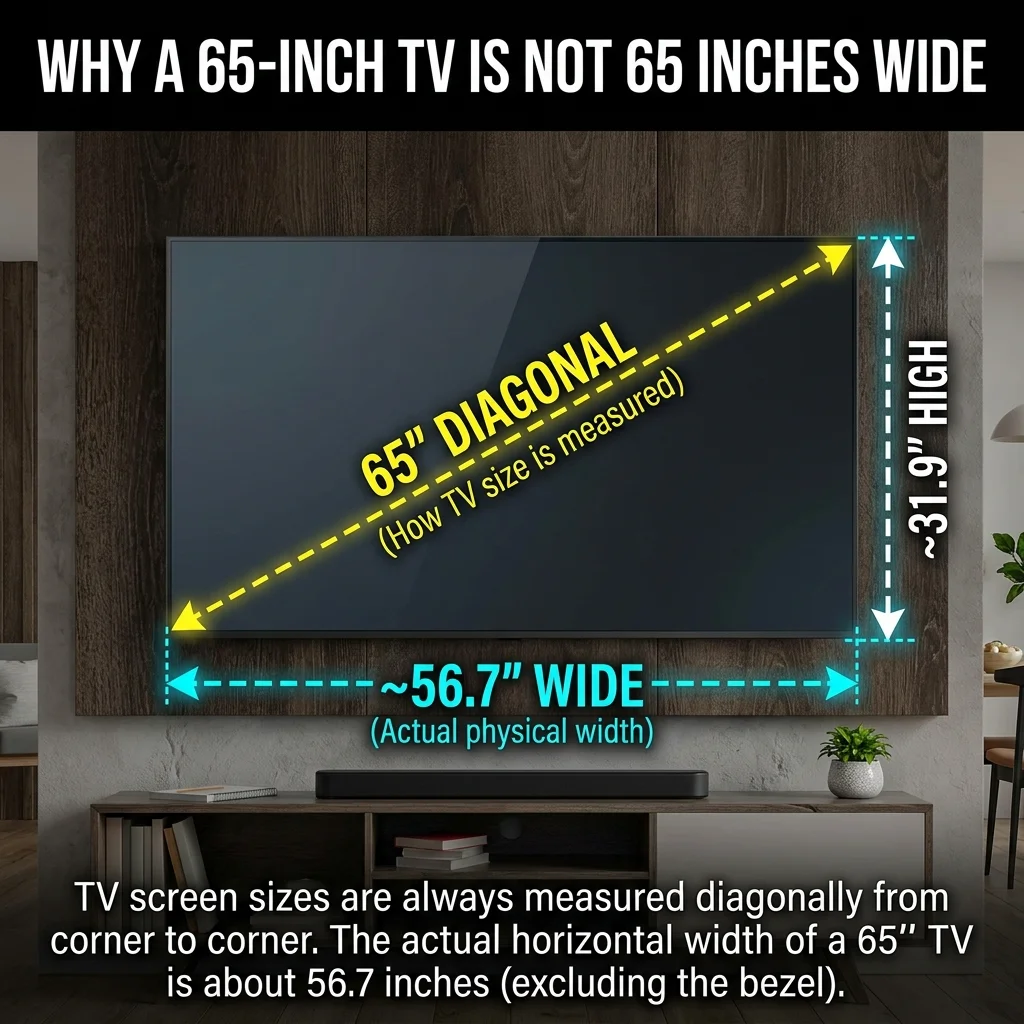
The biggest source of confusion is the way television screen sizes are measured. The number on the product label describes the diagonal of the display, not the distance from its left edge to its right edge.
To picture this, imagine drawing a straight line between the top-left and bottom-right corners of the screen. On a 65-inch television, that diagonal is approximately 65 inches long.
The horizontal width is shorter because it runs only across the screen. Similarly, the vertical height measures from the top edge to the bottom edge.
How Diagonal Measurement Determines Width
Most modern televisions use a 16:9 aspect ratio. In simple terms, the screen is 16 units wide for every 9 units of height.
When the diagonal measures 65 inches, the approximate screen dimensions become:
- Width: 56.7 inches
- Height: 31.9 inches
- Diagonal: 65 inches
These measurements describe the visible display area. The full television may be slightly wider or taller because of its frame or other design elements.
What Is the Actual Outside Width of a 65-Inch TV?
There is no single outside width for every 65-inch television. Different manufacturers use different frames, speaker arrangements, and cabinet designs.
For planning purposes, approximately 57 inches is a useful estimate for the screen width. However, the complete product may measure slightly more.
Before buying a particular model, check the manufacturer’s specification sheet. Look for the width and height with the stand removed if you plan to mount the TV on a wall.
If you intend to use a cabinet, also check the television’s stand dimensions and the distance between its feet. These measurements can determine whether it will sit securely on the furniture.
How Much Wall Space Does a 65-Inch TV Need?
A 65-inch television generally needs more horizontal space than the visible screen alone suggests. You should account for the frame, mounting arrangement, and the clearance you want around the display.
For example, a 60-inch-wide wall section may be wide enough for the screen itself, but it offers limited space at the sides. A wider area gives you more flexibility for positioning the television and adding accessories.
The best fit also depends on your room layout and viewing distance. A screen that fits physically may still feel too large or too small for the space.
Getting to 65-Inch TV Width Without a Tape Measure
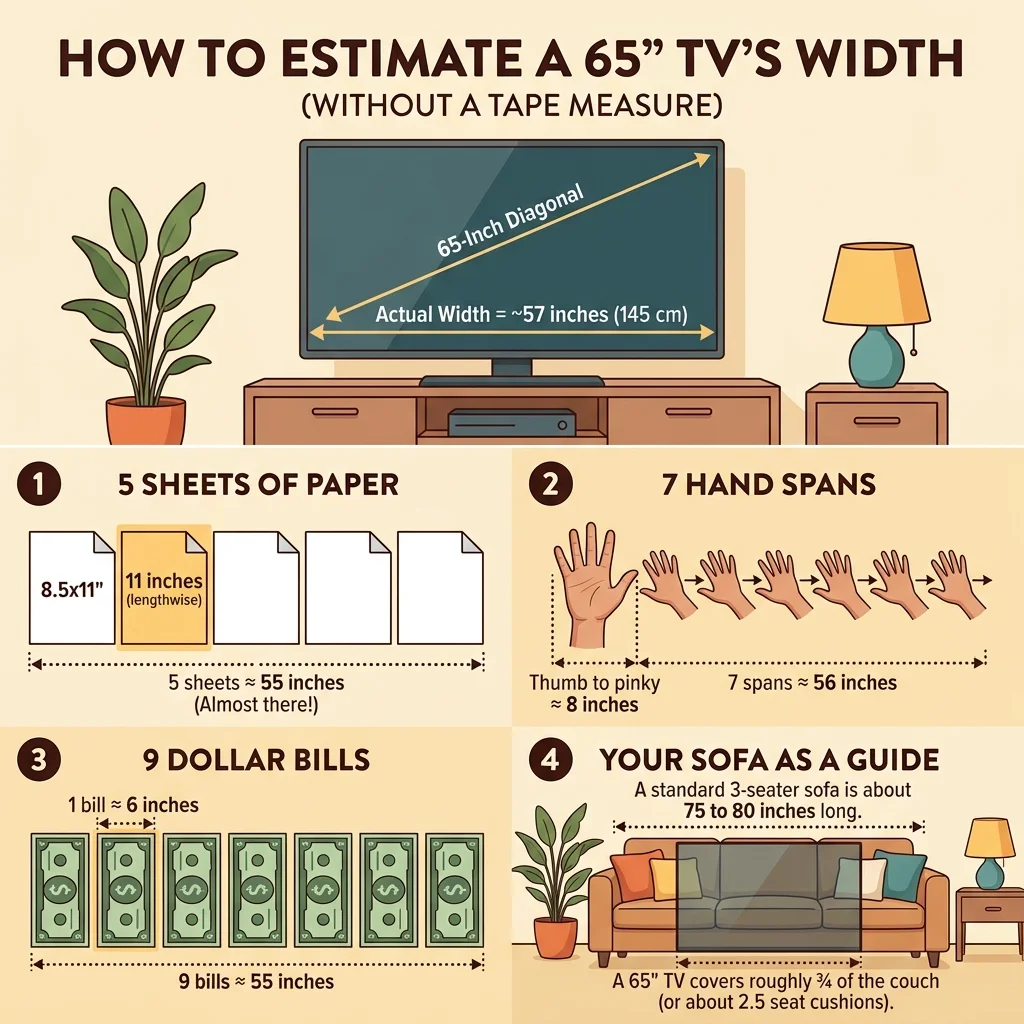
You can estimate the width of a 65-inch television using familiar objects, even if you do not have a tape measure nearby. These methods are useful for getting a general idea before rearranging furniture or visiting a store.
However, remember that visual estimates are not precise enough for a tight cabinet opening or wall-mount installation.
Use a Five-Foot Reference
Five feet equals 60 inches, while the screen is approximately 56.7 inches wide.
If you know the length of a five-foot table or bench, imagine the TV as slightly narrower. This gives you a quick sense of its horizontal size.
Compare It With a Queen Mattress
A standard U.S. queen mattress is approximately 60 inches wide. A typical 65-inch TV screen is about 3.3 inches narrower.
If you have a queen bed at home, its width provides a convenient reference. Nevertheless, do not assume every mattress or television has the same dimensions.
Use Cardboard or Paper
If you have a large piece of cardboard, you can mark out a rough width of nearly 57 inches. Compare that line with your wall, desk, or planned TV location.
For a more accurate result, measure the line with a ruler or a known-length measuring tool. Simply estimating by eye can lead to mistakes, particularly when the available space is limited.
Check Your Existing Furniture
A desk or bookshelf around 60 inches wide provides another useful reference. The TV screen should be slightly narrower than that furniture.
This comparison can help you decide whether the screen will dominate a wall or fit comfortably above a console. Still, use the exact manufacturer’s measurements before placing an order.
FAQs About 65-Inch TV Dimensions
How wide is a 65-inch TV in inches?
A typical 65-inch television with a 16:9 screen is approximately 56.7 inches wide across the visible display. The complete TV may be slightly wider because of its frame and design.
How wide is a 65-inch TV in feet?
The screen is approximately 4.73 feet wide, or about 4 feet 8.7 inches. For quick planning, you can think of it as just under 4 feet 9 inches.
How wide is a 65-inch TV in cm?
A typical 65-inch TV screen is approximately 144 centimeters wide. The exact outer width depends on the television model.
How tall is a 65-inch TV?
The screen of a typical 65-inch, 16:9 television is approximately 31.9 inches tall, or around 81 centimeters. The complete television may be taller when its frame or stand is included.
How many meters wide is a 65-inch TV?
The screen is approximately 1.44 meters wide. This conversion is useful when measuring a room or furniture with metric units.
Is a 65-inch TV actually 65 inches wide?
No. The 65-inch measurement refers to the diagonal distance between opposite corners of the screen. Its horizontal width is approximately 56.7 inches.
What size TV stand do I need for a 65-inch TV?
Choose a stand that supports the television’s weight and accommodates its actual dimensions. Check the distance between the TV’s feet, as well as the manufacturer’s recommendations, before buying furniture.
Will a 65-inch TV fit on a 60-inch-wide wall?
The visible screen is typically around 56.7 inches wide, so it is narrower than a 60-inch wall section. However, the frame and desired side clearance matter, so check the exact product dimensions before installation.
What everyday object is close to the width of a 65-inch TV?
A five-foot folding table or a standard U.S. queen mattress is a useful comparison. Both measure approximately 60 inches across or along their longer side, making them slightly larger than the TV screen’s width.
How far away should I sit from a 65-inch TV?
The ideal viewing distance depends on the screen resolution, your preferences, and the type of content you watch. Try different seating positions to find a comfortable view rather than relying on one distance as a strict rule.
Where That Leaves You
A typical 65-inch television has a screen width of approximately 56.7 inches, or 144 centimeters, and a screen height of about 31.9 inches, or 81 centimeters. The 65-inch label refers to the diagonal measurement, not the width.
For an easy mental picture, compare the screen with a five-foot table or a standard queen mattress. Both are slightly wider than the display, giving you a practical way to understand its size.
If you are buying a television for a particular wall, stand, or entertainment unit, use these conversions as a starting point. Then check the manufacturer’s exact dimensions before purchasing so your new TV fits your space comfortably.