
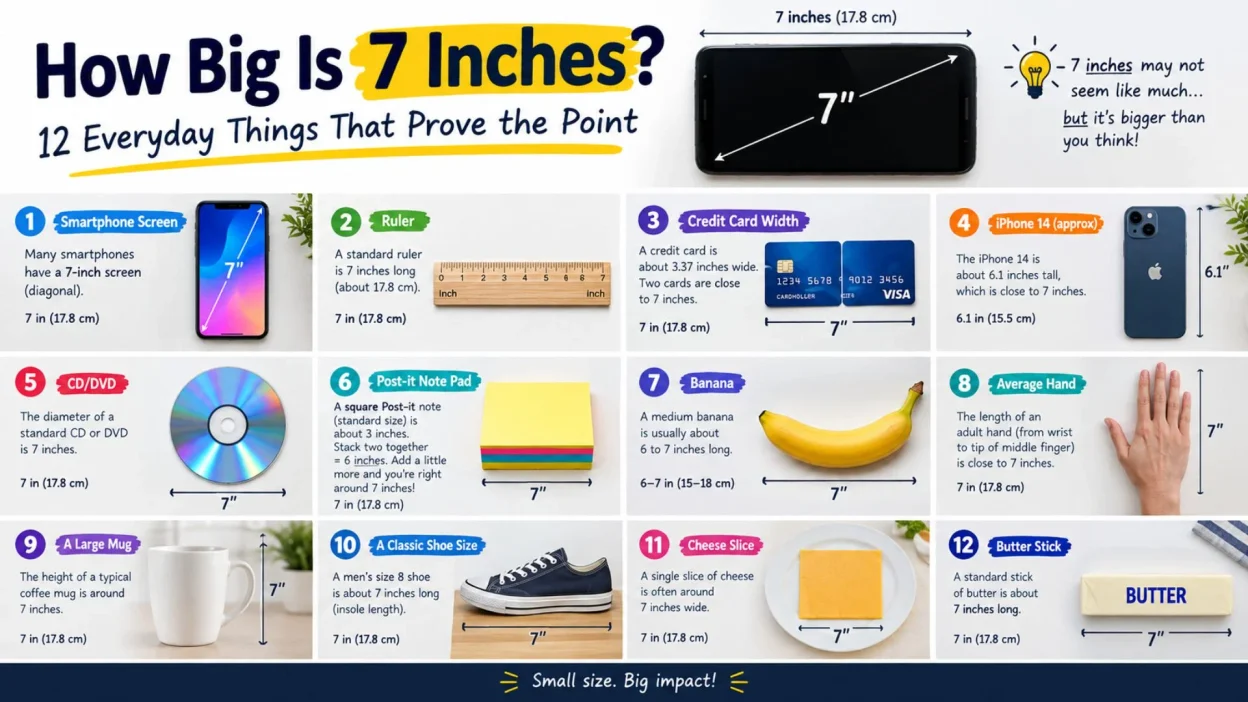
Seven inches is one of those measurements that sounds straightforward until you actually try to picture it. Most people can roughly gesture at “about a foot” or “about a yard,” but seven inches sits in an awkward middle zone—too long to fit neatly in your palm, too short to anchor to your body.
You run into this number more often than you might realise. It’s the blade length on a standard chef’s knife, the diagonal screen size on a small tablet, and roughly the length of a sharpened pencil. It’s also a common size for candles, cutlery, and even the height of certain kitchen appliances.
This guide breaks down exactly what seven inches converts to, where it sits on a ruler, and which everyday objects match it closely enough that you’ll never need to guess again.
Seven inches equals 0.583 feet, 17.78 centimetres, 177.8 millimetres, and 0.1778 metres. It’s just over half a foot—one inch longer than the six-inch midpoint—which makes it a handy reference point for everything from product dimensions to recipe pan sizes.
Table of Contents
- Every Unit 7 Inches Converts To
- Where 7 Inches Sits on a Ruler and Size Scale
- 12 Things That Measure About 7 Inches
- The Tablet Question People Actually Mean
- Getting to 7 Inches Without a Tape Measure
- FAQs
- Where That Leaves You
Every Unit 7 Inches Converts To
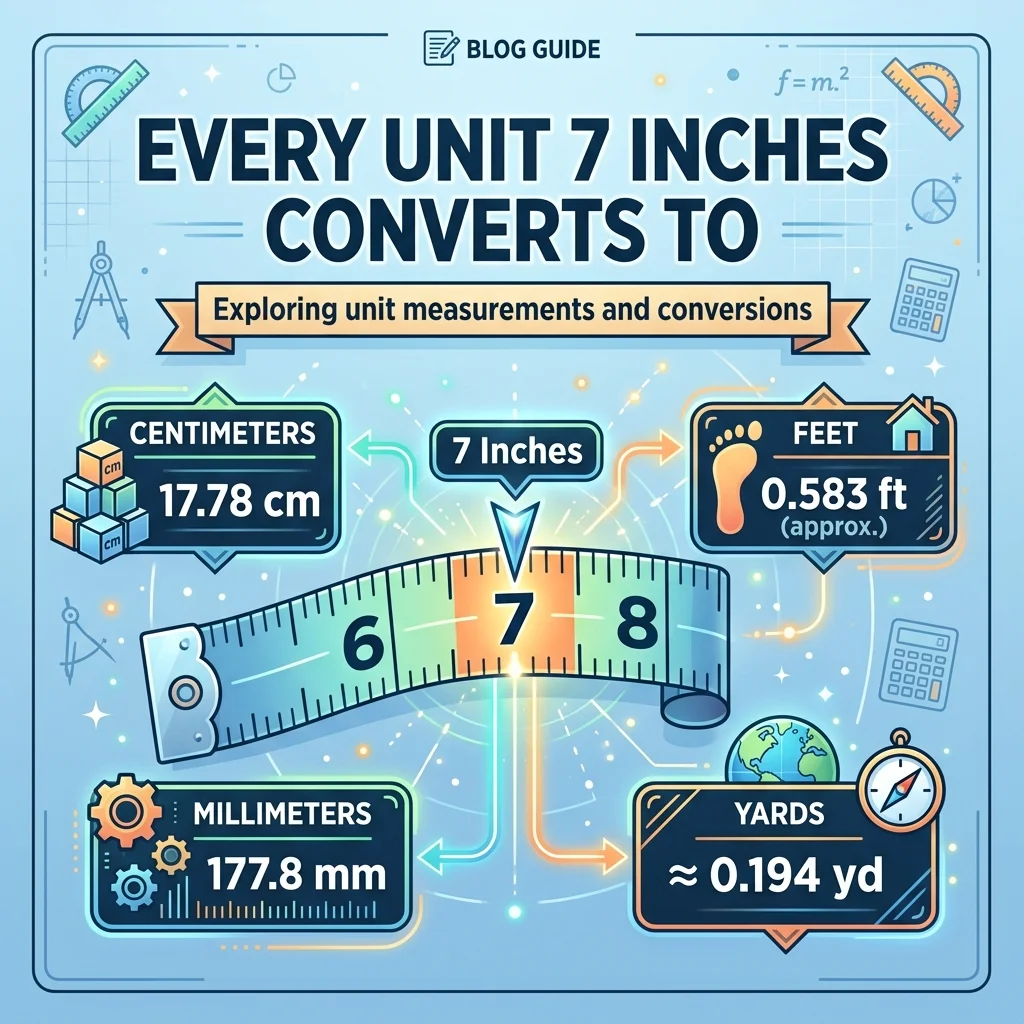
The conversions below are exact based on the international inch standard of 2.54 centimetres.
| Unit | Value |
|---|---|
| Inches | 7 |
| Feet | 0.5833 |
| Centimetres | 17.78 |
| Millimetres | 177.8 |
| Metres | 0.1778 |
| Yards | 0.1944 |
The maths is simple once you know the multipliers. To go from inches to feet, divide by 12—so 7 ÷ 12 gives you 0.583 feet. To convert to centimetres, multiply by 2.54. That’s 7 × 2.54 = 17.78 cm. Millimetres are just centimetres moved one decimal place: 177.8 mm. For metres, divide centimetres by 100, landing at 0.1778 m. And if you ever need yards, divide inches by 36.
If you’re shopping for something listed as “7 inches” but the site uses metric, you’ll see it as roughly 18 centimetres. That’s the version you’ll encounter on European product pages. For reference, 7 inches is just under half a metre—about 18% of a metre, to be precise.
Where 7 Inches Sits on a Ruler and Size Scale
Picture a standard 12-inch ruler. The 6-inch mark sits dead centre. Seven inches falls one tick past that midpoint, occupying a little more than half the ruler’s total length. If you laid the ruler across your palm, the 7-inch point would land somewhere near your fingertips, depending on hand size.
On a broader size scale, 7 inches is small. A standard sheet of paper is 11 inches long, so seven inches takes up about 64% of that length. A credit card is 3.375 inches long, meaning two cards placed end to end get you to 6.75 inches—just a quarter-inch shy of seven. A US dollar bill measures 6.14 inches, so adding a quarter (0.955 inches in diameter) end to end gets you to roughly 7.1 inches.
This measurement matters in specific contexts. Seven inches is the classic blade length for a santoku or chef’s knife—long enough for most chopping tasks but short enough for control. It’s also the diagonal screen size of compact tablets, and the height of many small desk fans and Bluetooth speakers. You’ll find it stamped on baking pans, candle labels, and even some action figures.
12 Things That Measure About 7 Inches
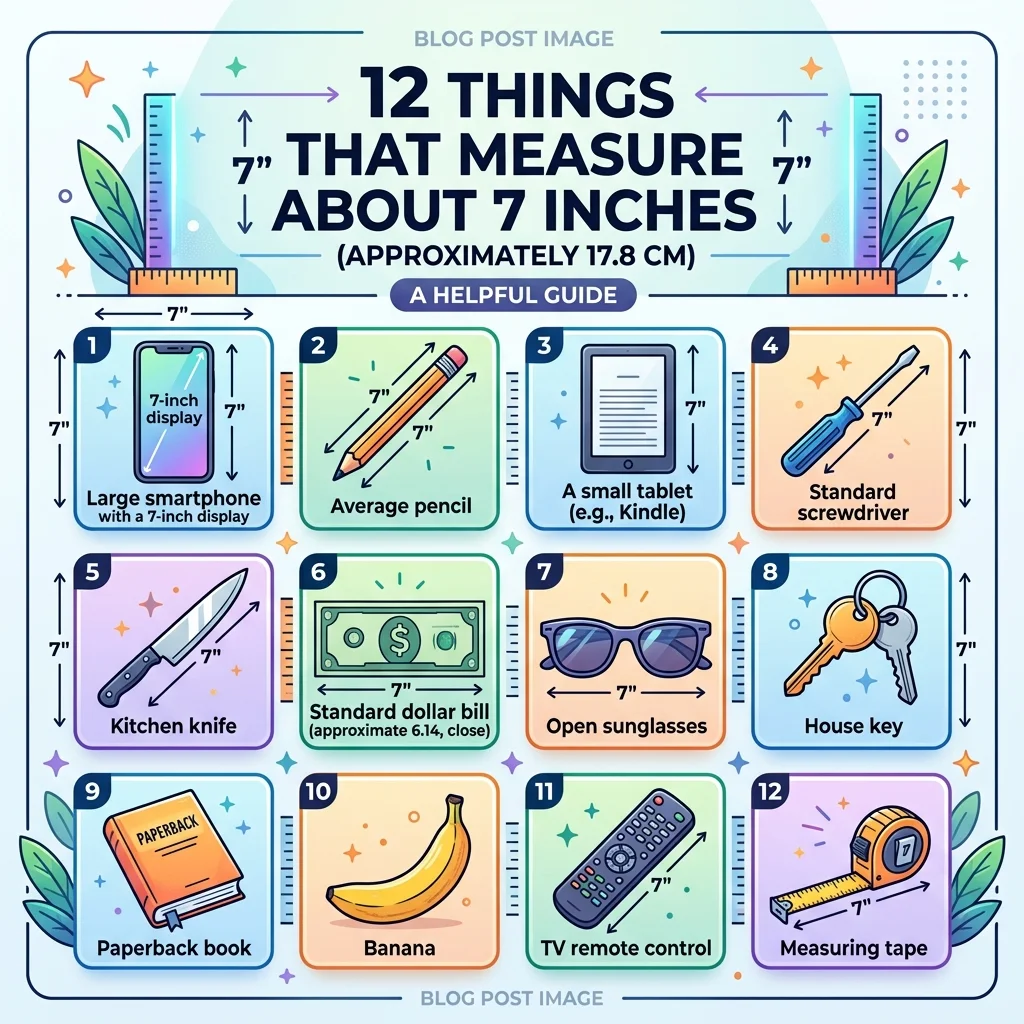
Each comparison below is genuinely close to seven inches. Approximate language is used where the object isn’t exactly that length.
A Sharpened #2 Pencil
A brand-new #2 pencil measures 7.5 inches from tip to eraser. After a few rounds through a sharpener, that length drops to around 7 inches, which is why a well-used pencil becomes one of the most reliable seven-inch references you can carry.
Pencils are made at this length for a practical reason: it’s the sweet spot between having enough graphite to last through weeks of writing and remaining short enough to fit comfortably in a standard pencil case or behind an ear. Manufacturers have settled on this range for over a century.
The eraser end adds about half an inch, so when you account for the metal ferrule, a sharpened pencil lands right in the seven-inch zone. Next time you’re holding a pencil, you’re holding a seven-inch ruler.
[IMAGE: A sharpened yellow #2 pencil lying next to a ruler showing the 7-inch mark]
A Standard Butter Knife
A dinner-table butter knife—the flat, rounded-tip kind you use for spreading jam—typically measures between 6.75 and 7.25 inches from the tip of the blade to the end of the handle. Most fall right at seven inches.
Butter knives are sized this way because they need to reach across a slice of bread without being so long that they feel unwieldy at the table. The blade itself is usually around 3 inches, with the handle making up the rest. It’s a design that hasn’t changed much in centuries.
Here’s an interesting bit of history: the butter knife as we know it emerged in 17th-century France after King Louis XIV banned pointed knives at the dinner table to reduce violence. The rounded tip became standard, and the dimensions we use today evolved from that practical safety measure.
[IMAGE: A silver butter knife resting on a white dinner plate with a ruler beside it]
Two Credit Cards End to End
A standard credit card is 3.375 inches long and 2.125 inches wide. Place two cards end to end along their length, and you get 6.75 inches—just a quarter-inch short of seven. Add a coin to the line, and you’re there.
Credit cards are standardised globally under the ISO/IEC 7810 ID-1 format. That 3.375-inch length isn’t random; it was designed to fit comfortably in wallets and work with ATM and point-of-sale machines worldwide. The consistency makes them a surprisingly useful measuring tool.
The next time you’re stuck without a ruler and need a rough seven-inch estimate, two cards plus a stacked pair of quarters gets you within a hair of the mark. It’s not exact, but for most everyday purposes, it’s close enough.
[IMAGE: Two standard credit cards placed end to end with a quarter next to them, all beside a ruler]
A Dollar Bill Plus a Quarter
A US dollar bill measures 6.14 inches long and 2.61 inches wide. Laid end to end with a quarter—which has a diameter of 0.955 inches—the total comes to 7.095 inches, which is almost exactly seven inches.
This combination works because both items are universally available and have fixed dimensions. Currency dimensions don’t change, so this trick works anywhere in the United States. The dollar bill’s length has been 6.14 inches since 1928, when US currency was resized to its current dimensions.
The width of a dollar bill is also useful: 2.61 inches is close to the width of a standard credit card, so you can mix and match these items for quick estimates. A dollar bill and a quarter together are a portable seven-inch measuring kit.
[IMAGE: A US dollar bill laid flat with a quarter placed at one end, showing the combined length reaching about 7 inches]
A Medium Banana
A medium-sized banana measures approximately 7 to 8 inches along its outer curve. The exact length varies by ripeness and variety, but grocery-store bananas consistently fall in this range.
Bananas grow to this size because they’re harvested at a specific stage of maturity that balances sweetness, firmness, and shelf life. A banana that’s too small hasn’t developed enough sugars; one that’s too large may be overripe by the time it reaches your kitchen.
This makes the banana a handy visual reference—it’s slightly curved, so it’s not ideal for precise measurement, but if you’re trying to judge whether something is “about seven inches,” a medium banana gives you a quick, tangible answer.
[IMAGE: A medium banana lying next to a ruler, with the curve spanning approximately 7 inches]
A Standard Salad Fork

Most salad forks measure between 6.5 and 7 inches from the tip of the tines to the end of the handle. Dinner forks run slightly longer, usually 7.5 to 8 inches, but salad forks hit the seven-inch mark more reliably.
The fork’s proportions have been refined over centuries. The four-tine design became standard in the 19th century, and the handle length was calibrated for comfortable grip and leverage. A salad fork is shorter than a dinner fork because it’s designed for lighter foods and doesn’t need the same reach.
If you’re at a restaurant or in your own kitchen, pulling out a salad fork gives you an instant seven-inch reference. It’s one of those everyday objects you’ve probably handled thousands of times without realising it’s a measuring tool.
[IMAGE: A stainless steel salad fork lying beside a ruler with the 7-inch mark visible at the handle end]
A 7-Inch Chef’s Knife
A 7-inch chef’s knife or santoku has a blade that measures exactly seven inches from the heel to the tip—the handle is not included in this measurement. This is one of the few objects on this list that is genuinely, precisely seven inches.
Knife makers settled on this size because it offers an ideal balance for most home cooks. A 7-inch blade is long enough to handle onions, carrots, and proteins with ease, but short enough to feel agile on a cutting board. Larger 10-inch knives are better for professional kitchens with high-volume prep, while smaller 5-inch knives feel limiting for general tasks.
The 7-inch chef’s knife is also a popular choice for people with smaller hands or those who prefer a lighter blade. The measurement is standardised across brands, so if you buy a 7-inch knife, you know exactly what blade length you’re getting.
[IMAGE: A 7-inch chef’s knife with the blade measured against a ruler from heel to tip]
Five Toothpicks in a Row
A standard wooden toothpick measures about 2.5 inches long. Line up five of them end to end, and you get 12.5 inches—which is too long. But line up three toothpicks (7.5 inches) and you’re just over seven.
Toothpicks are made at this length for a reason: they need to be long enough to reach between teeth but short enough to be safe and disposable. The standard 2.5-inch toothpick has been the dominant size for decades.
Three toothpicks laid end to end give you 7.5 inches, which is close enough for a rough estimate. It’s not as elegant as a dollar bill and a quarter, but it works if you’re at a restaurant and need a quick visual.
[IMAGE: Three wooden toothpicks arranged end to end next to a ruler showing approximately 7 inches]
A Large Smartphone in a Case

Modern large-screen smartphones like the iPhone 15 Pro Max and Samsung Galaxy S24 Ultra measure approximately 6.3 to 6.7 inches in height. Add a protective case, which typically adds 0.3 to 0.5 inches, and many cased phones land right around seven inches tall.
Phone manufacturers have pushed screen sizes upward over the past decade, and the physical dimensions have followed. A phone that feels “big” in your hand is often closer to seven inches than people realise. The height measurement is the relevant one here—the width is usually 3 to 4 inches.
If you have a large phone in a case, you’re holding a seven-inch object. It’s one of the most accessible references available because most people have their phone within arm’s reach at all times.
[IMAGE: A large smartphone in a protective case being measured against a ruler showing approximately 7 inches in height]
A 7-Inch Tablet
A 7-inch tablet has a screen that measures seven inches diagonally from corner to corner. The physical device is larger—typically around 7.5 to 8 inches tall and 4.5 to 5 inches wide—because the screen is surrounded by a bezel.
Seven-inch tablets were once the dominant compact form factor. Apple’s iPad mini originally launched with a 7.9-inch screen, and many Android tablets settled on 7 inches as the standard small size. The diagonal measurement is used because it gives a single number that represents the screen’s overall size regardless of aspect ratio.
Tablets in this size range are designed for one-handed reading, note-taking, and casual browsing. They’re small enough to slip into a bag but large enough to display a full page of text comfortably. The 7-inch measurement appears on the spec sheet, but the device itself is noticeably larger.
[IMAGE: A 7-inch tablet held in one hand, with a ruler showing the diagonal screen measurement]
A Small Desk Fan
Many compact desk fans measure approximately 7 inches in blade diameter or overall height. These fans are designed to sit on a desk or nightstand and provide personal cooling without taking up much space.
The 7-inch size is popular because it moves enough air to be useful while remaining quiet and energy-efficient. Larger fans move more air but are noisier and bulkier. Smaller fans are quieter but often too weak to make a noticeable difference. Seven inches hits the sweet spot for personal use.
If you have a small desk fan, its blade diameter is probably close to seven inches. It’s not a precise reference, but it’s a real-world object that demonstrates the scale of this measurement in a functional context.
[IMAGE: A small desk fan sitting on a desk next to a ruler showing approximately 7 inches in diameter]
A Standard Envelope (Folded)
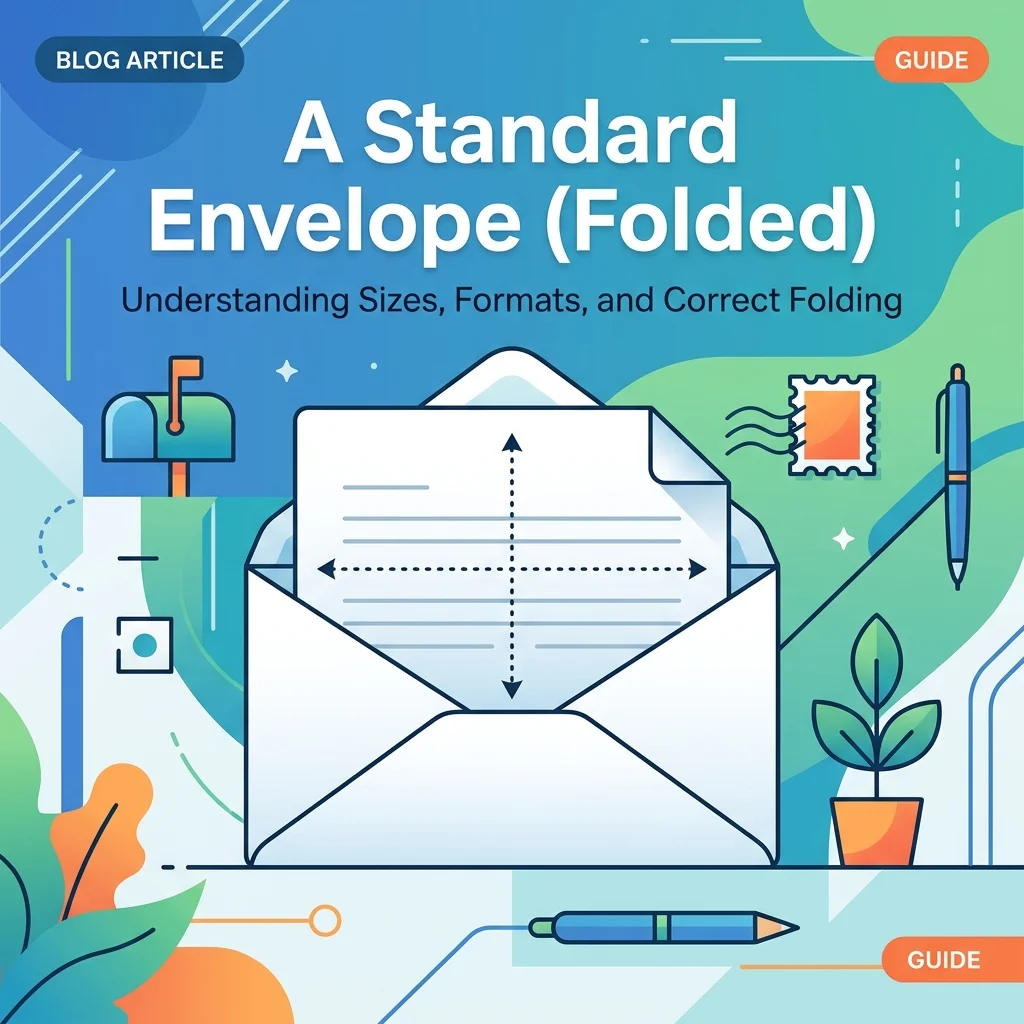
A #10 business envelope measures 4.125 by 9.5 inches. Fold it in half lengthwise, and the folded width comes to approximately 6.9 inches—close to seven.
The #10 envelope is the standard size for business correspondence in the United States. It’s designed to hold a letter-sized sheet of paper folded into thirds. When you fold the envelope itself, you create a handy seven-inch reference from an object most people have in a drawer.
Envelopes are also useful for estimating because they’re flat and rigid enough to hold against a surface. If you’re trying to visualise seven inches and you have mail nearby, a folded envelope gets you close.
[IMAGE: A standard #10 business envelope folded in half lengthwise next to a ruler showing approximately 7 inches]
The Tablet Question People Actually Mean

When people search for “how big is 7 inches” in the context of screens, they’re usually asking about a 7-inch tablet—not a phone. And there’s a good reason for the confusion: a 7-inch screen measurement refers to the diagonal, not the width or height.
A 7-inch tablet screen with a 16:9 aspect ratio measures approximately 6.1 inches wide and 3.4 inches tall. With a 4:3 aspect ratio, the screen is roughly 5.6 inches wide and 4.2 inches tall. The device itself adds bezels and casing, so a “7-inch tablet” is physically larger than seven inches in every dimension.
This is why a 7-inch tablet feels smaller than a 7-inch pencil. The pencil is seven inches in a straight line; the tablet’s seven inches runs diagonally across the screen, which is a shorter visual distance than you might expect.
Most manufacturers have moved away from the 7-inch tablet size in favour of 8-inch and 10-inch models, but 7-inch devices still exist for budget markets and specialised uses like e-readers and car entertainment systems. If you’re shopping for a “7-inch” tablet, check the physical dimensions in the specs—they’ll tell you the real size of the device.
Getting to 7 Inches Without a Tape Measure
You don’t need a ruler to get a decent seven-inch estimate. Here are five methods that work with items you already have.
Your hand. The average adult male hand measures about 7.6 inches from the base of the palm to the tip of the middle finger. The average adult female hand is about 6.8 inches. If your hand falls in this range, you’re carrying a built-in seven-inch reference. It’s not exact—hand sizes vary—but it’s close enough for rough estimates.
A dollar bill plus a coin. As mentioned earlier, a dollar bill (6.14 inches) plus a quarter (0.955 inches) gives you 7.095 inches. This is one of the most accurate portable methods because both items have fixed, standardised dimensions.
Two credit cards plus a coin. Two credit cards end to end measure 6.75 inches. Add a penny (0.75 inches in diameter) and you’re at 7.5 inches—slightly over but still in the ballpark. A dime (0.705 inches) gets you closer to 7.45 inches. Neither is perfect, but both are useful approximations.
A standard sheet of paper. A US Letter sheet measures 8.5 by 11 inches. Fold it so that the 8.5-inch side is halved, and you get 4.25 inches. That’s not helpful for seven inches directly, but if you fold the 11-inch side so the crease is about 7 inches from the edge, you’ve created a seven-inch reference.
Your foot. The average adult male foot is about 10.6 inches long; the average female foot is about 9.4 inches. Neither is seven inches, but if you know your own foot length, you can estimate the difference. Subtract roughly 2.5 to 3.5 inches from your foot length to get close to seven.
These methods are approximations, not precise measurements. For anything where exactness matters—cutting materials, fitting furniture, or buying replacement parts—use an actual ruler or tape measure. But for quick everyday estimates, these tricks will get you close enough.
FAQs
How many feet is 7 inches?
Seven inches equals 0.583 feet. Since one foot is 12 inches, seven inches is just over half a foot—one inch more than the six-inch midpoint.
How many centimetres is 7 inches?
Seven inches is exactly 17.78 centimetres. The conversion is 7 × 2.54 = 17.78. In metric countries, this is often rounded to 18 centimetres for everyday purposes.
How many metres is 7 inches?
Seven inches equals 0.1778 metres. This is just under 18% of a metre, or slightly less than one-fifth of a metre.
Is 7 inches considered long?
It depends entirely on context. For a pencil or a butter knife, seven inches is standard. phone screen, it’s large. For a human hand, it’s about average for an adult male. The measurement itself isn’t inherently long or short—it’s the object that gives it meaning.
What everyday object is about 7 inches long?
A sharpened #2 pencil is one of the most reliable references. A standard butter knife, a salad fork, and a medium banana are also close to seven inches. For a more precise reference, a 7-inch chef’s knife blade is exactly that length.
Can I visualise 7 inches without a tape measure?
Yes. Use your hand—the average adult male hand is about 7.6 inches from palm base to middle fingertip. Or use a dollar bill plus a quarter laid end to end, which measures 7.095 inches. These methods give you a quick, close estimate without any tools.
Is there a standard tablet with a 7-inch screen?
Yes, though they’re less common now than they once were. Seven-inch tablets were popular in the early 2010s, and some budget models still use this size. The measurement refers to the diagonal screen size, so the physical device is larger than seven inches.
Where That Leaves You
Seven inches sits in a practical middle ground—long enough to be useful, short enough to stay portable. It converts to 17.78 centimetres, 177.8 millimetres, and 0.583 feet, and it’s just one inch past the halfway point of a standard ruler.
The strongest everyday comparison is the sharpened #2 pencil. It’s an object almost everyone has handled, and at around seven inches after a few sharpenings, it gives you a tangible sense of the measurement without any mental gymnastics. A butter knife or a 7-inch chef’s knife blade works just as well if you’re in the kitchen.