Seven inches sounds simple until you try to picture it without a ruler. It is long enough to feel substantial in your hand, but still small enough to fit comfortably into many everyday objects.
That is why people often search how big is 7 inches when they are trying to understand the actual size of something. You might be comparing a screen, checking the length of an object, shopping for a product, or simply trying to visualize seven inches from a number on a page.
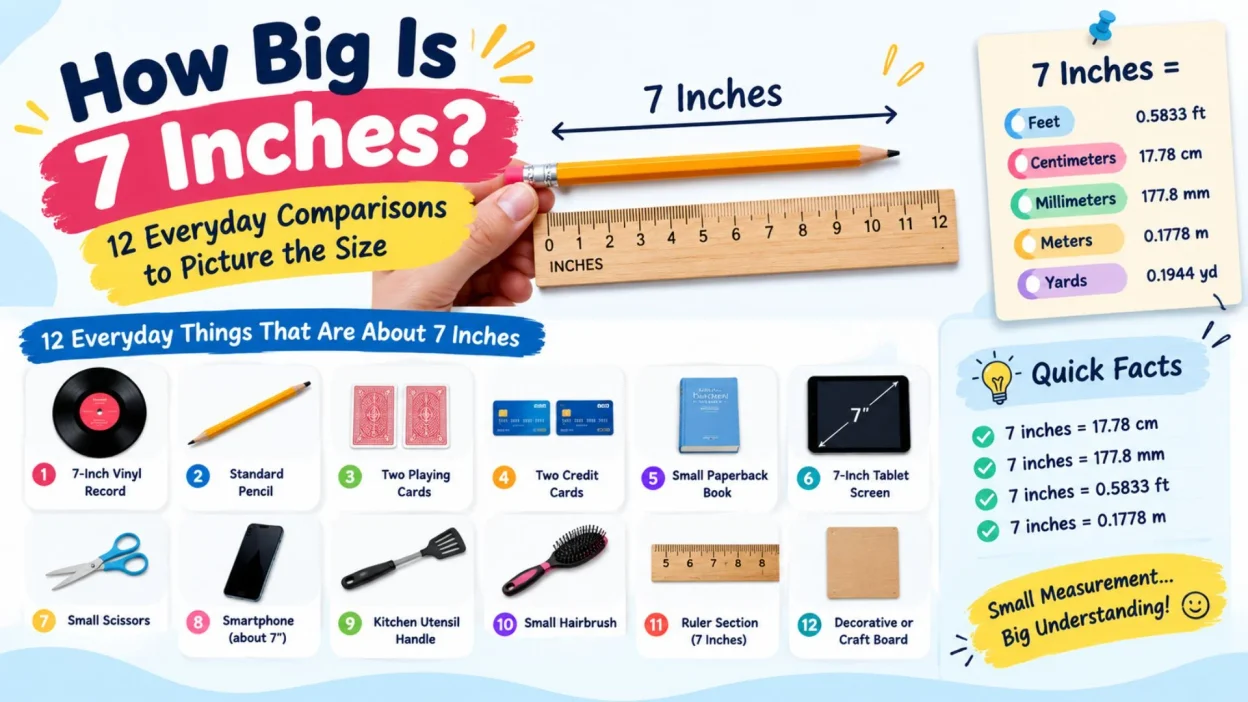
The easiest way to understand it is to convert the measurement into units you already recognize. Seven inches is 17.78 centimeters, or 177.8 millimeters. In feet, it is about 0.58 feet, which is just over half a foot.
7 inches equals 0.583 feet, 17.78 centimeters, 177.8 millimeters, and 0.1778 meters. From there, several familiar objects can make the measurement much easier to imagine.
Every Unit 7 Inches Converts To
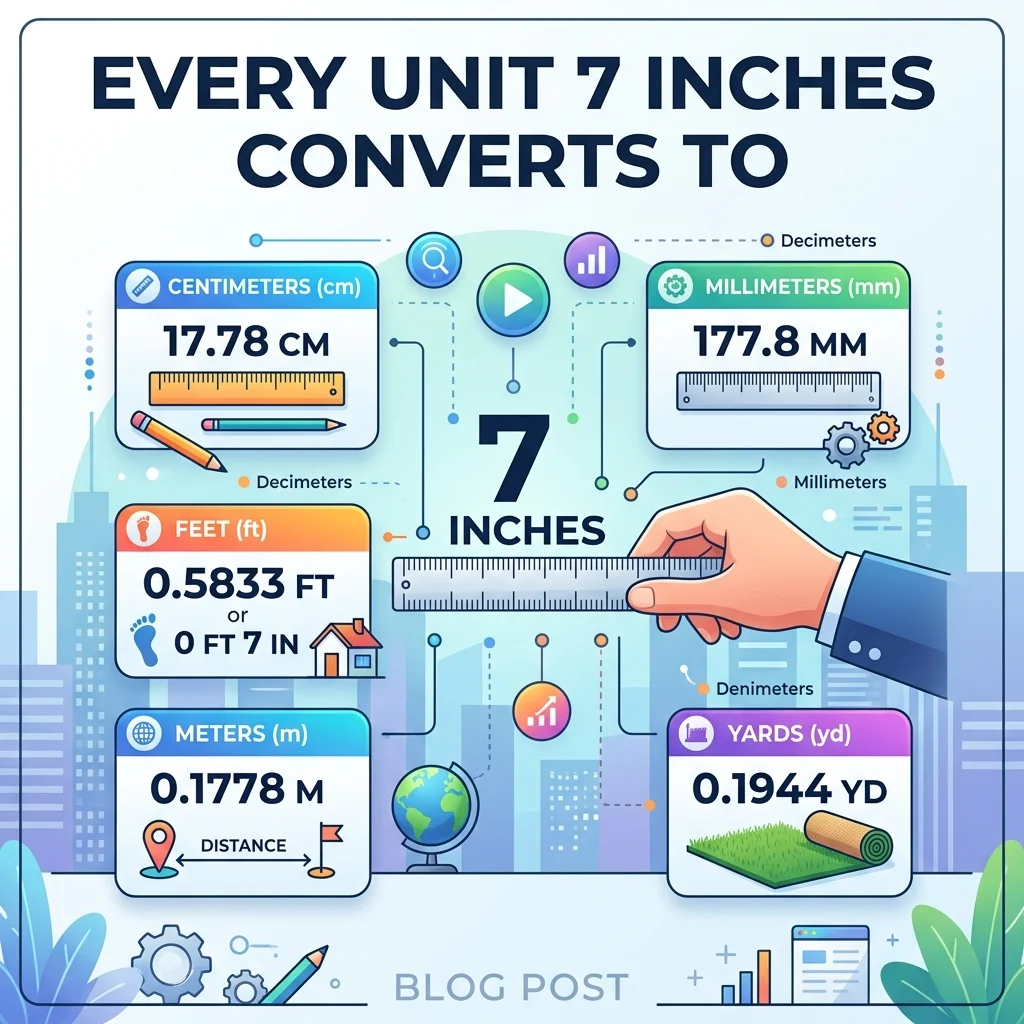
The number seven becomes much easier to understand when you see it in different measurement systems. The most useful conversions are inches, feet, centimeters, millimeters, meters, and yards.
| Unit | 7 Inches Equals |
|---|---|
| Inches | 7 in |
| Feet | 0.5833 ft |
| Centimeters | 17.78 cm |
| Millimeters | 177.8 mm |
| Meters | 0.1778 m |
| Yards | 0.1944 yd |
The math is straightforward.
To convert 7 inches to feet, divide by 12:
7 ÷ 12 = 0.5833 feet
To convert inches to centimeters, multiply by 2.54:
7 × 2.54 = 17.78 centimeters
For millimeters, multiply the centimeter measurement by 10:
17.78 × 10 = 177.8 millimeters
And for meters, divide the centimeter measurement by 100:
17.78 ÷ 100 = 0.1778 meters
So if you see 7 inches in feet, think a little more than half a foot. If you see 7 inches in cm, think about 18 centimeters. For 7 inches in mm, the answer is 177.8 mm.
Where 7 Inches Sits on a Common Size Scale

Seven inches is a relatively compact length. It is noticeably longer than a typical smartphone’s height, but considerably shorter than a standard 12-inch ruler.
One useful way to picture it is to think of the distance between six and eight inches. Seven inches sits directly in the middle, making it a convenient reference point for many small household measurements.
It is also almost 18 centimeters long. That puts it into a size range where many handheld objects, small books, screens, and accessories can be compared meaningfully.
Unlike a measurement such as seven feet, seven inches is not large enough to describe furniture height or room dimensions. Instead, it appears more naturally in product dimensions, object lengths, screen sizes, craft projects, and small household items.
The important thing is that 7 inches is a length, not automatically a width, height, or diameter. The way you experience it depends on which direction the measurement is taken.
12 Everyday Things That Measure About 7 Inches

The easiest way to understand seven inches is to stop thinking about the number and start thinking about objects.
Some items below are close to seven inches, while others are intentionally made at approximately seven inches or use seven inches as an important measurement. These comparisons are meant to help you visualize the scale rather than suggest that every object is exactly 7 inches.
A 7-Inch Vinyl Record
A 7-inch vinyl record is one of the rare everyday-style objects where the seven-inch measurement is actually part of the product’s name.
A 7-inch record has a diameter of 7 inches, so its width straight across the center is exactly the measurement you are trying to picture.
These records are commonly associated with singles and are much smaller than the familiar 12-inch LP records.
Hold a 7-inch record in front of you and the measurement becomes immediately obvious: it is a circular object stretching seven inches from one edge to the opposite edge.
A Standard Pencil
A typical wooden pencil is often around 7 to 8 inches long when new, depending on the design and manufacturer.
That makes a full-size pencil an excellent rough comparison for seven inches. A new pencil may be slightly longer than seven inches, while a used pencil can become noticeably shorter.
The familiar shape also makes this comparison especially useful. You have probably held hundreds of pencils, so there is no need to imagine an unfamiliar object.
Picture a regular pencil lying horizontally on a table. Seven inches is roughly the length you would expect from one end of a full-size pencil to the other.
Two Standard Playing Cards End to End
A standard playing card is approximately 3.5 inches long.
Place two cards end to end along their longer sides, and you get about 7 inches exactly.
This is a surprisingly useful comparison because playing cards are familiar, flat, and easy to arrange. You can mentally stack two cards in a straight line whenever you need to estimate seven inches.
The comparison also gives you a physical way to test the measurement. Two standard cards lined up lengthwise create a visual reference that is extremely close to seven inches.
Two Credit Cards End to End

A standard credit-card-sized card is approximately 3.375 inches wide.
Two cards placed end to end along their shorter dimensions would measure about 6.75 inches, which is only a quarter-inch shorter than seven inches.
That makes two cards an excellent approximation when you do not have a ruler available.
Because payment cards are standardized in size, this comparison is more dependable than using a random household object whose dimensions can vary considerably.
Imagine two bank cards touching edge to edge. The combined length is just slightly less than seven inches.
A Small Paperback Book
Many compact paperback books have a height somewhere around 7 to 8 inches, although book dimensions vary widely.
A smaller paperback can therefore provide a useful visual reference for seven inches. The important point is that this is an approximate comparison, not a universal book size.
Book publishers use several common trim sizes, so some paperbacks are noticeably taller or shorter than seven inches.
If you have a small paperback at home, place it next to a ruler and you may find that its shorter dimension is surprisingly close to the seven-inch mark.
A 7-Inch Tablet Screen Diagonal
A product described as having a 7-inch screen is referring to the screen’s diagonal measurement.
That does not mean the tablet is seven inches wide or seven inches tall. Instead, the distance from one corner of the display to the opposite corner is seven inches.
This distinction matters when shopping for electronics. A 7-inch display can belong to a device that is physically larger because the screen has bezels and a rectangular shape.
Think of a diagonal line running across the visible screen from one corner to the opposite corner. That line measures seven inches.
A Small Pair of Scissors
Some compact household or craft scissors have blades and handles that bring their total length into the neighborhood of seven inches.
Scissors vary considerably, however, so this should be treated as an approximate comparison rather than a standard dimension.
Small craft scissors may be shorter, while larger kitchen or fabric scissors can be considerably longer.
If you have a compact pair of scissors nearby, place them beside a ruler. You may find that their overall length gives you a useful visual reference for the seven-inch range.
A Smartphone Is Close, But Usually Shorter

Modern smartphones are useful for visualizing seven inches because many large phones are in the general neighborhood of six to seven inches in height.
However, most phones should not be treated as an exact seven-inch comparison. Their physical height and their screen size are different measurements.
A large smartphone may be around 6.3 to 6.5 inches tall, while its screen is measured diagonally and can be a similar or larger number.
So if you picture a large smartphone and add a little extra length, you can get a rough sense of seven inches.
A Short Kitchen Utensil Handle
Some small kitchen tools and utensil handles fall around the seven-inch range, particularly compact tools designed for small cookware or specialized tasks.
There is no universal seven-inch kitchen-utensil length, so this comparison depends heavily on the particular item.
Still, it can help you understand the physical scale. Seven inches is long enough for a comfortable handheld object but short enough to fit easily inside most kitchen drawers.
Picture a compact utensil laid flat on a counter. A seven-inch length would occupy roughly the space from your palm to somewhere beyond your fingertips.
A Small Hairbrush
Compact hairbrushes can be around seven inches long, particularly travel-size or smaller designs.
Full-size hairbrushes may be longer, so the comparison works best with a smaller brush rather than assuming every hairbrush has this dimension.
A hairbrush is another useful example because its length is easy to see in your hand. Seven inches represents a moderate handheld size rather than something tiny.
If you imagine holding a small brush lengthwise, its overall body can give you a reasonable mental picture of the measurement.
A Seven-Inch Ruler Section
This may sound obvious, but a ruler gives you the cleanest possible reference because the measurement is marked directly.
If you have a standard 12-inch ruler, the distance from the zero mark to the seven-inch mark is exactly seven inches.
The advantage is that you can compare seven inches with other objects directly. Place a pencil, book, phone, or household item alongside that section to see how close it comes.
Once you have done this a few times, the seven-inch distance becomes much easier to recognize without measuring it again.
A Small Decorative or Craft Board
Small craft boards, plaques, and decorative wooden pieces can often be made around seven inches in one dimension.
Unlike standardized objects, these items come in many sizes, so this is an approximate comparison rather than a fixed measurement.
A seven-inch board is large enough to serve as a noticeable decorative piece but small enough to hold comfortably in one hand.
Imagine a square board measuring roughly seven inches on each side. It would have a footprint considerably larger than a playing card but much smaller than a sheet of printer paper.
The 7-Inch Screen Question People Actually Mean

When someone searches for a 7-inch screen, they may initially imagine a display that is seven inches wide. That is not how screen sizes are normally measured.
A screen’s advertised size usually refers to its diagonal measurement. Therefore, a 7-inch display measures seven inches from one corner to the opposite corner.
The actual width and height depend on the screen’s aspect ratio. A wider rectangular screen and a more square-shaped screen can both have a seven-inch diagonal while having different physical dimensions.
This is particularly important when shopping for tablets, monitors, navigation displays, car screens, or other electronics.
A 7-inch screen can also mean that the entire device is larger than seven inches. The outer body may include bezels, buttons, speakers, or other hardware surrounding the display.
So if you are asking how big is 7 inches because you saw “7-inch screen” in a product listing, remember this:
Seven inches describes the diagonal of the display, not necessarily its width or height.
That one detail prevents a lot of confusion when comparing electronic devices.
Getting to 7 Inches Without a Tape Measure
You do not always need a measuring tape to get a reasonable idea of seven inches. Several familiar objects can provide useful approximations.
Use Two Playing Cards
Two standard playing cards placed end to end measure about seven inches along their long sides.
This is one of the easiest mental references because most standard playing cards are approximately 3.5 inches long.
Use Two Payment Cards
Two standard-size payment cards placed end to end across their shorter dimensions come to roughly 6.75 inches.
That is only about a quarter-inch shy of seven inches, making it a surprisingly good approximation.
Compare It With a Pencil
A new full-size pencil is often around seven to eight inches long.
If you imagine a standard pencil and mentally remove a small amount from its length, you are close to seven inches.
Use a Ruler You Already Know
If you have a 12-inch ruler, the seven-inch mark gives you an exact reference.
After seeing seven inches several times, you can begin estimating the distance more confidently.
Think in Centimeters
Seven inches equals 17.78 centimeters.
If centimeters are more familiar to you, picture a length just under 18 centimeters. This can be easier than trying to estimate seven inches directly.
Remember that these methods are approximations unless the reference object has a standardized measurement. If accuracy matters for construction, fitting, cutting, or purchasing a precisely sized product, use an actual measuring tool.
FAQs
How many feet is 7 inches?
Seven inches equals 0.5833 feet. In everyday terms, that is a little more than half a foot.
How many centimeters is 7 inches?
Seven inches equals 17.78 centimeters. Rounded to the nearest centimeter, that is about 18 cm.
How many millimeters is 7 inches?
Seven inches equals 177.8 millimeters. This comes from multiplying seven inches by 25.4 millimeters per inch.
How many meters is 7 inches?
Seven inches equals 0.1778 meters. That is just under 0.18 meters.
Is 7 inches considered long?
For a small handheld object, seven inches is a moderate length. It is much longer than a credit card but shorter than a standard 12-inch ruler.
What everyday object is about 7 inches?
A full-size pencil is often around seven to eight inches long, making it a useful rough comparison. Two standard playing cards placed end to end are also approximately seven inches.
Can I visualize 7 inches without a ruler?
Yes. Two standard playing cards placed end to end are about seven inches long. Two standard payment cards placed end to end are also close, at approximately 6.75 inches.
Is a 7-inch screen seven inches wide?
No. A 7-inch screen normally refers to the diagonal distance from one corner of the display to the opposite corner. Its actual width and height depend on the screen’s aspect ratio.
Where That Leaves You
Seven inches is 17.78 cm, 177.8 mm, 0.5833 feet, and 0.1778 meters. Those conversions give you the mathematical answer, but familiar objects make the measurement much easier to remember.
For a quick mental picture, think of two standard playing cards placed end to end. Their combined length is about seven inches. A full-size pencil is another useful reference, although it can be slightly longer depending on the pencil.
The next time you see a seven-inch measurement, picture a length just under 18 centimeters or roughly the span of two playing cards. Once you connect the number with something you can actually hold, 7 inches stops being an abstract measurement and becomes much easier to visualize.