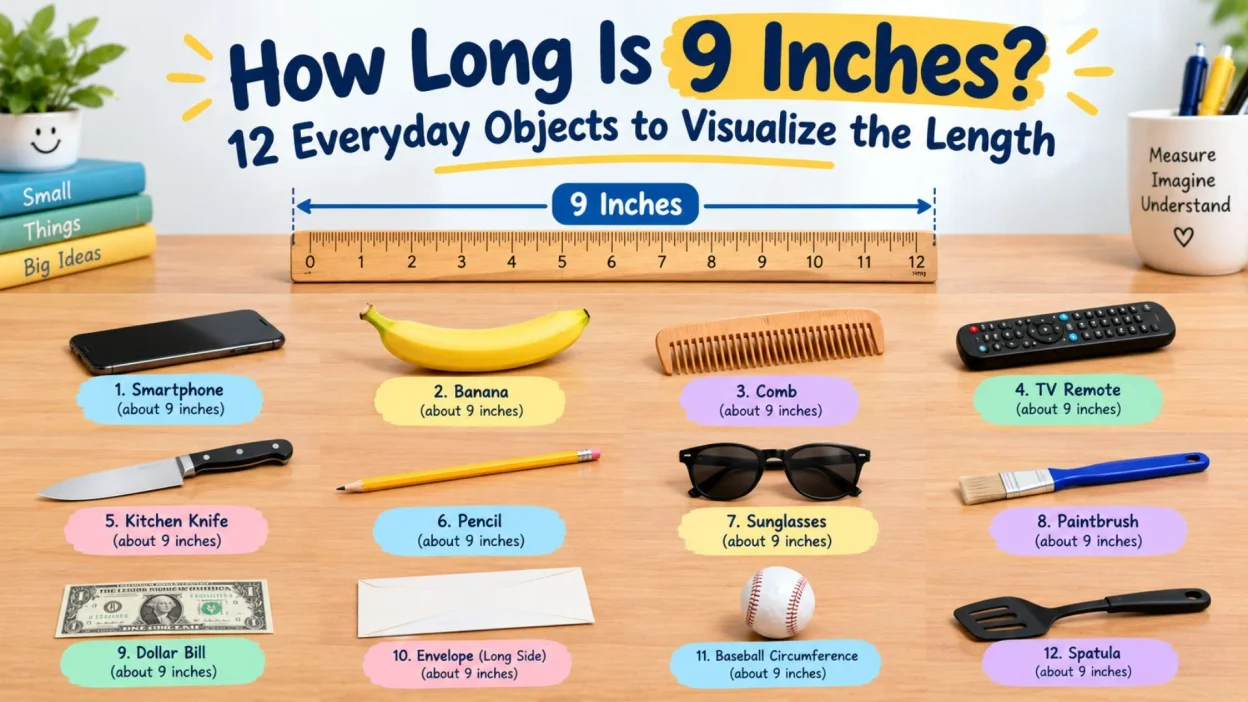
Nine inches might sound like a simple measurement, but picturing its exact length without a ruler can be surprisingly difficult. Is it about the size of a dinner plate, the length of a small tablet, or the width of a sheet of paper? Familiar objects make the answer much easier to understand.
You might encounter a 9-inch measurement when shopping for kitchenware, choosing a tablet, working on a DIY project, or checking whether an item will fit on a shelf. Knowing what this length looks like can help you make better decisions without constantly reaching for a measuring tape.
The conversion is straightforward: nine inches equals three-quarters of a foot. In metric measurements, that’s 22.86 centimeters, 228.6 millimeters, or 0.2286 meters.
Nine inches equals 0.75 feet, 22.86 centimeters, 228.6 millimeters, and 0.2286 meters.
In this guide, you’ll discover how 9 inches compares with everyday objects, how to convert it into different units, and how to estimate the length without a measuring tool. You’ll also learn why a 9-inch measurement can describe very different dimensions depending on the object.
Every Unit 9 Inches Converts To
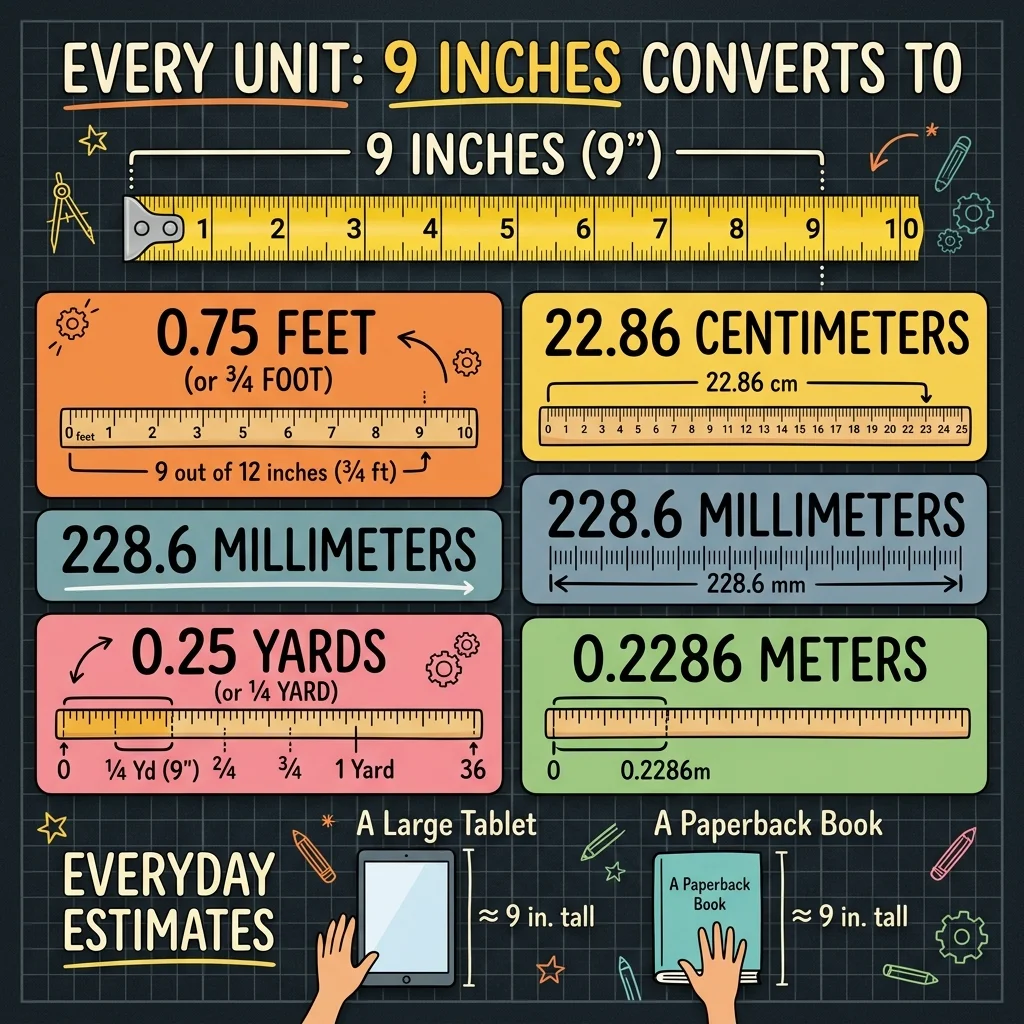
Understanding nine inches becomes easier when you know its equivalent in other measurement systems. You might need inches and feet for a household project, centimeters for an international product listing, or millimeters for a detailed technical measurement.
Here’s a quick reference table with the most useful conversions.
| Unit | Value |
|---|---|
| Inches | 9 inches |
| Feet | 0.75 feet |
| Feet and inches | 0 feet 9 inches |
| Centimeters | 22.86 cm |
| Millimeters | 228.6 mm |
| Meters | 0.2286 m |
| Yards | 0.25 yards |
| Miles | 0.000142 miles |
| Kilometers | 0.0002286 km |
How to Convert 9 Inches Into Other Units
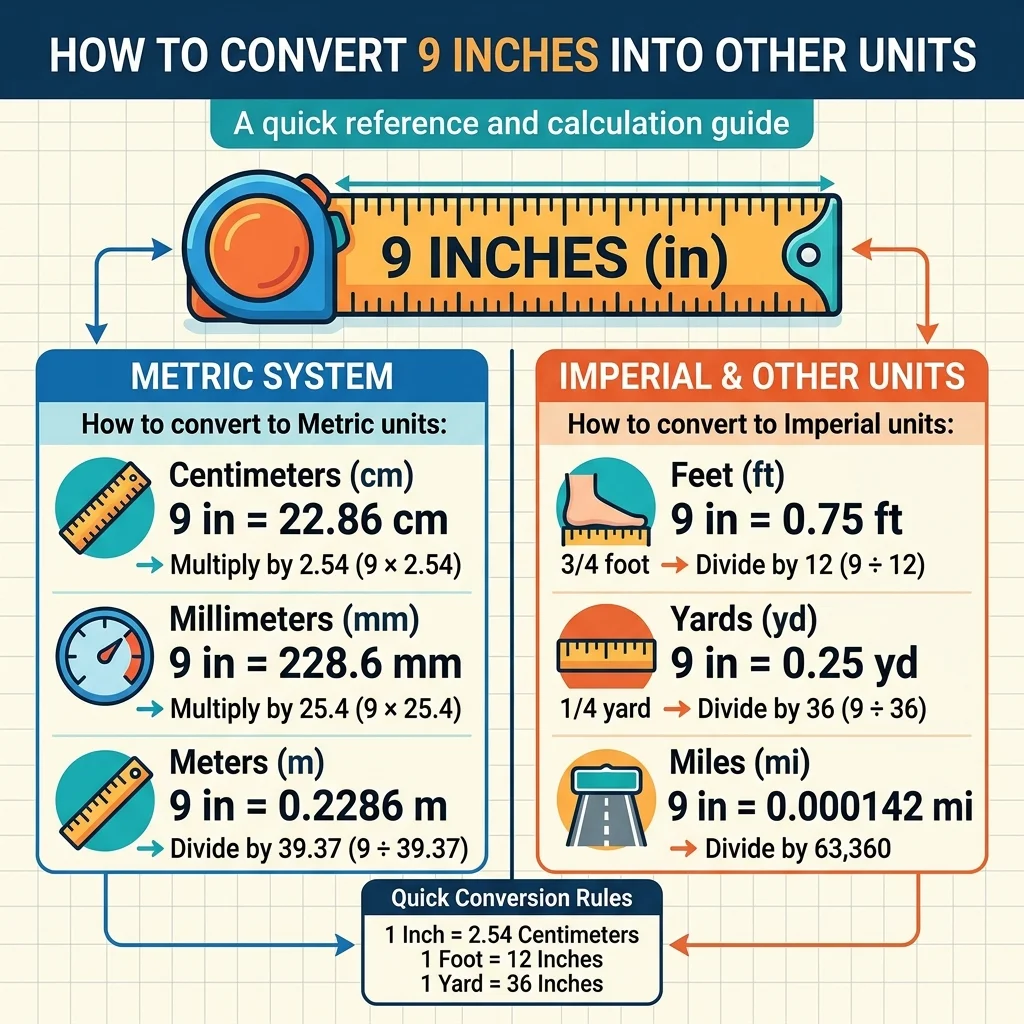
You don’t need a conversion calculator for every measurement. A few simple formulas will help you work out the answer whenever you need it.
Inches to feet: Divide the inches by 12.
9 ÷ 12 = 0.75 feet.
That means 9 inches is three-quarters of a foot, leaving another 3 inches to reach a full foot.
Inches to centimeters: Multiply the inches by 2.54.
9 × 2.54 = 22.86 centimeters.
Therefore, 9 inches in cm is 22.86 cm, which you can round to approximately 23 cm for everyday estimates.
Inches to millimeters: Multiply the inches by 25.4.
9 × 25.4 = 228.6 millimeters.
This conversion is useful for small construction projects, product specifications, and crafting.
Inches to meters: Multiply the inches by 0.0254.
9 × 0.0254 = 0.2286 meters.
Inches to yards: Divide the inches by 36.
9 ÷ 36 = 0.25 yards.
For most everyday situations, remembering that nine inches is approximately 23 centimeters is sufficient. If you’re cutting materials or checking a tight space, however, use the precise value of 22.86 cm.
Where 9 Inches Fits on a Common Size Scale
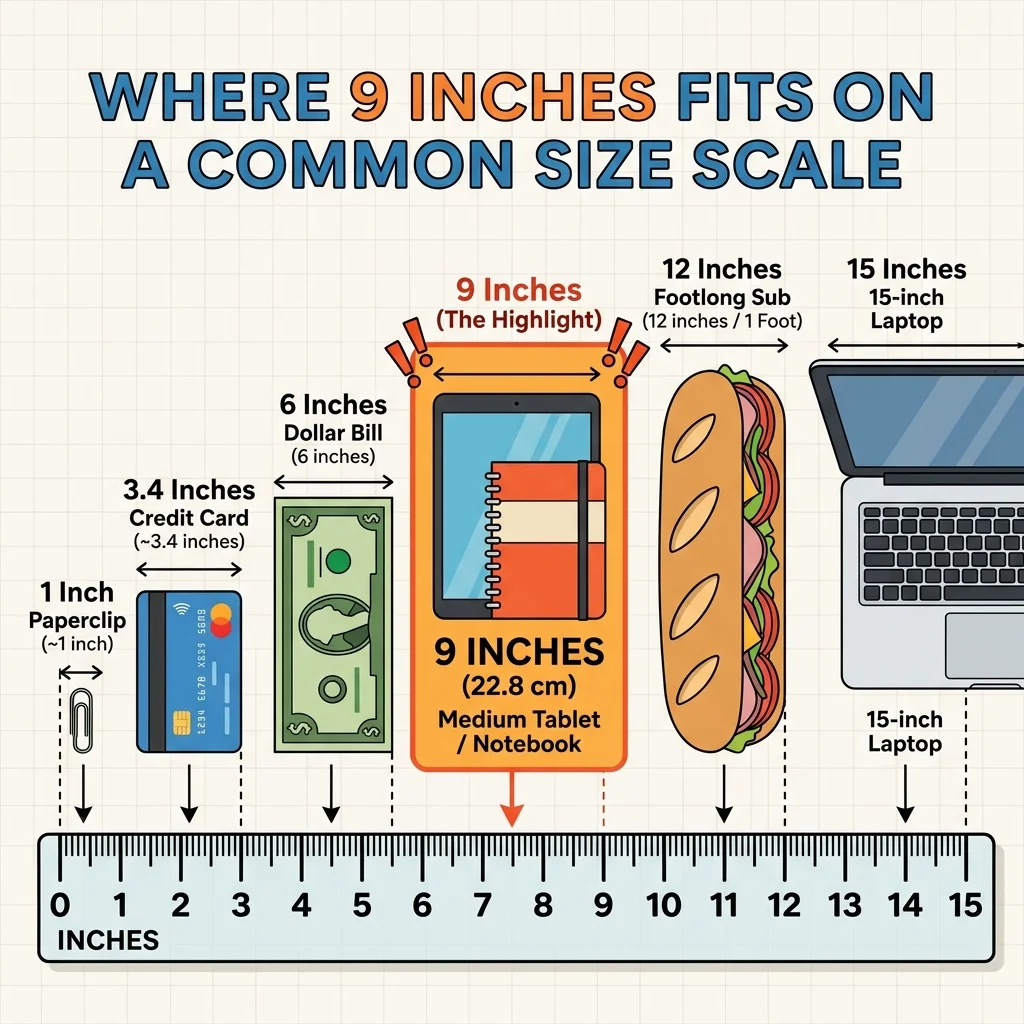
Nine inches is a relatively short measurement compared with furniture, doors, and large appliances. However, it’s long enough to describe many familiar household items, from small plates to compact kitchen tools.
One of the easiest ways to picture it is to imagine a standard 12-inch ruler. Nine inches covers three-quarters of its length, leaving a 3-inch section at the end.
Here are a few useful comparisons to help you understand the scale.
- Compared with one foot: Nine inches is 75% of a foot.
- Compared with 10 inches: It’s just 1 inch shorter.
- Compared with 12 inches: It’s 3 inches shorter than a full foot.
- Compared with 20 centimeters: It’s 2.86 cm longer.
- Compared with 30 centimeters: It’s 7.14 cm shorter.
- Compared with one meter: It’s a little less than one-quarter of a meter.
The shape of an object also affects how you interpret its dimensions. A 9-inch plate measures across its diameter, while a 9-inch book might be measured vertically from its bottom edge to its top edge.
A screen introduces another difference. Its advertised size is generally measured diagonally, not across its width.
These distinctions matter when shopping online. Two products can both have a 9-inch measurement and still look completely different because their shapes and measurement methods are different.
12 Everyday Things That Measure About 9 Inches
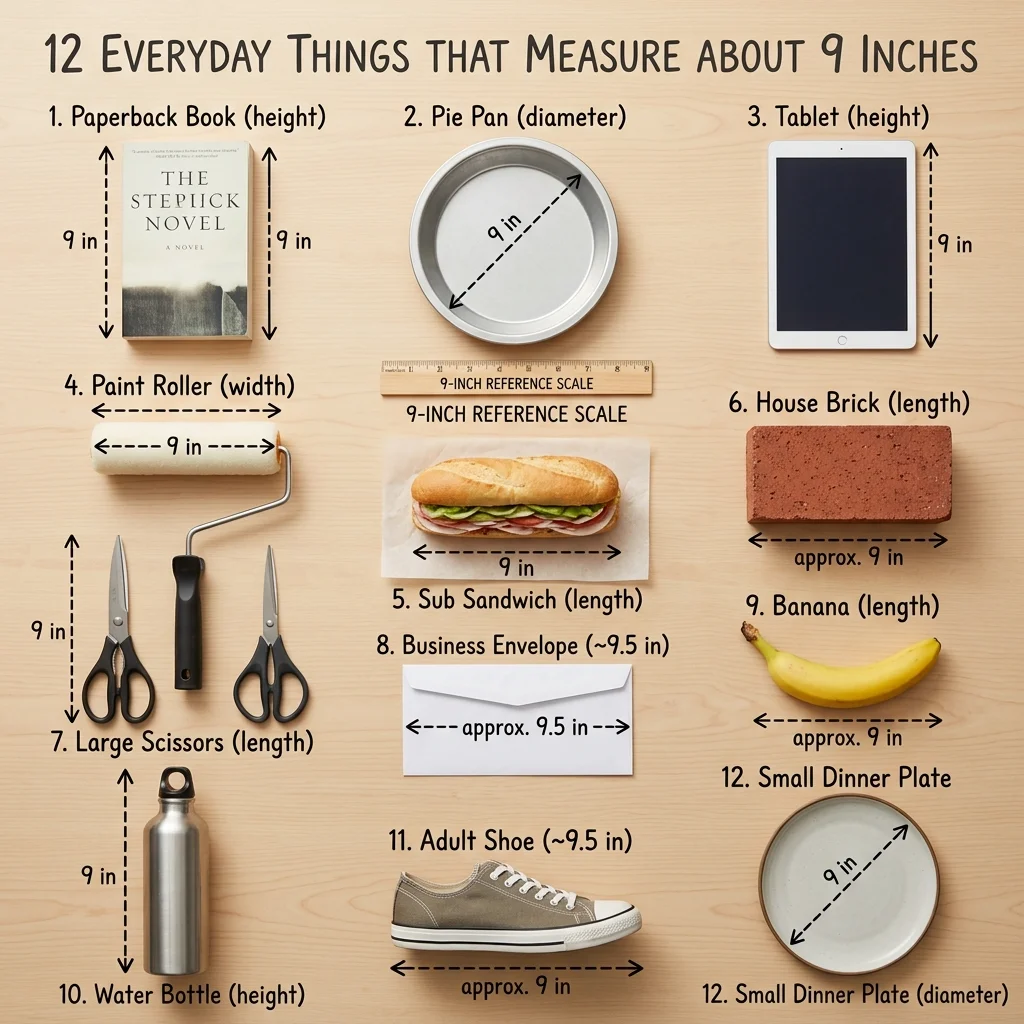
The easiest way to visualize nine inches is to compare it with familiar objects. Some products are commonly sold in this size, while others come close enough to provide a useful reference.
Keep in mind that actual dimensions vary by brand, design, and model. The comparisons below are practical guides rather than guarantees that every example measures exactly nine inches.
A 9-Inch Dinner Plate
A dinner plate measuring 9 inches across is one of the simplest ways to visualize this length. Its diameter is 22.86 cm, measured in a straight line from one edge through the center to the opposite edge.
Plates in this size range are commonly used for smaller meals, lunches, desserts, or individual servings. Some dinner plates are larger, so it’s worth checking the listed diameter if you’re buying a particular size.
The important detail is that nine inches refers to the distance across the plate, not the distance around its circular rim.
Imagine setting a plate on your kitchen table and measuring straight across its middle. That line provides a clear visual reference for the length you’re trying to picture.
A 9-Inch Cake Pan
Round cake pans are frequently sold in 8-inch and 9-inch sizes, making a 9-inch pan a realistic example. Its nominal diameter is approximately 22.86 centimeters.
Home bakers use this size for sponge cakes, layer cakes, and other desserts. The exact internal baking area may be slightly smaller than the outside diameter because of the pan’s construction and rim.
A cake pan is especially useful as a comparison because its advertised size is commonly given in inches. You can immediately understand what the number represents without converting another measurement.
Picture a round metal pan on your kitchen counter. Its diameter is close to the shorter side of US letter paper, which measures 8.5 inches, plus another half inch.
A Small 9-Inch Pizza

A pizza measuring 9 inches across provides a familiar and memorable comparison. Its diameter is approximately 22.86 cm, measured from the outer crust on one side to the opposite side.
Pizza sizes vary between restaurants, and not every restaurant sells a 9-inch option. Some use terms such as small, personal, or individual instead of specifying an exact diameter.
The circular shape makes this comparison easy to understand. Whether the pizza is cut into four, six, or eight slices, its diameter remains the same.
Imagine a small pizza on a serving board. Its width gives you a useful picture of nine inches, although the crust and toppings can make the edges less precise than a ruler.
A Compact Tablet Screen
Some compact tablets have screens marketed around the 9-inch size class. For a screen, the measurement generally refers to the diagonal distance between opposite corners of the display.
That means the screen isn’t necessarily 9 inches wide or 9 inches tall. Its actual width and height depend on its aspect ratio, while the complete tablet will be larger because of the frame and body.
Diagonal measurements allow buyers to compare screens of different shapes using a single figure. Two devices with the same diagonal can still have noticeably different proportions.
Imagine holding a compact tablet horizontally. The 9-inch measurement runs diagonally across the display rather than along its top or side edge.
The Width of US Letter Paper, Plus Half an Inch
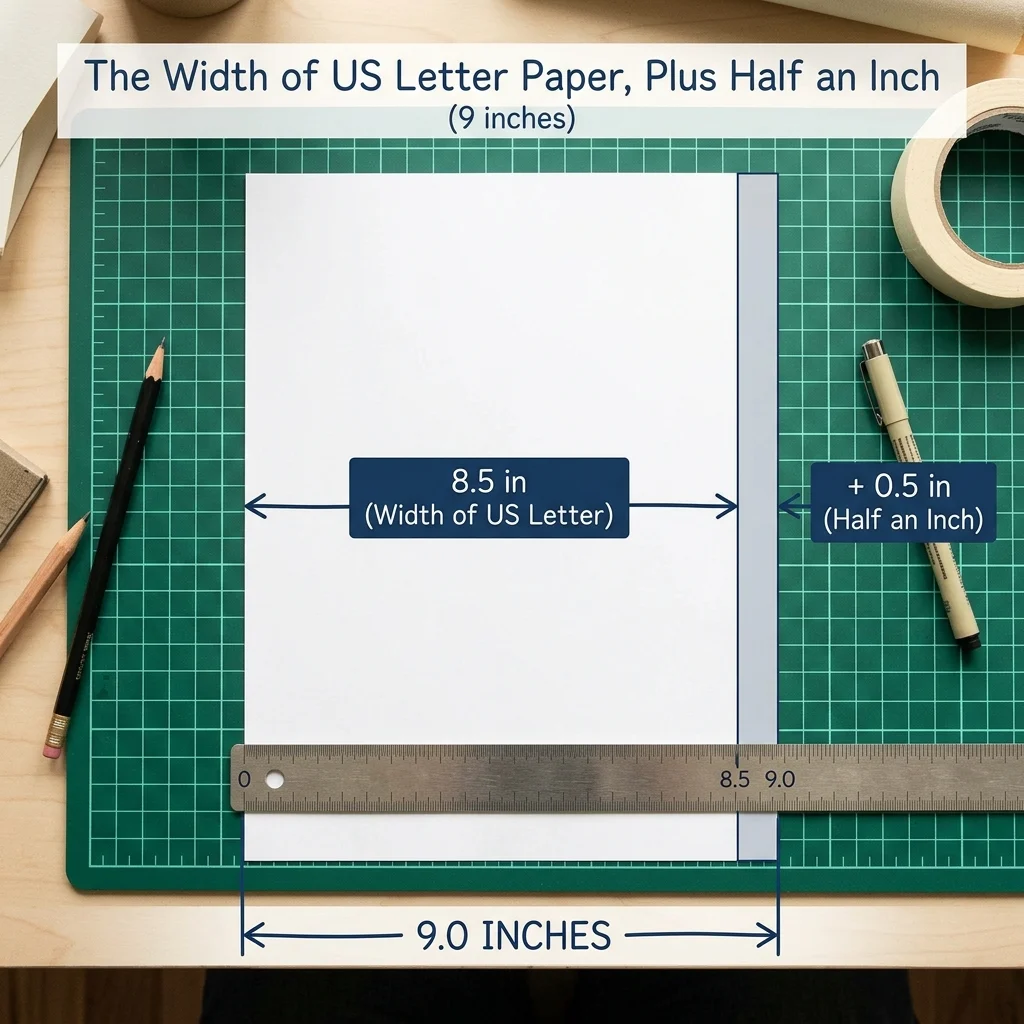
US letter paper measures 8.5 inches wide and 11 inches long. Its shorter edge is therefore only half an inch less than nine inches.
This is a particularly convenient comparison because printer paper is common in offices, schools, and homes across the United States. Its standardized dimensions also make it more reliable than estimating from an object with an unknown size.
The half-inch difference may seem small, but it matters for projects that require accurate cutting or fitting paper into a holder.
Hold a sheet horizontally and look across its shorter edge. That width gives you a close estimate of nine inches, with another half inch needed to reach the full measurement.
A 9-Inch Frying Pan
A frying pan with a cooking surface around 9 inches wide offers another practical reference. Small skillets come in various sizes, and manufacturers may measure the top rim rather than the flat cooking surface.
A pan in this range can be useful for cooking eggs, warming small portions, or preparing food for one or two people. The usable cooking area is generally smaller than the outside diameter.
If you’re buying cookware, check whether the advertised size refers to the rim, the base, or another part of the pan. These measurements can differ enough to affect storage and burner compatibility.
Picture a compact skillet on your stovetop. Its diameter is comparable to a small dinner plate, although its sides and handle give it a very different overall shape.
A 9-Inch Pie Dish
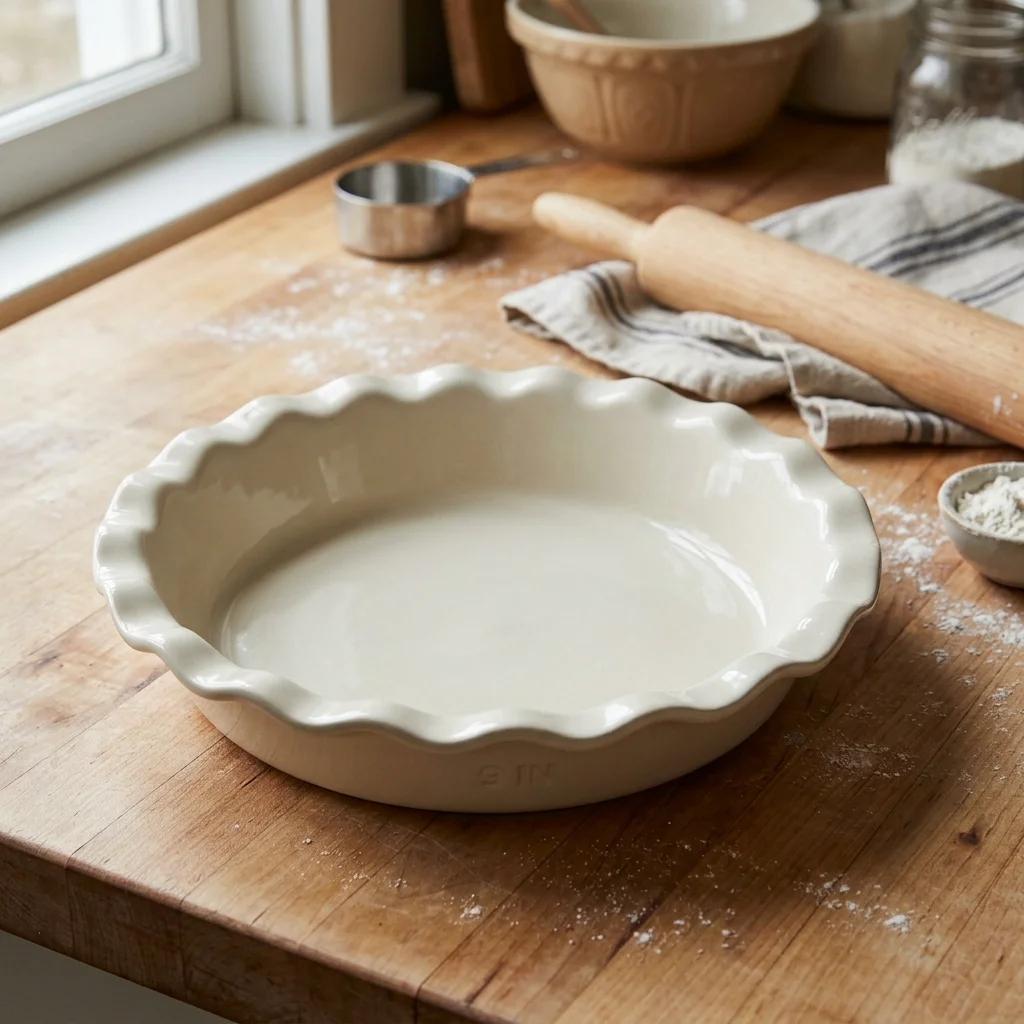
Many pie recipes call for a 9-inch dish, making this a familiar measurement for home bakers. The number usually refers to the nominal diameter across the top opening.
A pie dish is useful for fruit pies, pumpkin pies, and other traditional desserts. Because the sides slope inward, the bottom is generally narrower than the opening.
This example highlights an important measurement principle: one object can have several dimensions. A pie dish may be 9 inches across its top while measuring considerably less across its base.
Imagine looking straight down at an empty pie dish. The widest opening gives you the reference for nine inches, while its depth is measured separately.
A 9-Inch Square Baking Pan
A 9-inch square baking pan has sides that measure 9 inches each. Unlike a round cake pan, which is measured by its diameter, a square pan is generally described by the length of its sides.
These pans are commonly used for brownies, cornbread, small cakes, and baked desserts. Recipes often specify the pan size because changing the dimensions can affect food thickness and baking time.
The outside measurement can be slightly larger than the usable interior, depending on the thickness of the metal and the design of the rim.
Picture a square pan sitting on a counter. Each side measures 22.86 cm, giving you a clear example of nine inches as a straight-line dimension.
A Large Paperback Book

Some large-format paperback books stand close to 9 inches tall, although many ordinary paperbacks are shorter. This comparison works best with oversized novels, workbooks, and educational books rather than compact editions.
Book dimensions vary according to the publisher, page count, trim size, and intended purpose. Height is usually measured vertically from the bottom edge to the top edge when the book stands upright.
Books are useful comparison objects because they’re easy to find and handle. If you have a large paperback, you can place it beside a ruler to see whether it comes close to the target length.
Stand the book upright on a flat surface and look at its vertical edge. A book around nine inches tall reaches approximately 23 cm above the surface.
A Chef’s Knife With a 9-Inch Blade
Some chef’s knives have blades around 9 inches long, although many common models have shorter blades. A 9-inch blade is a larger example, so it shouldn’t be considered the standard size for every kitchen knife.
Knife measurements can refer to the blade alone or to the entire knife, depending on the manufacturer’s listing. For a useful comparison, check whether the stated length begins at the handle or includes it.
Longer blades provide more cutting surface for certain tasks, such as working with large ingredients. However, the right knife length depends on the user’s comfort, experience, and intended use.
Imagine a knife laid flat on a kitchen counter with the handle excluded from the measurement. The blade alone would extend roughly 23 cm from heel to tip.
A Small Cutting Board
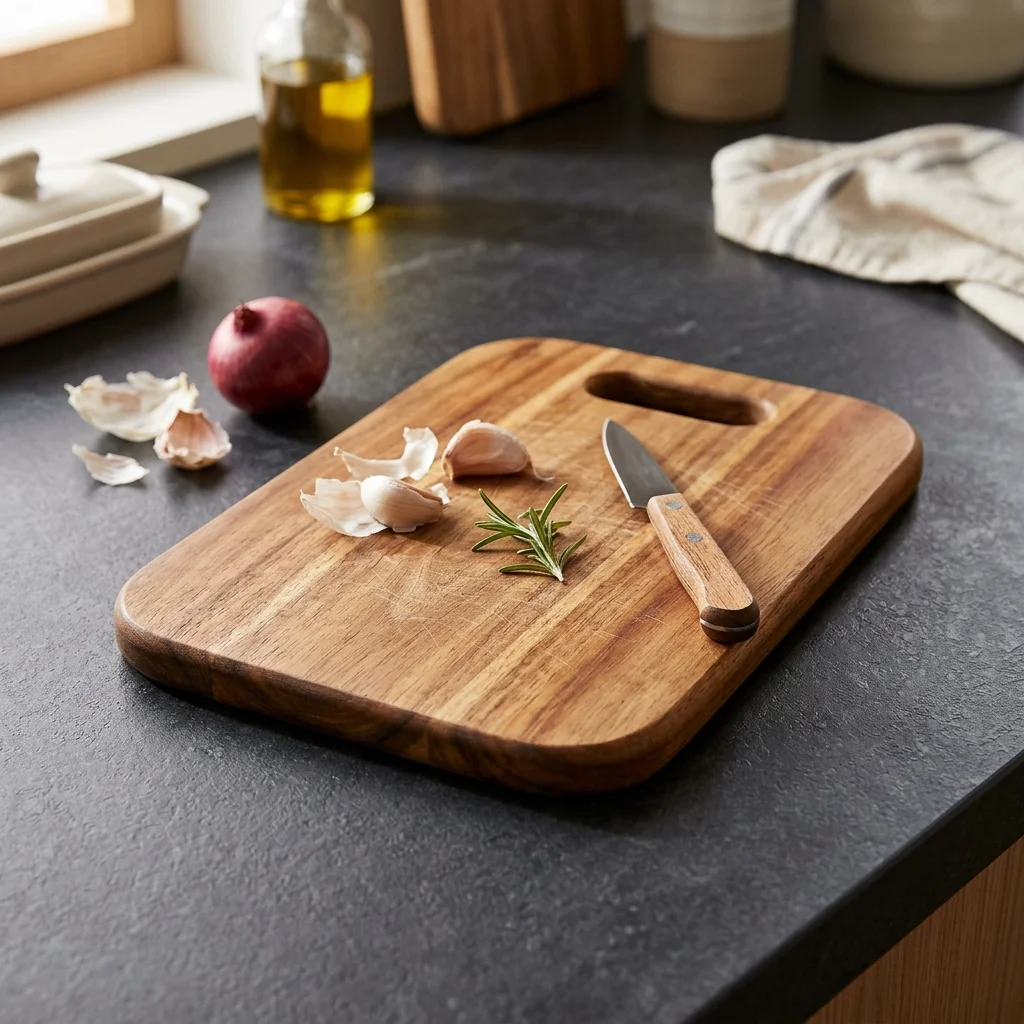
Compact cutting boards are sometimes around 9 inches long, particularly those designed for small kitchens, quick food preparation, or serving snacks. Larger boards are also common, so this is a size example rather than a universal standard.
A board’s dimensions generally describe its overall length and width. If it’s 9 inches long, the other dimension depends on whether the board is square or rectangular.
Small boards can be convenient for slicing a lemon, preparing a garnish, or chopping a modest amount of food. They also require less counter space and can be easier to store.
Imagine a compact cutting board on the kitchen counter. Its longer edge may span approximately 22.86 cm, giving you a useful reference for other short lengths around the home.
A 9-Inch Wall Clock
A wall clock with a 9-inch diameter provides a clear circular reference. Clocks come in many sizes, and nine inches is a plausible size for a compact clock in a kitchen, bedroom, or office.
The diameter is measured across the clock from one outer edge to the opposite edge. If the frame extends beyond the face, the overall outside diameter may be larger than the visible dial.
A clock is particularly helpful for visualizing nine inches because its circular outline makes the measurement easy to imagine. It also demonstrates the difference between diameter and circumference.
Picture a compact clock hanging on a wall. Its outside width spans roughly 23 cm, offering a simple reference for other round objects.
What Does a 9-Inch Measurement Actually Mean?
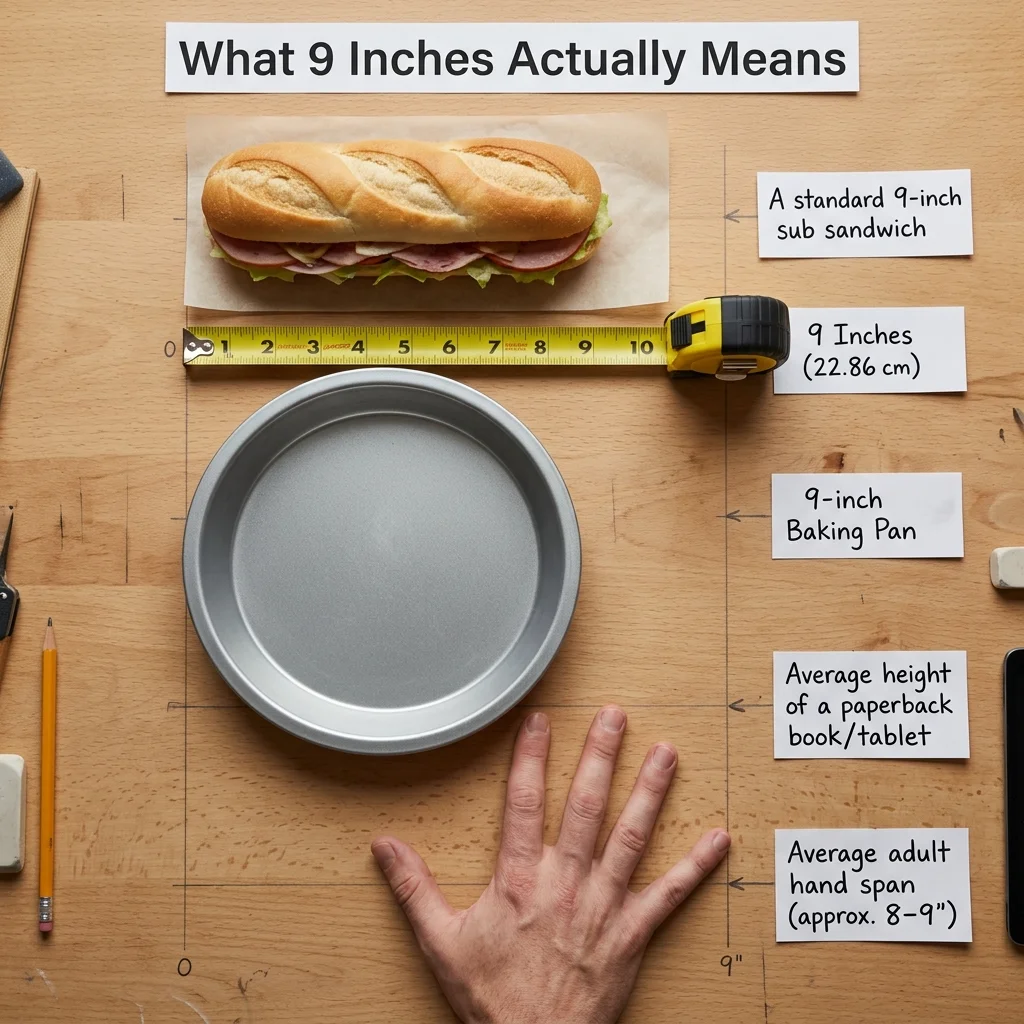
People searching for this measurement may want to understand a product listing, compare dimensions, or picture a specific object. The correct interpretation depends on which part of the object is being measured.
Is a 9-Inch Screen Really 9 Inches Wide?
Not necessarily. Screens are generally measured diagonally from one corner of the display to the opposite corner.
For example, a screen with a 9-inch diagonal and a 16:9 aspect ratio would be approximately 7.85 inches wide and 4.42 inches tall. These figures describe the display area, not the complete device.
A screen with a different aspect ratio would have different width and height measurements even if its diagonal were still nine inches.
Is a 9-Inch Round Object 9 Inches Around?
No. A circular object with a 9-inch diameter has a circumference of approximately 28.27 inches.
The diameter measures the straight distance across the center. The circumference measures the entire distance around the outside edge.
This distinction matters when purchasing round plates, baking pans, pie dishes, and similar products. A listing that describes a 9-inch diameter doesn’t mean the rim measures nine inches around.
Is 9 Inches Considered Large?
It depends on the object.
A 9-inch dinner plate is a familiar size, while a 9-inch screen is relatively compact compared with larger displays. A 9-inch knife blade, meanwhile, is longer than many commonly used kitchen knife blades.
The number alone doesn’t determine whether something is large or small. Its shape, intended purpose, and typical product dimensions provide the necessary context.
Getting to 9 Inches Without a Tape Measure
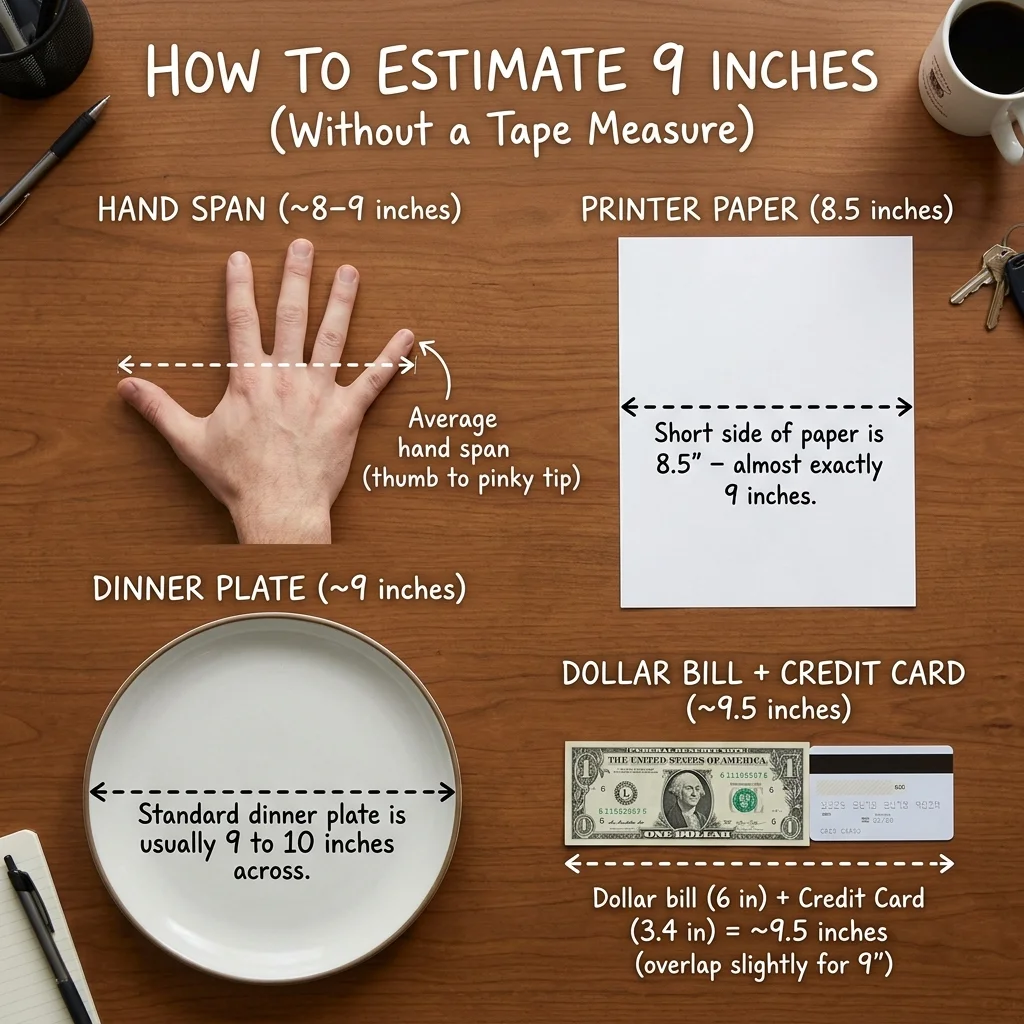
You can estimate nine inches without owning a measuring tape. The most reliable approach is to use an object with a known size rather than relying entirely on memory.
Use the Shorter Edge of Printer Paper
US letter paper is 8.5 inches wide. That’s only half an inch shorter than nine inches, making it a handy reference for quick estimates.
If you’re trying to judge a length across a desk or shelf, compare it with the shorter edge of a sheet of paper. Add approximately half an inch to picture the full nine inches.
Remember that this comparison applies to US letter paper. Other paper sizes, including A4, have different dimensions.
Picture Three-Quarters of a Foot
A standard foot contains 12 inches, so nine inches covers three-quarters of that length.
If you have a 12-inch ruler, locate the 9-inch mark. The remaining distance to the end is 3 inches.
This method is especially useful because it relates the measurement to a unit many people already recognize.
Compare It With a Dinner Plate
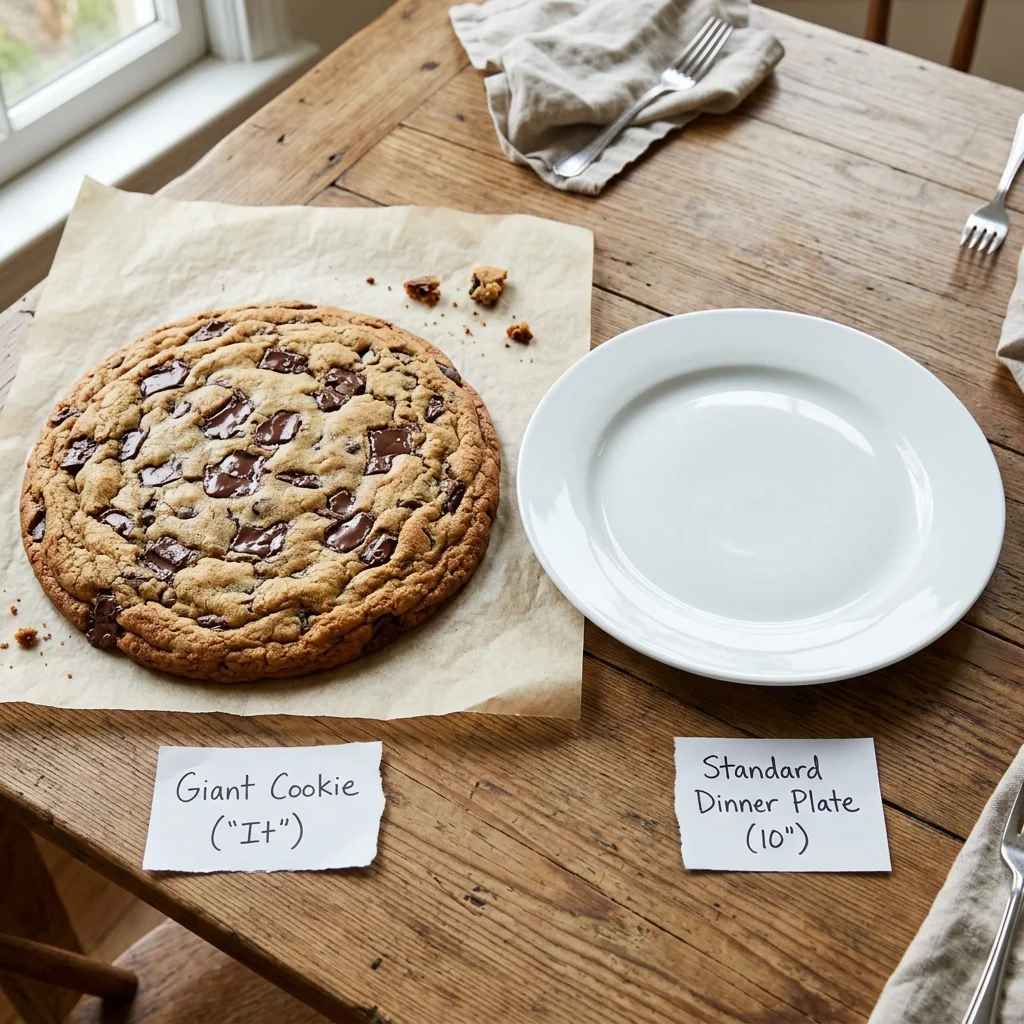
A dinner plate with a confirmed 9-inch diameter offers a convenient visual reference. Look straight across the center rather than measuring around the curved rim.
Not every dinner plate is nine inches wide, so use a ruler to check its diameter if you need an accurate comparison.
Once you know the size of one plate, you can use it to estimate similar objects, such as serving dishes and compact round trays.
Estimate 23 Centimeters
Since nine inches equals 22.86 centimeters, rounding the measurement to 23 cm is useful for everyday estimates.
A metric ruler with centimeter markings makes this approach particularly simple. Find the 23 cm mark to see almost exactly how long nine inches is.
For detailed work, remember that 23 cm is a rounded equivalent rather than the exact conversion.
Use a Baking Pan With a Known Size
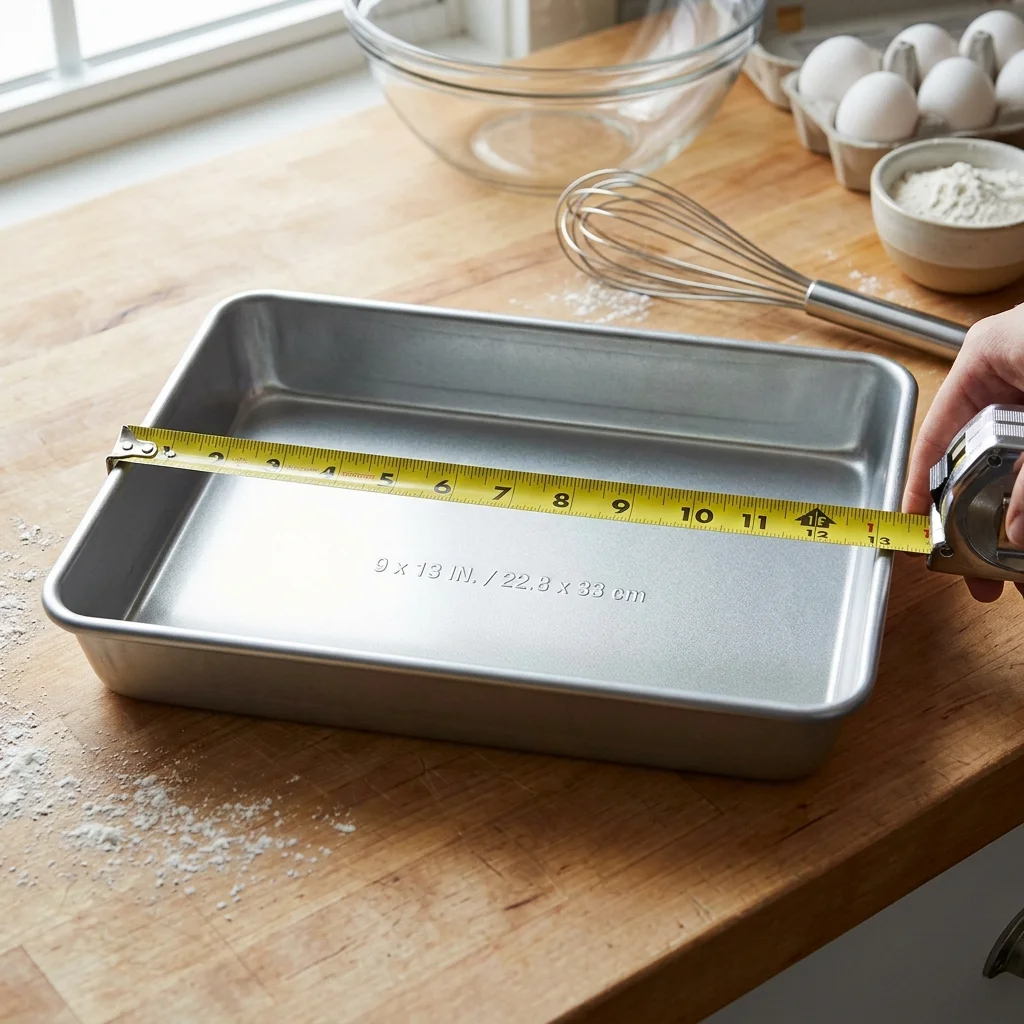
If you have a baking pan labeled 9 inches, one side of a square pan or the diameter of a round pan can serve as a reference.
Place the object you’re estimating beside the pan and compare the corresponding edges. This method is practical for quick household measurements, but visual alignment can introduce errors.
For cutting materials, installing fixtures, or checking whether something will fit into a tight opening, use an actual ruler or measuring tape.
FAQs About 9 Inches
How many feet is 9 inches?
Nine inches equals 0.75 feet, or three-quarters of a foot. Divide nine by 12 because one foot contains 12 inches.
How many centimeters is 9 inches?
Nine inches equals 22.86 centimeters. For quick mental calculations, you can round it to approximately 23 cm.
How many millimeters is 9 inches?
Nine inches equals 228.6 millimeters. This conversion is useful for technical specifications, craft projects, and small construction measurements.
How many meters is 9 inches?
Nine inches equals 0.2286 meters. That’s slightly less than one-quarter of a meter, which is 25 centimeters.
How long is 9 inches compared with a ruler?
Nine inches is three-quarters of a standard 12-inch ruler. It leaves a 3-inch section at the end, making a ruler an easy way to visualize the length.
What everyday object is about 9 inches long?
A 9-inch dinner plate, cake pan, or small pizza can provide a useful comparison. The shorter side of US letter paper is also close at 8.5 inches.
Can I visualize 9 inches without a measuring tape?
Yes. Compare the measurement with the shorter edge of US letter paper or picture three-quarters of a foot. These methods are useful for estimates, but a ruler is more reliable when precision matters.
Is a 9-inch screen 9 inches wide?
Usually not. Screen sizes are generally measured diagonally from one corner to the opposite corner. The actual width and height depend on the display’s aspect ratio.
Where That Leaves You
Nine inches becomes much easier to picture when you connect it with familiar objects. It equals 0.75 feet, 22.86 centimeters, 228.6 millimeters, or 0.2286 meters.
A 9-inch dinner plate or cake pan provides one of the clearest visual comparisons because you can see the distance across its diameter. If you don’t have either nearby, the 8.5-inch width of US letter paper gives you a close alternative.
For a quick mental reference, remember that nine inches is three-quarters of a foot and approximately 23 centimeters. That simple comparison can help you estimate everyday dimensions, understand product specifications, and decide when you need a more precise measurement tool.