Ten centimeters sounds simple until you try to picture it without a ruler. Is it the length of your palm, the width of a small phone, or the height of a coffee mug? Familiar objects can make this measurement much easier to understand.
You might encounter 10 cm when checking a product’s dimensions, measuring a craft project, comparing household items, or reading a school assignment. It is a small but useful length, especially when you need a quick estimate rather than a full measuring tool.
The good news is that converting it takes only a moment. Once you know the equivalent in inches, feet, millimeters, and meters, you can use everyday objects to develop a reliable sense of its size.
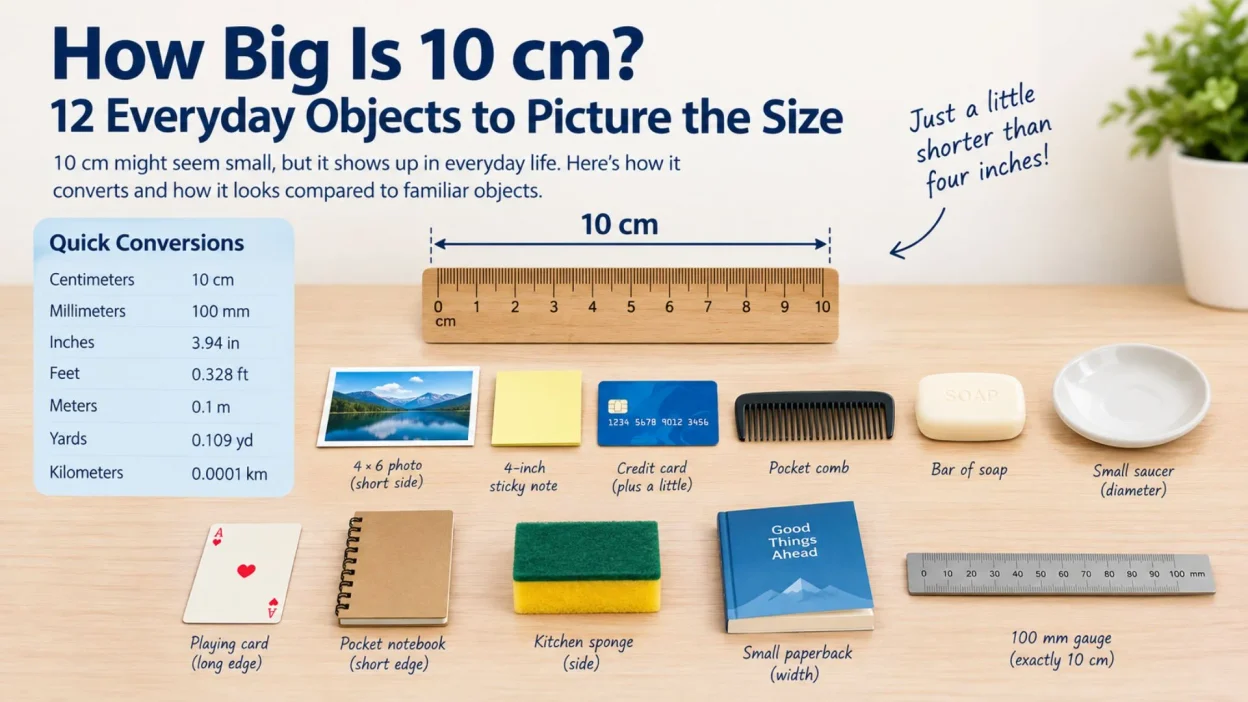
10 cm equals approximately 3.94 inches, 0.328 feet, 100 millimeters, and 0.1 meters. That is just a little shorter than four inches, making a four-inch reference a convenient starting point for visualizing it.
Every Unit 10 cm Converts To
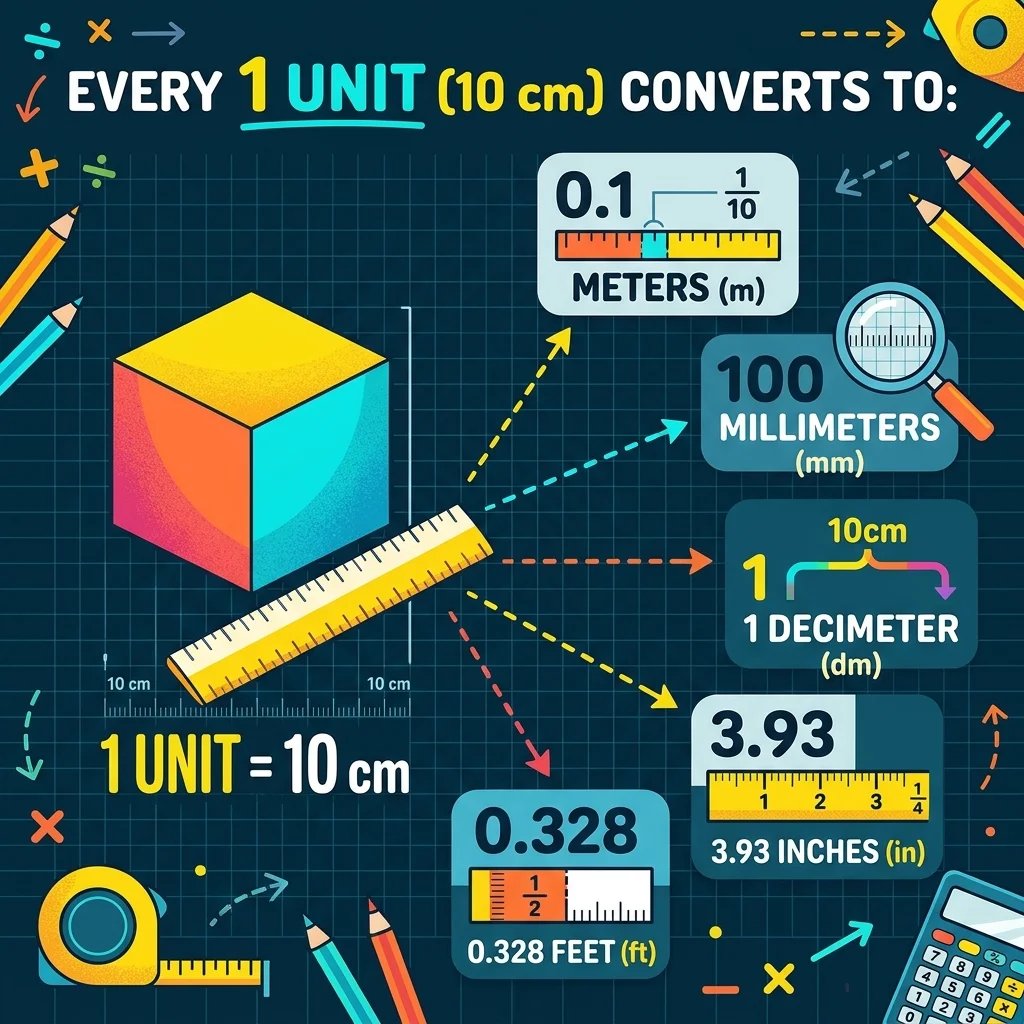
The metric system makes 10 cm particularly easy to understand because it is a tenth of a meter and exactly 100 millimeters.
Here are the most useful conversions at a glance.
| Unit | Value |
|---|---|
| Centimeters | 10 cm |
| Millimeters | 100 mm |
| Inches | 3.937 inches |
| Feet | 0.3281 ft |
| Meters | 0.1 m |
| Yards | 0.1094 yd |
| Kilometers | 0.0001 km |
How the conversions work
10 cm in inches: Divide 10 by 2.54. The result is approximately 3.94 inches.
10 cm in feet: Divide the inch equivalent by 12, giving about 0.328 feet. This is roughly one-third of a foot.
10 cm in millimeters: Multiply 10 by 10. The answer is exactly 100 mm.
10 cm in meters: Divide 10 by 100, which gives exactly 0.1 m.
10 cm in yards: Divide the centimeter measurement by 91.44. The result is approximately 0.1094 yards.
For most everyday tasks, you only need to remember two figures: 10 cm is about 4 inches, and 100 mm is exactly 10 cm. The four-inch comparison is rounded, so it is useful for estimating rather than precision work.
Where 10 cm Fits on a Common Size Scale
Ten centimeters is a compact length. It is long enough to notice immediately in your hand but short enough to fit comfortably inside a pocket, pencil case, or small drawer.
Think of a four-inch ruler segment. At 10.16 cm, it is almost identical to the target measurement. This is one of the easiest ways to picture 10 cm because the difference is only 1.6 millimeters.
On a metric ruler, 10 cm spans from the zero mark to the 10-centimeter mark. It also covers ten individual centimeter divisions, or 100 millimeter divisions.
Here is a quick way to place it on a familiar scale:
- 1 cm: A very small length, roughly comparable to the width of a fingernail.
- 5 cm: Half of the target measurement.
- 10 cm: Approximately four inches.
- 20 cm: Twice the target length.
- 100 cm: One meter, or ten times the target length.
The key distinction is that 10 cm describes length, not necessarily height or width. A rectangular object could be 10 cm wide and 20 cm long, while a round object might measure 10 cm across its diameter.
12 Everyday Things That Measure About 10 cm
Finding an object that measures exactly 10 cm is not always easy. However, several familiar items have dimensions close enough to help you estimate the length. Remember that manufacturers, designs, and individual objects vary.
A 4-Inch Ruler Segment
Closest simple reference: 10.16 cm
A four-inch ruler segment is one of the most reliable comparisons for 10 cm. Four inches converts to 10.16 cm, which is only 0.16 cm longer than your target.
This makes it particularly useful for schoolwork, crafting, sewing, and quick household measurements. If you have a ruler marked in inches, the four-inch point gives you a very close reference.
You do not need to imagine the entire ruler. Just picture the distance from its starting point to the four-inch mark.
The Short Side of a 4 × 6-Inch Photograph
Approximate comparison: 10.16 cm
A common 4 × 6-inch photo measures 4 inches along its shorter side. That edge is approximately 10.16 cm, making it an excellent everyday comparison.
Printed photographs are useful because their dimensions are usually standardized. If you have a physical 4 × 6-inch print, you can use its short edge to estimate the target length.
Imagine holding the photograph in landscape orientation. Its shorter vertical edge is just over 10 cm, while its longer edge measures 15.24 cm.
A 4-Inch Square Sticky Note
Approximate comparison: 10.16 cm per side
Some sticky notes come in four-inch square formats. Each side measures approximately 10.16 cm, putting it very close to 10 cm.
The square shape makes the comparison particularly easy. Instead of estimating a single line, you can look at one complete edge and get a sense of the distance.
Check the package dimensions before using a sticky note as a reference because smaller sizes, such as three-inch squares, are also common.
The Width of an Adult Palm
An adult palm can be a handy reference when a ruler is unavailable. Depending on the person, the width across the palm may be close to 8–10 cm or sometimes greater.
This comparison is convenient because your hand is always nearby. Place your fingers together and look across the broad part of your palm, excluding the thumb.
However, hand dimensions differ considerably with age, body size, and individual anatomy. Treat your palm as a personal estimating tool rather than a universal 10 cm standard.
A Small Bar of Soap
Some compact rectangular bars of soap measure around 9–10 cm along their longest edge. That makes a suitably sized bar a useful household comparison.
Soap is designed in many shapes, from slim oval bars to thick rectangular blocks. There is no single standard length, so the particular product matters.
Look at the long edge of a small bar rather than its thickness. If it is close to the width of four fingers placed together, it may provide a rough visual estimate, although finger widths vary.
A Compact Pocket Comb
Small pocket combs are often designed to fit into a bag or grooming kit, and some are approximately 10 cm long.
Their length makes them a convenient object to compare with your target. A compact comb may fit across your palm, while a full-size styling comb can be considerably longer.
Because pocket combs come in different designs, check the actual length if accuracy matters. The comparison is most useful when you already own a small comb and want to estimate its size at a glance.
A Small Saucer
A small saucer or dipping dish may measure around 10 cm across, depending on its style. This gives you a circular object that helps visualize the target as a width rather than a straight line.
To make the comparison, imagine a line running across the center of the dish from one outer edge to the other. That distance is its diameter.
Not every saucer is this small; many coffee and tea saucers are significantly wider. Choose a compact dish and check its dimensions before treating it as a close match.
The Long Edge of a Standard Playing Card
A typical poker-size playing card measures about 8.9 cm along its longer edge. That is approximately 1.1 cm shorter than 10 cm.
Although it is not an exact match, a playing card is a familiar object that makes the target easier to estimate. Imagine adding about a centimeter to the card’s long edge.
Playing cards are usually around 6.3 cm wide, so their longer dimension is the one that provides the better comparison.
The Long Edge of a Credit Card
A standard bank card following the common ID-1 format measures 85.60 mm long, or 8.56 cm. That makes it noticeably shorter than 10 cm, but still a helpful reference.
Picture the card’s longest edge, then imagine extending it by roughly 1.4 cm. That additional distance brings you close to the target.
Bank cards are useful because their dimensions are standardized, unlike many household objects. Still, handle your actual card carefully and avoid exposing personal or payment information when using it as a reference.
The Width of a Small Paperback Book
Some compact paperback books are approximately 10–11 cm wide. Their size depends on the publisher, book format, and intended market, so this is an approximate comparison rather than a fixed standard.
Look at the front cover and measure across its shorter horizontal dimension. On a small-format book, this width can be close to 10 cm.
This is a practical reference when you are estimating shelf space, packing a bag, or comparing the dimensions of small printed materials. A regular paperback may be considerably wider, so use a genuinely compact edition.
A Small Kitchen Sponge
A compact cleaning sponge may measure around 10 cm along one side. Many everyday sponges fall within this general range, although larger kitchen sponges can be much longer.
Its rectangular shape helps you visualize a 10 cm edge without needing to picture a ruler. Place the sponge on a counter and compare its shorter side with the target length.
Sponges compress when squeezed, so use their relaxed dimensions for a more meaningful estimate. If you need a precise measurement for a storage compartment, check the sponge with a ruler.
A Compact Notebook’s Short Edge
Some pocket notebooks have a short edge close to 10 cm. Small notebooks vary in format, but certain compact designs are made to fit easily into handbags, jacket pockets, and travel kits.
Look across the narrower side of the cover. If the notebook is roughly 10 cm wide, it provides a simple visual reference for the target.
Do not assume that every pocket notebook has this dimension. Some are much narrower, while others are closer to standard A6 paper size, which measures 10.5 × 14.8 cm.
A 100-Millimeter Measuring Gauge
A measuring gauge or marked scale designed around 100 mm gives you the exact metric equivalent of 10 cm. This is a more technical comparison, but it is useful in workshops, classrooms, and craft spaces.
Since one centimeter equals 10 millimeters, 100 mm converts directly to 10 cm. There is no rounding involved.
If you have a metric ruler, you can create the same reference by marking the distance from 0 to 100 mm. This is particularly useful when you want to check other objects against a known length.
What Does 10 cm Look Like on a Screen?
One related question people often have is whether 10 cm describes the width or height of a phone, television, or computer screen.
The answer depends on the product and its measurement system. Screens are usually advertised by their diagonal length, while their width and height depend on the aspect ratio and the size of the bezels.
For example, a screen with a 10 cm diagonal would be very small compared with a typical laptop or television. It would measure approximately 3.94 inches diagonally.
For a rectangular screen with a 16:9 aspect ratio, a 10 cm diagonal corresponds to an active display area approximately:
- Width: 8.72 cm
- Height: 4.90 cm
- Diagonal: 10 cm
These dimensions are calculated from the 16:9 ratio and exclude any surrounding frame.
A screen measuring 10 cm wide is different: its diagonal would be longer than 10 cm. This distinction matters when comparing electronic products because a diagonal measurement cannot be used interchangeably with width or height.
Getting to 10 cm Without a Tape Measure
You can estimate 10 cm without owning a measuring tape. The trick is to choose a familiar reference and remember whether it is slightly longer or shorter than the target.
Use the Four-Inch Reference
Four inches equals 10.16 cm. If you can picture the four-inch mark on a ruler, you already have a close mental reference.
This is one of the easiest methods when switching between imperial and metric measurements.
Compare It With a 4 × 6-Inch Photo
The shorter side of a standard 4 × 6-inch photo is about 10.16 cm. If you have a print nearby, use that edge as your guide.
Remember that a photograph’s longer edge is 15.24 cm, so make sure you use the correct side.
Use a Credit Card as a Starting Point
A standard bank card is 8.56 cm long. Imagine extending its longest edge by approximately 1.44 cm to reach 10 cm.
This method is less precise than using a ruler, but it can help with quick estimates when you know the card’s standard dimensions.
Use Your Own Palm
Measure the width of your palm once with a ruler. If it happens to be close to 10 cm, you can reuse it as a personal reference later.
Do not assume someone else’s palm will give the same result. Body measurements vary, so this technique works best after checking your own hand.
Remember the 100-Millimeter Rule
Ten centimeters is exactly 100 mm. If you have a metric ruler or another tool with millimeter markings, count ten groups of 10 mm.
For tasks involving cutting, drilling, fitting components, or assembling furniture, estimate only when precision is not important. Use a proper measuring tool whenever a small error could affect the result.
For another practical comparison, see [INTERNAL LINK: How Big Is 4 Inches? Everyday Measurement Comparisons].
Frequently Asked Questions
How many feet is 10 cm?
Ten centimeters equals approximately 0.3281 feet. That is close to one-third of a foot, although it is not exactly one-third.
How many inches is 10 cm?
Ten centimeters equals approximately 3.94 inches. It is just 0.16 cm shorter than four inches.
How many millimeters is 10 cm?
Ten centimeters equals exactly 100 millimeters. Multiply centimeters by 10 to convert them to millimeters.
How many meters is 10 cm?
Ten centimeters equals exactly 0.1 meters. Divide centimeters by 100 to convert the measurement into meters.
How long is 10 cm in real life?
It is a little shorter than four inches. The short edge of a standard 4 × 6-inch photograph is a useful comparison because it measures about 10.16 cm.
Is 10 cm considered long?
That depends on what you are measuring. Ten centimeters is a short distance for furniture or room dimensions, but it can be substantial for a small accessory, a craft project, or a compact electronic component.
What everyday object is about 10 cm long?
A four-inch ruler segment is approximately 10.16 cm long. Some small bars of soap, pocket combs, and compact notebooks may also be close to 10 cm, depending on their dimensions.
Can I measure 10 cm without a ruler?
Yes, you can estimate it using a four-inch reference or the shorter edge of a 4 × 6-inch photograph. These comparisons are close to 10 cm, but a ruler is preferable when you need an exact measurement.
Where That Leaves You
Ten centimeters is easier to visualize once you connect it with familiar objects. It equals exactly 100 mm and 0.1 meters, or approximately 3.94 inches and 0.328 feet.
For a quick mental picture, remember a four-inch ruler segment or the shorter edge of a 4 × 6-inch photograph. Both are just a fraction longer than 10 cm, making them useful references for everyday estimating.
The most important thing is to distinguish a close comparison from an exact measurement. When a task requires precision, use a ruler; when you only need a rough idea, these everyday references can make 10 cm much easier to picture.