Five inches might sound easy to imagine, but it can be surprisingly difficult to picture until you compare it with something familiar. It is longer than a standard credit card is wide, yet shorter than many smartphones. That small difference can matter when measuring a shelf, checking a product’s dimensions, or choosing the right tool.
The measurement appears in everyday items such as kitchen utensils, craft supplies, small screens, and household accessories. However, the actual size of these objects can vary by brand and design.
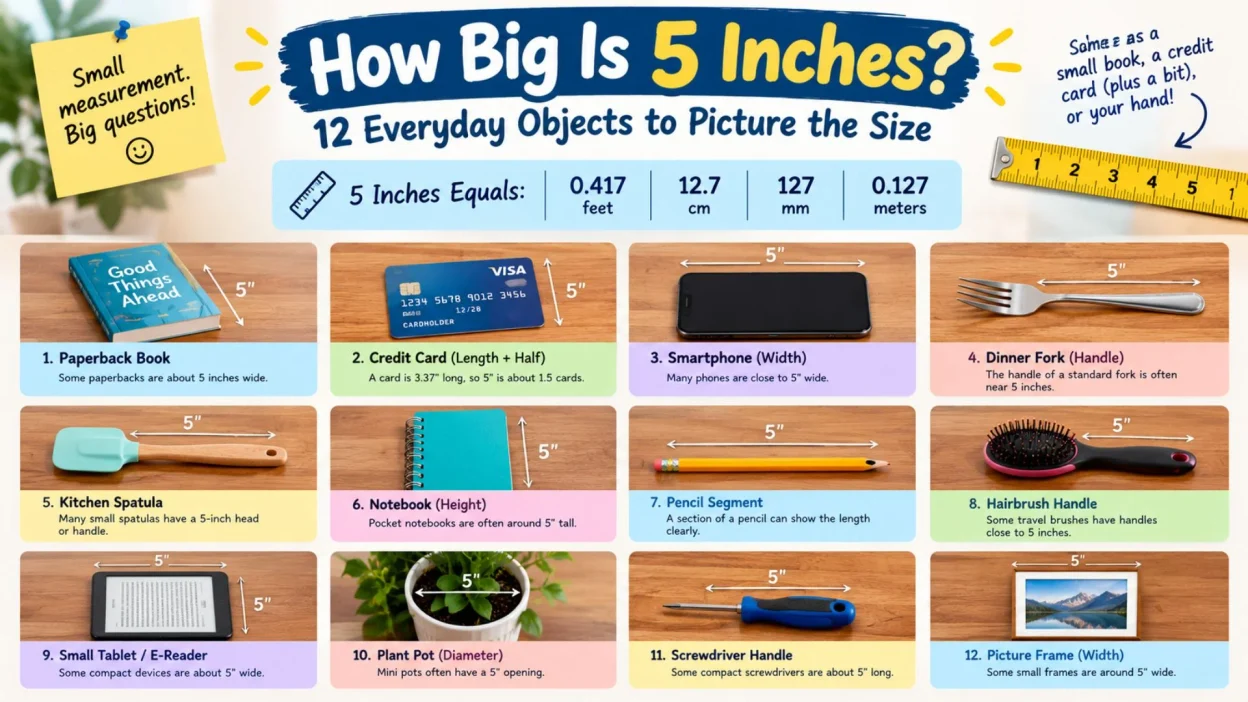
So, how big is 5 inches in practical terms? It equals 12.7 centimeters, 127 millimeters, or about 0.417 feet. This guide explains the conversions and explores familiar objects that help you visualize the length without a ruler.
Five inches equals 0.417 feet, 12.7 centimeters, 127 millimeters, and 0.127 meters.
Every Unit 5 Inches Converts To
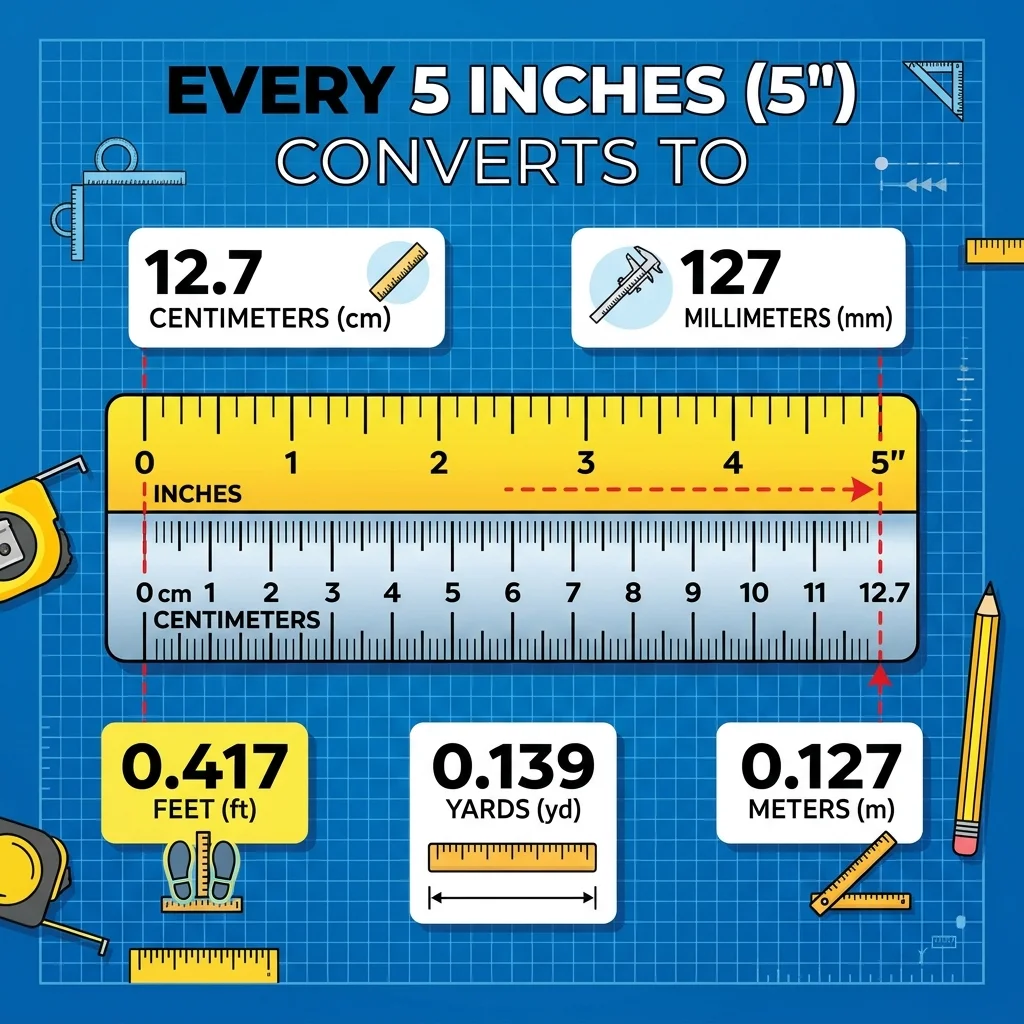
Five inches is a short length, but converting it into different units makes it easier to use in projects, shopping, and measurements.
| Unit | Value |
|---|---|
| Inches | 5 inches |
| Feet | 0.4167 feet |
| Centimeters | 12.7 cm |
| Millimeters | 127 mm |
| Meters | 0.127 m |
| Yards | 0.1389 yards |
| Fraction of a foot | 5/12 of a foot |
How the conversions work
The math is simple once you know the standard conversion factors.
- Inches to feet: Divide 5 by 12 to get approximately 0.417 feet.
- Inches to centimeters: Multiply 5 by 2.54 to get 12.7 cm.
- Inches to millimeters: Multiply 12.7 by 10 to get 127 mm.
- Inches to meters: Divide 12.7 by 100 to get 0.127 m.
- Inches to yards: Divide 5 by 36 to get approximately 0.139 yards.
For most everyday tasks, 12.7 cm is the easiest conversion to remember. Meanwhile, 127 mm can be more useful for technical drawings, hardware, and product specifications.
Where 5 Inches Fits on a Common Size Scale

Five inches is about the length of an adult hand from the wrist crease to the tip of the middle finger for some people, although hand sizes vary considerably. It is also close to the width of a small paperback book or the length of certain kitchen tools.
This measurement is useful when you need to judge whether an object will fit in a drawer, bag, box, or narrow space. However, five inches describes only one dimension. An object that is 5 inches long may be much wider or thicker.
For example, a 5-inch-long utensil is easy to hold in one hand, while a 5-inch-wide decorative item may occupy much more space on a table. Therefore, always check whether the measurement refers to length, height, width, or diameter.
12 Things That Help You Picture 5 Inches

Everyday comparisons can make 5 inches easier to remember. The following examples are approximate unless a standard measurement is specified.
A Small Paperback Book’s Width
Some compact paperback books are around 5 inches wide, although many are narrower or wider depending on their format. This makes a small book a useful visual reference.
Book dimensions vary by publisher and edition. Therefore, a paperback is a helpful comparison rather than a guaranteed measuring tool.
A Large Smartphone’s Width Is Usually Less

Many smartphones measure around 2.5 to 3.5 inches wide, so 5 inches is noticeably wider than most phones. Holding your phone sideways can still help you understand how much space five inches represents.
However, phone sizes differ by model. A large phone is best used as a rough reference, not as an exact substitute for a ruler.
A Standard Credit Card’s Length
A typical bank card measures approximately 3.37 inches long and 2.13 inches wide. As a result, 5 inches is about 1.5 times the card’s longer edge.
This is a particularly useful comparison because payment cards follow a widely used standard size. Imagine the card’s length plus roughly another half-card length to picture five inches.
A Dinner Fork’s Usable Length
Some dinner forks are around 7 to 8 inches long overall, making 5 inches shorter than a typical full-size fork. Nevertheless, the handle or the distance from the base to a particular point may come close to five inches.
Fork designs vary, so this comparison works best when you focus on part of the utensil rather than assuming the entire fork is five inches long.
A Short Kitchen Spatula

Small spatulas and baking tools can have working heads or handles measuring close to 5 inches. The complete utensil is often longer, but one part may provide a useful comparison.
These compact tools are designed for tasks such as spreading icing, scraping small containers, or working in tight spaces. Check the product dimensions if an exact fit matters.
A Small Notebook’s Height
Pocket notebooks come in several sizes, and some are close to 5 inches tall. Their compact format makes them easy to carry in a bag or jacket pocket.
Still, notebook dimensions are not universal. Some are taller, while others are much smaller, so check the cover measurement before using one as a reference.
A Short Pencil Segment
A new standard pencil is usually much longer than 5 inches. However, a shortened pencil or a measured section of one can demonstrate the length clearly.
For a quick visual, mark five inches from the pencil’s tip using a ruler. This creates a simple reference you can reuse when estimating small objects.
A Small Hairbrush Handle

Some compact hairbrushes have handles or brush heads close to 5 inches long. Full-size brushes, however, are often longer.
A travel-size brush can help you picture the measurement because it is designed to fit into a handbag or toiletry pouch. Check the complete length and the brush-head length separately.
A Small Tablet or E-Reader’s Width
Some small electronic readers and compact devices have widths in the neighborhood of 5 inches. Their overall dimensions vary, and screen size is not the same as device width.
This distinction matters when shopping online. A screen advertised as a particular diagonal size may belong to a device that is wider or taller than that number suggests.
A Small Plant Pot’s Diameter
Miniature plant pots and nursery containers can have openings around 5 inches across. This measurement generally refers to the diameter of the opening, not the pot’s height.
For gardening, that distinction affects how much room a plant has for its roots. If you need a pot that fits a particular space, measure the widest point rather than relying on the product label alone.
A Short Screwdriver Handle

Some compact screwdrivers have handles close to 5 inches long, although the complete tool may be longer when the shaft is included. Handle dimensions vary with the tool’s purpose and design.
This comparison is especially useful in a toolbox. A five-inch handle is compact enough for many household tasks, but the total screwdriver length determines whether it can reach a recessed screw.
A Small Picture Frame’s Width
Some miniature photo frames are around 5 inches wide, depending on the frame style and the size of the picture it holds. The outer frame dimensions may be larger than the visible photo area.
This is a useful comparison when arranging decorations on a desk or shelf. However, measure the frame’s outside edges if you need it to fit a specific space.
The 5-Inch Screen Question

When people search for a 5-inch screen, they may mean a phone display, portable monitor, or another compact electronic device. However, screen size is normally measured diagonally, from one corner of the display to the opposite corner.
That means a screen measuring 5 inches diagonally is not necessarily 5 inches wide or 5 inches tall. Its actual width and height depend on the aspect ratio and the size of the surrounding device.
For example, a 5-inch screen with a 16:9 aspect ratio would have an approximate display width of 4.36 inches and height of 2.45 inches, excluding the bezel. Other aspect ratios produce different dimensions.
Therefore, if you need a device to fit a holder, case, or shelf, look for the manufacturer’s full width, height, and thickness measurements rather than relying only on the screen size.
Getting to 5 Inches Without a Tape Measure

You can estimate five inches with familiar objects, although these methods are less reliable than using a ruler.
- Use a bank card: Its long edge is about 3.37 inches. Add roughly half that length to estimate five inches.
- Use a ruler: If you have a standard ruler, mark the five-inch point and compare it with the object.
- Use a sheet of paper: Standard US letter paper is 8.5 inches wide. Five inches is a little under three-fifths of that width.
- Use your hand: The length of your hand may be close to five inches, but hand sizes vary. Compare it with a ruler once to learn your personal reference.
- Use a phone: Many phones are longer than five inches. Compare the target length with part of your phone rather than assuming the whole device matches.
These methods are useful for rough estimates. However, if you are cutting material, drilling holes, or buying a close-fitting component, use an actual measuring tool.
FAQs About 5 Inches
How many feet is 5 inches?
Five inches equals approximately 0.417 feet. It is also exactly five-twelfths of a foot.
How many centimeters is 5 inches?
Five inches equals 12.7 centimeters. To convert inches to centimeters, multiply the inch measurement by 2.54.
How many millimeters is 5 inches?
Five inches equals 127 millimeters. This conversion is useful for technical measurements and small hardware.
How many meters is 5 inches?
Five inches equals 0.127 meters. That is slightly more than one-eighth of a meter.
Is 5 inches considered long?
It depends on what you are measuring. Five inches is a short length for furniture or a full-size tool, but it can be substantial for a small accessory or compact household object.
What everyday object is about 5 inches long?
A compact paperback book, small notebook, or part of a kitchen utensil may be close to five inches. However, dimensions vary, so use these objects as visual references rather than exact standards.
Can I estimate 5 inches without a ruler?
Yes. A bank card, sheet of paper, or your hand can help you estimate the length. Nevertheless, these comparisons are approximate and should not replace accurate measuring when precision matters.
Where That Leaves You
Five inches is 12.7 cm, 127 mm, or about 0.417 feet. Although the number may seem abstract, familiar objects such as a compact notebook, small plant pot, or part of a kitchen utensil can help you picture the length.
For a quick estimate, compare five inches with the long edge of a bank card and imagine adding about half its length. If you need an exact measurement for a project or purchase, confirm it with a ruler rather than relying on memory. Once you connect the number with a familiar object, visualizing five inches becomes much easier.