Five inches occupies a strange middle ground in our mental measuring toolkit. It’s not as immediately graspable as “a foot” (the length of your shoe) or as “a yard” (a big step). It’s not as precise as a centimeter. When you try to picture it, your brain might flicker between a credit card and a paperback book, never quite settling. Yet this exact measurement shows up everywhere—from the screens we stare at to the tools we carry in our pockets.
Part of the problem is that 5 inches is a “Goldilocks” length: long enough to require a ruler, but short enough to seem deceptively simple. It’s the kind of measurement you might need when ordering a phone case, checking if a package will fit in a drawer, or trying to follow a recipe that calls for a five-inch pan. Without a reference point, it’s just a number.
But here’s the thing: your daily life is already full of objects that hit this mark almost exactly. You just haven’t noticed them. This guide will walk you through exactly what 5 inches equals in other units, how it compares to the objects you use every day, and how you can estimate it with nothing more than your own hands.
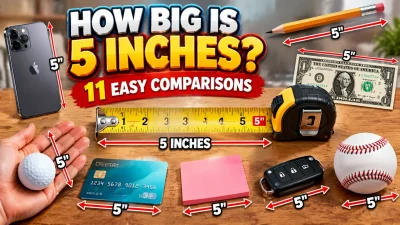
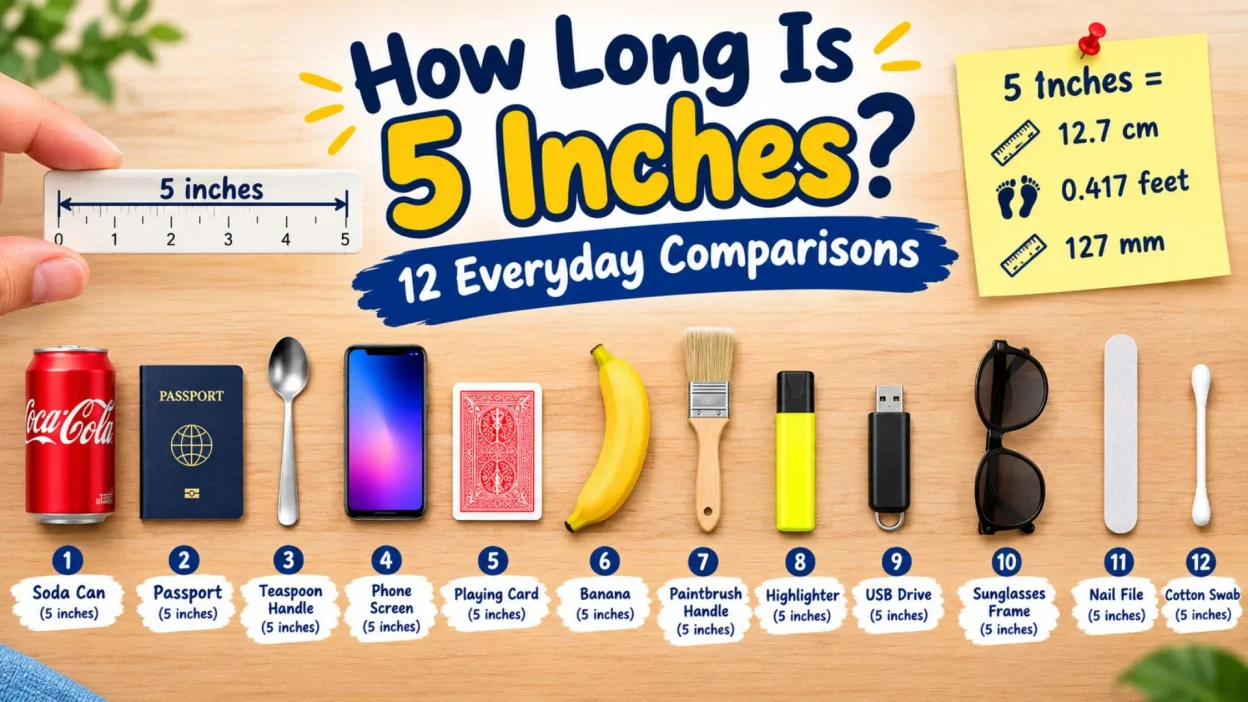
5 inches equals 0.417 feet, 12.7 centimeters, 127 millimeters, and 0.127 meters. It’s just under half a foot—roughly the length of a standard soda can standing upright, or the height of a passport photo.
Every Unit 5 Inches Converts To
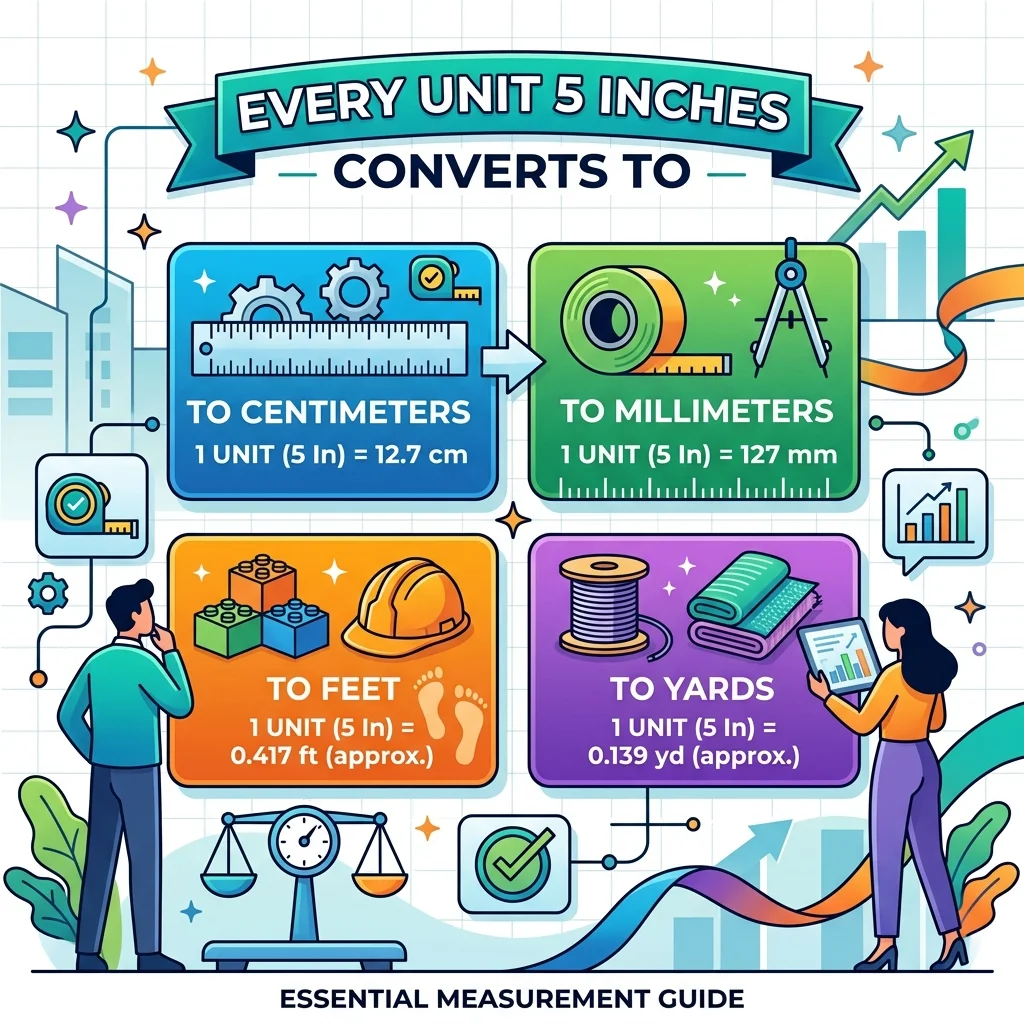
Before we start stacking up objects, it helps to see 5 inches translated into every unit that matters. This is especially useful if you’re working with metric measurements from a non-US product listing or trying to convert a recipe.
| Unit | Value |
|---|---|
| Inches | 5 |
| Feet | 0.417 |
| Centimeters | 12.7 |
| Millimeters | 127 |
| Meters | 0.127 |
| Yards | 0.139 |
The math behind these conversions is straightforward once you know the multipliers. To go from inches to feet, you divide by 12: 5 ÷ 12 = 0.417 feet. For centimeters, you multiply by 2.54: 5 × 2.54 = 12.7 cm. Millimeters follow the same logic but with a factor of 25.4: 5 × 25.4 = 127 mm. And for meters, you multiply by 0.0254: 5 × 0.0254 = 0.127 m.
In everyday terms, 5 inches in feet is a fraction just under half a foot. Five inches in centimeters lands at a neat 12.7, which is a number you’ll see on plenty of product spec sheets. And if you’re wondering about 5 inches in millimeters, 127 mm is the figure you’ll find on ruler markings and engineering drawings.
For a visual anchor: a standard US quarter is about 0.955 inches in diameter. Five of them lined up edge-to-edge would stretch to roughly 4.775 inches—just shy of the target. Add a dime (0.705 inches) and you’re well past it. That’s how tight the margin is at this scale.
Where 5 Inches Sits on the Everyday Size Chart
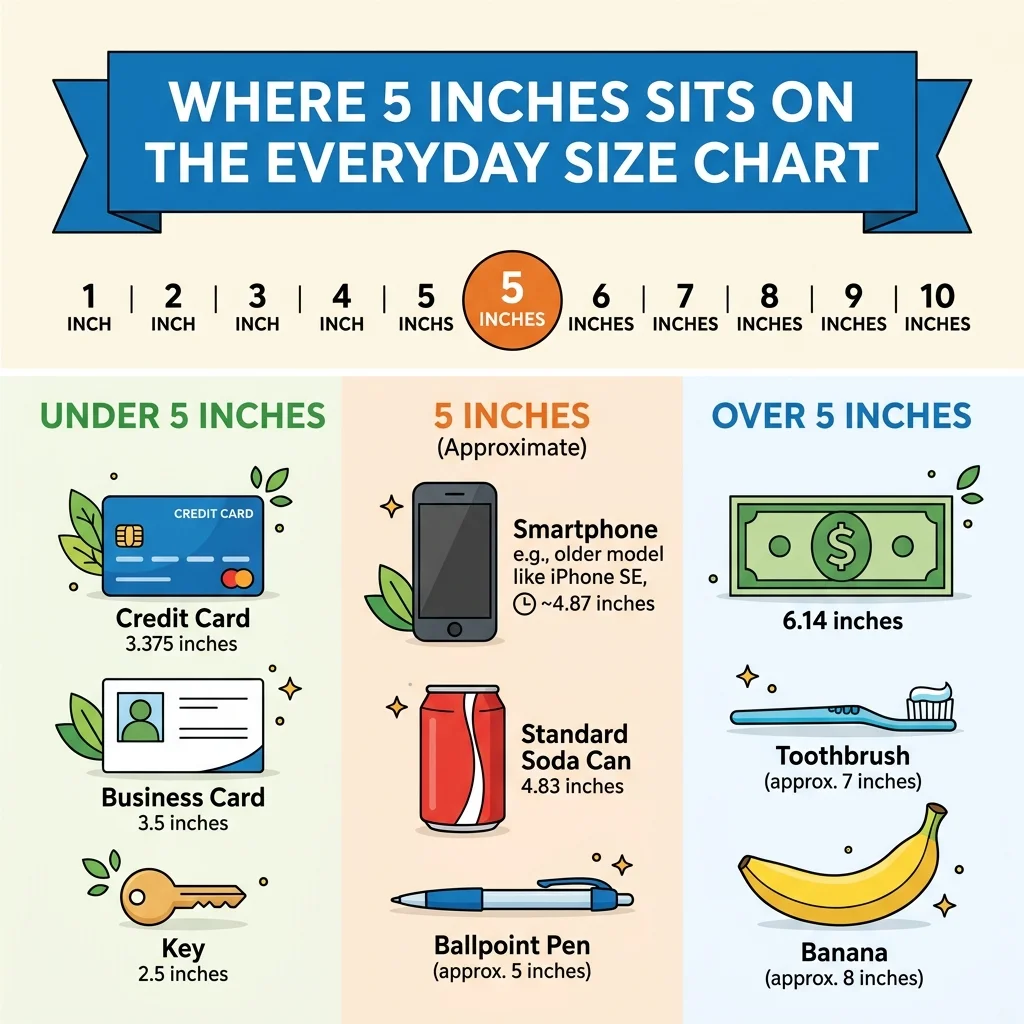
Five inches isn’t a “small” measurement, and it isn’t a “large” one. It sits right in the pocket-sized sweet spot—the range where objects are big enough to be functional but small enough to be portable.
Think of it this way: a credit card is 3.375 inches wide. A standard sheet of paper is 8.5 inches wide. Five inches falls between those two anchors, closer to the credit card than the paper. That’s why so many handheld tools, grooming accessories, and compact gadgets cluster around this length. Manufacturers don’t pick 5 inches by accident—it’s the longest a tool can be while still fitting comfortably in a pocket, a small purse, or a glove compartment.
In the world of screens, 5 inches sits at the smaller end of the modern smartphone range. Diagonal screen measurements of 5.0 to 5.5 inches were standard for flagship phones in the early 2010s, and they’re still common for budget devices today. Anything under 5 inches is now considered a “compact” phone, while anything over 6.5 inches enters “phablet” territory.
For kitchen tools, 5 inches is the typical length of a small paring knife blade or the handle of a standard teaspoon. It’s the size range where tools feel precise rather than bulky—good for detailed work, whether you’re slicing a strawberry or shaping a fingernail.
12 Things That Measure About 5 Inches
This is where the abstract number becomes something you can actually see and hold. Each of these objects is either exactly 5 inches or so close that the difference is negligible for everyday visualization. I’ve grouped them roughly from “most familiar” to “most surprising.”
1. An iPhone 7 Standing Upright
The iPhone 7 measures 5.44 inches tall, which makes it just over the 5-inch mark but close enough to serve as a reliable visual reference. When Apple released this model in 2016, it was one of the most widely carried phones in the world, so there’s a good chance you or someone near you has handled one.
The reason this phone lands in the 5-inch range is no accident. Phone designers spent years chasing the ideal balance between screen real estate and one-handed usability. A device that’s roughly 5.5 inches tall fits comfortably in most adult hands without requiring a two-handed grip, which is why this form factor dominated the market for years.
What makes the iPhone 7 particularly useful as a reference is its shape. It’s a solid, flat rectangle—easy to align against a surface or hold up next to something you’re trying to measure. If you have one in a drawer, you’ve got a permanent 5.4-inch ruler.
2. Two Adult Thumbs End to End
The average adult male thumb measures between 2.5 and 2.75 inches from tip to base. Press two thumbs together end-to-end, and you’re looking at roughly 5 to 5.5 inches of length. For women, thumbs tend to run slightly shorter, so the combined length might land closer to 4.5 inches—still in the ballpark.
This is one of the most portable references you’ll ever have, because your thumbs are always with you. The trick is calibration. Once you measure your own thumb once, you’ll know whether your personal “two-thumb” span is exactly 5 inches or a little off. It’s a body-based ruler that never needs batteries.
The reason thumbs work well for this estimate is their proportion. The human thumb is roughly one-twelfth of body height in many adults, which means its length scales predictably across different people. It’s not precise enough for carpentry, but it’s perfect for a quick check at the grocery store or hardware aisle.
3. A Standard 12-Ounce Soda Can

A 12-ounce aluminum soda can stands about 4.83 inches tall. That’s just under the 5-inch mark—close enough that if you add the thickness of the can’s rim or a bottle cap, you’re essentially there. This is one of the most universally available references on the planet. Almost every convenience store, vending machine, and refrigerator contains one.
The can’s height is dictated by a combination of ergonomics and manufacturing efficiency. It’s tall enough to hold a satisfying amount of liquid but short enough to fit in standard cup holders and vending machine slots. The 4.83-inch height has been an industry standard for decades because changing it would require retooling countless machines and vehicles.
What makes the soda can especially useful is its rigid, straight profile. You can stand it next to almost anything—a plant pot, a book, a piece of mail—and instantly see how 5 inches compares. It’s a reference that never requires a ruler.
4. A Bic Ballpoint Pen Without Its Cap
The classic Bic Cristal pen measures about 5.7 inches in length with the cap on, and roughly 5.25 inches for the barrel alone. That puts it just above the 5-inch mark, making it a slightly generous comparison—but a useful one, because pens are everywhere.
The Bic pen’s length is a triumph of standardized design. It’s long enough to provide a comfortable grip for most hands but short enough to slip into a shirt pocket or pencil case without protruding awkwardly. The hexagonal barrel, introduced in 1950, was specifically designed to prevent rolling and to fit neatly in the hand.
If you’re trying to visualize 5 inches in a pinch, a standard ballpoint pen is one of the fastest mental shortcuts available. Just remember it’s a touch longer than the target—about a quarter-inch over.
5. The Handle of a Standard Teaspoon
A typical teaspoon handle measures around 4.5 to 5 inches, depending on the manufacturer. The full spoon from bowl to tip usually runs 5.5 to 6 inches, but the handle alone is right in the 5-inch zone. This is a useful reference because teaspoons are in virtually every kitchen.
The handle length isn’t random. It’s designed to keep your fingers clear of hot liquid or food while still giving you enough leverage to scoop and stir. A 5-inch handle works for everything from stirring tea to eating cereal, which is why it’s become the default size across most cutlery sets.
Next time you’re in the kitchen and need a quick 5-inch estimate, just pick up a teaspoon and look at the handle. It’s a reference that’s always within arm’s reach.
6. A Deck of Playing Cards Laid Flat
A standard poker-size playing card measures 2.5 inches wide and 3.5 inches tall. That’s not 5 inches in either dimension—but the diagonal is. The diagonal of a standard card runs about 4.3 inches, which is still short of 5. However, if you lay two cards side by side lengthwise, the combined width is exactly 5 inches (2.5 + 2.5 = 5).
This is a clever trick for anyone who carries a deck of cards or has one at home. Two cards placed side by side, touching at the long edges, create a perfect 5-inch span. It’s the kind of reference that surprises people because they don’t instinctively think of cards as measuring tools.
The standard card size was formalized in the late 19th century and hasn’t changed much since, which makes it a reliable constant in a world of shifting product dimensions.
7. A Passport Photo’s Height
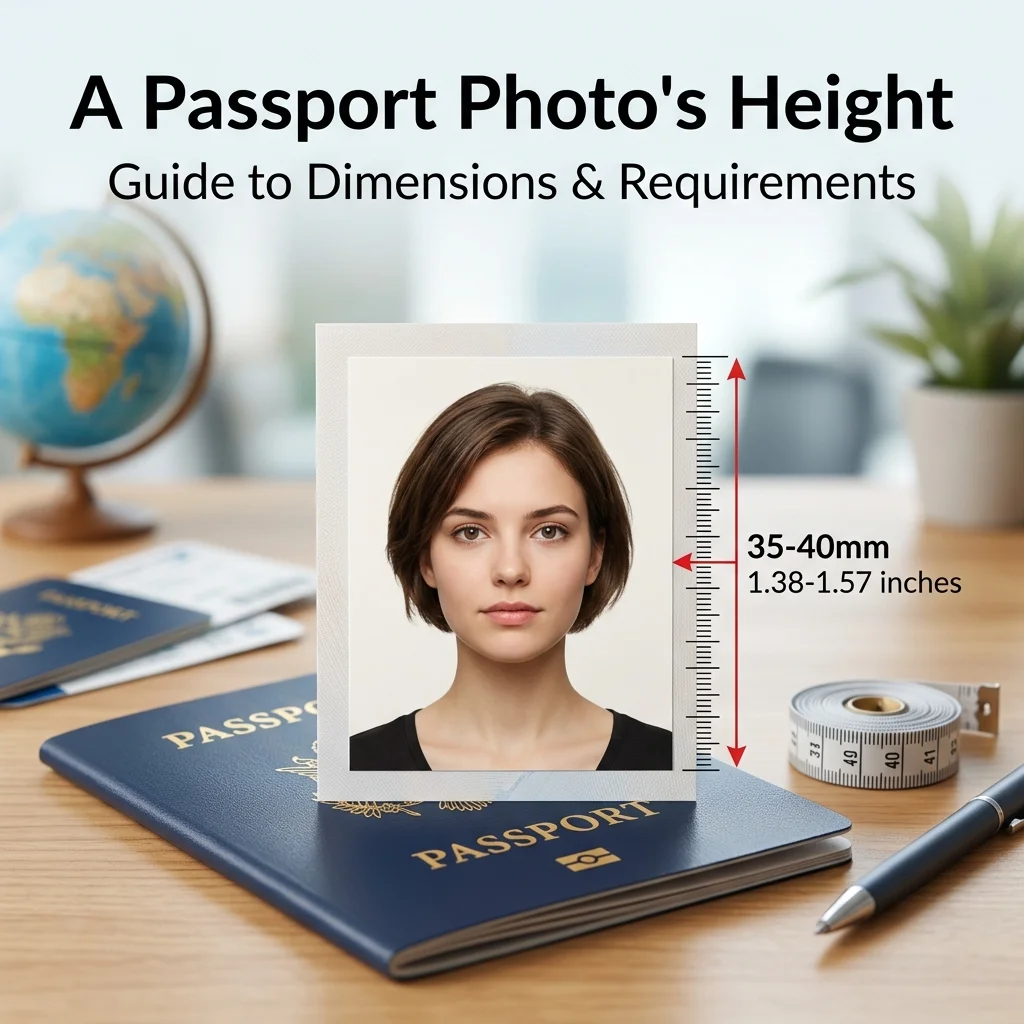
A US passport photo is 2 inches by 2 inches. That’s nowhere near 5 inches—but a standard passport booklet is a different story. The closed booklet measures roughly 3.5 inches wide by 4.9 inches tall. The height is just a hair under 5 inches, making the passport itself a near-perfect reference.
Passport dimensions are governed by international standards set by the ICAO, which specifies a closed size that fits into standard travel document holders and scanning equipment. The result is a booklet that’s small enough to slip into a jacket pocket but large enough to contain all the necessary pages and security features.
If you have a passport, you have a 5-inch reference point sitting in your drawer. The height of the closed booklet is about 4.9 inches—essentially 5 inches for any practical visualization purpose.
8. A Standard Toothbrush (Handle Section)
A typical adult toothbrush measures about 7.5 inches from bristle tip to handle end. The handle portion alone, from the neck to the base, is usually around 4.5 to 5 inches. This makes the handle a solid reference if you don’t want to count the bristles.
Toothbrush dimensions are driven by reach and control. The handle needs to be long enough to let you brush your back molars without gagging, but short enough to fit in a standard toothbrush holder. The 5-inch handle section is the part you grip, and it’s been optimized over decades of dental design.
Next time you’re in the bathroom, pick up your toothbrush and look at where the bristles end. Everything below that point is roughly 5 inches of handle.
9. A Small TV Remote
Many compact TV remotes measure between 5 and 5.5 inches in length. Streaming device remotes—like those for Roku or Amazon Fire TV—often fall right around the 5-inch mark because they’re designed to be minimalist and pocketable.
The reason remotes cluster in this range is ergonomic. A remote that’s too short feels cramped in the hand, while one that’s too long becomes unwieldy. Five inches is the Goldilocks zone where your thumb can reach all the buttons without shifting your grip. Manufacturers have converged on this size because it simply works.
If you have a small remote nearby, you’re holding a 5-inch reference. Just lay it next to whatever you’re trying to measure.
10. A Folded Dollar Bill (Lengthwise)
A US dollar bill measures 6.14 inches long and 2.61 inches wide. If you fold it in half lengthwise, you get a rectangle that’s 6.14 inches by 1.305 inches—not helpful for a 5-inch reference. But if you fold it widthwise, you get 3.07 inches. The real trick is folding it lengthwise so the short edge becomes the long edge: folding a dollar bill in half along its length gives you a piece that’s 6.14 inches long but half as wide—still 6.14 inches long.
The better approach: a dollar bill is 6.14 inches, which is just over 5 inches. If you fold it so that 1.14 inches overlaps, the remaining length is exactly 5 inches. That’s a bit fiddly, but it illustrates how close a dollar bill is to the target. In practice, a dollar bill is a “just over” reference—useful when you don’t need precision.
The dimensions of US currency are standardized so that bills fit into wallets and cash registers without folding. The 6.14-inch length is a compromise between portability and the space needed for security features.
11. A Garden Snail

A common garden snail measures about 0.8 to 1.2 inches in shell length. Line up five of them in a row, and you get roughly 4 to 6 inches, depending on the individual snails. This is a quirky reference, but it’s memorable—and it’s useful for anyone who spends time in gardens or yards.
The reason snails cluster in this size range is biological. Their shells need to be large enough to retract their bodies fully but small enough to remain mobile. The garden snail is one of the smallest common snail species, which is why it takes five of them to reach the 5-inch mark.
This comparison is more about approximation than precision. If you’re trying to visualize 5 inches and you happen to have a row of garden snails, you’re in luck—but don’t count on it for your next furniture assembly project.
12. A Travel-Size Lotion Bottle
Many travel-size toiletry bottles measure between 4.5 and 5.5 inches tall. The standard 3-ounce bottle that meets TSA carry-on requirements often stands right around 5 inches, depending on the brand and cap design.
The 3-ounce limit for carry-on liquids is what drives this size. Manufacturers need to fit exactly 3 ounces (about 89 milliliters) into a bottle that’s compact enough to pack but tall enough to dispense easily. The result is a bottle that typically lands in the 5-inch range.
If you travel regularly, you probably have one of these bottles in a toiletry bag. It’s a reliable 5-inch reference that you can pull out whenever you need to check a measurement on the fly.
The Phone Screen Question People Actually Mean
When someone searches for “how long is 5 inches compared to an object,” there’s a good chance they’re actually trying to figure out something specific about a phone screen. The phrase “5-inch screen” is one of the most common ways this measurement appears in everyday life, but it’s also one of the most misunderstood.
Here’s the thing: when a phone is advertised as having a “5-inch screen,” that measurement refers to the diagonal distance from one corner of the display to the opposite corner—not the width, not the height, and not the length of the phone itself. A phone with a 5-inch screen might be 5.5 inches tall and 2.7 inches wide. The diagonal is what’s being measured.
This distinction matters because people often expect a “5-inch phone” to be 5 inches tall. It’s not. The phone’s overall height is almost always larger than its screen diagonal because of bezels, the home button, and the camera housing. The iPhone 7, for example, has a 4.7-inch screen diagonal but a total height of 5.44 inches.
If you’re shopping for a phone and you see “5-inch display,” you’re looking at a device with a diagonal screen measurement of 5 inches. The physical phone will be taller and wider than that. If you’re trying to compare a 5-inch screen to a physical object, the screen itself is roughly the size of a standard index card laid diagonally—but the phone you hold in your hand will be noticeably bigger.
Getting to 5 Inches Without a Tape Measure
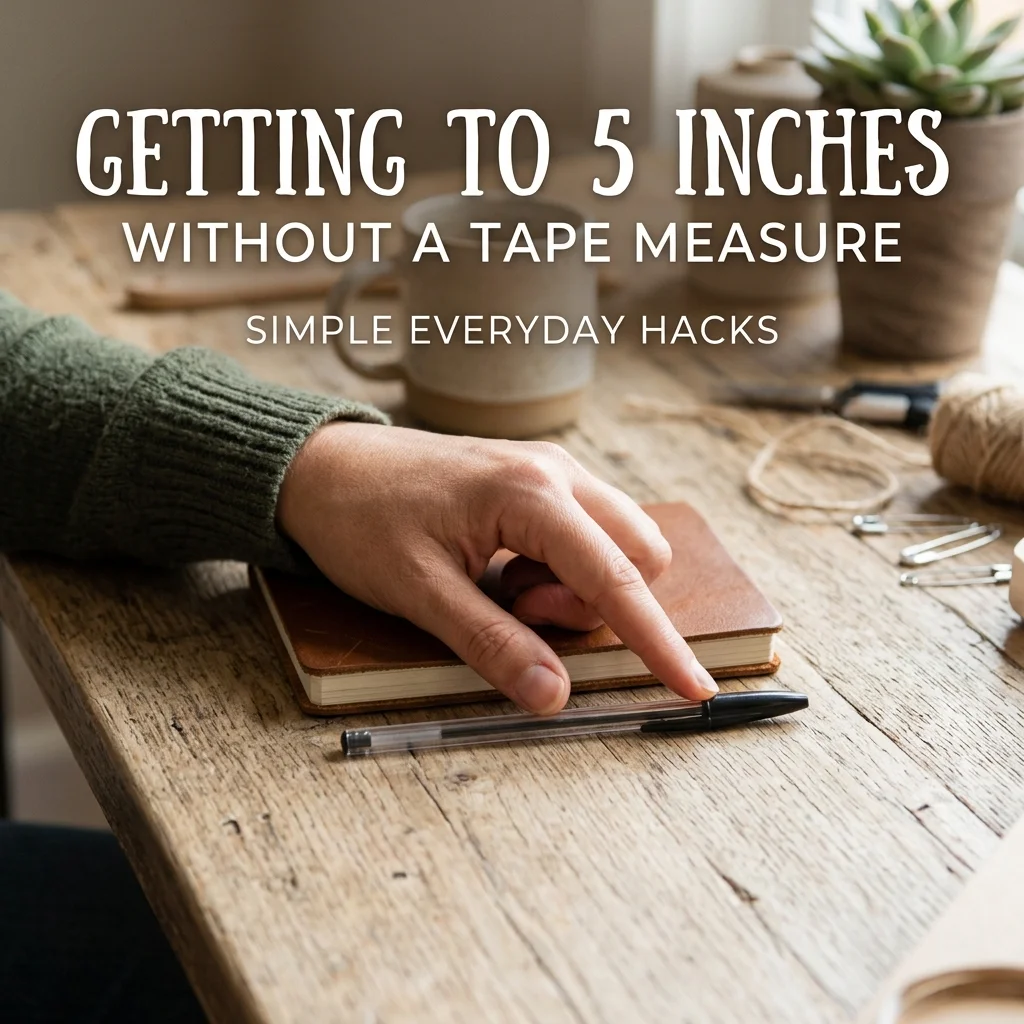
You don’t need a ruler to estimate 5 inches. Your body and your surroundings are full of reliable references. The key is to pick one or two that work for you, calibrate them once, and then trust them.
Your thumb knuckle. The distance from the tip of your thumb to the first knuckle is roughly 1 inch for most adults. Stack five of those together, and you’ve got 5 inches. This is one of the fastest estimates you can make because you don’t need any objects—just your hand. Test it against a ruler once, and you’ll know if your personal thumb-inch is accurate.
A standard index card. An index card measures exactly 5 inches by 3 inches. If you have one in your wallet, your desk drawer, or your recipe box, you have a perfect 5-inch reference. The 5-inch edge is the long side of the card. Keep one nearby, and you’ll never be stuck without a measurement again.
Your smartphone. If you have a phone with a 5-inch screen, the diagonal of the display is your reference. Lay the phone face-down on a surface and use the screen diagonal as a guide. Just remember that the phone’s body is larger than the screen, so you’ll need to account for the bezels.
A dollar bill and a fold. A US dollar bill is 6.14 inches long. Fold it so that about 1.14 inches overlaps the end, and the remaining exposed length is exactly 5 inches. It’s a bit of a party trick, but it works in a pinch when you’re at a store or a restaurant and need a quick estimate.
These methods won’t give you the precision of a tape measure, but they’ll get you within a quarter-inch in most cases. For everyday tasks—checking if a package will fit, estimating fabric for a craft project, or comparing product sizes online—that’s usually close enough. If you need exact precision for a home improvement project, it’s worth investing in a proper ruler or measuring tape. For more everyday measurement references, you might find our guide on [INTERNAL LINK: related measurement article] useful.
FAQs
How many feet is 5 inches?
Five inches equals 0.417 feet. To convert, divide 5 by 12, which gives you 0.4166 repeating. In practical terms, it’s just under half a foot.
How many centimeters is 5 inches?
Five inches equals 12.7 centimeters. The conversion is 5 multiplied by 2.54, since one inch is exactly 2.54 centimeters.
How many meters is 5 inches?
Five inches equals 0.127 meters. You get this by multiplying 5 by 0.0254, which is the number of meters in one inch.
How long is 5 inches on a ruler?
On a standard US ruler, 5 inches is the fifth mark from the left edge. Most rulers have inch markings every 1 inch and smaller fraction markings in between. Five inches is exactly halfway between the 4-inch and 6-inch marks.
What everyday object is about 5 inches?
A standard 12-ounce soda can is 4.83 inches tall, which is very close. The handle of a standard teaspoon is also around 4.5 to 5 inches. A closed passport booklet is about 4.9 inches tall.
Can I visualize 5 inches without a tape measure?
Yes. Use your thumb—the distance from tip to first knuckle is about 1 inch, so five thumb-widths is roughly 5 inches. You can also use a standard index card, which measures exactly 5 inches on its long edge.
Is 5 inches considered small?
It depends on the context. For a smartphone screen, 5 inches is on the smaller side of modern devices. For a hand tool or a pocket knife, 5 inches is a standard, practical size. The measurement itself isn’t inherently small or large—it’s all about what’s being measured.
Where That Leaves You
Five inches is 12.7 centimeters, 0.417 feet, and 0.127 meters. It’s the height of a soda can, the length of a teaspoon handle, and the diagonal of a compact phone screen. It’s a measurement that lives in your pocket, your kitchen drawer, and your bathroom cabinet.
The next time you need to visualize 5 inches, start with the soda can. It’s the most universal reference—almost everyone can find one, and its 4.83-inch height is close enough for any practical purpose. If you don’t have a can nearby, your thumb is the next best tool. Five thumb-widths, calibrated once, will serve you for life.
The real takeaway is that 5 inches isn’t an abstract number. It’s a length you’ve been holding, seeing, and using every day without realizing it. Once you’ve anchored it to something familiar, you’ll never struggle to picture it again.