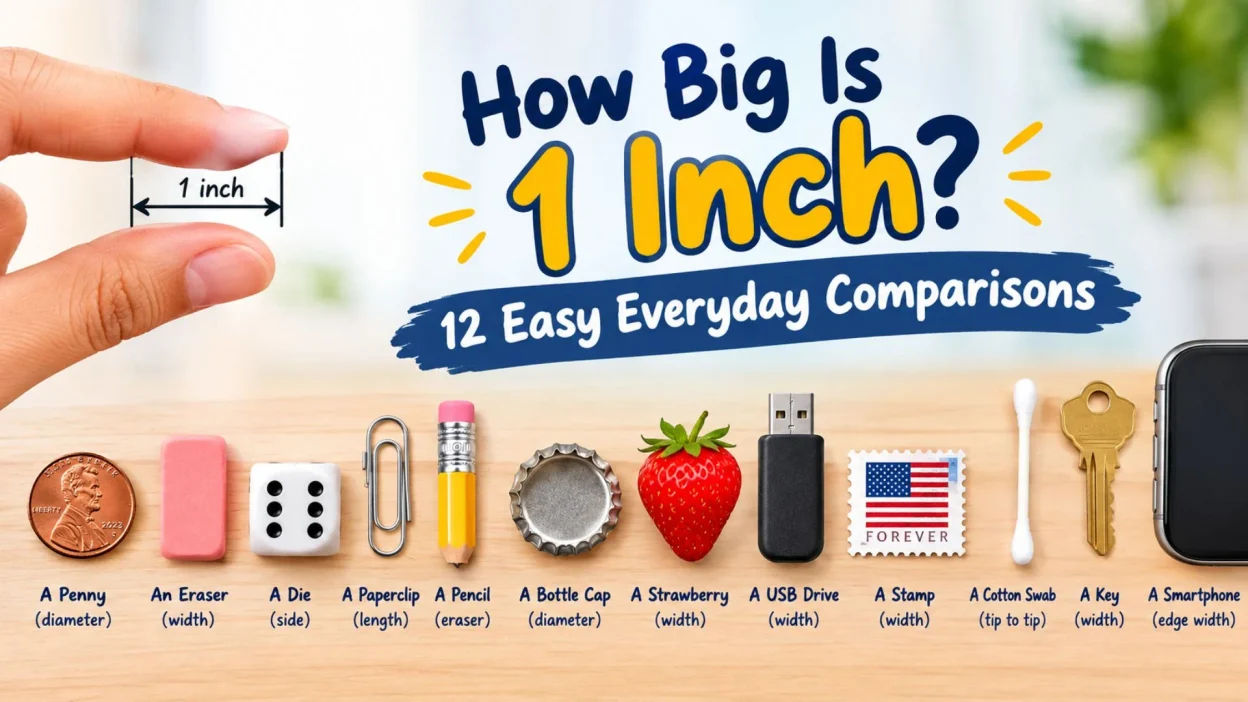
One inch is small enough to disappear into your hand, yet large enough to matter when you’re measuring a gap, fitting hardware, or checking a product size. The tricky part is that most people can recognize an inch on a ruler but cannot easily picture it without one.
If you have ever wondered how big 1 inch really looks, a few familiar objects make the answer much easier. A U.S. quarter, for example, is just slightly smaller than 1 inch across. A one-inch cube is another simple mental reference because its length, width, and height are all exactly 1 inch.
You may encounter this measurement in clothing, crafts, construction, electronics, packaging, jewelry, buttons, hardware, and household products. Knowing how to picture it can save you from reaching for a ruler every time.
1 inch equals 0.0833 feet, 2.54 centimeters, 25.4 millimeters, and 0.0254 meters.
This guide breaks down those conversions and then uses everyday objects to show what 1 inch looks like in real life.
Table of Contents
- Every Unit 1 Inch Converts To
- Where 1 Inch Sits on a Common Size Scale
- 12 Things That Measure About 1 Inch
- The Product Size Question People Actually Mean
- Getting to 1 Inch Without a Tape Measure
- FAQs
- Where That Leaves You
Every Unit 1 Inch Converts To
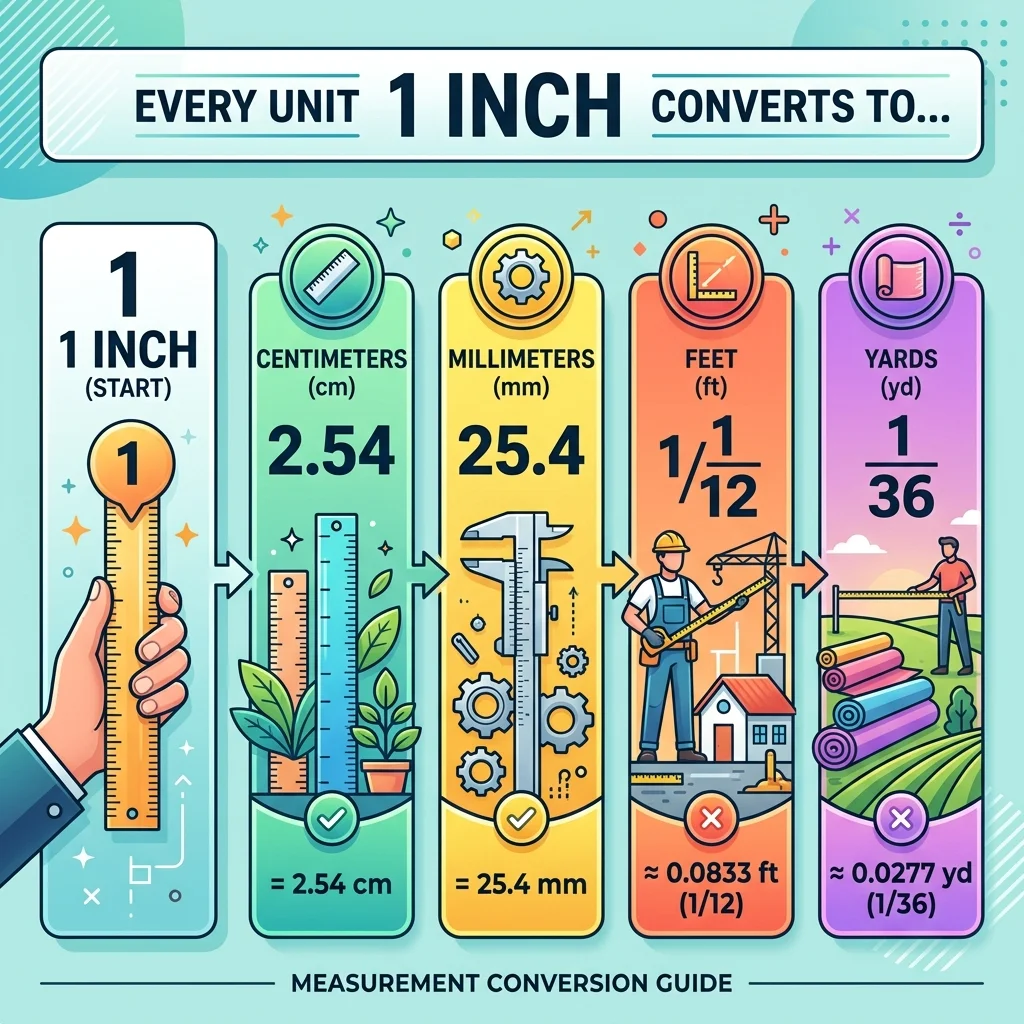
The basic conversion is straightforward, but seeing the numbers together helps put 1 inch into perspective.
| Unit | Value |
|---|---|
| Inches | 1 inch |
| Feet | 0.0833 ft |
| Centimeters | 2.54 cm |
| Millimeters | 25.4 mm |
| Meters | 0.0254 m |
| Yards | 0.0278 yd |
So, 1 inch in feet is about 0.0833 feet. Since there are 12 inches in one foot, you simply divide 1 by 12.
For 1 inch in cm, multiply by 2.54. That gives exactly 2.54 centimeters.
For 1 inch in mm, multiply 2.54 centimeters by 10. The result is exactly 25.4 millimeters.
The meter conversion is equally simple. Because a meter contains 100 centimeters, 2.54 centimeters equals 0.0254 meters.
The useful formulas are:
- Inches ÷ 12 = feet
- Inches × 2.54 = centimeters
- Inches × 25.4 = millimeters
- Inches × 0.0254 = meters
That means even a tiny one-inch measurement represents more than two and a half centimeters.
Where 1 Inch Sits on a Common Size Scale
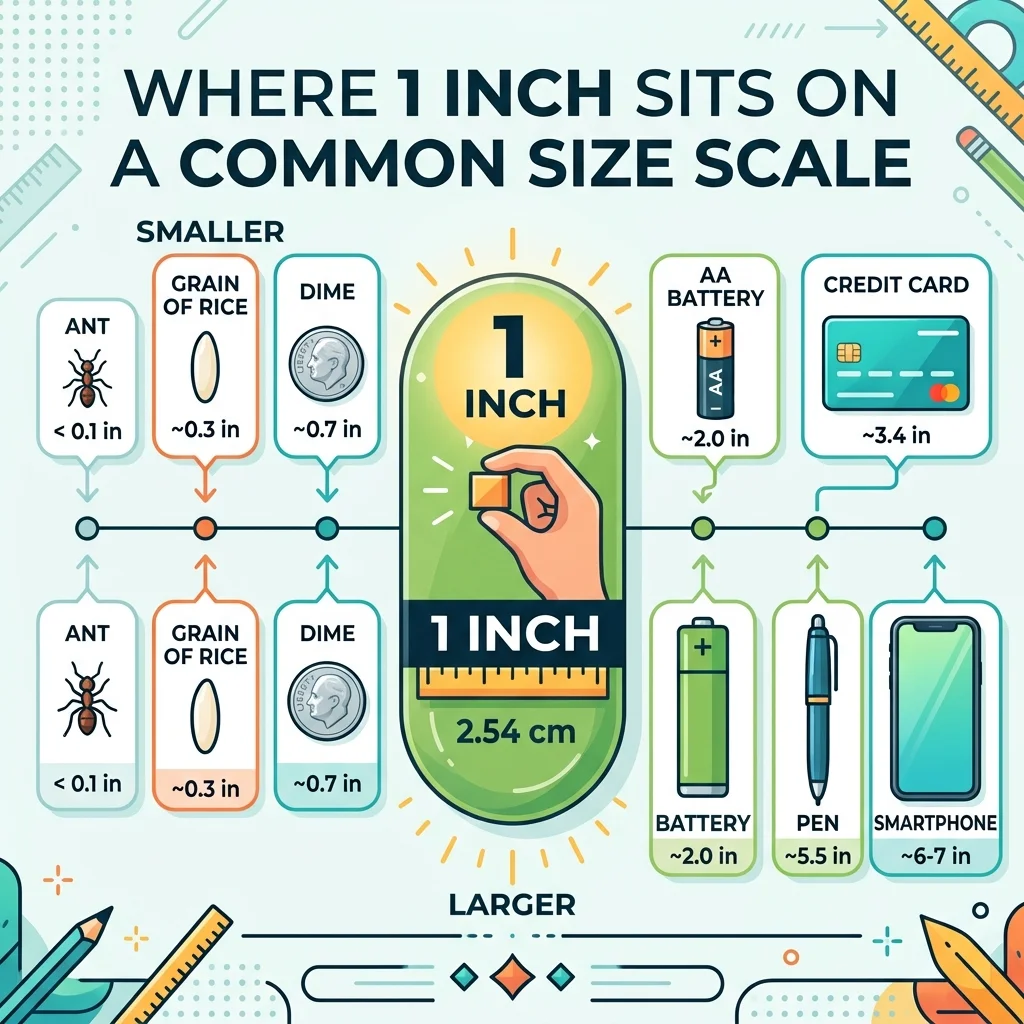
One inch is a small everyday length, but it is not microscopic. It is 25.4 millimeters from one end to the other, so you can easily see and handle an object that measures this much.
On a ruler, 1 inch is the distance between the zero mark and the large number 1. Most standard rulers divide that inch into smaller fractions, such as halves, quarters, eighths, and sixteenths.
That makes an inch especially useful for small objects. Screws, buttons, craft materials, hardware, gaps, picture frames, and many household items are often described using inches or fractions of an inch.
It is also worth remembering that 1 inch is a length, not an area. A one-inch line measures 1 inch long. A one-inch square has four sides that are each 1 inch long and covers 1 square inch.
The same distinction matters when someone says something is “one inch wide.” They are describing one dimension only. The object could be much longer or taller.
For quick mental visualization, think of 1 inch as a little wider than a U.S. quarter. That gives you a practical reference without needing a measuring tool.
12 Things That Measure About 1 Inch
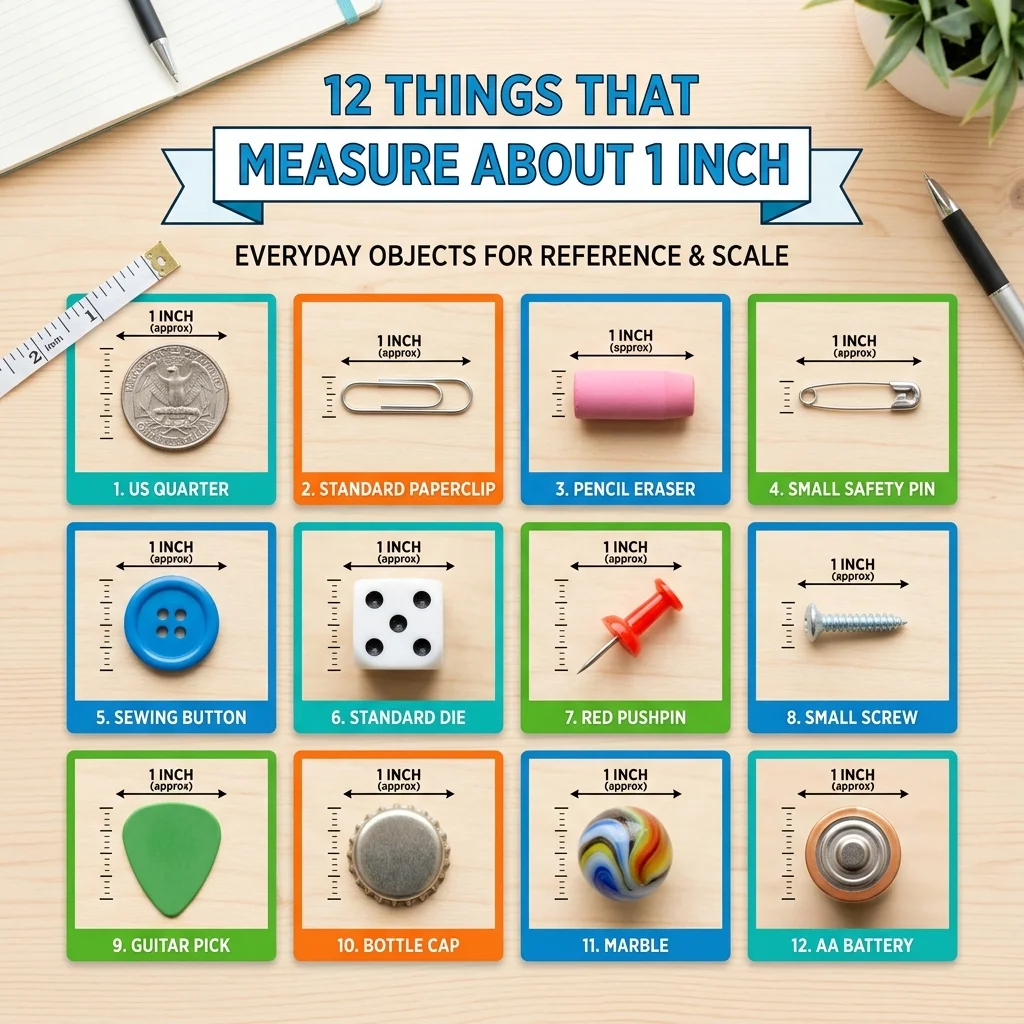
Finding everyday objects close to exactly 1 inch is surprisingly useful. Many small objects fall slightly below or above the mark, so the goal here is not to pretend they are identical.
The comparisons below are chosen because their dimensions are either close to 1 inch or are commonly available in a one-inch size.
1. A U.S. Quarter
A U.S. quarter has a diameter of about 24.26 millimeters. Since 1 inch is 25.4 millimeters, the quarter is only about 1.14 millimeters smaller.
That makes a quarter one of the easiest physical references for this measurement. Place it flat on a table and look across its widest point.
The difference is small enough that you can mentally treat the coin as a near-one-inch circle for rough estimates. For precise work, however, remember that it is not actually 1 inch wide.
If you have a quarter in your pocket, you already have a convenient visual comparison for 1 inch.
[IMAGE: a U.S. quarter placed beside a ruler showing the one-inch mark]
2. A One-Inch Wooden Craft Cube
Small wooden craft cubes are commonly sold in one-inch sizes. A true one-inch cube measures 1 inch across every side.
That means its length, width, and height are each 25.4 millimeters. Unlike a coin, this comparison represents the measurement in three dimensions.
A cube is particularly useful because it lets you see what 1 inch looks like in depth as well as across a flat surface.
Imagine holding the cube between your fingertips. It is a compact little block, roughly the width of a quarter but noticeably thicker.
[IMAGE: a one-inch wooden cube beside a ruler showing 1 inch]
3. A One-Inch Button
Large craft and sewing buttons are commonly available in one-inch diameters. A one-inch button is therefore a practical example when thinking about clothing or craft projects.
Its diameter measures about 25.4 millimeters, making it noticeably larger than many ordinary shirt buttons.
Buttons also provide a useful visual because their size is easy to recognize. If you have a large decorative button at home, check whether its package lists a one-inch diameter.
Picture that button sitting in the palm of your hand. It would look small, but certainly not tiny.
[IMAGE: a one-inch round button beside a ruler for scale]
4. A One-Inch O-Ring
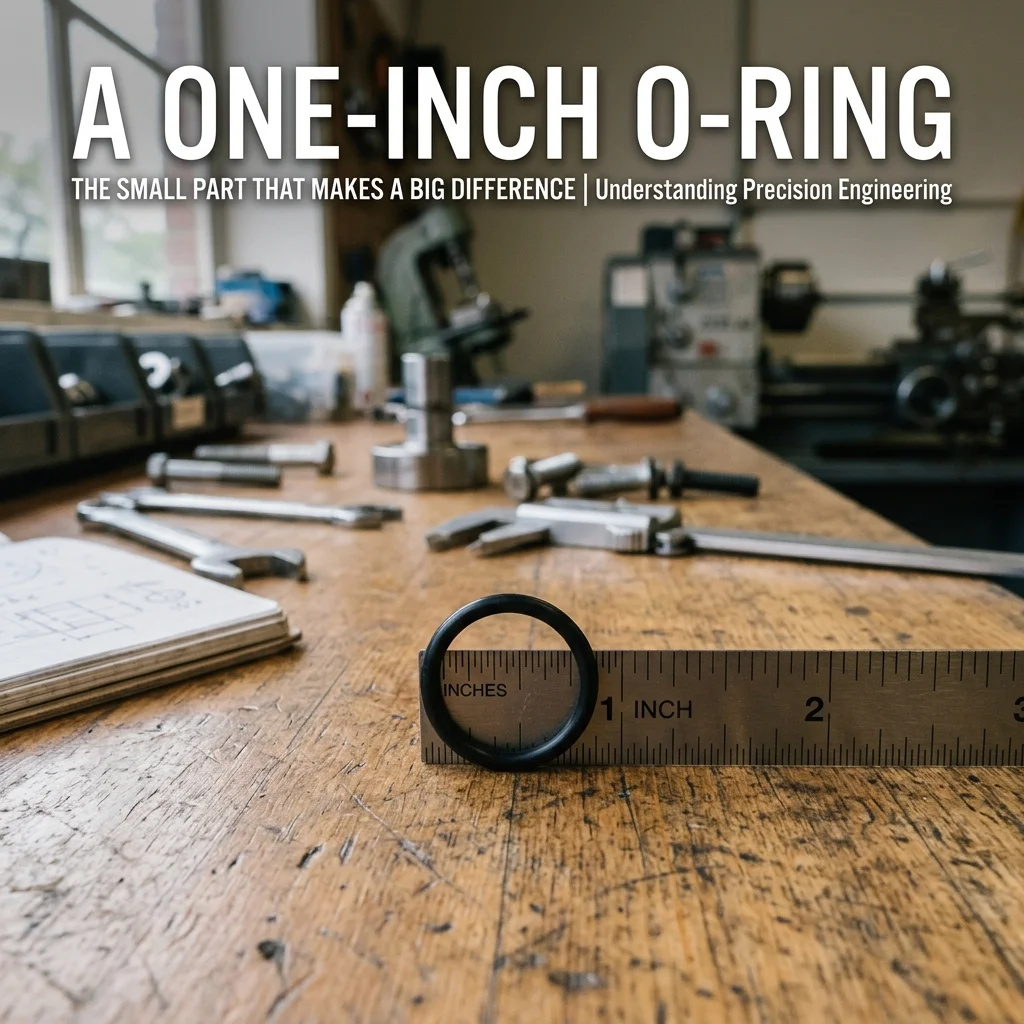
O-rings are commonly sold by size, and one-inch versions are widely available for seals, plumbing, machinery, and other applications.
Depending on the specification, the “one-inch” measurement can refer to the inside diameter rather than the entire outside width. That distinction is important when comparing O-rings.
A one-inch inside diameter means the open central hole measures about 25.4 millimeters across. The rubber itself adds additional width around that opening.
So this is a good example of why product measurements need context. A one-inch O-ring is not necessarily only one inch across from outside edge to outside edge.
[IMAGE: a one-inch O-ring beside a ruler with the inner diameter marked]
5. A One-Inch Rubber Grommet
Rubber grommets are another type of small component that can be specified in one-inch sizes. They are used to protect wires and cables passing through holes.
Some one-inch grommets are designed around a one-inch mounting-hole size rather than having a one-inch outside diameter. Always check which dimension the manufacturer is describing.
Even so, they provide a useful example of how often this measurement appears in practical hardware.
Visually, imagine a small rubber ring roughly the width of a quarter, but with a thicker body surrounding its center.
[IMAGE: a one-inch rubber grommet next to a ruler]
6. A One-Inch Ceramic Tile
Small mosaic and craft tiles are often manufactured in one-inch square sizes. A one-inch square tile measures 25.4 millimeters along each side.
Unlike a circular coin, this comparison shows the shape of the measurement clearly. Imagine four straight sides forming a compact square that is just over 2.5 centimeters wide.
One-inch tiles are especially useful for crafts, mosaics, miniature projects, and decorative work.
If you have several arranged together, the scale becomes even easier to understand. Four one-inch tiles in a row would span exactly 4 inches before accounting for any grout gaps.
[IMAGE: a one-inch square ceramic mosaic tile beside a ruler]
7. A One-Inch Binder Ring
Small binder rings and loose-leaf rings are available in one-inch sizes. In this case, the stated size can refer to the ring’s diameter or its intended capacity, depending on the product.
That makes binder rings another good reminder to read product specifications carefully.
A ring with a one-inch diameter has a circular opening roughly comparable to the width of a U.S. quarter.
Hold one between your fingers and its compact size gives you a quick mental reference for the measurement.
[IMAGE: a one-inch metal binder ring beside a ruler]
8. A One-Inch Cable Clip
Small cable-management clips are commonly sold in sizes around one inch. Depending on the design, that measurement might describe the cable capacity, mounting dimension, or overall size.
For this reason, a cable clip should be treated as an approximate visual reference unless its exact dimension is specified.
These clips are useful because they appear in everyday workspaces, behind desks, and around electronics.
A one-inch clip is small enough to fit comfortably between your fingertips, giving you a practical sense of how little 25.4 millimeters really is.
[IMAGE: a small one-inch cable clip next to a ruler]
9. A Large Craft Bead

Some large craft beads are made at roughly one-inch diameters. Their exact size varies by style, material, and manufacturer, so this is best treated as an approximate comparison.
A one-inch bead would be about 2.54 centimeters across. That is considerably larger than a typical small jewelry bead.
The round shape makes it easy to compare with a quarter. The bead would be slightly larger if its diameter reached a full inch.
Imagine holding it between your thumb and index finger. It would be clearly visible without feeling bulky.
[IMAGE: a large one-inch craft bead beside a ruler]
10. A One-Inch Foam Cube
Foam cubes are often produced in small standardized sizes for crafts, packaging, displays, games, and educational activities. A one-inch foam cube is another direct example of the measurement.
Because all three dimensions can be exactly one inch, it offers a particularly clean comparison.
Unlike a flat one-inch object, the cube gives you a better sense of volume. You can see that 1 inch is not simply a line on a ruler; it can describe the full width, height, and depth of an object.
Imagine stacking several of these cubes. Ten one-inch cubes placed end to end would create a row 10 inches long.
[IMAGE: a one-inch foam cube beside a ruler]
11. A One-Inch Square Sticker
Square stickers, labels, craft stickers, and small decorative decals are often sold in one-inch square formats.
A one-inch square measures 25.4 millimeters on every side. Its total area is 1 square inch, although the side length is the part relevant to this article.
This makes a sticker particularly useful for visualizing the difference between length and area. The sticker is 1 inch wide and 1 inch tall, while the surface it covers is 1 square inch.
Picture a small square label sitting on a notebook page. It would take up only a tiny portion of the page while still being easy to see.
[IMAGE: a one-inch square sticker beside a ruler]
12. The Width of Your Fingertip
Your fingertip can sometimes provide a rough visual reference for 1 inch, but this comparison varies considerably from person to person.
For some adults, the width of a fingertip or part of a thumb can be close to 1 inch. For others, it may be noticeably narrower or wider.
That makes your finger useful for estimating, but not for precision work. If a project requires an exact 1-inch gap, your body should not replace a ruler.
Still, once you compare your fingertip with a ruler, you can develop a surprisingly useful personal reference. Your own hand can then help you estimate small distances quickly.
[IMAGE: an adult fingertip beside a ruler showing one inch]
The Product Size Question People Actually Mean

When someone asks how big 1 inch is, they may actually be trying to understand whether a particular object will fit.
This happens often with buttons, screws, jewelry, craft supplies, hardware, screen components, labels, and small household products. In those situations, knowing that 1 inch equals 2.54 centimeters is useful, but it may not tell you everything you need.
The most important question is which dimension is 1 inch?
A product can be 1 inch wide but 4 inches long. A ring can have a 1-inch inside diameter while being larger on the outside. A button can have a 1-inch diameter but only a few millimeters of thickness.
This is why product listings often provide several measurements. Look for labels such as length, width, height, diameter, inside diameter, outside diameter, thickness, or depth.
For example, if you are buying a one-inch button, you generally care about its diameter. If you are buying a one-inch cube, the same number describes three dimensions.
So when someone asks, “How big is 1 inch?” the practical answer is 25.4 millimeters or 2.54 centimeters in one direction. The shape and other dimensions depend on the object.
Getting to 1 Inch Without a Tape Measure
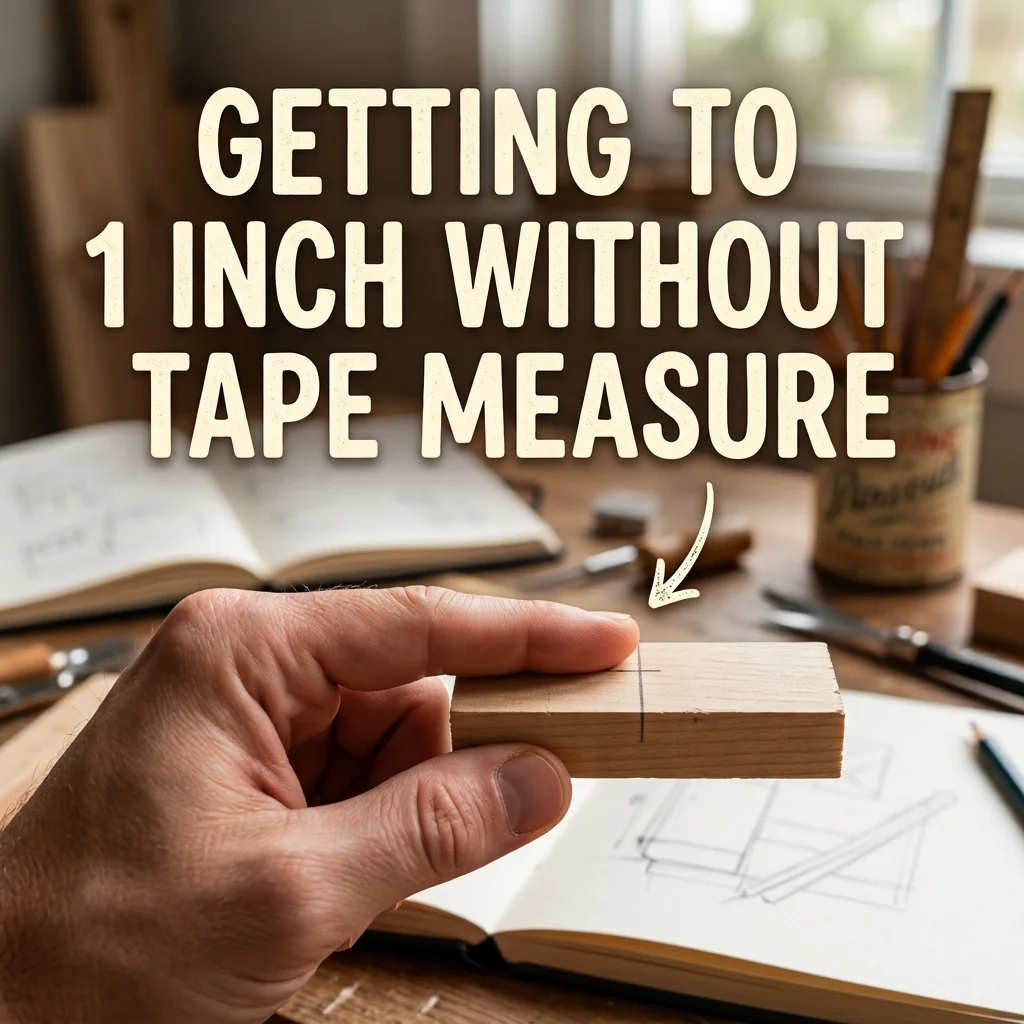
You can estimate 1 inch surprisingly well if you have a few familiar references.
Use a U.S. Quarter
A quarter is about 24.26 millimeters across, while 1 inch is 25.4 millimeters. That makes the coin slightly smaller than the target.
For a quick estimate, think of 1 inch as the diameter of a quarter plus a very small extra amount.
Use a One-Inch Square
If you have graph paper, craft materials, or a ruler with clearly marked squares, a 1-inch square is an excellent visual reference.
The key is to remember that its side length is 1 inch, not the entire perimeter.
Compare Your Fingertip
Your fingertip may be close to 1 inch across, but this varies between people. Check it against a ruler once, and you will know whether it works as a personal estimate.
Use this method for rough measurements rather than precision work.
Think in Centimeters
One inch is 2.54 centimeters. That means you can visualize it as slightly more than two and a half centimeters.
If you are more comfortable with the metric system, this may actually be the easiest mental conversion.
Picture a Small Craft Object
A one-inch button, wooden cube, tile, or sticker provides a more direct reference. These objects are often available in standardized one-inch sizes.
If you frequently work with crafts or small hardware, keeping one known one-inch item nearby can make future estimates much easier.
For exact measurements, though, there is still no substitute for a ruler or measuring tape.
[INTERNAL LINK: How Big Is 2 Inches? Everyday Comparisons That Make It Easy to Picture]
FAQs
How many feet is 1 inch?
One inch equals exactly 1/12 of a foot. In decimal form, that is approximately 0.0833 feet.
How many centimeters is 1 inch?
One inch equals exactly 2.54 centimeters. This is the standard international conversion used between inches and centimeters.
How many millimeters is 1 inch?
One inch equals exactly 25.4 millimeters. You can get this by multiplying 2.54 centimeters by 10.
How many meters is 1 inch?
One inch equals 0.0254 meters. That is a little over two-hundredths of a meter.
How long is 1 inch in real life?
One inch is a small length measuring 25.4 millimeters. A U.S. quarter is a useful near-match because its diameter is about 24.26 millimeters.
Is 1 inch considered small?
For everyday objects, 1 inch is generally a small measurement. It is large enough to see and handle easily, but small compared with common furniture, doors, people, and appliances.
What everyday object is about 1 inch?
A U.S. quarter is one of the easiest comparisons because it is just slightly smaller than 1 inch across. One-inch craft cubes, buttons, tiles, and other products can also provide direct references.
Can I measure 1 inch without a ruler?
You can estimate it using a quarter, your fingertip, or a known one-inch craft object. These methods are useful for rough estimates, but they should not replace a ruler when precision matters.
Where That Leaves You
One inch is exactly 2.54 centimeters, 25.4 millimeters, 0.0833 feet, and 0.0254 meters. That sounds more abstract than it really is once you connect it to familiar objects.
A U.S. quarter is an especially handy mental reference because its diameter is only slightly smaller than 1 inch. A true one-inch cube or button gives an even closer visual comparison when you have one available.
The simplest takeaway is this: picture a small circle just wider than a quarter, or imagine a compact cube measuring 1 inch on every side. Once you have that reference in your head, estimating small measurements becomes much easier without reaching for a ruler.