Ask someone to show you six feet with their hands and they’ll usually get close. Ask for ten feet and the gestures fall apart. It’s past the point where your arms, your stride, or your own body can give you an honest answer.
That’s what makes ten feet an odd measurement. It’s tall enough to feel abstract, but common enough that you’ve stood underneath it dozens of times without noticing. A basketball rim hangs at exactly that height. So do the ceilings in a lot of newer homes, and the shoulder of a fully grown African elephant sits right around the same mark.
This guide walks through every conversion for ten feet, explains where it lands on a height scale, and lines up twelve real objects that measure close to it. You’ll also get a few ways to estimate the height when there’s no tape measure within reach.
Ten feet equals 120 inches, 304.8 centimetres, 3,048 millimetres, and 3.048 metres. In yards, that’s 3.33. For scale, it’s roughly one and three-quarter times the height of an average American man.
Table of Contents

- Every Unit 10 Feet Converts To
- Where 10 Feet Sits on the Height Scale
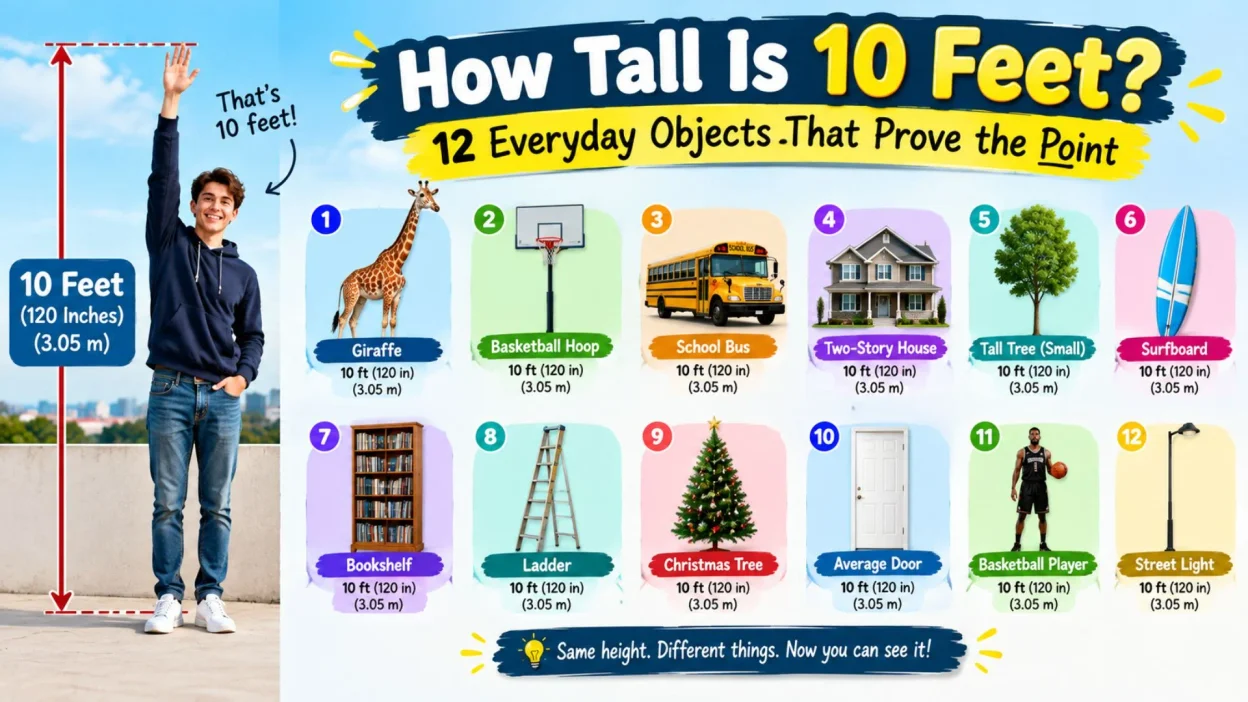
- 12 Things That Measure About 10 Feet
- The 10-Foot Ceiling Question People Actually Mean
- Getting to 10 Feet Without a Tape Measure
- FAQs
- Where That Leaves You
Every Unit 10 Feet Converts To
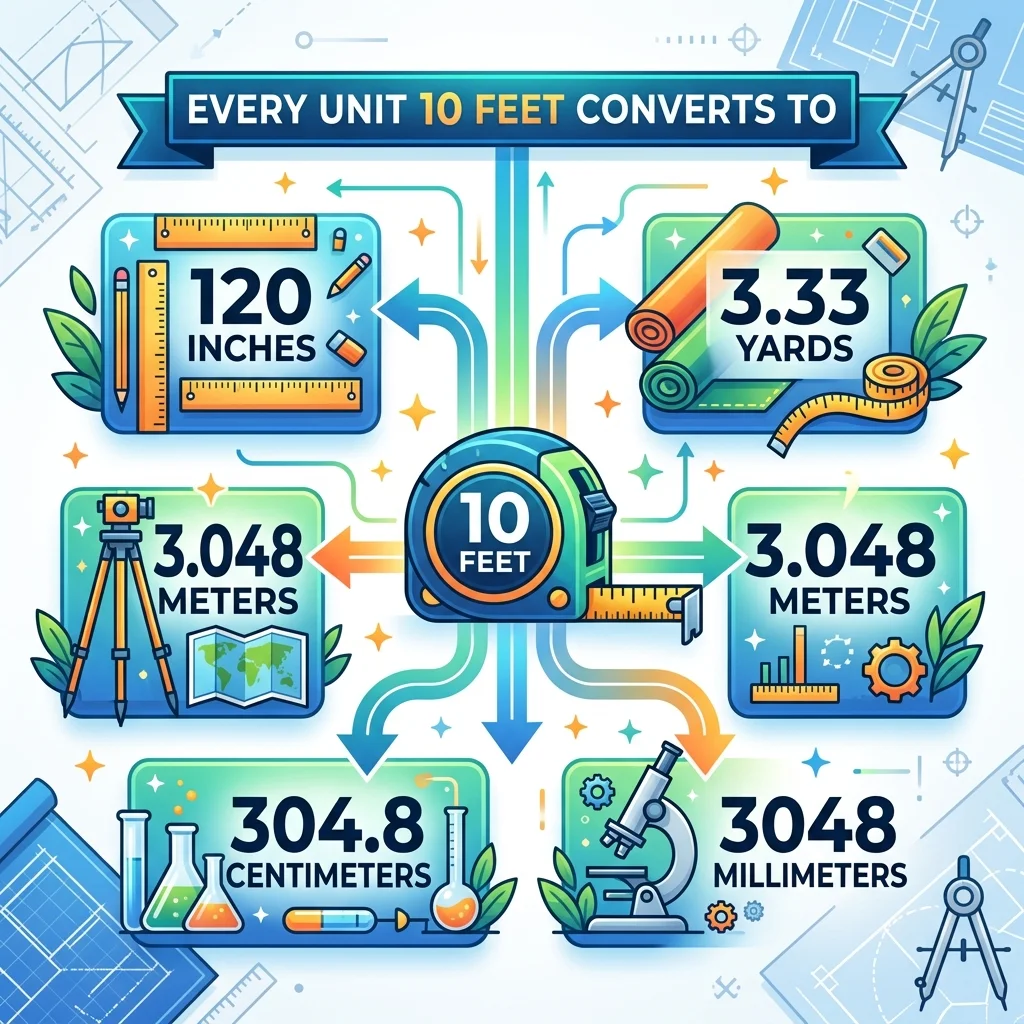
The numbers below use the international foot, defined as exactly 0.3048 metres.
| Unit | Value |
|---|---|
| Feet | 10 |
| Inches | 120 |
| Centimetres | 304.8 |
| Millimetres | 3,048 |
| Metres | 3.048 |
| Yards | 3.3333 |
The maths here is unusually tidy. Feet to inches means multiplying by 12, so 10 × 12 = 120 inches. Feet to centimetres means multiplying by 30.48, which gives 304.8 cm. Shift the decimal one place for millimetres and you land on 3,048 mm. To get metres, multiply feet by 0.3048, producing 3.048 m. Yards come from dividing by 3, which gives 3.33.
In metric markets, ten feet is written as 3.05 metres. That’s the figure you’ll see on architectural plans, furniture listings, and European product pages. If you’re estimating rather than measuring, three metres is about 19 centimetres short of ten feet—fine for a rough guess, useless for anything structural.
Where 10 Feet Sits on the Height Scale
Ten feet is not a human measurement. The tallest person in recorded history, Robert Wadlow, reached 8 feet 11 inches. Ten feet clears that by more than a foot, which tells you something important: this height is outside the range your body can demonstrate.
Compare it to averages instead. The average American man stands about 5 feet 9 inches, and the average American woman about 5 feet 4 inches. Ten feet is roughly 1.75 stacked American men, or 1.9 stacked American women. Neither number divides cleanly, which is part of why the height resists easy visualisation.
Where ten feet becomes familiar is in buildings. Older US homes typically have 8-foot ceilings. Contemporary builder homes often sit at 9 feet. Ten-foot ceilings are a deliberate upgrade, common in custom builds, living rooms, and primary bedrooms. Commercial floors and warehouses frequently use 10 feet as a minimum clear height, and storage units are often sold as 10×10 or 10×20 with ten-foot ceilings throughout.
So ten feet occupies a specific band: far above any person, at the upper end of residential ceilings, and at the lower end of industrial spaces. That middle position is why so many objects land near it.
12 Things That Measure About 10 Feet
Some of these are exact. Most are approximate, and that distinction is flagged wherever it matters.
A Regulation Basketball Hoop
The rim of a regulation basketball hoop sits exactly ten feet above the floor. Not roughly—exactly. The NBA, FIBA, NCAA, and nearly every organised league worldwide use the same figure.
That number has an origin story. In 1891, James Naismith nailed a peach basket to a gymnasium balcony in Springfield, Massachusetts. The balcony happened to be ten feet up. The height stuck, and more than a century of basketball has been played under it without change.
This makes the hoop the most trustworthy ten-foot reference in everyday life. Stand directly beneath a rim and look straight up. The distance you’re seeing is ten feet, and it’s taller than most people expect when they’re standing right under it.
[IMAGE: A regulation basketball hoop viewed from directly underneath, with the rim exactly 10 feet above the court]
An African Bush Elephant’s Shoulder

A mature male African bush elephant stands roughly 10 to 13 feet at the shoulder. Females are shorter, typically 8.5 to 11 feet. A well-grown bull lands right on the ten-foot mark.
Elephants are measured at the shoulder because it’s the highest fixed point on the skeleton. The height is a direct consequence of diet—an adult eats up to 300 pounds of vegetation daily, which needs an enormous digestive system, which needs an enormous frame to carry it.
Photographs flatten elephants and make them look smaller than they are. Standing beside one, the top of its back clears the reach of any person by several feet. Picture a single-storey wall covered in grey hide and moving toward you.
[IMAGE: An African bush elephant standing beside a height marker showing roughly 10 feet at the shoulder]
A Giraffe’s Shoulder Height
Here’s the detail most people miss about giraffes: their total height of 16 to 18 feet includes the neck. Measured at the shoulder, a mature male stands roughly 10 to 11 feet—right around our target.
Giraffes are the tallest living land animals, but that record comes from the neck. The body itself is built on the same scale as a large horse or a small elephant. The shoulder measurement is what zoologists use when they want to compare the animal’s frame rather than its reach.
This makes the giraffe a useful visual because the neck extends the height so dramatically. If you can picture where a giraffe’s back sits relative to a person standing beside it, you have a decent ten-foot reference.
[IMAGE: A giraffe standing beside a height scale, with the shoulder line marked at approximately 10 feet]
A 10-Foot Step Ladder
Step ladders are sold by nominal height, and 10-foot models are a standard category. Opened into its A-frame position, a 10-foot step ladder stands about ten feet tall at the top cap.
That size exists for a specific job: reaching ceilings, light fittings, and upper walls in rooms with ten-foot ceilings. Shorter ladders leave you stretching. Taller ones get heavy and awkward to move indoors. Ten feet is the practical answer for residential and light commercial work.
One safety detail worth knowing—on most step ladders, the top two or three rungs are marked off-limits for standing. The usable working height is lower than the ladder’s nominal height, which is why ladder ratings and reach height are quoted as separate figures.
[IMAGE: A 10-foot A-frame step ladder fully opened, standing beside a wall]
A High-Cube Shipping Container

A standard shipping container measures 8 feet 6 inches tall on the outside. A high-cube container measures 9 feet 6 inches. Neither is exactly ten feet, but the high-cube gets close enough to be useful.
High-cubes were introduced to carry taller cargo—machinery, oversized pallets, and stacked loads that won’t fit in a standard box. That extra foot of height doesn’t sound like much, but across a full container it adds real volume.
Stand beside a high-cube and the roof sits comfortably above your head, above your reach, and above the reach of anyone standing on the ground. If you’ve seen one on a truck or at a port, you’ve seen a very near ten-foot object.
[IMAGE: A high-cube shipping container with its 9-foot-6-inch height marked against a scale]
A 3-Metre Diving Springboard
Competitive springboards are set at 3 metres above the water. That converts to 9.84 feet—just under ten feet, close enough that most people would round it up.
The 3-metre springboard is one of two standard competition heights, the other being the 10-metre platform. The springboard flexes and returns energy to the diver; the platform is rigid. Both are measured from the board surface to the water, not from the pool deck.
Standing on a 3-metre board, the water looks a long way down. That’s intentional—the height gives divers enough rotation time for complex dives while keeping impact speed manageable. It’s a ten-foot event in all but the last two inches.
[IMAGE: A diver standing on a 3-metre springboard with the height marked as approximately 9.8 feet above the water]
A 10-Foot Longboard Surfboard
Traditional longboards are frequently built at 10 feet, and some run 10 feet 6 inches. Stand one upright on its tail and you have a genuine ten-foot vertical measurement.
Ten feet is the classic longboard length because it maximises paddling speed and makes catching waves easier. The trade-off is manoeuvrability—a board this long turns slowly and catches wind badly when you’re carrying it. That’s why shortboard designs took over performance surfing while longboards stayed popular for cruising and small surf.
Leaning a ten-foot board against a wall gives you an instant reference. The nose sits well above a standard doorway, which is 6 feet 8 inches, so the extra three-plus feet is easy to see.
[IMAGE: A 10-foot longboard surfboard standing upright on its tail next to a wall]
A 10-Foot Trampoline on Its Edge
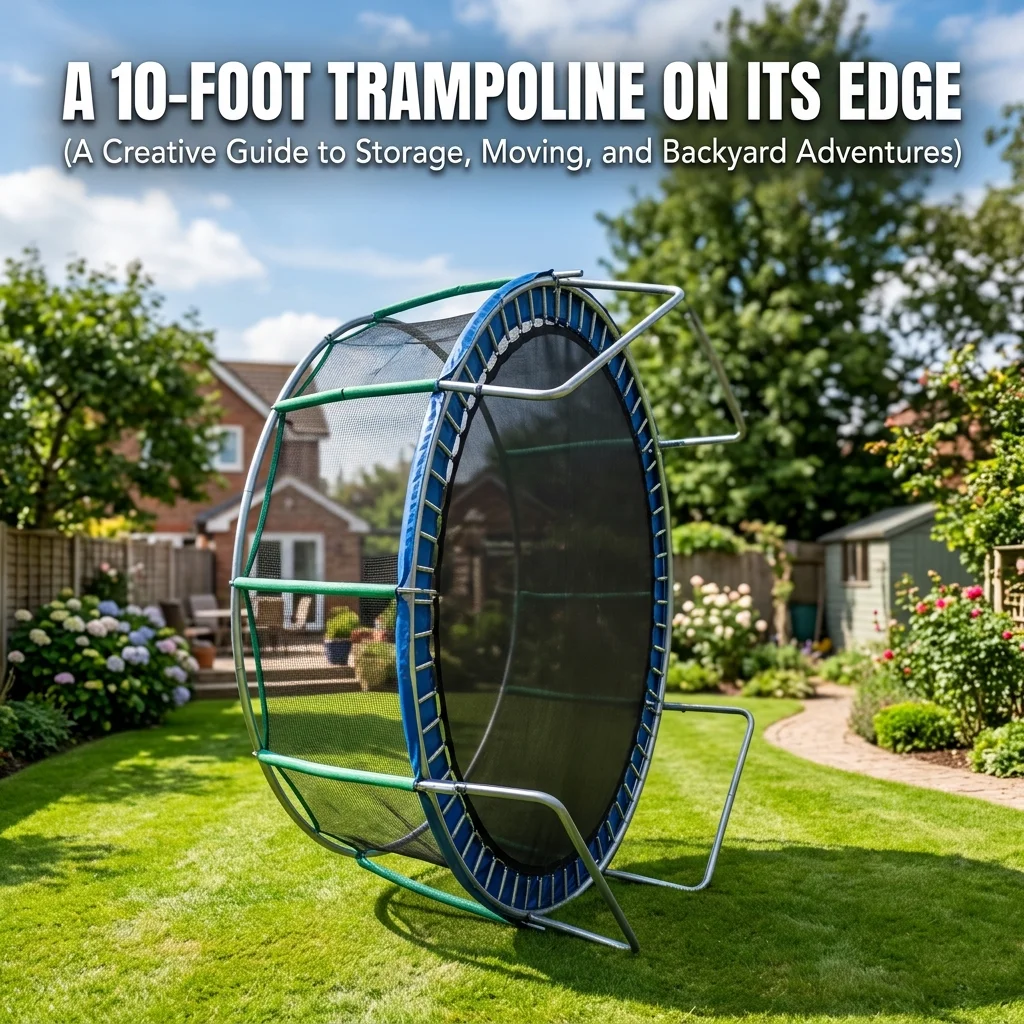
Trampolines are sold by frame diameter, and 10 feet is one of the most common round sizes. Tip one up on its edge and the frame reaches roughly ten feet tall.
Round trampolines are sized by diameter because that number tells you the jumping surface. A 10-foot model is generally rated for one jumper at a time, while 12 and 14-foot versions handle more. Buyers pick based on yard space and the age of the people using it.
This one works well as a reference because so many people have seen a ten-foot trampoline in a neighbour’s garden. If you can picture that circle, rotate it 90 degrees and you have the height.
[IMAGE: A 10-foot round trampoline standing on its edge, showing the frame reaching approximately 10 feet tall]
A Room With a 10-Foot Ceiling
Ten-foot ceilings are common in new American homes, particularly in living rooms and primary bedrooms. Against the older 8-foot standard, the extra two feet changes how the whole room reads.
Builders moved toward taller ceilings for several reasons. Taller rooms feel more generous, they allow larger windows, and they improve air circulation by giving warm air more room to rise. The cost is real—more wall to frame, drywall, paint, and heat.
If you’re standing in a room with a ten-foot ceiling, you’re standing inside the measurement. Look up. That floor-to-ceiling distance is ten feet, and it’s one of the easiest ways to internalise the height.
[IMAGE: A living room with a 10-foot ceiling, with a height scale marked from floor to ceiling]
A Large Male Polar Bear Standing Upright
A big male polar bear can reach close to ten feet tall when it stands on its hind legs. On all fours, the same bear measures roughly 4 to 5 feet at the shoulder.
Polar bears don’t stand upright often. The posture is used for surveying surroundings, intimidating rivals, or reaching into ice holes. But when it happens, the height is startling—a standing polar bear can meet a person’s eye and keep going up.
The ten-foot figure applies to the largest males. Females and younger animals are shorter. Still, it’s one of the few animals where a genuine ten-foot vertical measurement is realistic, which makes it a memorable mental image.
[IMAGE: A large polar bear standing on its hind legs next to a height scale showing about 10 feet]
A 10-Foot Christmas Tree

Artificial Christmas trees are commonly sold at 10 feet, sitting between the standard 7.5-foot tree and the oversized 12-foot versions. Ten feet is roughly the point where most homes can no longer fit one without vaulted ceilings.
Real trees at this height exist but are harder to source and much harder to keep fresh indoors. Artificial trees dominate the ten-foot category because the height demands a heavy stand and a lot of decoration, both easier to engineer into a reusable product.
If you’ve seen a ten-foot tree in a hotel lobby or shopping centre, you’ve seen the scale. Decorating the top third usually requires a ladder, and the topper sits above the reach of most adults even standing on a chair.
[IMAGE: A 10-foot artificial Christmas tree in a room with high ceilings, next to a person for scale]
A Ten-Foot 2×4 Stud
Dimensional lumber is sold in fixed lengths, and ten feet is one of the standard options alongside 8, 12, and 16 feet. Stand a ten-foot 2×4 on its end and you have an exact ten-foot vertical line.
The 2×4 is the backbone of American framing. Ten-foot lengths are used for taller walls, garage headers, and any application where an 8-foot stud would come up short. Builders buy by length because cutting down a 16-footer wastes material and time.
A ten-foot stud is thin and easy to overlook, but it’s the most literal ten-foot object you can hold. Lean it against a wall and compare it to a doorway—the board clears the top of the frame by more than three feet.
[IMAGE: A ten-foot 2×4 lumber stud standing on its end beside a standard doorway]
The 10-Foot Ceiling Question People Actually Mean
A large share of people searching “how tall is 10 feet” are really asking about ceilings. They’re buying a home, reading floor plans, or standing in a room wondering whether what they’re looking at is 9 feet or 10.
The difference matters more than it sounds. An 8-foot ceiling is the traditional American standard—it feels normal, slightly enclosed, familiar. A 9-foot ceiling is the modern builder default and reads as comfortably open. A 10-foot ceiling is a deliberate design decision. In a standard-sized room it feels generous, almost loft-like, and it changes how every other element in the space behaves.
Measuring your own ceiling is straightforward. Use a tape measure from floor to ceiling, keeping the tape as vertical as you can. If your tape isn’t long enough, measure from the floor to eye level, then from eye level to the ceiling, and add the two numbers. For a quicker check, compare the wall against a standard 6-foot-8-inch door—the ceiling should sit noticeably higher than a door and a half.
Ten-foot ceilings also change how you furnish. Standard 8-foot curtains look short. Light fixtures need longer drops. Ceiling fans need downrods so they don’t sit uselessly high. Paint colours read differently because there’s more wall to cover. It’s a height that quietly dictates every design choice in the room.
Getting to 10 Feet Without a Tape Measure
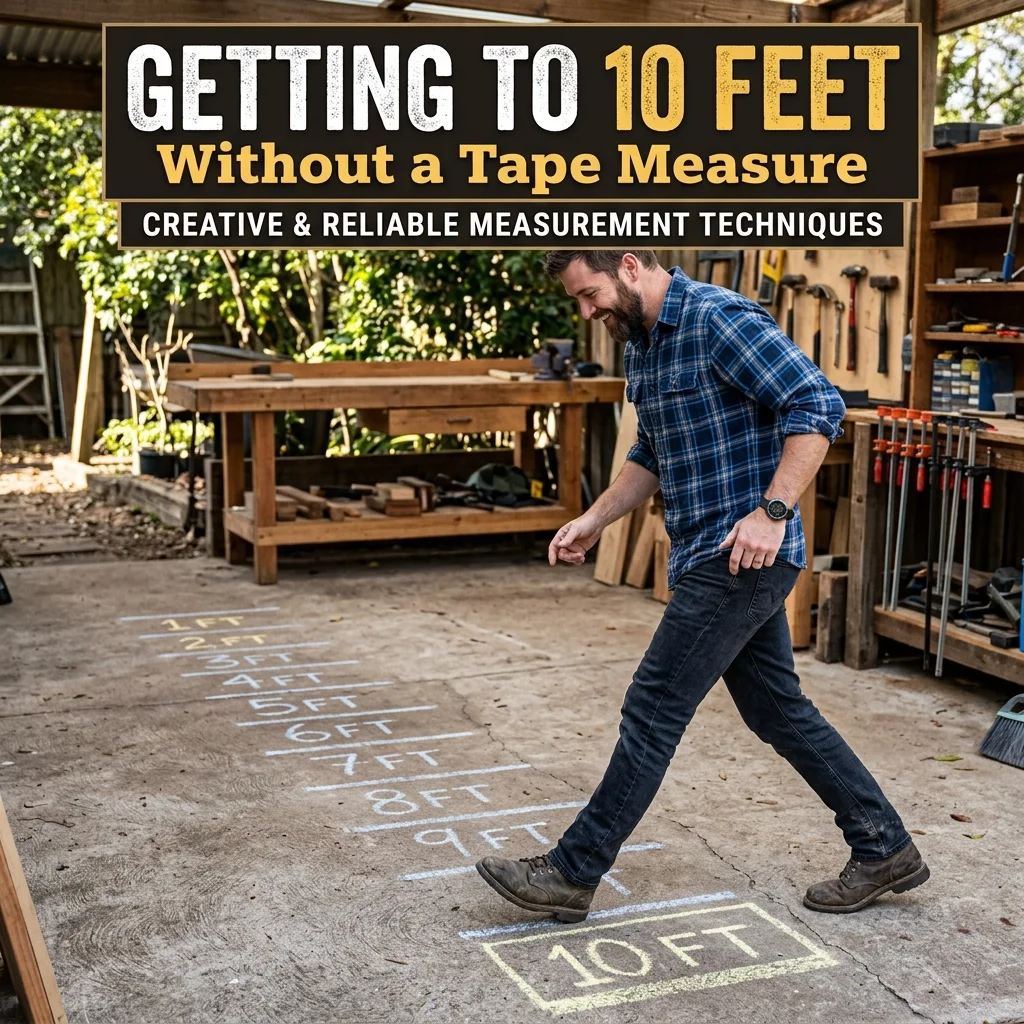
You won’t always have a tape measure. Here are five ways to get close to ten feet using things already around you.
A basketball hoop. If you’re near a court, the rim is exactly ten feet. It’s the only reference here that’s precise rather than approximate. Stand under it and look up.
One and a half standard doors. Interior doors in US homes are typically 6 feet 8 inches tall—80 inches. One and a half door heights equals 120 inches, which is exactly ten feet. If you can picture a door, you can picture the measurement plus half again.
Fifteen standard bricks. A US modular brick is about 7⅝ inches long, and with a standard ⅜-inch mortar joint it occupies 8 inches of wall. Fifteen of them laid end to end come to 120 inches. On a construction site, this is one of the most accurate no-tool methods available.
Twenty dollar bills. A US dollar bill is 6.14 inches long. Twenty laid end to end measure 122.8 inches, or 10 feet 2.8 inches. Slightly over, but within a couple of inches for practical purposes.
Stacking your own height. Divide ten feet by your height in feet. An average American man at 5 feet 9 inches would need about 1.74 of himself to reach ten feet. An average American woman at 5 feet 4 inches would need roughly 1.88. Neither divides cleanly, which is exactly the point—ten feet is nearly two people tall.
Everything except the basketball hoop is an approximation. For anything structural—framing, electrical work, hanging a door—use a real tape measure. Estimates are for thinking, not building.
FAQs
How many inches is 10 feet?
Ten feet is exactly 120 inches. The conversion is 10 × 12 = 120.
How many centimetres is 10 feet?
Ten feet equals 304.8 centimetres. Multiply feet by 30.48 to get the figure, usually rounded to 305 cm in everyday conversation.
How many metres is 10 feet?
Ten feet is 3.048 metres. That’s the exact figure based on the international foot of 0.3048 metres.
How tall is a 10-foot ceiling compared to a standard one?
A standard older US home has 8-foot ceilings, so ten feet is two feet taller—about 25% more vertical space. Modern builder homes often sit at 9 feet, making a ten-foot ceiling one foot above that baseline.
What everyday object is about 10 feet tall?
The most reliable is a regulation basketball hoop, which is exactly ten feet to the rim. A ten-foot step ladder, a high-cube shipping container, and a ten-foot section of lumber are also close.
Can I estimate 10 feet without a tape measure?
Yes. One and a half standard interior doors measure exactly ten feet, and fifteen standard bricks laid end to end do the same. A basketball rim is exactly ten feet if you have court access.
How many yards is 10 feet?
Ten feet equals 3.33 yards. Divide feet by 3 to convert.
Where That Leaves You
Ten feet converts to 120 inches, 304.8 centimetres, and 3.048 metres—tidy numbers once you’ve committed them to memory. The harder part is picturing the height, and that’s where a basketball hoop does the heavy lifting. It’s the only everyday object that’s exactly ten feet, and there’s one in almost every neighbourhood.
If there’s no court nearby, a high-cube shipping container or a ten-foot step ladder will get you close. Both are common enough that you’ve probably stood beside one without registering the scale.
Next time someone mentions ten feet, don’t picture a ruler. Picture the rim of a hoop, or an elephant’s shoulder, or the ceiling of a well-built living room. That’s the measurement—always a little taller than you expect.