Thirty feet sounds straightforward until you try to picture it without a measuring tape. Most people can easily imagine 3 feet or 6 feet, but once a measurement reaches several times a person’s height, it becomes much harder to judge by eye.
A useful way to picture 30 feet is to think of 10 yards. On a football field, that is the distance between two yard lines separated by ten yards. That gives you a much better mental reference than simply imagining a long line.
You may come across 30 feet when looking at a recreational vehicle, boat, extension ladder, utility pole, building dimension, sports distance, or outdoor space. The measurement is long enough to span a room several times but not so long that it feels enormous.
In this guide, we’ll convert 30 feet into other units and compare it with familiar objects, sports dimensions, vehicles, and everyday spaces.
30 feet equals 360 inches, 10 yards, 914.4 centimeters, 9,144 millimeters, and 9.144 meters.
Table of Contents
- Every Unit 30 Feet Converts To
- Where 30 Feet Sits on a Common Length Scale
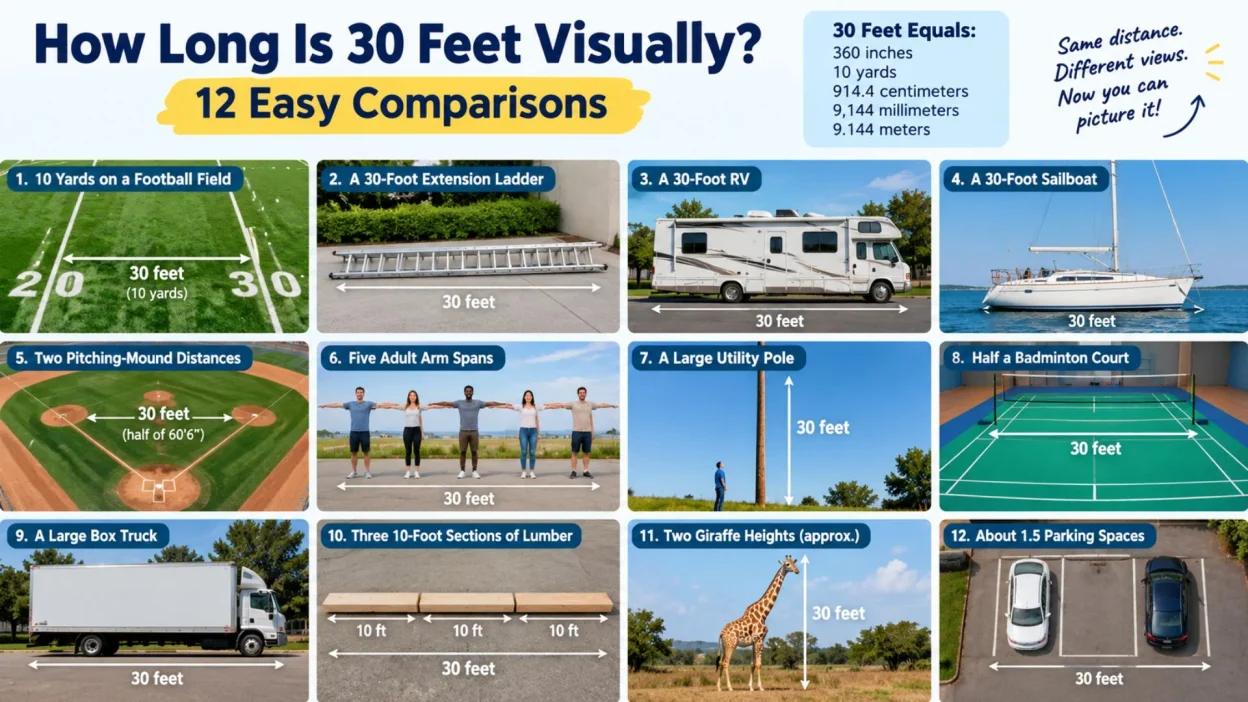
- 12 Things That Help You Visualize 30 Feet
- The 30-Foot Sports Question People Actually Mean
- Getting to 30 Feet Without a Tape Measure
- FAQs About 30 Feet
- Where That Leaves You
Every Unit 30 Feet Converts To
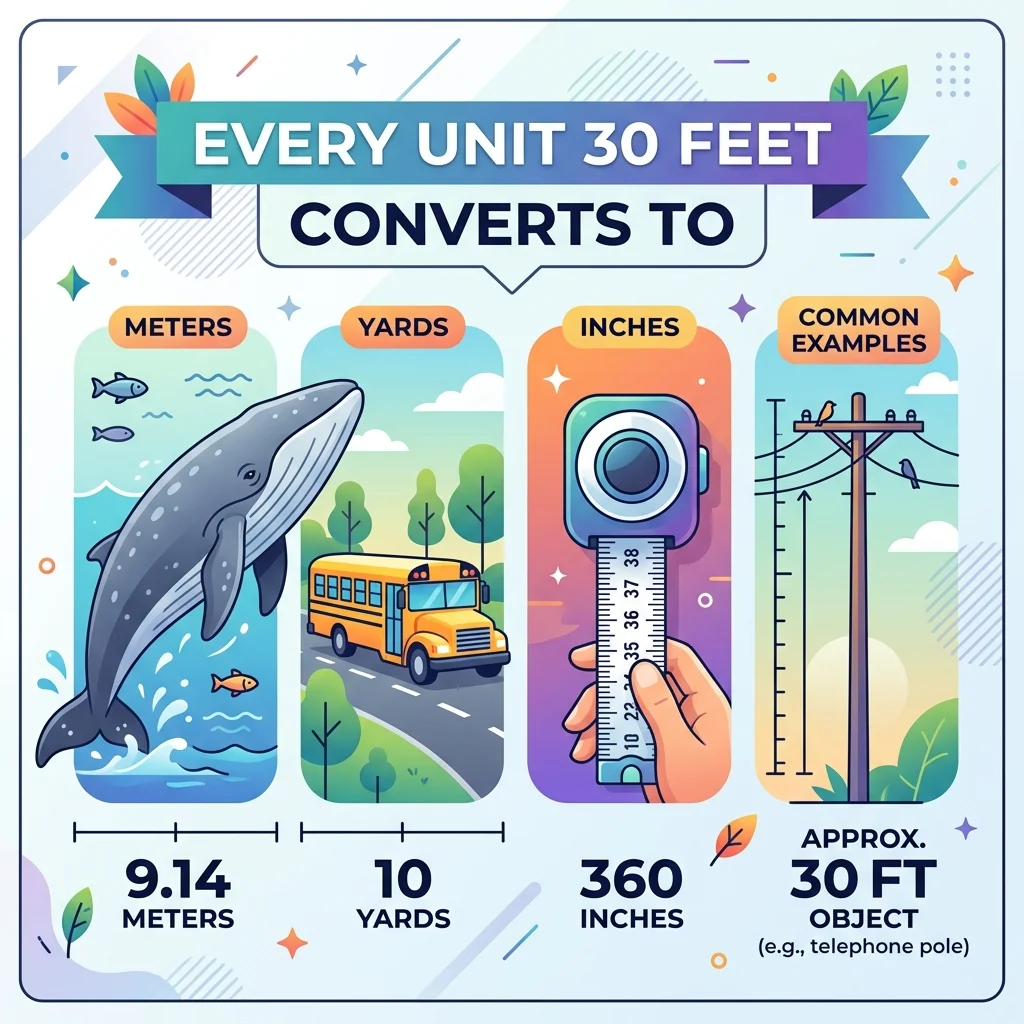
The easiest way to understand 30 feet is to see the same distance expressed in several familiar units.
| Unit | 30 Feet Equals |
|---|---|
| Inches | 360 inches |
| Feet | 30 feet |
| Yards | 10 yards |
| Centimeters | 914.4 cm |
| Millimeters | 9,144 mm |
| Meters | 9.144 m |
| Kilometers | 0.009144 km |
| Miles | About 0.00568 miles |
So, if you’re searching for 30 feet in feet, the answer is simply 30 feet.
For 30 feet in cm, multiply 30 by 30.48:
30 × 30.48 = 914.4 cm
For 30 feet in mm, multiply the centimeter measurement by 10:
914.4 × 10 = 9,144 mm
For 30 feet in meters, divide by 3.28084:
30 feet = 9.144 meters
And because one yard contains 3 feet:
30 ÷ 3 = 10 yards
That last conversion is particularly useful because 10 yards is an easy distance to recognize on a football field.
Where 30 Feet Sits on a Common Length Scale
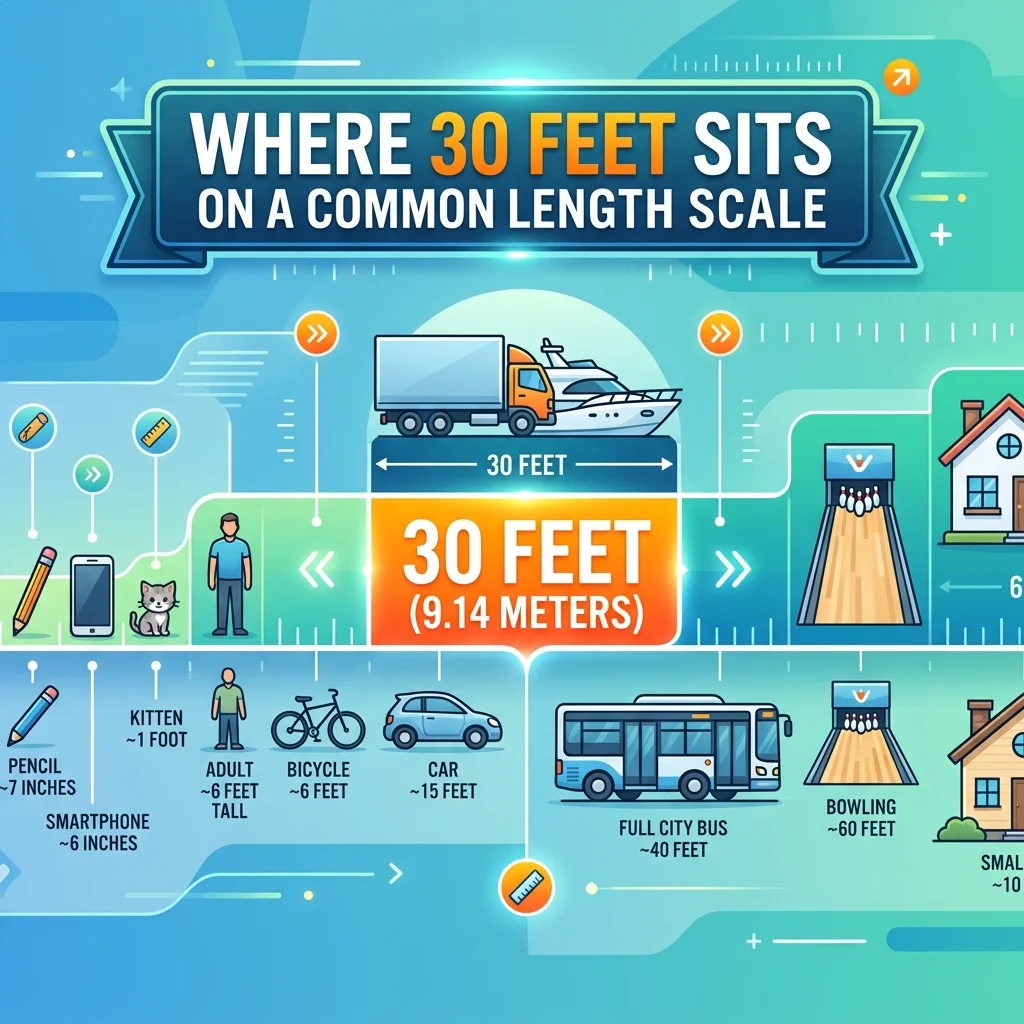
Thirty feet is a substantial distance for an everyday object or indoor space.
For perspective, a typical interior room may be somewhere around 10 to 20 feet across, depending on the building. A 30-foot distance could therefore span a large room from one end to the other or extend across several smaller rooms.
It is also considerably longer than the height of a typical two-story house’s individual floor-to-ceiling spaces. But it is not an unusually huge outdoor distance. In a driveway, backyard, sports area, or parking lot, 30 feet can disappear surprisingly quickly.
Another useful reference is a baseball diamond. The distance from the pitcher’s mound to home plate is 60 feet 6 inches, so 30 feet is almost exactly half of that distance.
That gives you an excellent way to imagine how long 30 feet visually: picture the pitching distance from the mound to home plate, then imagine stopping almost halfway.
12 Things That Help You Visualize 30 Feet
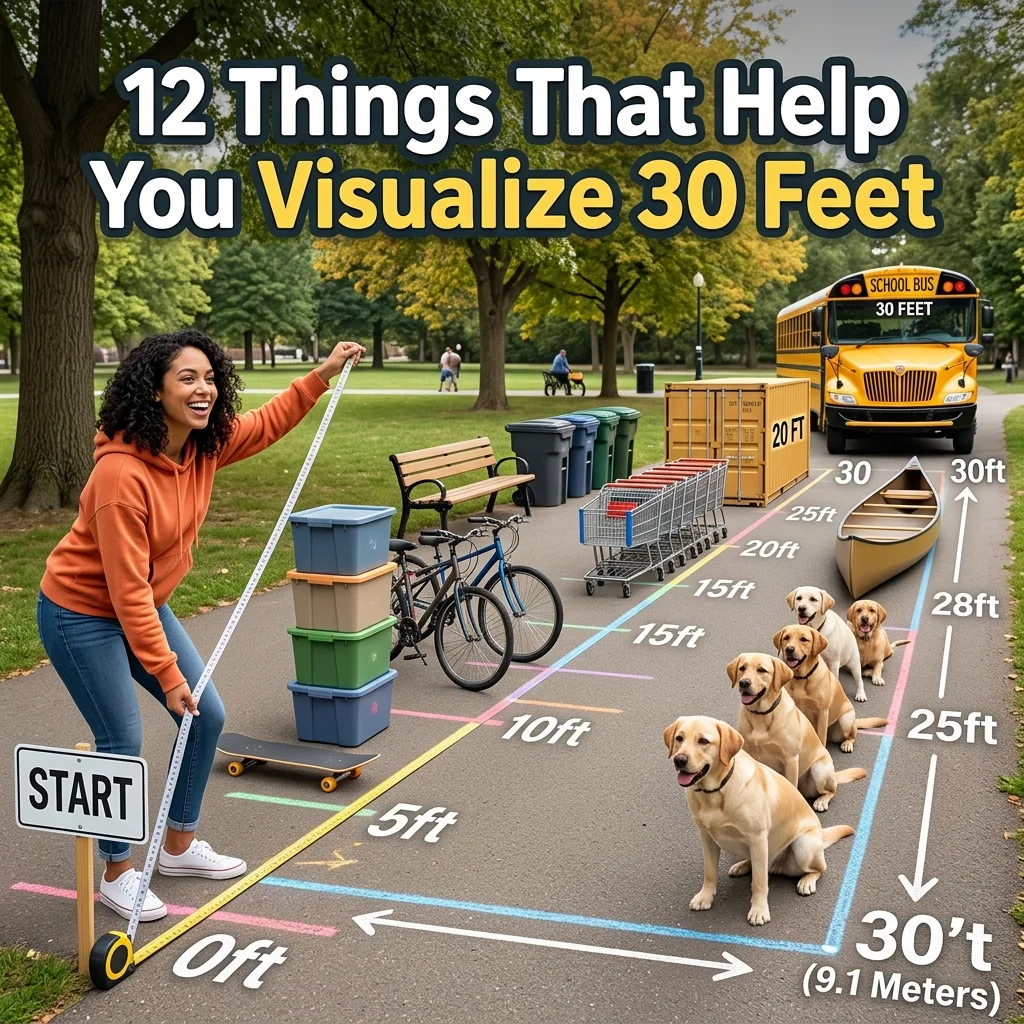
1. Ten Yards on a Football Field
Perhaps the cleanest way to visualize 30 feet is with a football field.
One yard equals 3 feet, so 10 yards equals exactly 30 feet. On a marked football field, the distance between two yard lines ten yards apart gives you a precise visual reference.
This is useful because football fields already divide long distances into clearly marked sections. You don’t have to imagine 30 individual feet; you only need to recognize a 10-yard stretch.
Picture standing at one yard line and walking toward another line ten yards away. The space between them is exactly 30 feet.
[IMAGE: football field showing a clearly marked 10-yard distance between two yard lines]
2. A 30-Foot Extension Ladder
Long extension ladders are commonly available in lengths around 24, 28, 32, and 40 feet, depending on the type and manufacturer. A ladder labeled 30 feet gives you an especially direct physical example of the measurement.
A 30-foot ladder is much longer than the small household ladders people usually keep indoors. When laid out along the ground, it would stretch roughly nine meters.
It is worth remembering that ladder length and the actual vertical height reached are not necessarily the same thing because ladders are often positioned at an angle.
For visualization purposes, though, imagine a straight line nearly the length of a small residential building’s frontage.
[IMAGE: long 30-foot extension ladder laid horizontally for scale]
3. A Typical 30-Foot Recreational Vehicle
Some motorhomes and recreational vehicles are built at lengths around 30 feet. Exact dimensions vary considerably between models, but 30 feet is a useful size category for larger RVs.
Imagine a vehicle almost 9.2 meters long. That’s far longer than a normal passenger car and can occupy most of a driveway.
A 30-foot RV also shows why length can feel different when viewed in real life. Standing beside one makes the distance seem much larger than simply reading “30 feet” on a specification sheet.
Picture a long vehicle stretching from one end of a driveway toward the other.
[IMAGE: approximately 30-foot motorhome parked beside a residential driveway]
4. A 30-Foot Sailboat

Small cruising sailboats can be built around the 30-foot mark, making a 30-foot boat another useful visualization.
A boat of this length measures about 9.14 meters from bow to stern. Depending on its design, the mast and rigging can make it appear much taller than its hull length suggests.
A 30-foot boat is large enough to feel substantial while still belonging to a size range commonly associated with smaller cruising vessels.
Imagine placing the boat on a straight line on land. Its bow-to-stern length would cover 30 feet.
[IMAGE: approximately 30-foot cruising sailboat viewed from the side]
5. About Two Baseball Pitching-Mound Distances
The distance from a regulation baseball pitcher’s plate to home plate is 60 feet 6 inches.
Half of that is 30 feet 3 inches.
That means 30 feet is only three inches shorter than half the standard pitching distance.
This is one of the most accurate sports-based ways to visualize the measurement. If you’ve watched a baseball game, imagine the full distance between the mound and home plate and mentally divide it almost perfectly in half.
[IMAGE: baseball diamond showing the 60-foot-6-inch pitching distance divided near the halfway point]
6. Around Five Adult Arm Spans
An adult’s arm span is often roughly comparable to their height, although individuals vary. For someone around 6 feet tall, an extended fingertip-to-fingertip span might be close to 6 feet.
Five such spans would therefore come to about 30 feet.
This isn’t an exact measuring technique because people’s heights and arm spans differ. It is better used as a rough mental picture than as a precision measurement.
Imagine five adults standing in a line with their arms stretched horizontally from fingertip to fingertip. If each span were about 6 feet, the combined distance would be close to 30 feet.
[IMAGE: five adults demonstrating approximately six-foot arm spans in a straight line]
7. A Large Utility Pole
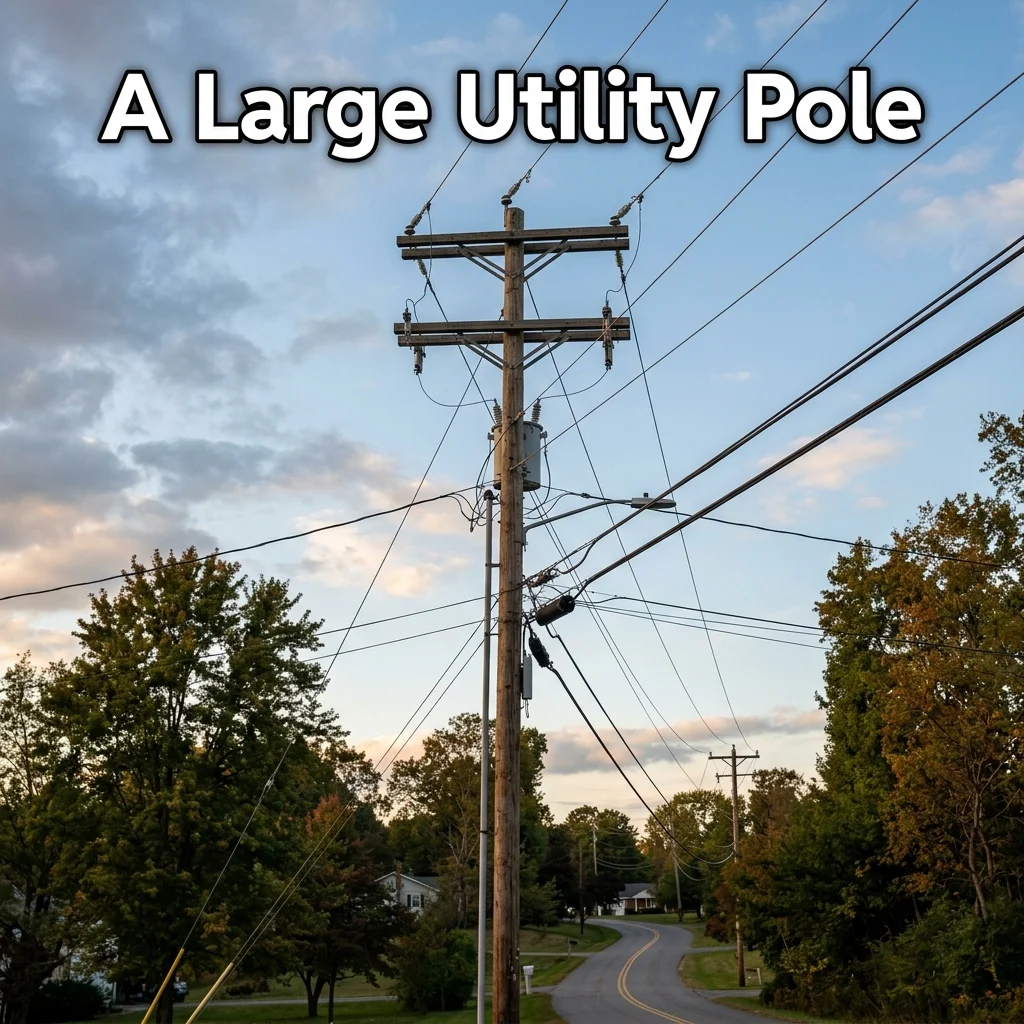
Utility poles vary in length depending on their purpose, location, and installation requirements, but poles in the neighborhood of 30 feet are common enough to provide a useful visual reference.
A pole measuring 30 feet would rise about 9.14 meters from end to end. Viewed vertically, that is dramatically taller than a person.
It can be easier to imagine the measurement as a vertical object than a horizontal line. Picture a pole extending upward several times the height of an adult.
The important point is that not every utility pole is 30 feet; this is a size comparison rather than a claim that all poles have the same length.
[IMAGE: approximately 30-foot utility pole standing beside an adult for scale]
8. About Half a Regulation Badminton Court
A standard badminton court is 44 feet long for singles or doubles play.
Thirty feet is therefore considerably more than half the court but shorter than its full length.
This is useful if you’ve ever stood on a badminton court because the lines give you an immediate sense of scale. A 30-foot stretch would cover most of the court’s length while leaving roughly 14 feet remaining.
Imagine walking from one baseline toward the opposite end and stopping about two-thirds of the way there.
[IMAGE: badminton court with an approximately 30-foot section highlighted along its length]
9. A Large Box Truck Is in the Same General Range
Medium and large box trucks come in many lengths, but some vehicle configurations occupy a range around 20 to 30 feet or more.
A truck near the 30-foot mark provides a familiar road-based comparison. It is clearly longer than a typical family car, which makes 30 feet easier to appreciate.
If you’ve seen a delivery truck parked along a street, imagine its full length from the front bumper to the rear cargo doors. Depending on the truck, that distance can approach 30 feet.
Because truck sizes vary, treat this as a broad comparison rather than an exact standard.
[IMAGE: large box delivery truck approximately 30 feet long beside passenger cars]
10. Three Ten-Foot Sections of Lumber

Thirty feet can also be imagined as three consecutive 10-foot sections.
Long construction materials are available in many lengths, although standard lumber dimensions vary by product and supplier. The useful part of this comparison is the simple arithmetic rather than claiming that a particular board is normally sold at exactly 30 feet.
Imagine three straight 10-foot lines placed end to end. Together, they create one continuous 30-foot distance.
This method is especially handy outdoors because a 10-foot section is already a reasonably familiar length for many building and landscaping projects.
[IMAGE: three clearly marked 10-foot sections placed end to end to create 30 feet]
11. Roughly Two Giraffe Heights
Adult giraffes can stand roughly 14 to 18 feet tall, with males generally reaching the upper part of that range. That means two giraffes standing one above the other would exceed 30 feet, but one giraffe is already more than halfway there.
This is a fun way to understand the vertical scale of 30 feet. Picture a tall adult giraffe standing upright, then imagine another several feet of height above its head.
It isn’t a precise 30-foot comparison because giraffes differ substantially in height. Its value is in showing that 30 feet is an impressive vertical distance in relation to a large animal.
[IMAGE: tall adult giraffe beside a vertical 30-foot measurement scale]
12. About 4½ to 5 Parking-Space Lengths
Parking spaces vary by country and location, but a typical car parking space is often around 18 to 20 feet long.
That means 30 feet is roughly one and a half parking spaces, not four or five. If you’re picturing parking stalls, imagine one complete space plus another half-to-two-thirds of a space.
This comparison is useful because parking spaces are visually familiar. A 30-foot stretch would be long enough to cover the length of one parked vehicle’s space and continue well into the next.
Always treat parking dimensions as approximate because parking layouts differ.
[IMAGE: two adjacent parking spaces with a 30-foot distance marked across them]
The 30-Foot Sports Question People Actually Mean
When people search how long is 30 feet visually, they’re often trying to understand the distance in a space they already know.
Sports fields are particularly useful because their markings provide built-in measuring references.
In American football, 30 feet is exactly 10 yards, making a football field one of the simplest visual references available. Find any two yard lines that are ten yards apart and you’ve got a precise 30-foot span.
Baseball provides another excellent reference. The pitching distance from the pitcher’s plate to home plate is 60 feet 6 inches, meaning 30 feet is almost exactly half that distance.
These examples are more reliable than comparing 30 feet with random household objects because the sports dimensions are standardized.
Getting to 30 Feet Without a Tape Measure
You don’t need to physically measure 30 feet to get a reasonable mental picture.
Use a football field. If you have access to a marked field, 10 yards equals exactly 30 feet. This is one of the easiest visual references.
Use an adult’s height. If someone is about 6 feet tall, five of those heights placed end to end would give approximately 30 feet. It is only an estimate because people vary in height.
Use the baseball pitching distance. Imagine the standard 60-foot-6-inch distance from the pitching plate to home plate and picture the halfway point. Thirty feet is just three inches short of that halfway distance.
Break it into smaller chunks. Instead of trying to visualize 30 feet at once, think of it as three 10-foot sections. Smaller distances are generally easier to judge.
Count normal walking steps. An adult’s walking step varies, so this is only a rough method. Someone taking steps of about 2.5 feet would need around 12 steps to cover 30 feet.
For an exact measurement, however, these methods are not substitutes for a tape measure, measuring wheel, or other appropriate measuring tool.
[INTERNAL LINK: How Far Is 500 Feet? Everyday Comparisons]
FAQs About 30 Feet
How many feet is 30 feet?
30 feet is exactly 30 feet. It is also equal to 10 yards or 360 inches.
How many centimeters is 30 feet?
30 feet equals 914.4 centimeters. This comes from multiplying 30 feet by 30.48 centimeters per foot.
How many meters is 30 feet?
30 feet equals 9.144 meters. In everyday conversation, you could describe this as approximately 9.14 meters.
How long is 30 feet visually?
Thirty feet is a little more than nine meters long. A useful way to picture it is as 10 yards on a football field or almost half the pitching distance in baseball.
Is 30 feet considered long?
For an everyday object or indoor space, 30 feet is quite long. Outdoors, however, it is a moderate distance that can be covered in only a short walk.
What everyday object is about 30 feet long?
Large RVs, some boats, long ladders, and certain commercial vehicles can be around 30 feet long. Their exact dimensions vary, so they should be treated as approximate comparisons.
Can I visualize 30 feet without a tape measure?
Yes. Think of 10 yards on a football field, three 10-foot sections, or almost half of the 60-foot-6-inch baseball pitching distance.
How many yards are in 30 feet?
There are exactly 10 yards in 30 feet because one yard contains 3 feet.
Where That Leaves You
Thirty feet is 360 inches, 10 yards, 914.4 centimeters, and 9.144 meters. The easiest visual reference is probably a 10-yard section of a football field because the yard markings make the distance clear.
For another strong mental image, think about the baseball pitching distance. Thirty feet is almost exactly half of the 60 feet 6 inches between the pitcher’s plate and home plate.
The next time you need to picture 30 feet, don’t imagine a mysterious 30-foot line. Think 10 yards, or picture a long RV, a 30-foot ladder, or roughly half a baseball pitching distance. Those familiar references make the measurement much easier to see in your mind.