A full-size bed can look surprisingly large in a bedroom, yet its actual measurements are easy to lose track of once you see the mattress covered with sheets, pillows, and blankets. The numbers become much easier to understand when you compare them with familiar things around the home.
A standard full mattress is 54 inches wide and 75 inches long. That makes it 4 feet 6 inches wide and 6 feet 3 inches long. It is also commonly called a double bed.
The size sits between a twin and a queen. A twin has the same 75-inch length but is only 38 inches wide, while a queen is 60 inches wide and 80 inches long. So, a full gives a solo sleeper considerably more width than a twin without taking up as much space as a queen.
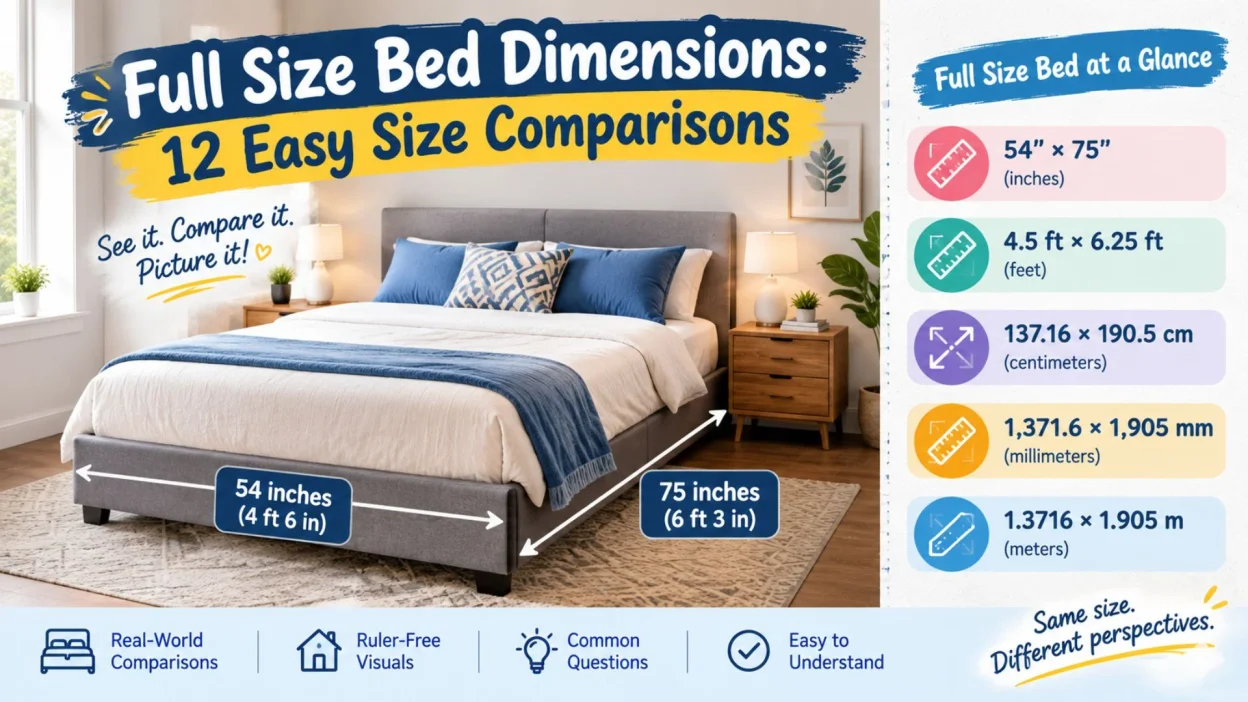
Full size bed dimensions equal 54 inches wide by 75 inches long, or 4 feet 6 inches by 6 feet 3 inches, 137.16 cm by 190.5 cm, 1,371.6 mm by 1,905 mm, and 1.3716 meters by 1.905 meters.
This guide breaks that size down into conversions, mattress comparisons, room-planning context, and everyday objects. By the end, you should be able to picture a full-size bed without reaching for a tape measure.
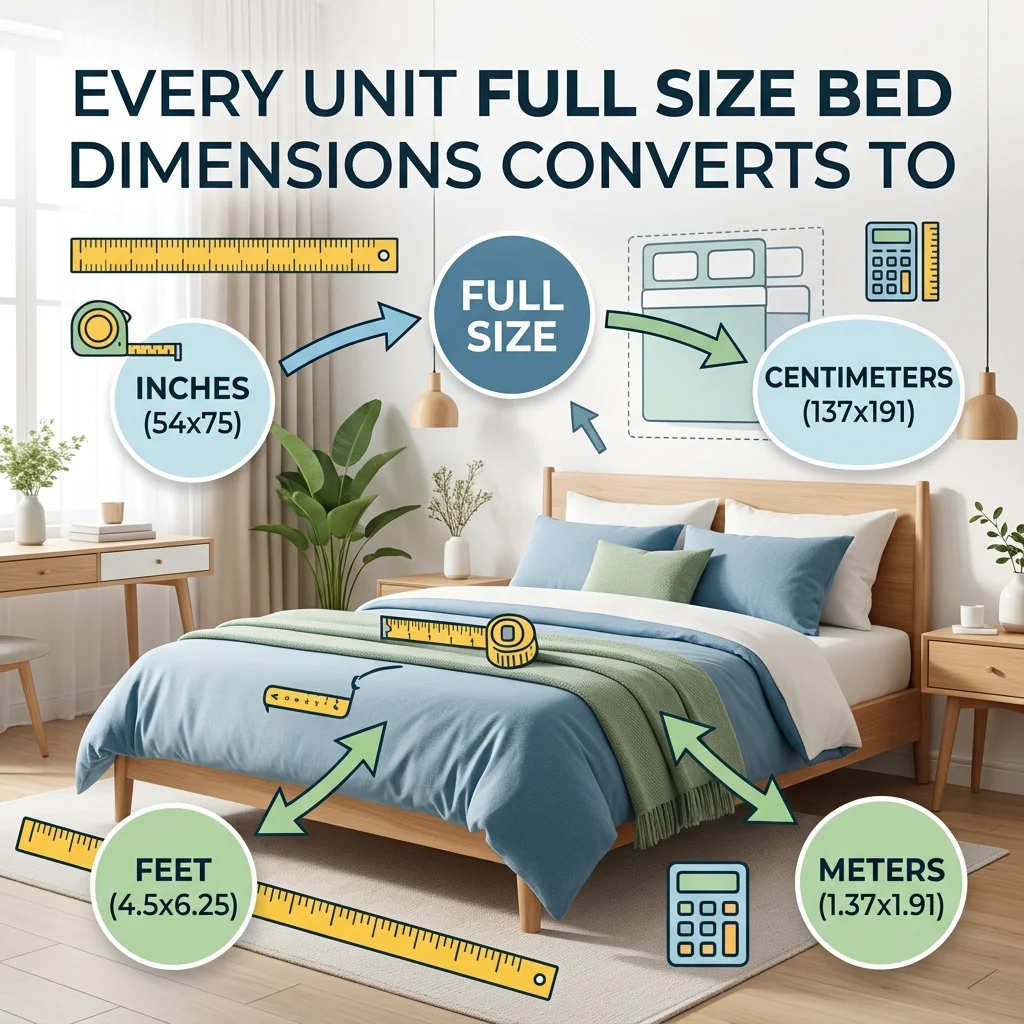
Every Unit Full Size Bed Dimensions Converts To
For a standard full mattress, the key measurement is 54 inches wide × 75 inches long. Industry guides generally use those dimensions, although individual manufacturers can have small variations.
| Unit | Width | Length |
|---|---|---|
| Inches | 54 in | 75 in |
| Feet | 4 ft 6 in | 6 ft 3 in |
| Decimal feet | 4.5 ft | 6.25 ft |
| Centimeters | 137.16 cm | 190.5 cm |
| Millimeters | 1,371.6 mm | 1,905 mm |
| Meters | 1.3716 m | 1.905 m |
| Yards | 1.5 yd | 2.083 yd |
The math is straightforward.
To convert inches into feet, divide by 12:
54 ÷ 12 = 4.5 feet
75 ÷ 12 = 6.25 feet
For centimeters, multiply each measurement by 2.54:
54 × 2.54 = 137.16 cm
75 × 2.54 = 190.5 cm
For millimeters, multiply inches by 25.4:
54 × 25.4 = 1,371.6 mm
75 × 25.4 = 1,905 mm
So if you search for full size bed dimensions in feet, think 4.5 feet wide by 6.25 feet long. In centimeters, it is about 137 × 191 cm.
The mattress also has about 4,050 square inches of sleeping surface, or roughly 28.1 square feet.
One important distinction matters when planning a room: these measurements describe the mattress. A bed frame, headboard, footboard, or side rails can make the finished bed slightly larger.
Where a Full Bed Fits on the Mattress Size Chart

The easiest way to understand a full bed is to put it beside the other standard mattress sizes.
| Mattress Size | Width | Length |
|---|---|---|
| Twin | 38 in | 75 in |
| Twin XL | 38 in | 80 in |
| Full | 54 in | 75 in |
| Queen | 60 in | 80 in |
| King | 76 in | 80 in |
| California King | 72 in | 84 in |
These standard dimensions show something interesting: a full and a twin have exactly the same length, but the full is 16 inches wider. A full is also 6 inches narrower and 5 inches shorter than a queen.
That extra width makes a noticeable difference for a person sleeping alone. You get considerably more side-to-side room than on a twin without moving all the way up to queen size.
For two adults, however, a full bed provides less personal space than a queen. Each person would have only about 27 inches of mattress width if two sleepers divided the surface evenly.
Room size matters, too. A full mattress itself covers about 28 square feet, but you need additional floor space around it for walking, furniture, doors, and drawers.
That is why the mattress measurement should never be treated as the complete footprint of the bedroom setup.
12 Things That Help You Picture Full Size Bed Dimensions
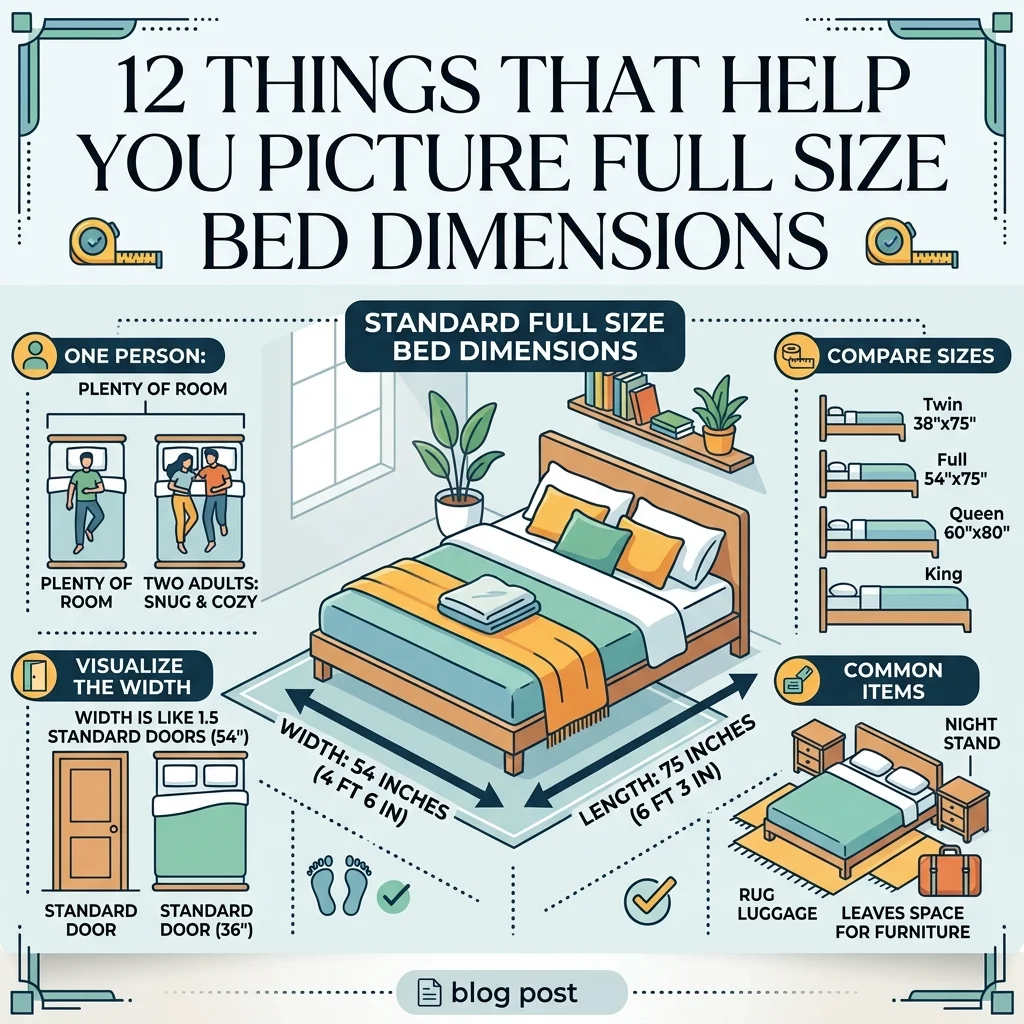
The best way to visualize 54 × 75 inches is to break the dimensions apart. Some comparisons below match the full mattress closely, while others help you picture its 75-inch length or 54-inch width.
1. A Standard Full Mattress
The most direct comparison is, of course, the mattress itself.
A full mattress measures about 54 inches across and 75 inches from head to foot. That gives you a rectangular sleeping surface measuring roughly 4.5 feet by 6.25 feet.
Its length is exactly the same as a standard twin mattress. The major difference is width: a full gives you 16 additional inches of side-to-side space.
This is why a full can feel like a substantial upgrade from a twin even though neither mattress is longer.
Stand at the foot of one and look toward the headboard. The 75-inch length is just over 6 feet, so it is noticeably longer than a 6-foot object.
2. A Twin Mattress Has the Same 75-Inch Length
A standard twin mattress is about 38 × 75 inches. Its 75-inch length matches the length of a full exactly.
That makes a twin useful for visualizing the long side of a full bed. Imagine a twin mattress and then add 16 inches of width.
The extra space does not extend the bed toward the headboard. Instead, it spreads outward along the sides.
If you have ever seen a twin bed in a child’s room, you already have a good mental picture of how long a full bed is.
3. A 6-Foot Folding Table
A common 6-foot folding table gives you another useful length comparison.
Six feet equals 72 inches, which is only 3 inches shorter than the 75-inch length of a full mattress. That makes the table very close in length.
The difference is small enough that you can use a 6-foot table as a practical visual reference for the long side of a full bed.
Picture the table extending from one end of the mattress toward the other. The mattress would continue about three more inches.
4. A 6-Foot-Tall Person
A person who is exactly 6 feet tall measures 72 inches from head to toe.
A full mattress is 75 inches long, so it is 3 inches longer than that person’s height.
Of course, people do not lie perfectly flat or measure themselves like a rigid object. Mattress length also does not guarantee that every sleeper will have plenty of extra space.
Still, a 6-foot person standing beside a full mattress gives you an intuitive sense of the length.
5. A Person Who Is 6 Feet 3 Inches Tall
A person who is 6 feet 3 inches tall measures 75 inches. That is exactly the same numerical length as the standard full mattress.
This does not mean the mattress is ideal for every 6-foot-3-inch sleeper. A person’s sleeping position and preferred amount of extra space matter.
It simply gives you a perfect visual reference for the 75-inch dimension.
If you know someone around 6’3″, imagine them standing straight next to the mattress. Their height and the mattress length would be numerically equal.
6. A Standard 80-Inch Door Is Five Inches Longer
Many interior doors are around 80 inches tall, making them a useful nearby reference.
Compared with a 75-inch full mattress, an 80-inch door is only 5 inches longer. That is a relatively small difference when you are picturing the overall length.
The comparison is especially useful because doors are familiar and easy to find in almost any home.
Imagine laying the mattress length against the height of an 80-inch door. The mattress would come up just short of the full door height.
7. A 75-Inch Television Measures 75 Inches Diagonally
A 75-inch TV gives you an interesting measurement comparison because its 75 inches refer to the diagonal, not its width.
A typical 16:9 television with a 75-inch diagonal is roughly 65 inches wide and 37 inches tall. The exact dimensions vary slightly by model.
That means a 75-inch TV is not shaped like a full mattress. Its diagonal simply matches the mattress’s 75-inch length.
This is a useful reminder that the same number can describe very different physical dimensions depending on how a product is measured.
8. A 54-Inch Round Table
A round table with a 54-inch diameter provides a strong visual reference for the width of a full mattress.
The full mattress is also 54 inches wide. The difference is that the mattress is rectangular, while the table is circular.
If you imagine drawing a straight line across the widest part of a 54-inch round table, that line would equal the width of the mattress.
This comparison is especially useful when you are trying to understand the 4-foot-6-inch width rather than the 6-foot-3-inch length.
9. A 6-Foot Rug
A rug measuring 6 feet long is 72 inches long, making it only 3 inches shorter than a full mattress.
The rug will usually be much narrower than the mattress, depending on its design. Still, its length gives you a quick way to picture the 75-inch dimension.
If you have a 6-foot rug at home, imagine adding a 3-inch strip to one end. That gets you very close to the full mattress length.
It is a simple comparison because rugs are common household items and their dimensions are usually easy to understand.
10. A Full-Size Fitted Sheet
A full-size fitted sheet is designed around a mattress with approximately 54 × 75 inches of surface dimensions.
That makes bedding one of the most practical ways to understand the size because it follows the same mattress category.
The fitted sheet also reminds you that mattress thickness is a separate measurement. A full mattress can have different thicknesses even when its width and length remain standard.
So when buying sheets, check the mattress depth as well as the full-size label.
11. A Full-Size Bed Frame
A full-size bed frame is built to hold a mattress measuring about 54 × 75 inches, but the outside frame can be larger.
Rails, legs, upholstery, headboards, and footboards can all extend beyond the mattress edges.
That means you should not assume a bed frame will occupy exactly 54 × 75 inches of floor space.
If you are measuring a bedroom, check the manufacturer’s exterior dimensions rather than relying only on the mattress size.
12. A Queen Mattress Shows the Difference Clearly
A queen mattress measures about 60 × 80 inches, so it is 6 inches wider and 5 inches longer than a full.
Those numbers may sound small, but they add up to a meaningful increase in surface area.
A full has about 4,050 square inches of mattress surface. A queen has about 4,800 square inches, so the queen provides roughly 750 additional square inches.
Put another way, a queen gives you more room in both directions while keeping a familiar rectangular shape.
What Does a Full Size Bed Actually Feel Like in a Room?
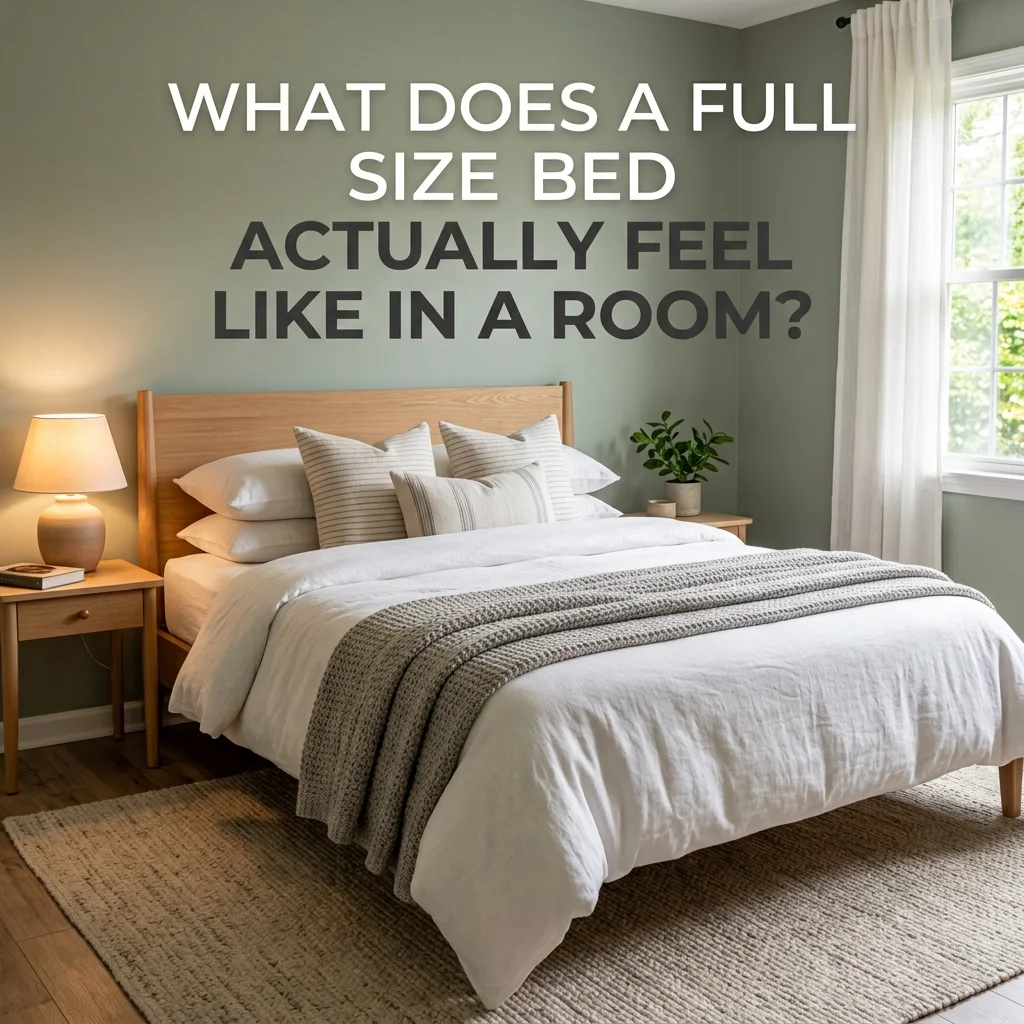
The mattress measurements tell only half the story. The other half is how much empty floor remains around it.
A full mattress covers about 28.1 square feet. That sounds modest, but a bed frame can increase the footprint, and you still need room to walk around the bed.
For a small bedroom, the 54-inch width can be useful because it gives a single sleeper considerably more sleeping space than a twin without taking up the width of a queen.
The 75-inch length also works well for many sleepers. However, a person who is very tall may want to consider a longer mattress size. A twin XL, queen, and king are all 80 inches long, while a California king reaches 84 inches.
There is another practical point: mattress dimensions can vary slightly between brands. Sleep Foundation notes that manufacturers may have small variations, so checking the actual product specifications is sensible before buying a frame or bedding.
The Full vs. Queen Question People Actually Mean
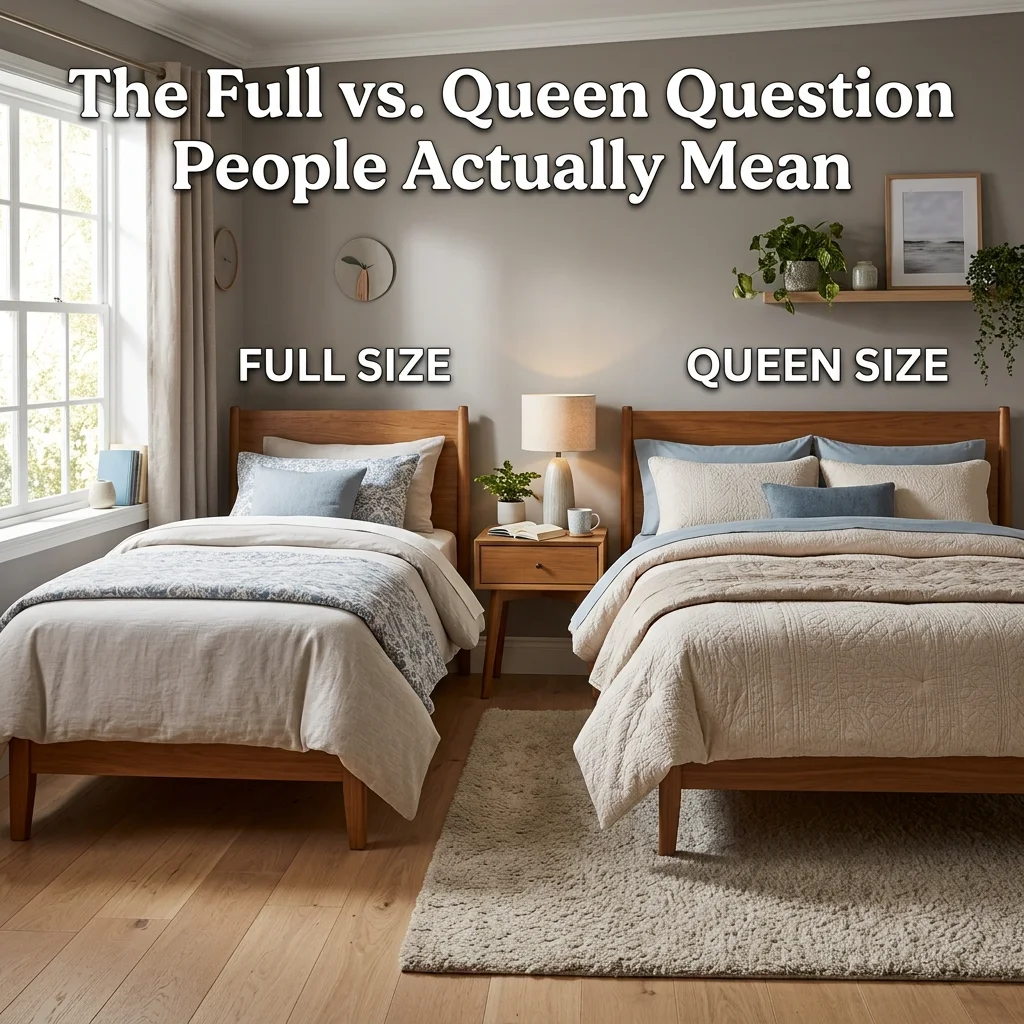
When people search full size bed dimensions, they are often trying to decide whether a full or queen will work better in their room.
The numbers make the choice easier to visualize.
A full is 54 × 75 inches. A queen is 60 × 80 inches. That means moving from a full to a queen adds 6 inches of width and 5 inches of length.
The extra space can matter when two adults share the mattress. A full divides into roughly 27 inches of width per person, assuming the surface is split evenly. A queen provides about 30 inches per person.
For one sleeper, however, the full can offer a comfortable middle ground between a twin and queen. It is wider than a twin while using less floor space than a queen.
The right choice depends on the room, the sleeper’s height, and whether the mattress will be shared. A full is also commonly called a double, so those two names generally refer to the same standard mattress category.
Getting to Full Size Bed Dimensions Without a Tape Measure
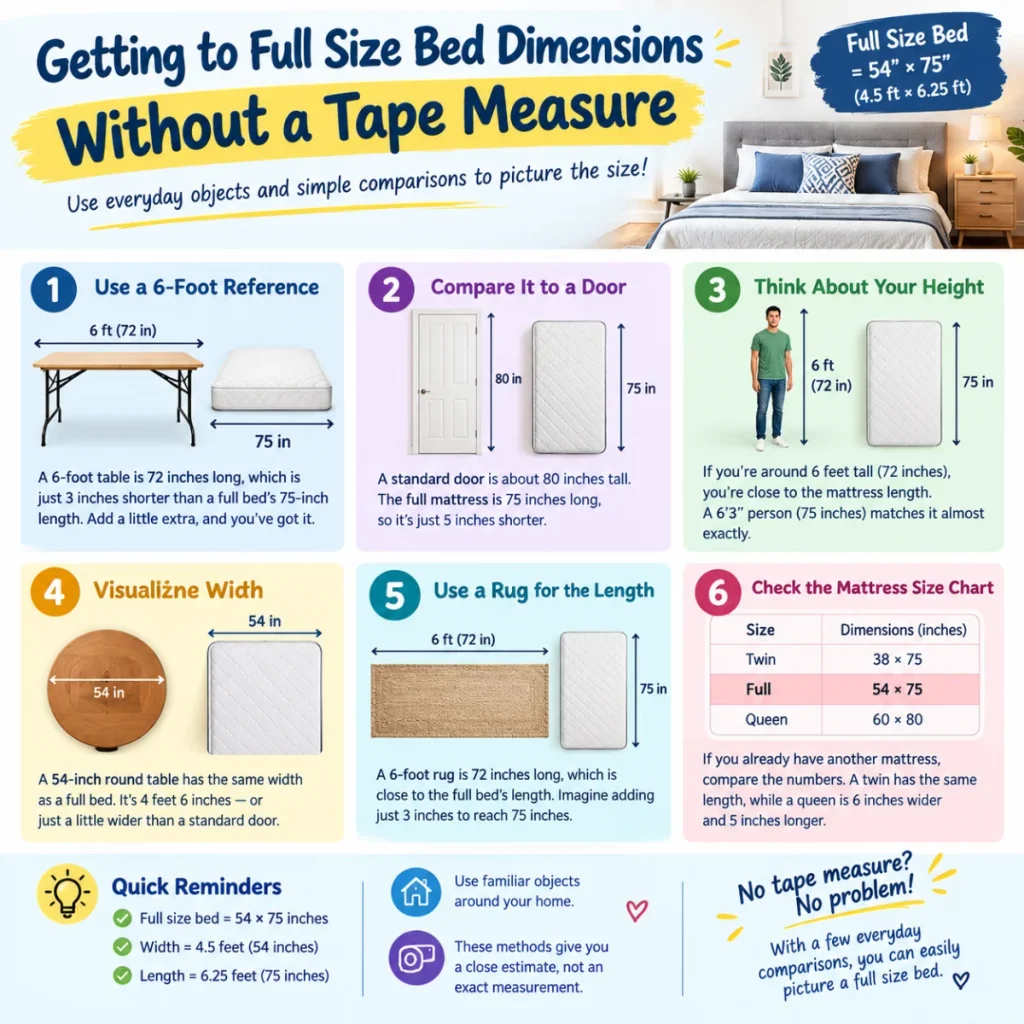
You do not need a tape measure to get a rough mental picture of a full mattress. A few familiar references can get you surprisingly close.
Use a 6-Foot Reference
Start with something that is about 6 feet long, such as a six-foot folding table or rug.
A full mattress is 75 inches, while six feet is 72 inches. Add roughly 3 inches and you are at the mattress length.
This is an approximation, not a substitute for measuring.
Compare It With a Door
An 80-inch interior door is close to the 75-inch mattress length.
Imagine the mattress standing upright next to the door. Its 75-inch length would be about 5 inches shorter than an 80-inch door.
This is a particularly useful visual because doors are familiar and easy to inspect.
Use Your Own Height
If you are around 6 feet tall, you are about 72 inches high. A full mattress is only 3 inches longer.
Someone who is exactly 6 feet 3 inches tall gives you an even closer reference because that height equals 75 inches.
Remember that this is only a visualization trick. Human height and mattress length describe different physical situations.
Picture the Width as 4½ Feet
The width is easier to remember as 4.5 feet.
Imagine a 4-foot length plus another 6 inches. That gives you the 54-inch width of a full mattress.
This is helpful when deciding whether the bed will leave enough side-to-side space in a room.
Use the Mattress Size Chart
If you already have another mattress, compare the numbers rather than guessing.
A twin has the same 75-inch length but is 16 inches narrower. A queen is 5 inches longer and 6 inches wider.
That makes the mattress-size chart one of the most reliable ways to visualize the difference.
FAQs
How many feet is a full size bed?
A standard full mattress is 4 feet 6 inches wide and 6 feet 3 inches long. In decimal form, that is 4.5 feet by 6.25 feet.
How many centimeters is a full size bed?
A 54 × 75-inch full mattress converts to approximately 137.16 × 190.5 cm. That is about 137 cm wide and 191 cm long.
How many meters is a full size bed?
A full mattress is approximately 1.3716 meters wide by 1.905 meters long. For everyday planning, you can round that to about 1.37 × 1.91 meters.
How wide is a full size bed?
A standard full mattress is 54 inches wide, which equals 4 feet 6 inches or 137.16 cm. The outside width of a finished bed can be greater because of its frame or headboard.
How long is a full size bed?
A standard full mattress is 75 inches long, or 6 feet 3 inches. The bed frame itself may extend beyond that measurement.
Is a full bed bigger than a twin?
Yes. Both are typically 75 inches long, but a full mattress is 54 inches wide while a twin is about 38 inches wide. That gives the full 16 additional inches of width.
Is a full bed smaller than a queen?
Yes. A standard full mattress is 54 × 75 inches, while a queen is 60 × 80 inches. The queen is therefore 6 inches wider and 5 inches longer.
Is a full bed the same as a double bed?
Generally, yes. “Full” and “double” are commonly used names for the same standard mattress size, approximately 54 × 75 inches.
Can two adults sleep on a full bed?
Two adults can sleep on a full bed, but each person would have less width than on a queen. A full is often more suitable when space is limited or when a single sleeper wants more room than a twin provides.
How much space does a full mattress take up?
The mattress surface is about 4,050 square inches, or roughly 28.1 square feet. The actual floor area needed will be larger once you account for the bed frame and walking space around it.
Where That Leaves You
The easiest way to remember full size bed dimensions is 54 × 75 inches. Think of that as 4 feet 6 inches wide by 6 feet 3 inches long, or approximately 137 × 191 cm.
For visualization, the 75-inch length is almost the same as a 6-foot object, while the 54-inch width is 4.5 feet. A twin gives you the same length with considerably less width, while a queen adds 6 inches of width and 5 inches of length.
If you are planning a bedroom, remember that the mattress is not necessarily the complete footprint. The frame can extend beyond its edges, so use the manufacturer’s exterior measurements when floor space really matters. Once you picture a full bed as a 4½-by-6¼-foot rectangle, its size becomes much easier to understand.