Have you ever wondered how people describe the size of a room, a table, a box, or even a television? The answer is dimensions. Dimensions tell us how big or small something is by describing its measurements, such as length, width, height, and depth.
In simple terms, dimensions help us understand the size and shape of objects. For example, when buying furniture, knowing its dimensions helps you decide whether it will fit in your room. Similarly, builders, designers, engineers, and students use dimensions in everyday tasks.
Understanding what are dimensions is useful in mathematics, science, construction, shopping, and daily life. Let’s explore their meaning, different types, practical examples, and common uses.
📏 What Are Dimensions?
Dimensions are measurable properties that describe the size, shape, or extent of an object or space. They help explain how long, wide, tall, or deep something is.
For example, a rectangular box may have three dimensions:
- Length: 12 inches
- Width: 8 inches
- Height: 6 inches
These measurements describe the box’s overall size. Therefore, dimensions provide a clear way to understand and compare physical objects.
In mathematics and science, dimensions can also describe directions or independent measurements used to locate something in space.
📐 What Are the Main Types of Dimensions?
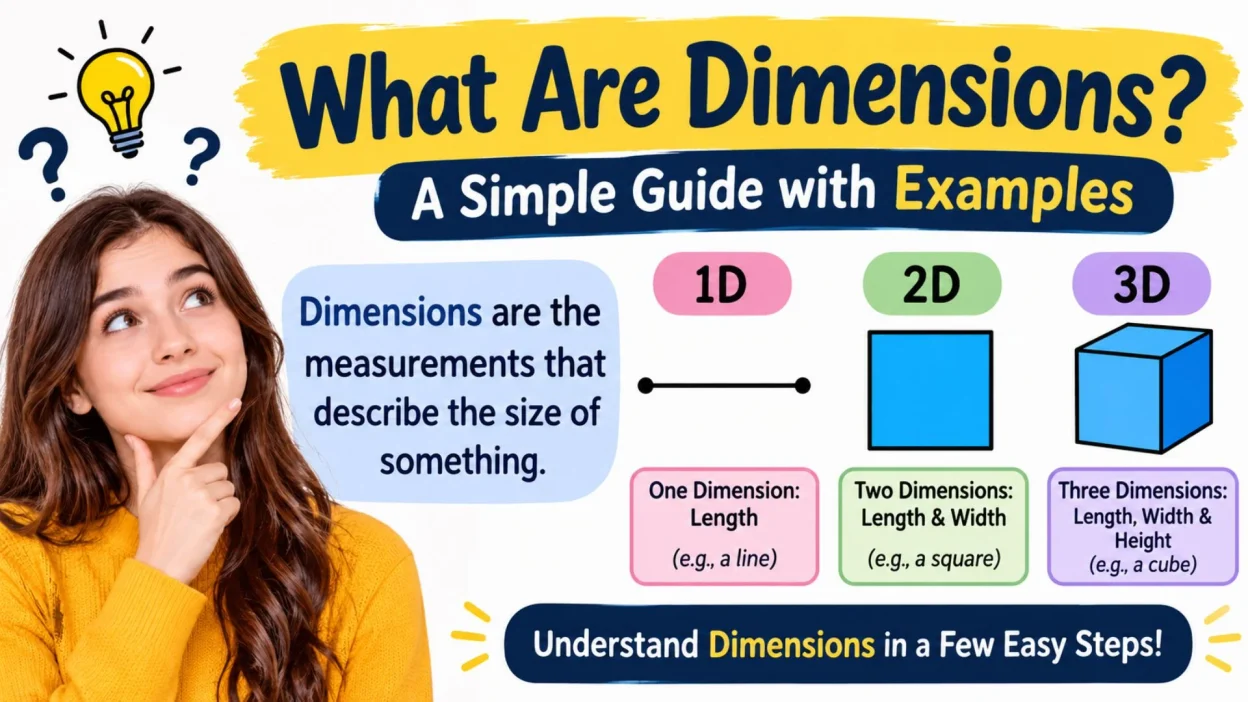
There are different types of dimensions depending on the object or subject being discussed. The most common physical dimensions are one-dimensional, two-dimensional, and three-dimensional.
1. One-Dimensional (1D)
One-dimensional objects have only one measurable direction, usually length.
- A straight line has one dimension.
- A piece of string can be measured by length.
- A ruler helps measure one-dimensional distances.
2. Two-Dimensional (2D)
Two-dimensional objects have length and width but no measurable depth.
- A square has length and width.
- A rectangle has two dimensions.
- A flat drawing on paper is generally two-dimensional.
3. Three-Dimensional (3D)
Three-dimensional objects have length, width, and height or depth.
- A cube has three dimensions.
- A refrigerator has length, width, and height.
- A room has length, width, and height.
Most physical objects around us are three-dimensional.
🏠 What Are the Four Dimensions?
The four dimensions commonly used to describe physical objects are length, width, height, and depth. Although height and depth are sometimes used interchangeably in measurements, each term has a specific purpose.
Here is what each measurement means:
- Length: Measures how long an object is from one end to another.
- Width: Measures how wide an object is from side to side.
- Height: Measures how tall an object is from bottom to top.
- Depth: Measures how far an object extends from front to back.
For example, when measuring a wardrobe, you might use length, width, and height to describe its overall size. However, depth is particularly useful when checking how much space it occupies.
📦 Examples of Dimensions in Everyday Life
Dimensions are everywhere, from household furniture to electronic devices. Understanding them makes it easier to compare sizes and choose suitable products.
Here are some familiar examples:
- Door: Height and width help determine whether furniture can pass through it.
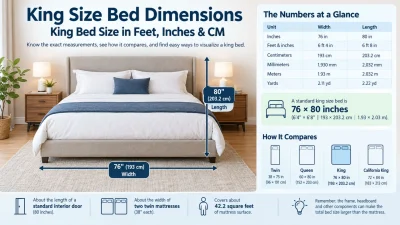
- Bed: Length, width, and height describe its overall measurements.
- Dining table: Its length, width, and height determine how much space it needs.
- Refrigerator: Dimensions help you check whether it fits in your kitchen.
- Television: Screen dimensions are commonly described using diagonal measurements.
- Mobile phone: Height, width, and thickness describe its physical size.
- Shipping box: Length, width, and height help calculate its volume.
- Swimming pool: Length, width, and depth describe its capacity and shape.
- Window: Height and width determine the size of its opening.
- Room: Length, width, and height help calculate floor area and interior volume.
These examples show why dimensions matter when purchasing, designing, building, or organizing physical spaces.
📊 What Is the Difference Between 1D, 2D, and 3D?
One-dimensional, two-dimensional, and three-dimensional measurements describe different ways of understanding space. Each type adds another measurable direction.
| Dimension | Measurements | Example |
|---|---|---|
| 1D | Length | Straight line |
| 2D | Length and width | Square |
| 3D | Length, width, and height | Cube |
A one-dimensional object has length but no width or height in the mathematical model. Meanwhile, a two-dimensional shape has both length and width.
In contrast, three-dimensional objects have depth or height as well. Therefore, they occupy physical space and have volume.
📐 How Are Dimensions Measured?
Dimensions are measured using different tools depending on the object’s size and shape. Choosing the correct measuring tool helps produce accurate results.
Common measuring tools include:
- Ruler: Useful for measuring small objects, such as books and stationery.
- Measuring tape: Ideal for measuring furniture, rooms, and clothing.
- Meter stick: Helps measure longer distances and objects.
- Laser distance meter: Measures room dimensions and larger spaces.
- Caliper: Measures small thicknesses and external or internal distances.
- Micrometer: Measures extremely small dimensions with high precision.
Measurements are usually recorded in units such as inches, feet, centimeters, meters, and millimeters.
For instance, a notebook might measure 30 centimeters in height and 21 centimeters in width. However, a large room may be measured in feet or meters.
📏 Common Units Used for Dimensions
Different measurement systems use different units to describe dimensions. The metric system is widely used internationally, while inches and feet are common in countries such as the United States.
Here are some commonly used units:
| Unit | Equivalent |
|---|---|
| 1 millimeter | 0.1 centimeters |
| 1 centimeter | 10 millimeters |
| 1 meter | 100 centimeters |
| 1 kilometer | 1,000 meters |
| 1 inch | 2.54 centimeters |
| 1 foot | 12 inches |
| 1 yard | 3 feet |
| 1 mile | 5,280 feet |
For example, if a table is 120 centimeters long, you can also describe its length as 1.2 meters.
Similarly, converting between inches and centimeters makes it easier to compare products sold in different countries.
🧮 How Do Dimensions Help Calculate Area and Volume?
Dimensions are useful for calculating the area and volume of objects. These calculations help people understand how much surface space or physical space something occupies.
Calculating Area
Area measures the surface covered by a two-dimensional shape.
For a rectangle, the formula is:
\[ \text{Area}=\text{Length}\times\text{Width} \]
For example, a room measuring 12 feet long and 10 feet wide has an area of:
\[ 12\times10=120\text{ square feet} \]
Therefore, the room has 120 square feet of floor space.
Calculating Volume
Volume measures the amount of three-dimensional space an object occupies.
For a rectangular box, the formula is:
\[ \text{Volume}=\text{Length}\times\text{Width}\times\text{Height} \]
Suppose a storage box measures 10 inches long, 8 inches wide, and 6 inches high.
\[ 10\times8\times6=480\text{ cubic inches} \]
Its volume is 480 cubic inches.
🌍 What Are Dimensions in Mathematics and Physics?
In mathematics and physics, dimensions have broader meanings than ordinary object measurements. They describe the number of independent directions or quantities needed to represent something.
For example, a point on a straight line needs one coordinate. However, locating a point on a flat surface requires two coordinates.
Similarly, locating a point in ordinary three-dimensional space requires three coordinates.
- One-dimensional space: Uses one coordinate.
- Two-dimensional space: Uses two coordinates.
- Three-dimensional space: Uses three coordinates.
- Four-dimensional space: Can include three spatial coordinates and time in the context of spacetime physics.
In physics, time is commonly treated as the fourth coordinate in spacetime. This concept helps scientists describe events and understand how space and time relate to each other.
🏡 Why Are Dimensions Important in Daily Life?
Dimensions make everyday decisions easier because they provide accurate information about size, distance, and space.
Whether you are decorating a home or ordering a product online, measurements help prevent mistakes.
Here are some practical reasons dimensions are important:
- Furniture shopping: Check whether a sofa or bed fits your available space.
- Home construction: Builders use measurements to plan walls, doors, and rooms.
- Interior design: Designers use dimensions to arrange furniture properly.
- Online shopping: Product measurements help customers compare sizes.
- Transportation: Vehicle dimensions help determine parking and storage requirements.
- Packaging: Accurate measurements help select suitable shipping boxes.
- Clothing: Body measurements help people choose appropriate sizes.
- Gardening: Dimensions help plan garden beds and outdoor spaces.
- Architecture: Architects use measurements to prepare accurate building plans.
- Education: Students use dimensions to understand geometry and measurement.
Consequently, understanding dimensions saves time, improves accuracy, and reduces costly mistakes.
💻 What Are Dimensions in Digital Design?
In digital design, dimensions describe the size of images, graphics, screens, and other visual elements. They are particularly important when creating websites, social media graphics, and digital advertisements.
For example, an image may have a width of 1920 pixels and a height of 1080 pixels.
Its dimensions are written as 1920 × 1080 pixels.
Common digital measurement terms include:
- Width: The horizontal size of an image or screen.
- Height: The vertical size of an image or screen.
- Resolution: The number of pixels used to display an image.
- Aspect ratio: The proportional relationship between width and height.
- Pixel dimensions: The total horizontal and vertical pixel measurements.
Understanding these terms helps designers create images that display correctly across different devices.
🔍 Dimensions vs. Measurements: What Is the Difference?
Dimensions and measurements are closely related, but they do not mean exactly the same thing.
Dimensions describe the properties or directions that define an object’s size. Measurements provide the actual numerical values of those properties.
For example, consider a rectangular table.
- Length, width, and height are its dimensions.
- 120 cm, 70 cm, and 75 cm are its measurements.
Therefore, dimensions explain what needs to be measured, while measurements tell you how large each dimension is.
This distinction is especially useful in mathematics, construction, product descriptions, and engineering.
📚 Common Mistakes When Understanding Dimensions
Although dimensions seem simple, people sometimes misunderstand how they work. Knowing these common mistakes can help you read measurements correctly.
- Confusing length with width: Length usually describes the longer horizontal side, while width describes the distance across it.
- Ignoring height: Some people measure only length and width, forgetting the vertical dimension.
- Mixing measurement units: Comparing inches with centimeters without conversion can cause errors.
- Confusing area with volume: Area measures a surface, whereas volume measures three-dimensional space.
- Ignoring product depth: A product may fit in width and height but still be too deep.
- Misreading screen size: Television screen sizes are generally measured diagonally, not horizontally.
- Assuming all objects have three dimensions: Mathematical models can represent one-dimensional and two-dimensional shapes.
By paying attention to these differences, you can understand measurements more accurately.
📝 Tips for Measuring Dimensions Accurately
Accurate measurements are important when buying furniture, planning construction, or designing a space. Even a small mistake can create problems later.
Use these simple tips:
- Choose a suitable measuring tool for the object.
- Measure from the correct starting and ending points.
- Keep measuring tape straight and properly aligned.
- Record every measurement immediately.
- Use the same measurement unit throughout your calculations.
- Measure each dimension at least twice.
- Check doorways and pathways before purchasing large furniture.
- Include depth when measuring objects that occupy floor space.
- Avoid rounding measurements too early.
- Compare your final measurements with the product specifications.
These simple steps can make your measurements more reliable and help you avoid unnecessary expenses.
Frequently Asked Questions About Dimensions
1. What are dimensions in simple words?
Dimensions are measurements that describe the size of something, including its length, width, height, and depth.
2. What are the three main dimensions?
The three main physical dimensions are length, width, and height. Together, they describe the size of three-dimensional objects.
3. What are the four dimensions of an object?
The four commonly used measurements are length, width, height, and depth. However, not every object requires all four measurements.
4. What is a 2D dimension?
A 2D shape has two dimensions: length and width. Examples include squares, rectangles, and circles.
5. What is a 3D dimension?
A 3D object has length, width, and height or depth. Examples include cubes, boxes, and furniture.
6. What is the difference between dimensions and size?
Dimensions describe measurable directions, while size refers to the overall magnitude of an object. Numerical measurements help express its dimensions.
7. How are dimensions written?
Dimensions are commonly written as length × width × height. For example, 12 × 8 × 6 inches describes a rectangular object.
🎯 Conclusion
Understanding what are dimensions helps us describe and compare the size of objects accurately. The main physical dimensions include length, width, height, and depth, while mathematical concepts also explain one-dimensional, two-dimensional, and three-dimensional space.
Moreover, dimensions are essential in everyday activities, including furniture shopping, construction, interior design, mathematics, and digital graphics. Knowing how to measure and interpret them makes practical decisions easier.
Whether you are measuring a small box or planning a large room, understanding dimensions gives you a clearer picture of size, space, and shape.