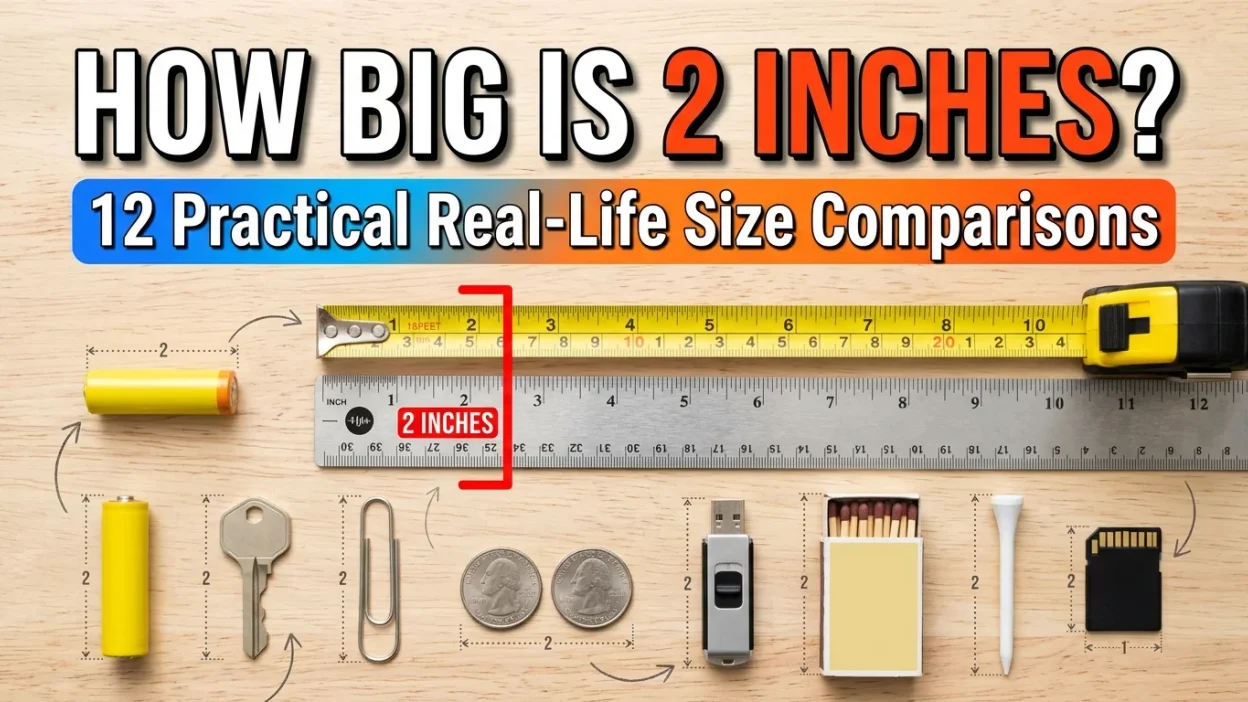
Two inches may sound like a very small measurement, but it can be surprisingly useful when you need to estimate an object’s size, check a product dimension, or understand how much space something occupies. Whether you are measuring a small household item, shopping online, working on a craft project, or comparing everyday objects, knowing what 2 inches looks like can make things much easier.
In metric measurements, 2 inches equals 5.08 centimeters, or 50.8 millimeters. It is a little over five centimeters long. Although this measurement is easy to write down, imagining it without a ruler can be difficult.
The good news is that you do not need a measuring tool every time. Familiar objects such as an AA battery, a golf ball, a ping-pong ball, and a standard playing card can help you picture this length. In this guide, you will discover 12 practical comparisons, learn how to visualize 2 inches, and understand how this measurement appears in everyday situations.
📏 How Big Is 2 Inches in Different Measurements?
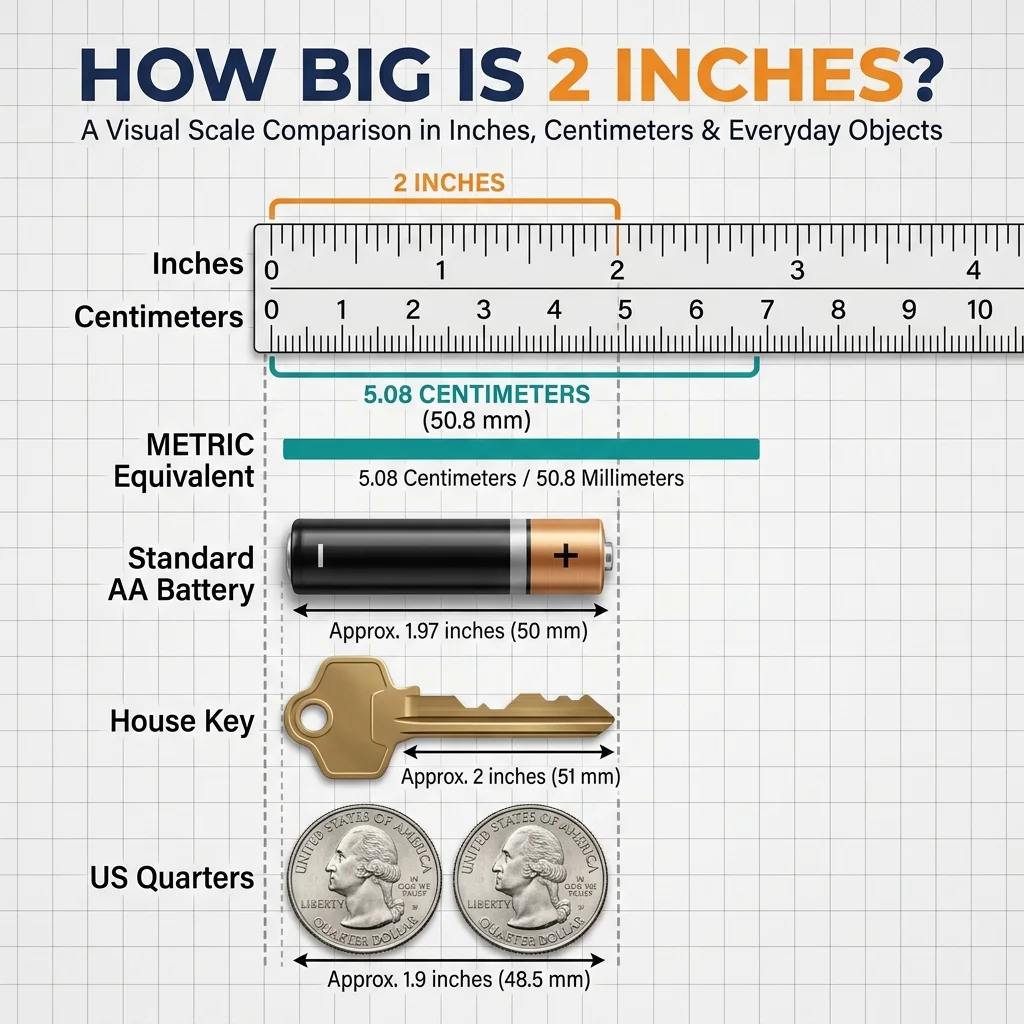
Before comparing 2 inches with everyday objects, it helps to understand its equivalent measurements. Inches are commonly used in the United States for measuring small objects, clothing, furniture, screens, and household products.
Two inches is a relatively short length, but converting it into other units makes it easier to understand when you use the metric system.
MAIN MEASUREMENT
2 inches
A little over five centimeters
5.08 cm
Centimeters
50.8 mm
Millimeters
0.167 ft
Feet (approximately)
0.0556 yd
Yards (approximately)
Here is what these conversions mean in simple terms:
- In centimeters: Two inches equal 5.08 centimeters. This is the most useful conversion if you normally measure objects using centimeters.
- In millimeters: The measurement equals 50.8 millimeters. This unit is helpful for small components, crafts, and detailed measurements.
- In feet: Two inches equal one-sixth of a foot, or approximately 0.167 feet.
- In yards: The measurement is approximately 0.0556 yards, which is a small fraction of a yard.
For quick everyday calculations, remember that one inch equals 2.54 centimeters. Multiply the number of inches by 2.54 to convert it into centimeters.
👀 What Does 2 Inches Look Like?
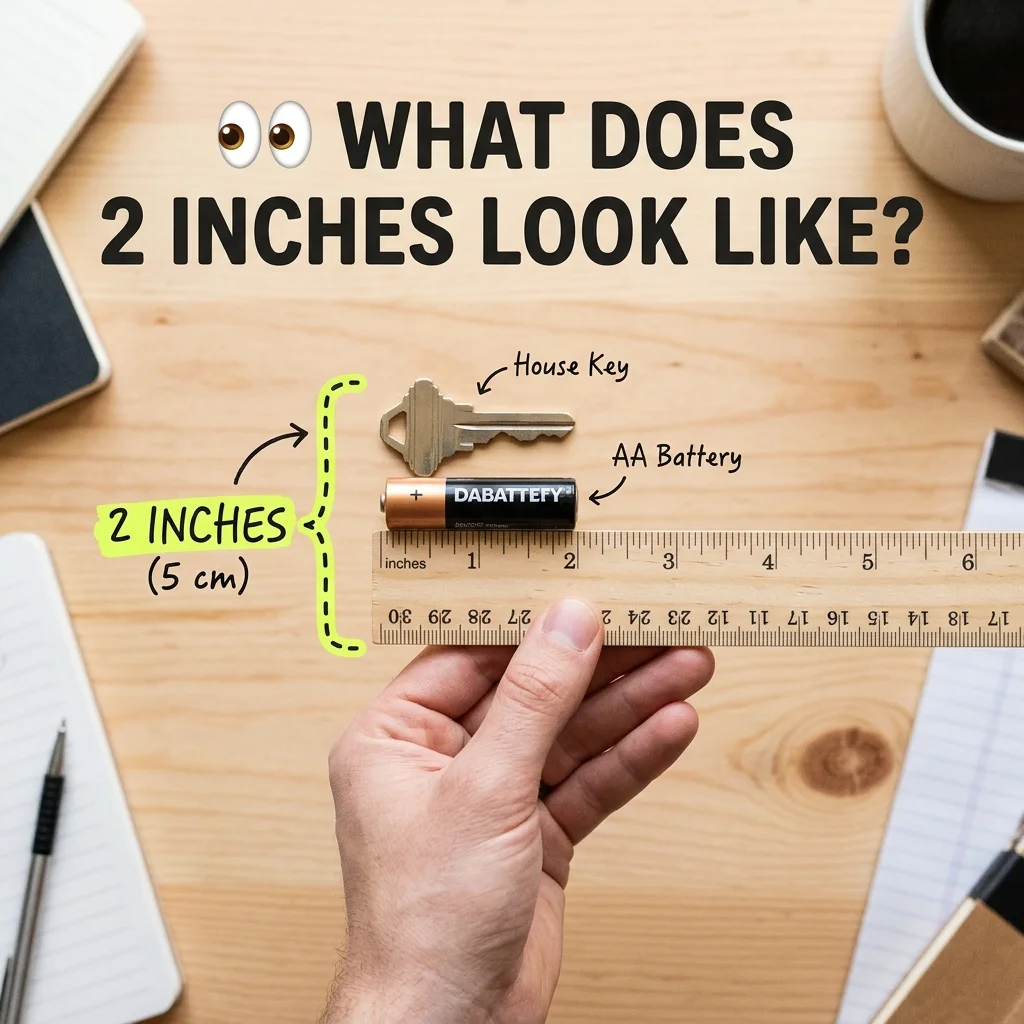
Two inches is approximately the length of a small battery or slightly more than the diameter of a golf ball. It is short enough to fit comfortably between the tips of your thumb and index finger when you spread them apart by a modest distance.
Imagine a standard ruler. The space between the zero mark and the two-inch mark gives you a clear picture of the measurement. If you do not have a ruler nearby, you can use objects with familiar dimensions to estimate it.
A helpful way to remember this size is to picture a little more than five centimeters. It is not as long as a standard credit card, but it is close to the length of an AA battery.
Keep in mind that comparisons are estimates. Objects can differ slightly by manufacturer, model, and design, so use an actual measuring tool when precision matters.
🔍 12 Everyday Objects That Help You Visualize 2 Inches
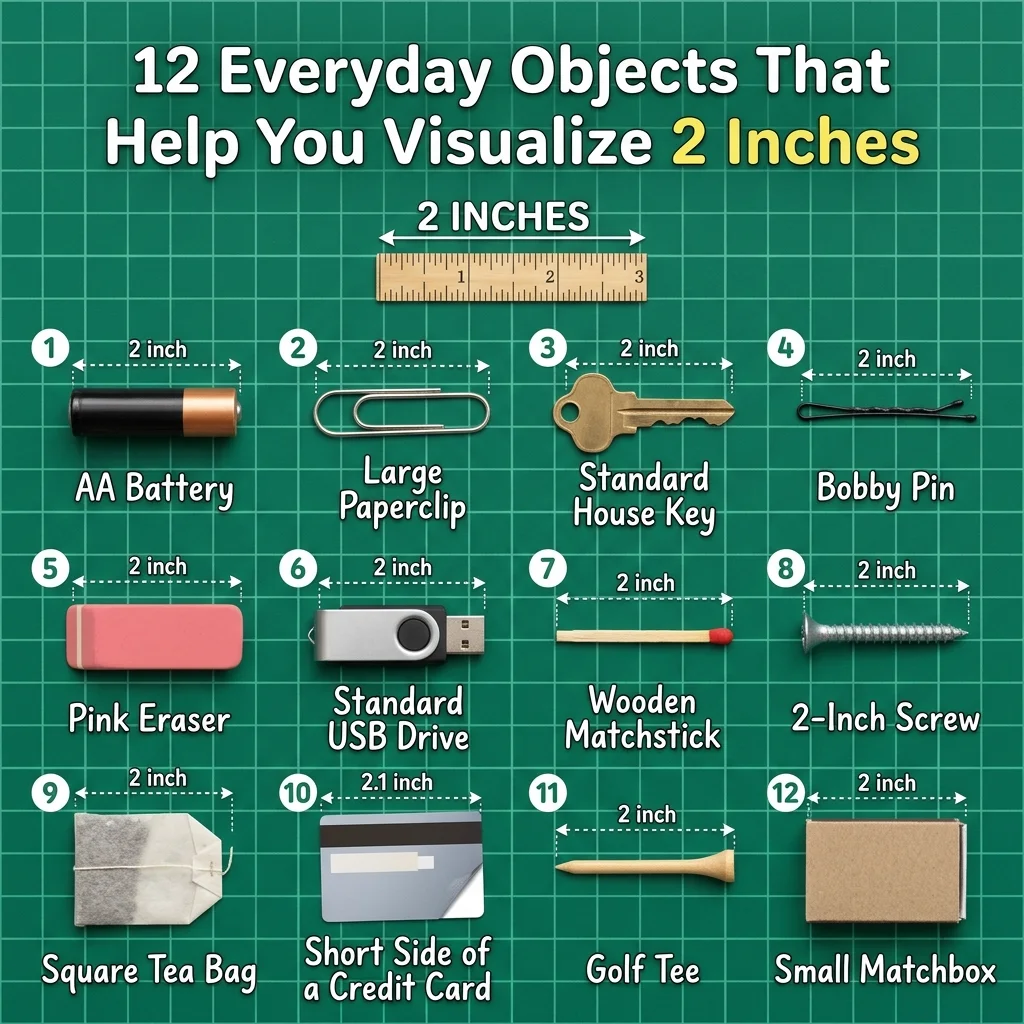
You can understand a measurement much faster when you compare it with objects you already recognize. The following examples provide practical reference points for imagining a two-inch length.
Some are very close to two inches, while others are slightly longer or shorter. Each comparison will explain the difference so you can use it correctly.
🔋 1. An AA Battery
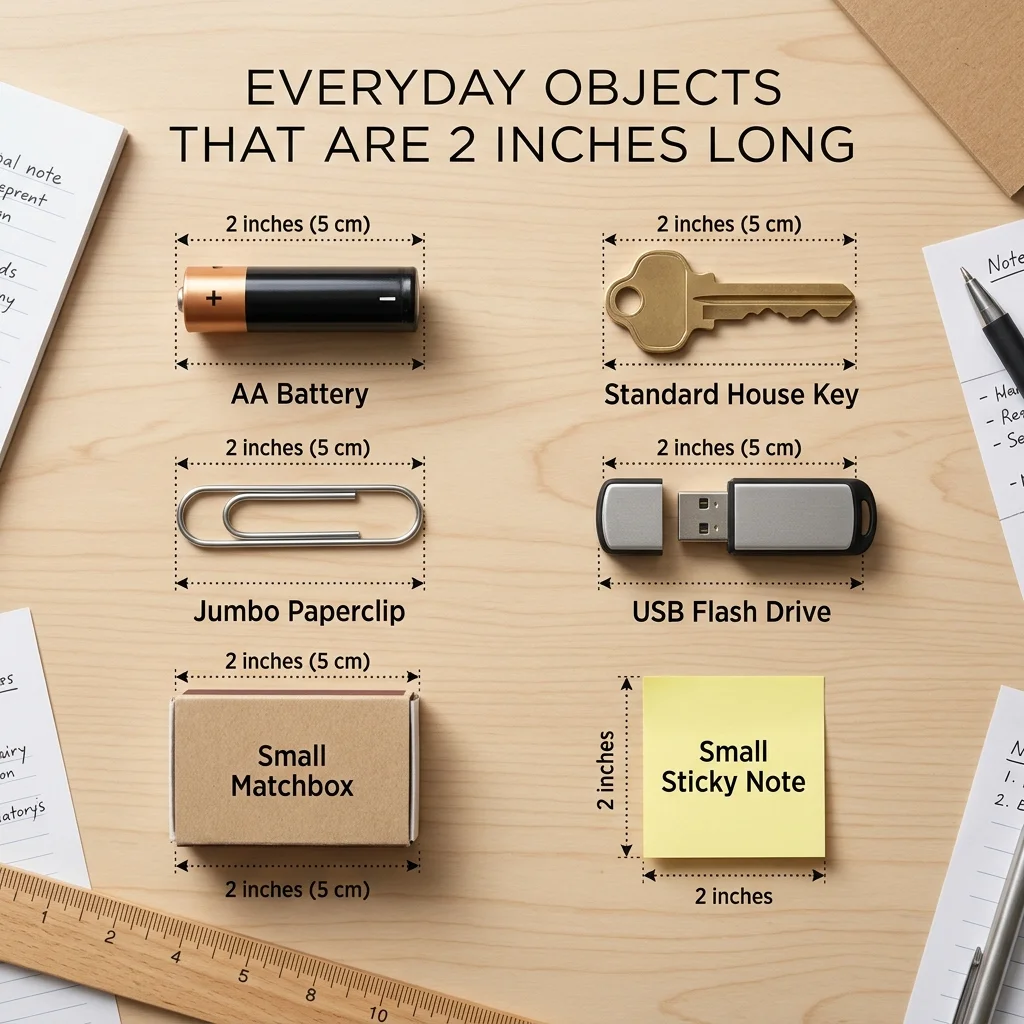
A standard AA battery is approximately 1.99 inches long, making it one of the closest everyday comparisons to 2 inches.
This means that if you hold an ordinary AA battery vertically, its length is almost exactly the same as two inches. It is a particularly useful reference because AA batteries are common in television remotes, clocks, toys, flashlights, and wireless accessories.
You can use this comparison when estimating the length of a small object or checking whether something is around five centimeters long.
Remember: A standard AA battery is approximately 2 inches long, although dimensions can vary slightly between products.
🏌️ 2. A Golf Ball
A standard golf ball has a diameter of at least 1.68 inches. This makes it slightly smaller than a two-inch measurement.
Although a golf ball is round rather than straight, its width provides a familiar way to visualize a length close to two inches.
Imagine placing a golf ball next to a ruler. Its diameter would cover about 1.68 inches, leaving a small gap before reaching the two-inch mark.
This comparison is especially useful if you play golf or have golf equipment at home.
🏓 3. A Ping-Pong Ball
A standard table-tennis ball has a diameter of 40 millimeters, which equals approximately 1.57 inches.
It is noticeably smaller than two inches, but still provides a useful visual reference. Picture the ball sitting on a table. Its width is slightly less than four-fifths of the two-inch distance.
Because ping-pong balls are lightweight and familiar, they are convenient for estimating small dimensions. However, remember that the ball’s diameter is not a full two inches.
💳 4. The Short Side of a Credit Card
A standard bank card measures approximately 3.37 inches long and 2.125 inches wide.
Its shorter side is therefore just a little longer than two inches. This makes the width of a credit card an excellent comparison when you want to picture a measurement close to 2 inches.
Imagine holding a bank card with its shorter edge facing you. That edge is approximately 0.125 inches longer than your target measurement.
Since most debit and credit cards follow a standardized size, this comparison is useful in many countries.
📎 5. A Large Paperclip
Large paperclips are often around two inches long, although their dimensions depend on the style and manufacturer.
A standard large paperclip provides a simple visual reference because it is narrow and elongated. Its overall length can help you imagine a two-inch measurement more easily than a round object.
Place one beside a ruler to check its actual size. Some paperclips are shorter, while oversized varieties may extend beyond two inches.
This is a useful household comparison for students, office workers, and anyone who regularly handles stationery.
🧊 6. A Small Ice Cube
A large ice cube measuring two inches across provides a direct example of this size.
However, not every ice cube is two inches wide. Many household ice cubes are considerably smaller, and their dimensions depend on the tray or ice maker.
If you have a large cocktail ice cube or specialty ice mold, it may be close to the two-inch measurement. Check the width rather than assuming every cube has the same dimensions.
This comparison is helpful because a two-inch cube also gives you an idea of how much space a three-dimensional object can occupy.
🧱 7. Two One-Inch Blocks Placed Together
Two one-inch blocks placed directly beside each other create a combined length of exactly two inches, provided each block is accurately one inch wide.
This is one of the simplest ways to visualize the measurement. You do not need to estimate the size of a familiar product because the two smaller units add up mathematically.
You can use wooden blocks, plastic cubes, or other objects with known one-inch dimensions.
The method is also useful for children learning basic measurement because it demonstrates how smaller lengths combine to form a larger one.
🪙 8. A Stack of Two-Inch Measurement References Using Coins
Coins can help you estimate short measurements, although a single coin is not close to two inches in diameter.
For example, a US quarter is approximately 0.955 inches wide. Placing two quarters side by side creates a combined width of about 1.91 inches.
That is slightly less than two inches, but it provides a useful approximation.
This method works best when the coins are arranged edge to edge without overlapping. It also shows how two smaller measurements can help you estimate a larger one.
🧼 9. A Small Travel Soap Bar
Some travel-size soap bars are approximately two inches long, making them another practical household comparison.
However, soap products come in many shapes and sizes. A hotel soap bar may be shorter or wider depending on its brand and packaging.
If you have a small rectangular bar at home, compare its longest side with a ruler. You may find that it is close to five centimeters.
This comparison is particularly useful when estimating the dimensions of small bathroom products, travel accessories, or toiletry containers.
🧷 10. A Small Sewing Button
A typical sewing button is much smaller than two inches, but an oversized decorative button may measure close to this length.
Large buttons are used in coats, costumes, crafts, and decorative projects. Their diameters can vary considerably, so the comparison depends on the specific button.
A two-inch button would be noticeably larger than the small buttons commonly found on shirts.
This example is helpful when working on sewing projects because button sizes are often described in millimeters or other small units.
📐 11. Two Inches on a Standard Ruler
A standard inch ruler is the most direct reference for visualizing two inches.
Find the zero mark and follow the ruler until you reach the number two. The distance between those points is exactly two inches.
This may sound obvious, but seeing the measurement on a ruler helps you understand how small divisions work. The marks between whole inches represent fractions such as one-half, one-quarter, and one-eighth of an inch.
If you need an accurate measurement for a craft, repair, or product comparison, a ruler is more reliable than estimating with everyday objects.
📝 12. A Two-Inch Sticky Note
Some mini sticky notes are sold in two-inch square sizes. If you have one, each side gives you a direct reference for the measurement.
A two-inch sticky note is useful because it demonstrates both length and width. Its square shape makes it easy to imagine a small surface measuring 2 inches by 2 inches.
However, sticky notes are available in several dimensions, including larger square and rectangular formats. Check the packaging or measure the note before using it as a reference.
This comparison is especially handy for office work, study notes, crafts, and organizing small items.
📐 How to Measure 2 Inches Without a Ruler
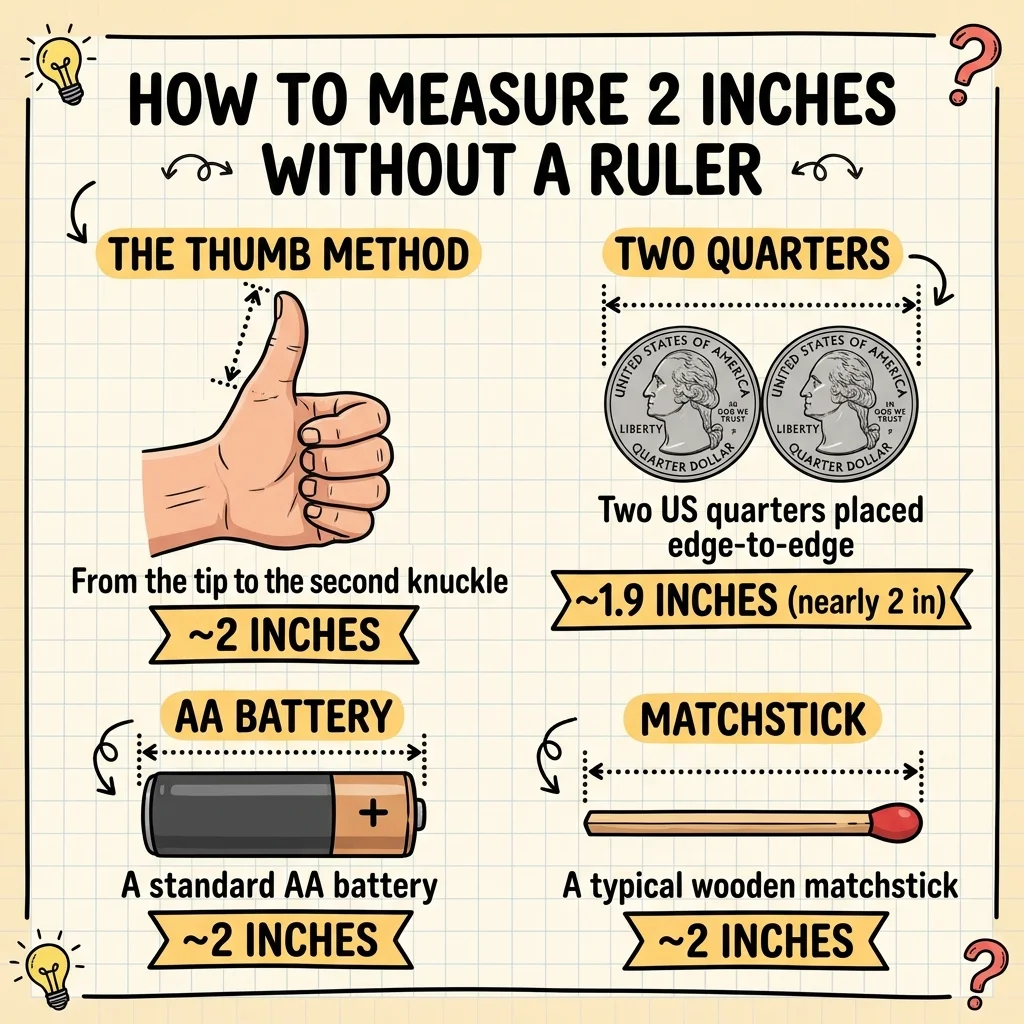
You may sometimes need to estimate two inches when a ruler or measuring tape is not available. Although an estimate cannot replace an accurate measurement, familiar objects can help you get reasonably close.
Here are several simple methods.
- Use an AA battery: A standard AA battery is approximately 1.99 inches long, so it is an excellent quick reference.
- Compare with a credit card: The shorter side of a standard bank card is approximately 2.125 inches.
- Use two quarters: Two US quarters placed side by side measure approximately 1.91 inches across.
- Use your fingers: Spread your thumb and index finger until the gap looks close to five centimeters. Hand sizes vary, so this is only a rough estimate.
- Fold a paper strip: If you know a paper’s dimensions, you can mark a two-inch section and use it as a temporary guide.
For accurate work, use a ruler or measuring tape. Estimation is useful for everyday visualization, but it should not be relied on when precise dimensions are required.
✋ Can You Estimate 2 Inches Using Your Fingers?
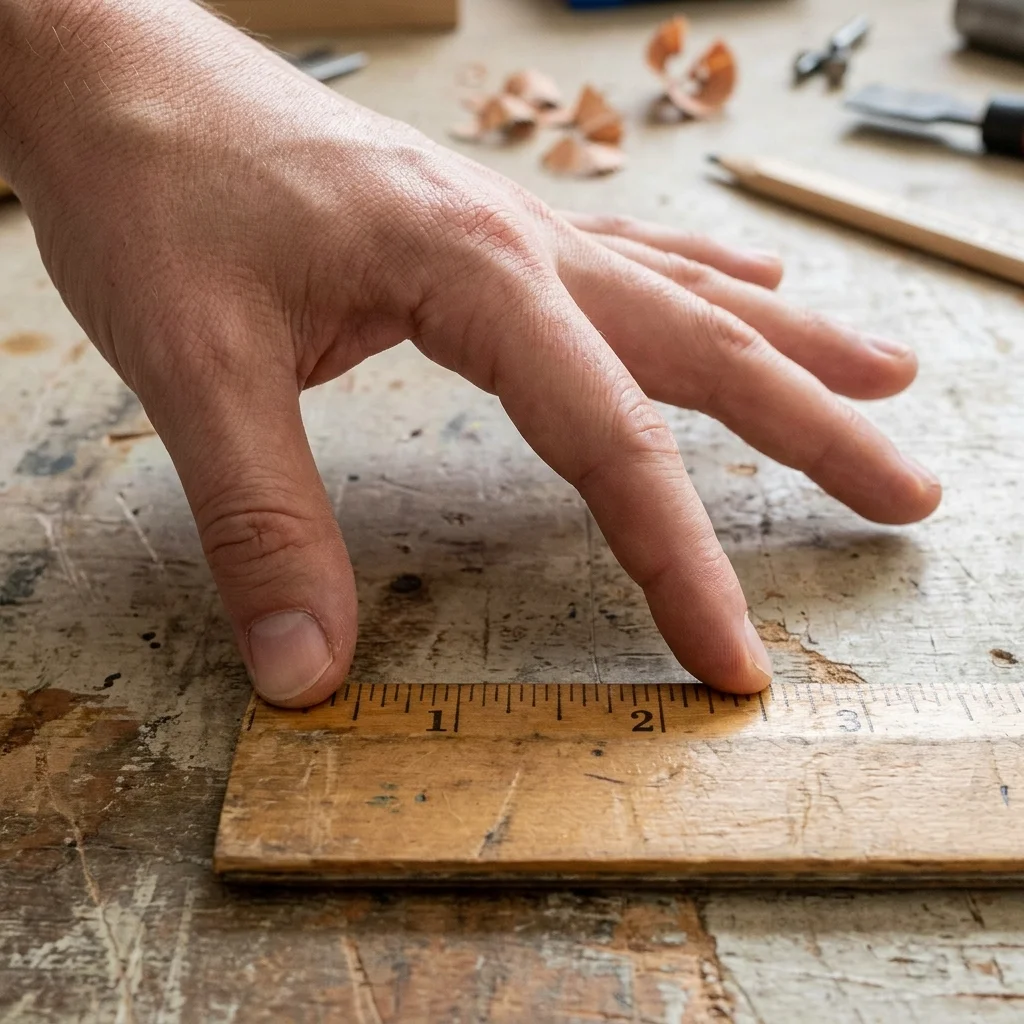
Yes, you can use your fingers to estimate two inches, but the result will vary depending on your hand size.
For some adults, the width of a thumb is close to three-quarters of an inch to one inch. Therefore, two thumb widths placed side by side may provide a rough idea of a two-inch distance.
Another approach is to spread your thumb and index finger apart. Adjust the gap until it is close to five centimeters.
However, hand measurements are not standardized. A child’s fingers will generally be smaller than an adult’s, and even adults have different hand proportions.
If you want to create your own hand-based reference, measure the distance between your fingers once with a ruler. After that, you can use the same hand position for quick estimates.
🏠 Where Does a 2-Inch Measurement Appear in Everyday Life?
Two inches may seem insignificant, but it appears in many products and everyday objects. Understanding this size can help when shopping, organizing, decorating, and completing small projects.
Here are some common situations where the measurement may matter:
- Craft projects: Small decorations, wooden pieces, and paper shapes may require two-inch dimensions.
- Office supplies: Mini sticky notes and some stationery products are available in this size.
- Household accessories: Small fittings, knobs, and decorative components may have two-inch dimensions.
- Sewing: Buttons, fabric details, and small design elements may be measured in inches.
- Gardening: Seed spacing and small plant accessories may use short measurements.
- Cooking: Some specialty ice molds and food decorations are close to two inches.
- Technology: Small connectors, accessories, and device components may have dimensions around this length.
The important thing is to identify which dimension is being described. A product listed as two inches wide may have a different height and depth.
📦 Understanding 2 Inches in Product Dimensions
When shopping online, you may see measurements written as 2 × 2 inches, 2 × 3 inches, or 2 × 4 inches. These numbers describe different dimensions of an object.
For example:
- 2 × 2 inches: A square surface with a length of two inches and a width of two inches.
- 2 × 3 inches: A rectangular surface measuring two inches by three inches.
- 2 × 4 inches: A longer rectangle measuring two inches by four inches.
- 2 × 2 × 2 inches: A cube with each side measuring two inches.
This distinction matters because two inches alone describes only one length. It does not tell you the total size or volume of a three-dimensional product.
Before ordering something online, check whether the listed measurement refers to height, width, length, diameter, or thickness. Product photos can sometimes make an item look larger or smaller than it really is.
📊 Is 2 Inches Considered Big or Small?
Two inches is generally considered a small measurement. It is shorter than many everyday items, including a smartphone, a standard bank card’s longest side, and a typical adult hand.
However, whether two inches is big or small depends on what you are measuring.
For example, two inches may be large for a small button but very small for a table, shelf, or television. In a craft project, it might be a useful decorative width. In construction, it could describe a narrow gap or a small fitting.
| Object or Use | How 2 Inches Compares |
|---|---|
| Small button | Usually much larger |
| AA battery | Almost the same length |
| Golf ball | Slightly larger than its diameter |
| Credit card width | Slightly shorter |
| Smartphone length | Much shorter |
| Small sticky note | Can match one side |
| Paperclip | Similar to some large styles |
Therefore, it is better to compare the measurement with the object you are working with rather than labeling it universally large or small.
📏 How to Visualize 2 Inches in Centimeters
If you normally use the metric system, thinking in centimeters may be easier than imagining inches. Since 2 inches equals 5.08 centimeters, you can picture a line that is just over five centimeters long.
A centimeter ruler makes this comparison straightforward. Find the zero mark, then move along the ruler until you reach the 5-centimeter mark. The remaining distance to 5.08 centimeters is very small.
Here are a few ways to remember the conversion:
- Five centimeters: This is almost exactly two inches, but it is 0.08 centimeters shorter.
- Fifty millimeters: This is also slightly shorter than two inches, which equals 50.8 millimeters.
- Five centimeters plus 0.8 millimeters: This gives you the exact metric equivalent.
- Half of ten centimeters: Two inches is just a little more than half of a ten-centimeter length.
For everyday estimates, five centimeters is usually close enough. However, if you are cutting material, fitting a component, or following technical instructions, use the exact 5.08-centimeter conversion.
🪚 How Much Is 2 Inches on a Tape Measure?
A tape measure marked in inches usually shows whole inches with smaller lines between them. To find two inches, start at the zero point and follow the tape to the number 2.
The space between these marks represents the full two-inch length. Depending on the tape, you may also see smaller marks that divide each inch into halves, quarters, eighths, or sixteenths.
Understanding these markings helps when you need to measure something accurately.
- 0 inches: The starting point of the measurement.
- 1 inch: Halfway between zero and two inches.
- 2 inches: The endpoint of the measurement.
- 1½ inches: The halfway point between one and two inches.
- 1¾ inches: One quarter of an inch before the two-inch mark.
- 1⅞ inches: One eighth of an inch before the two-inch mark.
When measuring an object, line up the tape’s zero point with one end. Then read the number at the opposite end. Avoid starting at the metal hook’s outer edge if the tape is designed to account for the hook’s movement.
🧵 Why Two Inches Matter in Sewing, Crafts, and DIY Projects
A two-inch measurement appears frequently in small creative projects. It can describe the width of a fabric strip, the length of a decorative piece, or the size of a paper shape.
In sewing, for example, a two-inch strip may be used for a border, trim, or fabric detail. The actual amount of material needed will depend on seam allowances and the finished design.
In paper crafts, two inches can be useful for making labels, small cards, decorations, and scrapbook elements. A square measuring two inches on each side is compact but still large enough to display a short word or simple design.
For DIY projects, the measurement may describe:
- A small wooden spacer.
- A narrow decorative trim.
- The diameter of a circular craft piece.
- A short gap between two components.
- The width of a small bracket or fitting.
- A section of ribbon or decorative tape.
Always distinguish between the measurement of the finished item and the amount of material needed to make it. For example, a two-inch finished fabric strip may require additional material for folding or stitching.
🛒 How to Judge a 2-Inch Product Before Buying It Online
Product listings often include measurements that are difficult to visualize on a screen. A photograph may use close-up angles, enlarged details, or a plain background that makes a small item appear much bigger.
If a product is listed as two inches long, compare that measurement with an object you already know. An AA battery is especially useful because its length is almost exactly two inches.
Before placing an order, check these details:
- Read the full dimensions: Look for length, width, height, and depth rather than relying on one number.
- Check the measurement unit: Confirm whether the listing uses inches, centimeters, or millimeters.
- Look for a size reference: Some sellers show a ruler, hand, or familiar object beside the product.
- Read customer reviews: Buyers sometimes mention whether the item looks smaller or larger than expected.
- Check the product description: A two-inch diameter is not the same as a two-inch length.
- Consider packaging: The listed measurement may describe the product itself rather than its box.
These checks are particularly helpful when buying accessories, decorations, craft supplies, small tools, and replacement parts.
🧮 Quick Ways to Calculate Two Inches
You can convert two inches into other units using a few simple calculations. These are useful when following international product specifications or working with measurements from different countries.
| Conversion | Calculation | Result |
|---|---|---|
| Inches to centimeters | 2 × 2.54 | 5.08 cm |
| Inches to millimeters | 2 × 25.4 | 50.8 mm |
| Inches to feet | 2 ÷ 12 | 0.1667 ft |
| Inches to yards | 2 ÷ 36 | 0.0556 yd |
| Inches to meters | 2 × 0.0254 | 0.0508 m |
A simple rule makes these conversions easier: multiply inches by 2.54 to get centimeters. To convert centimeters back into inches, divide by 2.54.
For example, if an online product is listed as 10.16 centimeters long, divide 10.16 by 2.54. The result is four inches.
Frequently Asked Questions About 2 Inches
How many centimeters are in 2 inches?
Two inches equal 5.08 centimeters. This is slightly more than five centimeters and is a useful conversion when comparing measurements in the metric system.
How many millimeters are in 2 inches?
Two inches equal 50.8 millimeters. Since one inch contains 25.4 millimeters, multiplying 25.4 by two gives the exact result.
Is 2 inches the same as 5 centimeters?
Not exactly. Five centimeters equal approximately 1.97 inches, while two inches equal 5.08 centimeters. The difference is small, but it matters in precise measurements.
What common object is almost exactly 2 inches long?
A standard AA battery is approximately 1.99 inches long. It is one of the closest everyday comparisons to a two-inch measurement.
Is a golf ball 2 inches wide?
No. A standard golf ball has a diameter of at least 1.68 inches. It is slightly smaller than two inches, although it can still help you visualize a nearby measurement.
Is 2 inches considered a small measurement?
Yes, two inches is generally a small length. However, its importance depends on the object. It may be large for a button but small for a shelf or piece of furniture.
How can I measure 2 inches without a ruler?
You can use a standard AA battery as an approximate reference because it is almost two inches long. Two US quarters placed side by side are another close estimate, measuring approximately 1.91 inches.
How wide is 2 inches in millimeters?
Two inches are 50.8 millimeters wide or long, depending on the dimension being measured. This conversion is useful for small parts, craft materials, and product specifications.
What does 2 × 2 inches mean?
A measurement of 2 × 2 inches describes a square or rectangular surface that is two inches long and two inches wide. It does not describe the item’s thickness or height unless another dimension is provided.
How does 2 inches compare with a credit card?
A standard credit card is approximately 3.37 inches long and 2.125 inches wide. Therefore, two inches is slightly shorter than the card’s shorter side.
Conclusion
Two inches equals 5.08 centimeters or 50.8 millimeters. Although it is a small measurement, you can visualize it using familiar objects such as an AA battery, golf ball, ping-pong ball, large paperclip, and the shorter side of a standard credit card.
For quick estimates, everyday comparisons can help you understand the size without reaching for a ruler. However, when accuracy matters, use a measuring tape or ruler and check whether the dimension refers to length, width, height, or diameter.
Once you remember that two inches is just over five centimeters, it becomes much easier to picture this measurement in household items, crafts, shopping, and everyday projects.