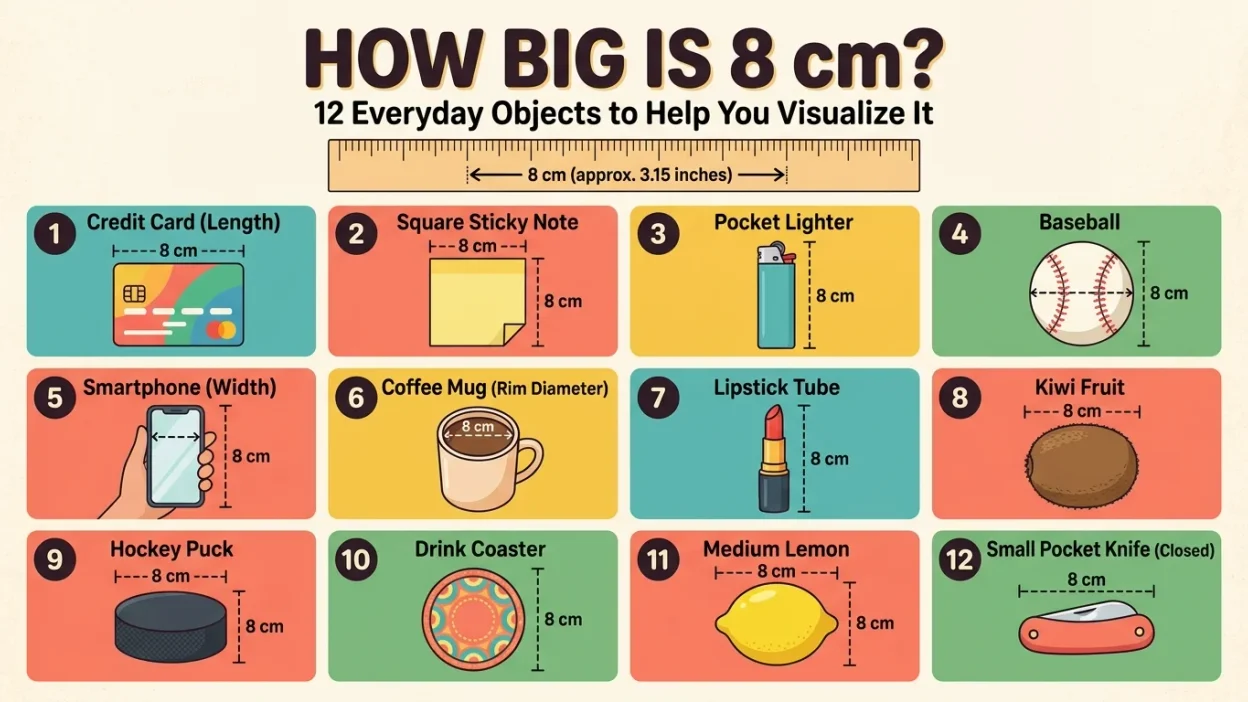
Eight centimeters may sound like a small distance, but it is easier to understand when you compare it with familiar objects. It is slightly longer than 3 inches and close to the diameter of a standard hockey puck. That gives you a useful starting point before looking at other examples.
You might encounter 8cm when checking the dimensions of a product, measuring a small household item, working on a craft project, or comparing an object’s size. However, numbers alone do not always make physical dimensions easy to picture.
So, how big is 8cm in inches, feet, and meters? What everyday objects are close to this length? And how can you estimate it without a measuring tape?
8cm equals approximately 3.15 inches, 0.262 feet, 80 millimeters, and 0.08 meters. Let’s break down these conversions and explore practical comparisons that make the measurement easier to visualize.
Every Unit 8cm Converts To
The most useful way to understand 8cm is to compare it with other measurement units. Centimeters are common in metric measurements, while inches and feet are frequently used in the United States.
Here is a quick reference table showing the equivalent values.
| Unit | Value |
|---|---|
| Centimeters | 8 cm |
| Millimeters | 80 mm |
| Inches | 3.15 inches |
| Feet | 0.262 feet |
| Meters | 0.08 meters |
| Yards | 0.0875 yards |
The easiest conversion to remember is 3.15 inches. In everyday conversation, you can round this to approximately 3.2 inches.
How to Convert 8cm Into Other Units
You can calculate these values using a few simple formulas. Each conversion follows a standard mathematical relationship.
- Centimeters to inches: Divide 8 by 2.54 to get approximately 3.15 inches.
- Centimeters to millimeters: Multiply 8 by 10 to get 80mm.
- Centimeters to meters: Divide 8 by 100 to get 0.08 meters.
- Centimeters to feet: Divide 8 by 30.48 to get approximately 0.262 feet.
- Centimeters to yards: Divide 8 by 91.44 to get approximately 0.0875 yards.
These calculations are useful when product specifications use different measurement systems.
For example, someone asking how much 8cm is in feet may simply want to understand the measurement using a familiar unit. In that case, 0.262 feet provides the accurate conversion.
Remember these basic formulas:
- Inches = Centimeters ÷ 2.54
- Millimeters = Centimeters × 10
- Meters = Centimeters ÷ 100
- Feet = Centimeters ÷ 30.48
Where 8cm Sits on a Measurement Scale
Eight centimeters falls just beyond the 3-inch mark. It is shorter than 3.5 inches and considerably smaller than half a foot.
This makes it a relatively small measurement for household dimensions, but it can be significant when measuring compact objects and accessories.
The following table shows how 8cm compares with nearby measurements.
| Measurement | Inches | Centimeters |
|---|---|---|
| 2 inches | 2.00 in | 5.08 cm |
| 2.5 inches | 2.50 in | 6.35 cm |
| 3 inches | 3.00 in | 7.62 cm |
| 8cm | 3.15 in | 8 cm |
| 3.5 inches | 3.50 in | 8.89 cm |
| 4 inches | 4.00 in | 10.16 cm |
| 5 inches | 5.00 in | 12.70 cm |
Notice that 8cm is only 0.38cm longer than 3 inches. That difference is less than half a centimeter.
If you are familiar with inch-based rulers, imagine moving slightly beyond the 3-inch mark. You will be very close to the target measurement.
11 Everyday Things That Are Around 8cm
Everyday comparisons make measurements easier to remember. Instead of trying to picture an abstract number, you can think about objects you have seen or handled.
The following examples are close to 8cm in at least one dimension. Their actual sizes can vary by manufacturer, variety, or design, so treat them as visual references rather than exact measuring tools.
1. A Standard Hockey Puck
A standard ice hockey puck measures approximately 7.62cm across. Its diameter is exactly 3 inches, making it slightly smaller than 8cm.
Hockey pucks are designed with a flat, circular shape. Their standardized dimensions help players handle and strike them consistently during a game.
The puck is also approximately 2.54cm thick. This means its diameter is considerably larger than its height.
Imagine measuring straight across the circular face of a puck. You would need to add just 0.38cm to reach 8cm.
2. A 3-Inch Square Sticky Note
A common 3-by-3-inch sticky note measures approximately 7.62cm on each side.
It is slightly smaller than 8cm, but the difference is difficult to notice without a ruler. This makes it one of the simplest office supplies to use as a visual reference.
Sticky notes are useful for reminders, short messages, and marking important information in books. Their square shape also makes their dimensions easy to understand.
Place one flat on a desk and look at either side. Each edge is just under 8cm long.
3. A Standard Baseball
A regulation baseball has a diameter of approximately 7.3cm. This makes it smaller than 8cm, although it provides another useful everyday comparison.
The ball is designed to fit comfortably in a player’s hand. Its size and weight are standardized for organized baseball.
The raised stitching is another recognizable feature. It helps players grip the ball and influences how it moves when thrown.
A baseball is not an exact 8cm match. However, imagining its diameter extended by roughly 7mm brings you close to the target measurement.
4. The Long Side of a Credit Card
A standard payment card measures approximately 8.56cm along its longer edge and 5.4cm along its shorter edge.
The longer side is slightly bigger than 8cm. Its difference is approximately 0.56cm, making it a useful comparison.
Credit cards follow standardized dimensions so they can fit payment terminals, wallets, and card readers.
Place a card flat on a surface and examine its longer edge. It gives you a familiar reference that is just a little longer than 8cm.
5. A Small Round Jar Lid
Some small jar lids have a diameter close to 8cm. However, their sizes depend on the container and manufacturer.
A lid measuring 8cm across provides a direct comparison. Its circular shape makes it easy to identify the measurement from one outer edge to the opposite edge through the center.
Jar lids are designed to fit specific container openings. Therefore, there is no single standard size for every jar.
Check a small food jar in your kitchen. Its lid may provide a useful reference if its diameter is close to the target.
6. A Small Tomato
Some larger cherry tomatoes and small round tomatoes can measure around 7–8cm across. Their dimensions vary with the variety and growing conditions.
Tomatoes are practical household comparisons because they are easy to find. You may also notice considerable size differences between varieties.
A round tomato can be measured across its widest point. This gives you its approximate diameter.
If you find one measuring close to 8cm, it can help you picture the target measurement without using a ruler.
7. A Small Lemon
A small lemon may measure approximately 7–8cm along its longest dimension. The exact length depends on the variety and how it grows.
Unlike a perfectly round object, a lemon usually has an oval shape. Its length and width can therefore be noticeably different.
This example highlights an important measurement detail: an object can be 8cm long without being 8cm wide.
Look at a small lemon from end to end. Its longest dimension can provide a useful estimate of 8cm.
8. A Compact USB Flash Drive
Some compact USB flash drives measure around 5–8cm in length. Their dimensions depend on the design, connector, and protective cover.
This is a useful comparison for people familiar with computer accessories. However, not every flash drive reaches 8cm.
The total length may include the body and an attached cap. Retractable models can have different overall dimensions.
If you have a longer compact USB drive, measure it from one end to the other. It may provide a close reference for the target length.
9. A Small Desk Coaster
Some compact drink coasters measure approximately 8cm across. However, many commonly sold coasters are larger, often measuring around 9–10cm or more.
A coaster provides a useful flat surface for understanding dimensions. You can measure its diameter if it is round or one side if it is square.
The size often depends on the type of glass or cup it is designed to support.
A compact coaster with an 8cm diameter is a close match. Check its actual dimensions before treating it as an exact reference.
10. A LEGO Brick Measurement
LEGO construction pieces use a standard spacing of 8mm between neighboring stud centers.
Across 10 stud intervals, that spacing covers 80mm, which equals 8cm.
This is an interesting comparison for people who enjoy building with construction toys. The familiar studs provide a useful way to understand repeated small measurements.
However, the 8cm figure refers to the distance across 10 intervals between stud centers. It does not automatically describe the outside length of every LEGO brick.
Imagine a row with 10 spaces, each measuring 8mm. Together, they cover exactly 80mm.
11. A Small Kitchen Measuring Spoon
Some kitchen measuring spoons have handles close to 8cm long. However, this is not a standardized dimension across different brands and designs.
The bowl and handle also have different dimensions. A compact spoon may have a shorter handle, while a larger design can extend beyond 8cm.
Kitchen measuring spoons are common household tools, making them useful for checking small dimensions.
Measure from the handle tip to the opposite edge of the spoon. If the total length is around 8cm, it provides a practical comparison.
Why 8cm Can Mean Different Things for Different Products
An 8cm measurement does not always describe the same type of dimension. It may refer to an object’s length, width, height, or diameter.
Understanding the difference is important when comparing products or checking whether an item will fit into a particular space.
Is 8cm a Length or a Diameter?
Length usually describes the distance from one end of an object to the other. Diameter describes the distance across a circular object through its center.
For example, an 8cm USB drive would be 8cm long. An 8cm jar lid would be 8cm across its circular surface.
Although both measurements use the same number, they describe different physical dimensions.
Does 8cm Mean the Same Size for Every Product?
No. The overall size of an object depends on its shape and design.
An item that is 8cm wide may be much taller or shorter. Similarly, an object with an 8cm diameter can have a different circumference.
When shopping online, check whether the product listing specifies length, width, height, or diameter. This detail helps you avoid choosing an item that does not fit your needs.
Getting to 8cm Without a Measuring Tape
You can estimate 8cm using familiar objects and simple measuring references. These methods are helpful when you do not have a ruler nearby.
However, remember that visual estimates are not as reliable as actual measurements.
1. Use a 3-Inch Reference
Three inches equal 7.62cm. This is only 0.38cm shorter than 8cm.
If you can recognize a 3-inch object, you already have a useful starting point. Imagine adding a little less than half a centimeter to it.
2. Check a Metric Ruler
A metric ruler is one of the easiest tools for measuring 8cm accurately.
Start at the zero mark and follow the centimeter scale until you reach 8. The distance between these two marks is exactly 8cm.
If your ruler includes millimeters, look for the 80mm mark instead.
3. Compare It With a Hockey Puck
A standard hockey puck measures approximately 7.62cm in diameter.
Its circular face provides a useful visual reference. An 8cm measurement is slightly larger, so the difference is easy to understand.
4. Print an 8cm Measurement Guide
You can print a simple line measuring 8cm and use it as a reference.
Before printing, select 100% or actual size in the printer settings. Avoid fit-to-page options because they can change the dimensions.
After printing, check the line with a ruler to confirm that the printer has not resized it.
5. Try a Smartphone Measuring Tool
Some smartphones include built-in measuring features or support measurement applications.
These tools use the camera to estimate distances. Their accuracy can depend on lighting, camera calibration, and object positioning.
They are useful for quick estimates, but a physical ruler is more dependable when precision matters.
Frequently Asked Questions
How many inches is 8cm?
Eight centimeters equals approximately 3.15 inches. It is slightly longer than the 3-inch mark on an inch ruler.
How many feet is 8cm?
Eight centimeters equals approximately 0.262 feet. This is a little more than one-quarter of a foot.
How many millimeters is 8cm?
Eight centimeters equals 0.08 meters. Divide the centimeter value by 100 to convert it into meters.
Can I visualize 8cm without a measuring tape?
Yes. You can use a 3-inch reference, a standard hockey puck, or a printed measurement guide. These comparisons provide a helpful estimate, although a ruler is better for exact measurements.
Is 8cm considered a large measurement?
It depends on the object. Eight centimeters is relatively short for furniture or room dimensions, but it can be a noticeable size for a small accessory or household item.
Where That Leaves You
Eight centimeters equals approximately 3.15 inches, 80mm, 0.262 feet, and 0.08 meters. It is a small but useful measurement that appears in different household products and everyday objects.
A standard hockey puck and a 3-inch sticky note are two easy comparisons to remember. Both measure approximately 7.62cm, which is just slightly shorter than 8cm.
The next time you need to visualize this length, picture a 3-inch object with a little extra distance added. For accurate work, use a metric ruler and locate the 80mm mark.