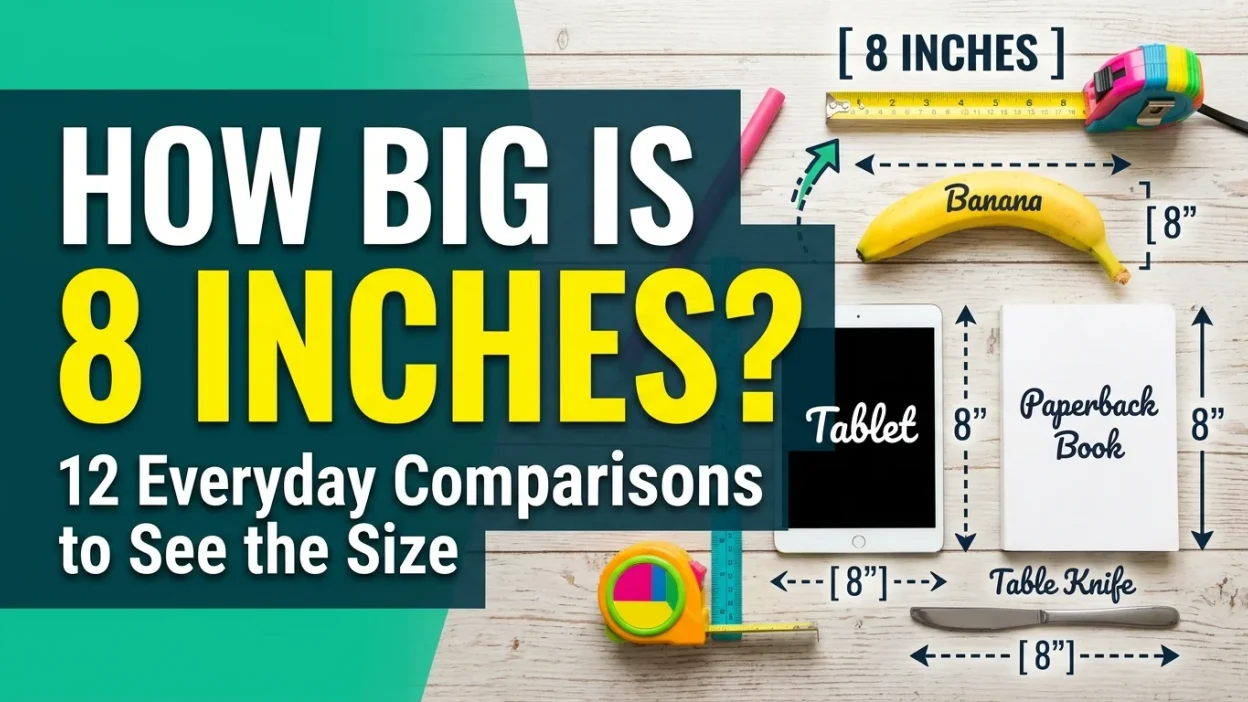
Eight inches may sound like a small measurement, but it can be surprisingly difficult to picture without a familiar object nearby. It is longer than a typical smartphone and slightly shorter than the width of a standard US letter-size sheet of paper.
You might come across this measurement when checking a tablet screen, choosing a kitchen utensil, measuring a package, or comparing household items. However, eight inches can describe length, width, height, or even the diagonal of a screen. The meaning depends on what you are measuring.
The easiest way to understand it is to connect the number with objects you already recognize. A few everyday comparisons can make the measurement much easier to imagine.
8 inches equals ⅔ of a foot, 20.32 centimeters, 203.2 millimeters, and 0.2032 meters. Let’s look at these conversions, compare the length with familiar objects, and explore ways to estimate it without a measuring tape.
Every Unit 8 Inches Converts To
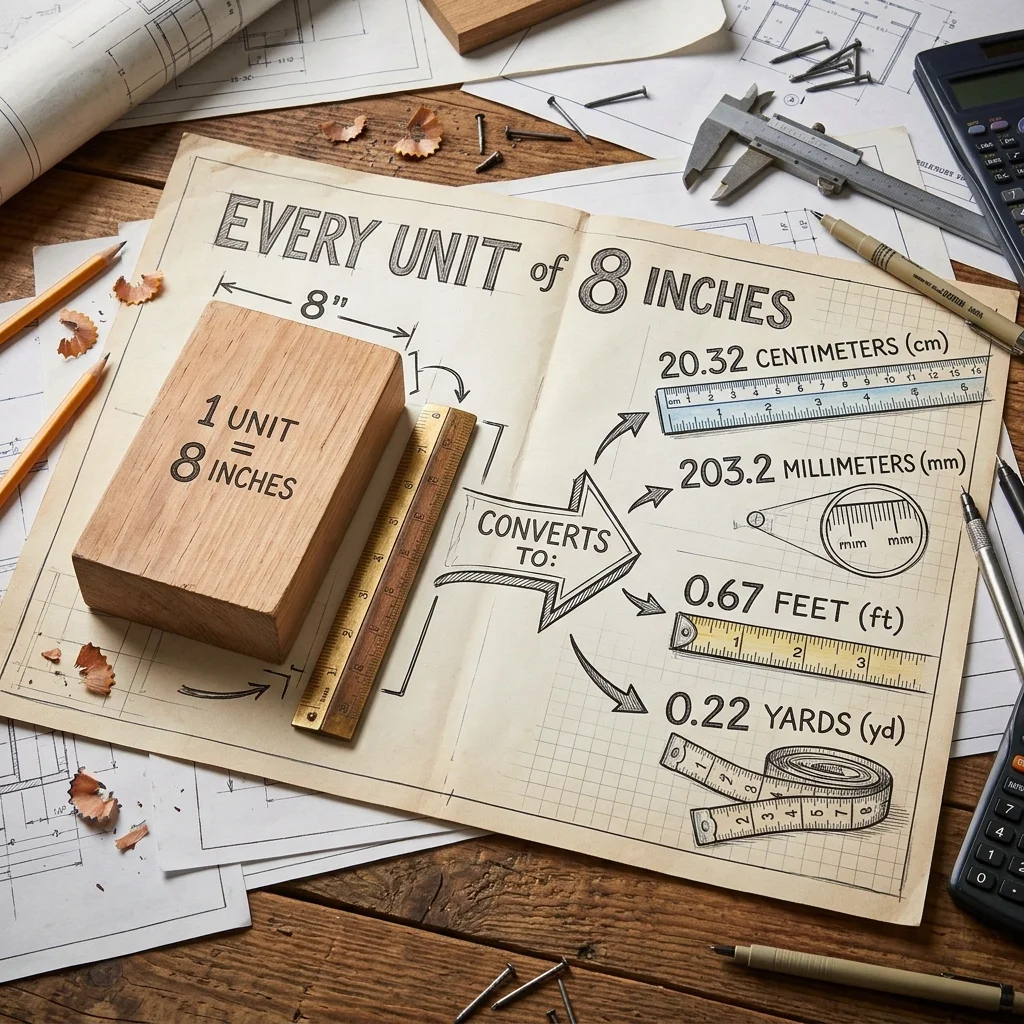
Eight inches is slightly more than 20 centimeters. This makes it easy to understand whether you normally use the imperial or metric measurement system.
Here is a quick reference table showing how the measurement converts into other units.
| Unit | Value |
|---|---|
| Inches | 8 inches |
| Feet | 0.6667 feet |
| Feet and inches | 0 feet 8 inches |
| Centimeters | 20.32 cm |
| Millimeters | 203.2 mm |
| Meters | 0.2032 m |
| Yards | 0.2222 yards |
How to Calculate These Conversions
You can convert eight inches using a few basic mathematical operations.
- To feet: Divide 8 by 12. The result is approximately 0.667 feet.
- To centimeters: Multiply 8 by 2.54. The result is 20.32 cm.
- To millimeters: Multiply 20.32 by 10. The result is 203.2 mm.
- To meters: Divide 20.32 by 100. The result is 0.2032 meters.
- To yards: Divide 8 by 36. The result is approximately 0.2222 yards.
For quick calculations, remember these two formulas:
- Inches ÷ 12 = feet
- Inches × 2.54 = centimeters
If someone asks how big 8 inches is in metric units, the simplest answer is 20.32 cm. It is also exactly two-thirds of a foot.
Where 8 Inches Fits on a Common Size Scale
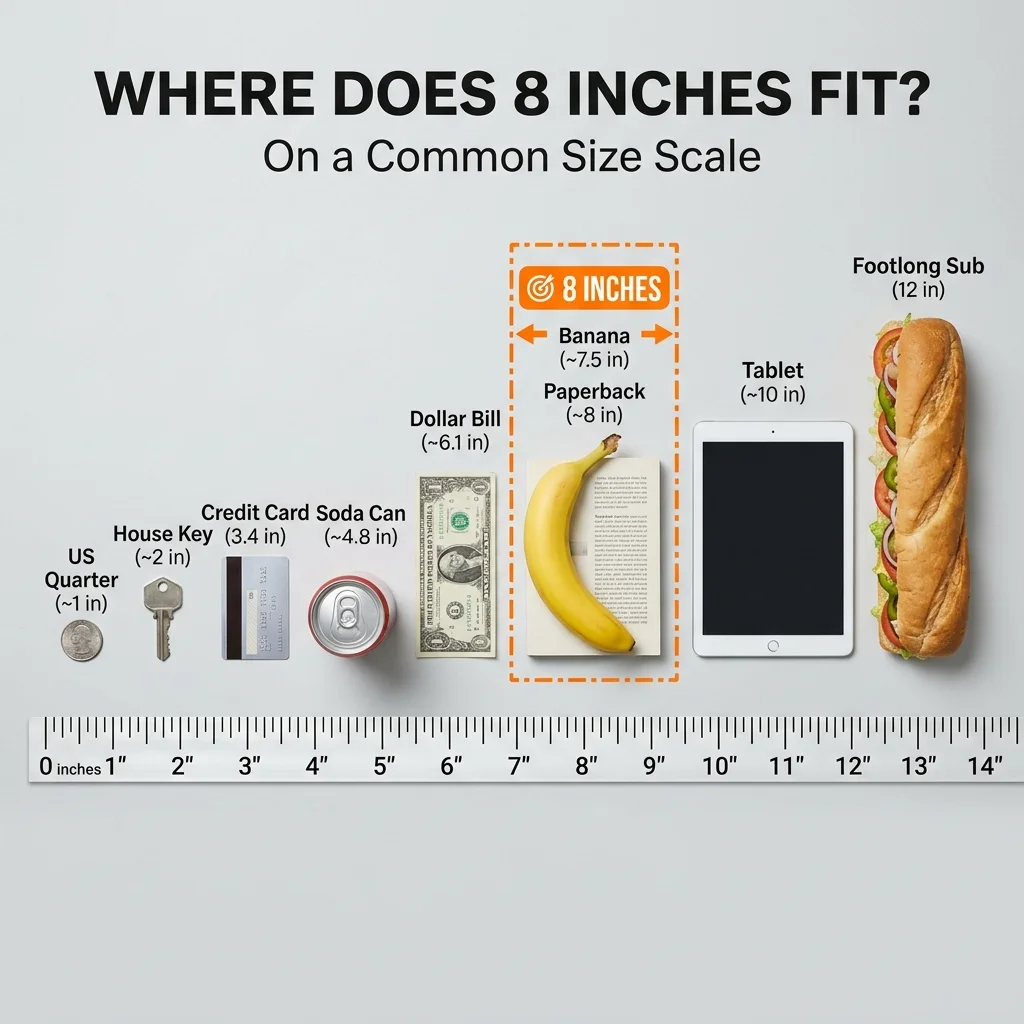
Eight inches is a useful measurement for smaller objects. It is not especially long compared with furniture or building materials, but it can be quite noticeable on a handheld item.
For a quick mental picture, imagine a 12-inch ruler. Eight inches covers two-thirds of its total length. In other words, it reaches well beyond the halfway point but stops before the final four inches.
The measurement can describe several dimensions:
- Length: The distance between an object’s two ends.
- Width: The distance across its shorter or wider side.
- Height: How far an object extends vertically.
- Diameter: The distance across a circular object through its center.
- Diagonal: The distance between opposite corners, commonly used for screens.
This difference is particularly important when shopping online. An 8-inch tablet does not necessarily have an eight-inch body or an eight-inch width. Its screen measurement is usually taken diagonally.
Therefore, always check whether a product specification refers to its screen, overall length, width, height, or diameter.
12 Everyday Things That Help You Visualize 8 Inches
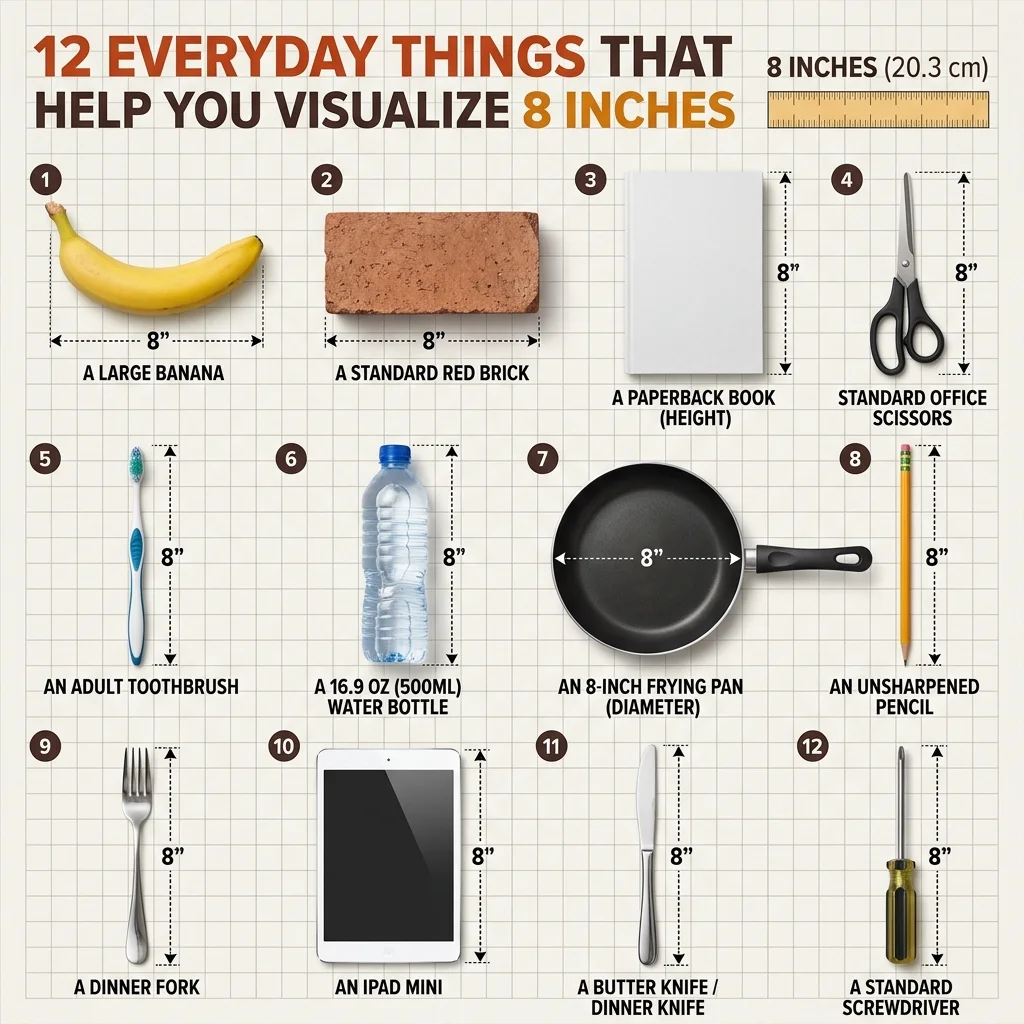
Everyday comparisons make measurements easier to understand. The following objects are either close to eight inches or provide a useful reference for estimating the length.
Actual dimensions vary by manufacturer and design, so approximate examples are identified accordingly.
1. The Short Side of US Letter Paper
A standard US letter-size sheet of paper measures 8.5 inches wide and 11 inches long. Its shorter edge is only half an inch longer than the measurement we are trying to visualize.
This makes printer paper a convenient reference. You can find it in offices, schools, and many homes.
The difference is small enough that the paper gives you a good visual estimate, although it is not an exact eight-inch match.
2. A 20-Centimeter Ruler
A 20 cm ruler measures approximately 7.87 inches. That is just 0.13 inches shorter than eight inches.
Because the metric measurement is so close, it provides an excellent comparison. In fact, many people who use centimeters regularly may find this reference easier than working with inches.
Place the ruler on a flat surface and look at its full length. You will see almost exactly how far eight inches extends.
3. A Compact Tablet Screen
An 8-inch tablet has a display measuring eight inches diagonally from one corner to the opposite corner.
That does not mean the screen is eight inches wide. Its width and height depend on the display’s aspect ratio, while the outer device is usually larger than the visible screen.
Compact tablets are designed to be portable while still offering more viewing space than many smartphones. Imagine holding one in your hands to get a practical sense of the measurement.
4. A Small Dinner Plate
Some small dinner plates and side plates measure approximately eight inches across. Larger dinner plates are generally wider, so the size depends on the plate’s purpose.
The important measurement here is the diameter. Measure from one outer edge to the opposite edge, passing through the center.
A plate around this size can be used for snacks, desserts, or smaller servings. Its circular shape makes it a useful way to picture eight inches across.
5. A Small Hardcover Book
Many compact hardcover books are close to eight inches tall, although book dimensions vary considerably.
Publishers choose different formats depending on the subject, page layout, and intended use. A pocket-sized book may be much shorter, while a large illustrated edition can be taller.
Hold a compact book upright and look at the distance from its bottom edge to its top. This gives you a familiar reference for a length of roughly 20 centimeters.
6. A Small Kitchen Knife
Some compact kitchen knives measure around eight inches from the tip of the blade to the end of the handle. However, this is the overall length, not necessarily the blade length.
Knife dimensions vary according to their intended purpose. A small utility knife, for example, may be considerably shorter than a larger chef’s knife.
If you have a compact kitchen knife, lay it flat on a counter and compare its full length with the eight-inch measurement. It provides a practical household reference.
7. A Large Kitchen Spatula
Some small kitchen spatulas have an overall length close to eight inches. Larger cooking utensils can extend well beyond this measurement.
The length usually includes both the handle and the flat or flexible working end. This means the head itself is much shorter than the full utensil.
A compact spatula is easy to picture because it is a familiar kitchen object. Imagine placing one horizontally on a countertop and measuring from its tip to the end of its handle.
8. A Small Square Picture Frame
An eight-inch picture frame can have an opening or outside dimension of approximately eight inches, depending on its design.
The distinction matters because the frame’s border adds extra size around the photograph. An opening designed for an eight-inch picture may therefore have a larger overall measurement.
A square frame is particularly useful for visualizing the distance across. Imagine a small decorative frame with each side measuring about 20 centimeters.
9. A Compact Wooden Cutting Board
Small cutting boards are available in dimensions close to eight inches along one side. Larger boards used for preparing several ingredients are often much bigger.
A compact board is useful for simple kitchen tasks, such as cutting fruit or preparing a small portion of vegetables.
Look at the shorter or longer edge, depending on the board’s shape. It can help you understand how much space eight inches occupies on a flat surface.
10. A Small Wall Clock
Some compact wall clocks have an outside diameter of around eight inches. Their circular shape provides a clear reference for understanding the measurement.
Clock sizes are generally described by the diameter of the face or outer body. The exact specification depends on the manufacturer.
Imagine a circle slightly wider than 20 centimeters. That gives you a useful picture of an eight-inch measurement across.
11. A Compact Power Bank
Some larger portable power banks approach eight inches in length, although many smaller models are considerably shorter.
Their dimensions depend on battery capacity, internal components, and overall design. A higher-capacity model may need a larger outer casing.
If you own a long power bank, check its listed length. It may be a helpful comparison for understanding an object that measures close to eight inches.
12. A Short Measuring Ruler
An eight-inch ruler or measuring scale is the most direct way to represent this length. Compact measuring tools are available for school supplies, small projects, and toolkits.
Unlike a plate or book, a ruler has markings that show the actual distance. It is therefore more reliable when you need a precise measurement.
If you only have a standard 12-inch ruler, eight inches reaches exactly two-thirds of its length. That makes it one of the simplest comparisons to remember.
Is an 8-Inch Screen Actually 8 Inches Wide?
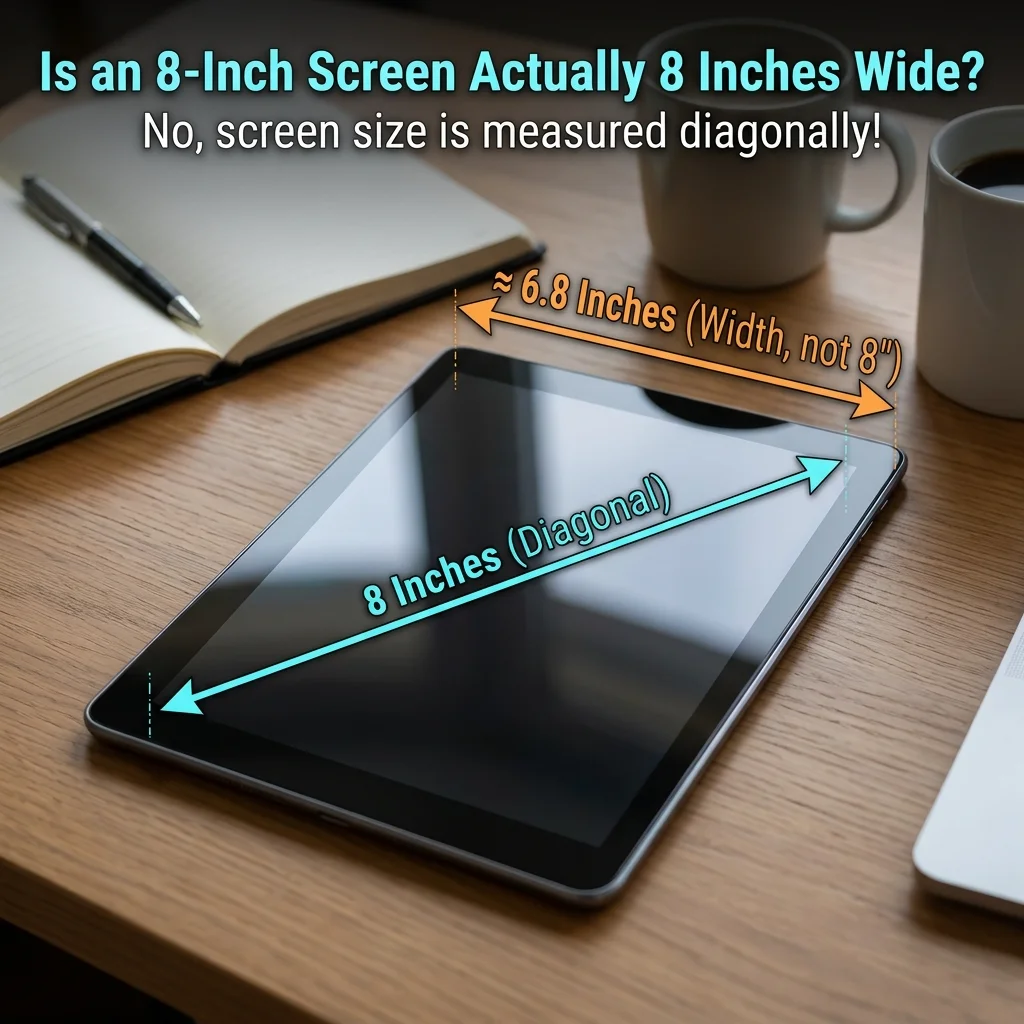
No. An 8-inch screen is measured diagonally, not horizontally from left to right.
Manufacturers use the diagonal measurement because it provides a consistent way to describe screen size. However, the actual width and height depend on the display’s aspect ratio.
Example: An 8-Inch Screen With a 16:10 Aspect Ratio
A display with an 8-inch diagonal and a 16:10 aspect ratio has approximately these dimensions:
| Screen measurement | Approximate size |
|---|---|
| Diagonal | 8 inches |
| Width | 6.78 inches |
| Height | 4.24 inches |
These numbers describe the visible display area. The tablet’s overall body will be larger because of its frame, bezels, and casing.
Is an 8-Inch Tablet Big Enough?
An 8-inch tablet is a compact option for everyday use. It can be suitable for:
- Reading e-books and digital documents.
- Browsing websites.
- Watching videos.
- Checking email and messages.
- Using educational applications.
- Carrying a portable device while travelling.
However, a smaller display provides less working space than a larger tablet. If you regularly use spreadsheets or several applications side by side, you may prefer a bigger screen.
The main advantage of an 8-inch display is portability. It offers more viewing area than many smartphones without becoming as bulky as a large tablet.
Getting to 8 Inches Without a Tape Measure
You can estimate eight inches using objects you probably already have at home. These methods are useful for quick comparisons, although a ruler is still necessary when accuracy matters.
Use the Shorter Side of Printer Paper
A US letter-size sheet is 8.5 inches wide. Eight inches is half an inch shorter, so the paper gives you a quick reference.
If you use A4 paper, its shorter side measures approximately 8.27 inches. This is an even closer comparison.
Use a 20 cm Ruler
A 20 cm ruler measures approximately 7.87 inches. The difference is small, making it one of the most practical metric references.
Simply compare the length with your target measurement. It will give you a close estimate without needing an inch-marked ruler.
Divide a 12-Inch Ruler Into Three Parts
If you have a standard 12-inch ruler, imagine dividing it into three equal sections. Each section represents four inches.
Two of those sections equal eight inches. This method is simple because you do not need to remember a complicated conversion.
Compare It With a Compact Tablet
An 8-inch tablet screen offers another visual reference. Remember that the display is measured diagonally, so its width and height will be shorter.
Use this comparison to understand the general scale rather than estimate an object’s exact length.
Use a Household Object You Have Measured Before
You can also use a book, kitchen utensil, or small cutting board as a reference if you know its actual dimensions.
For example, if you have already checked that an object measures eight inches, you can compare other items against it. This creates a reusable reference for future estimates.
For accurate cutting, fitting, or construction work, always confirm the measurement with a ruler or measuring tape.
Frequently Asked Questions
How many feet is 8 inches?
Eight inches equals approximately 0.667 feet. It is exactly two-thirds of one foot.
How many centimeters is 8 inches?
Eight inches equals 20.32 centimeters. The conversion is calculated by multiplying eight by 2.54.
How many millimeters is 8 inches?
Eight inches equals 203.2 millimeters. This is equivalent to 20.32 centimeters.
How many meters is 8 inches?
Eight inches equals 0.2032 meters. It is slightly more than one-fifth of a meter.
How long is 8 inches visually?
Eight inches is slightly shorter than the 8.5-inch width of a US letter-size sheet of paper. A 20 cm ruler is another close comparison.
Is 8 inches considered a large measurement?
It depends on the object. Eight inches is relatively small for furniture or appliances, but it is a noticeable length for a handheld item, small display, or kitchen tool.
What common object is closest to 8 inches?
A 20 cm ruler measures approximately 7.87 inches, making it a very close comparison. The shorter side of US letter paper is 8.5 inches, which is also useful for estimating.
Is an 8-inch tablet screen actually eight inches wide?
No. The screen size is measured diagonally between opposite corners. Its horizontal width is smaller and depends on the aspect ratio.
Where That Leaves You
Eight inches equals 20.32 centimeters, 203.2 millimeters, and approximately 0.667 feet. It is a little shorter than the width of standard US letter paper and almost identical to the length of a 20 cm ruler.
For a quick mental picture, remember the 20 cm ruler. It is a convenient reference that makes this measurement easy to estimate without complicated calculations.
Once you connect the number with familiar objects, it becomes much easier to understand. Just remember that visual comparisons are estimates, while a ruler provides the exact measurement.